Kyoto is the only one of Japan's three great food cities with no coast of its own. Tokyo opens onto a bay that carries its name. Osaka sits at the mouth of a river system that fed it. Kyoto sits in a basin ringed by mountains, and every sea fish eaten there arrived from somewhere else — over a pass on a man's back, and later on a rail spur. That single constraint explains the city's oldest sushi, its most famous summer fish, and why the best seat in Kyoto on a given night may not be a sushi seat at all.
Eighteen ri from the sea
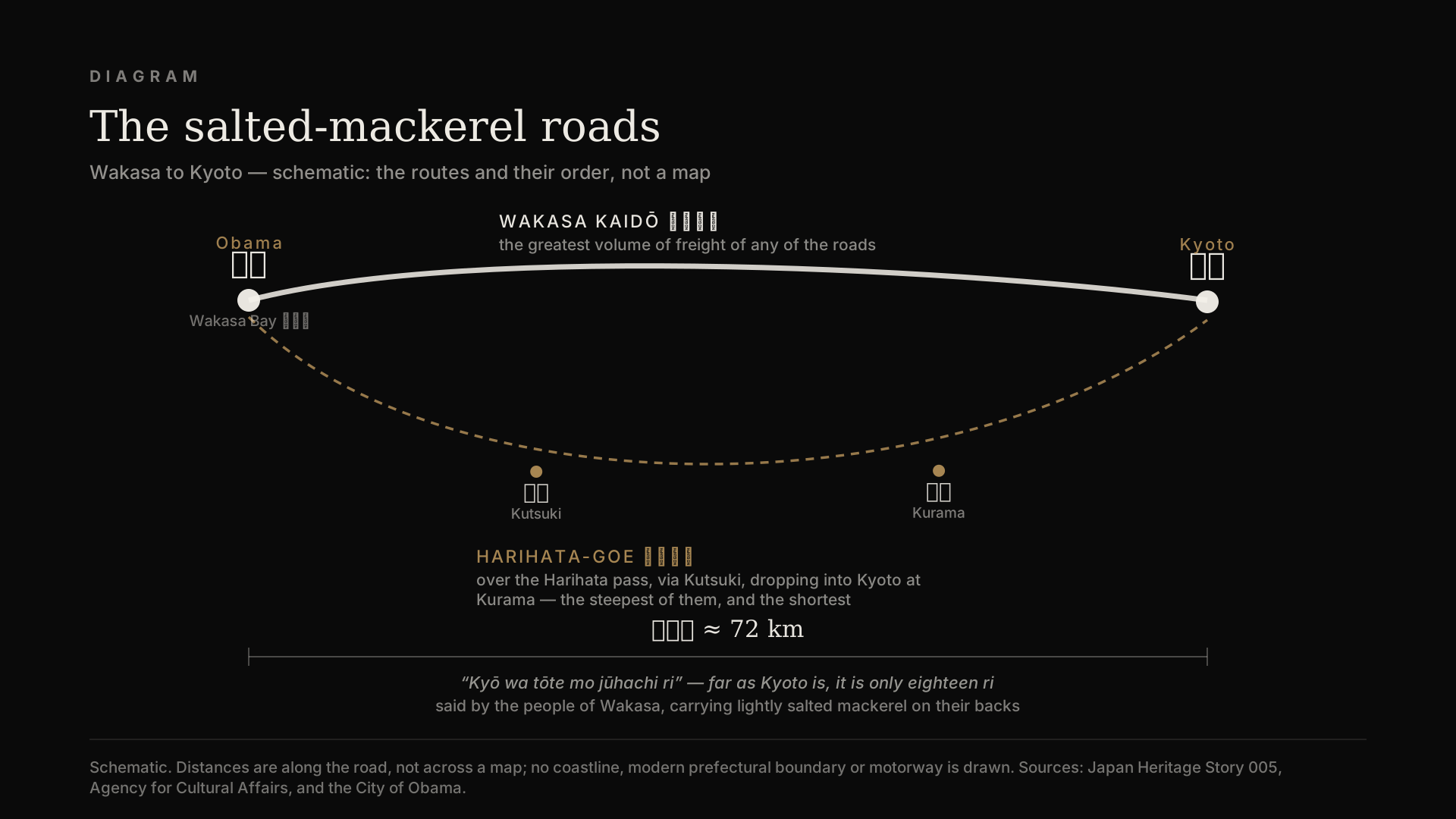
The sea that fed the old capital was Wakasa Bay, on the Japan Sea side, in what is now Fukui. Wakasa was a miketsukuni — one of the provinces charged with supplying salt and seafood to the imperial table — and the roads that carried the fish inland are known collectively as the Saba Kaidō, the mackerel road. Japan's Agency for Cultural Affairs recognised the whole network as a Japan Heritage story in the first cohort of 2015, on the strength of fifteen hundred years of continuous traffic along it.
Obama, the port at the northern end, still records the phrase the carriers used: Kyō wa tōte mo jūhachi-ri — the capital is far, but only eighteen ri. Eighteen ri is about seventy-two kilometres. The busiest route, the Wakasa Kaidō, carried the greatest volume; the hardest and shortest, the Harihata crossing, went over the pass by way of Kutsuki and came down into Kurama at the top of the city.
The detail that matters for sushi is the salt. Mackerel spoils faster than almost anything a person would want to eat raw, and it was salted at the coast — not preserved indefinitely, but timed. By the time the carriers reached the city on foot, the fish had cured to about the right degree. The road was not an obstacle the salting had to survive. The road was part of the recipe.
Kyoto did not find a way to keep mackerel unchanged across seventy-two kilometres. It built a dish out of the way the fish changed.
Sabazushi is festival food
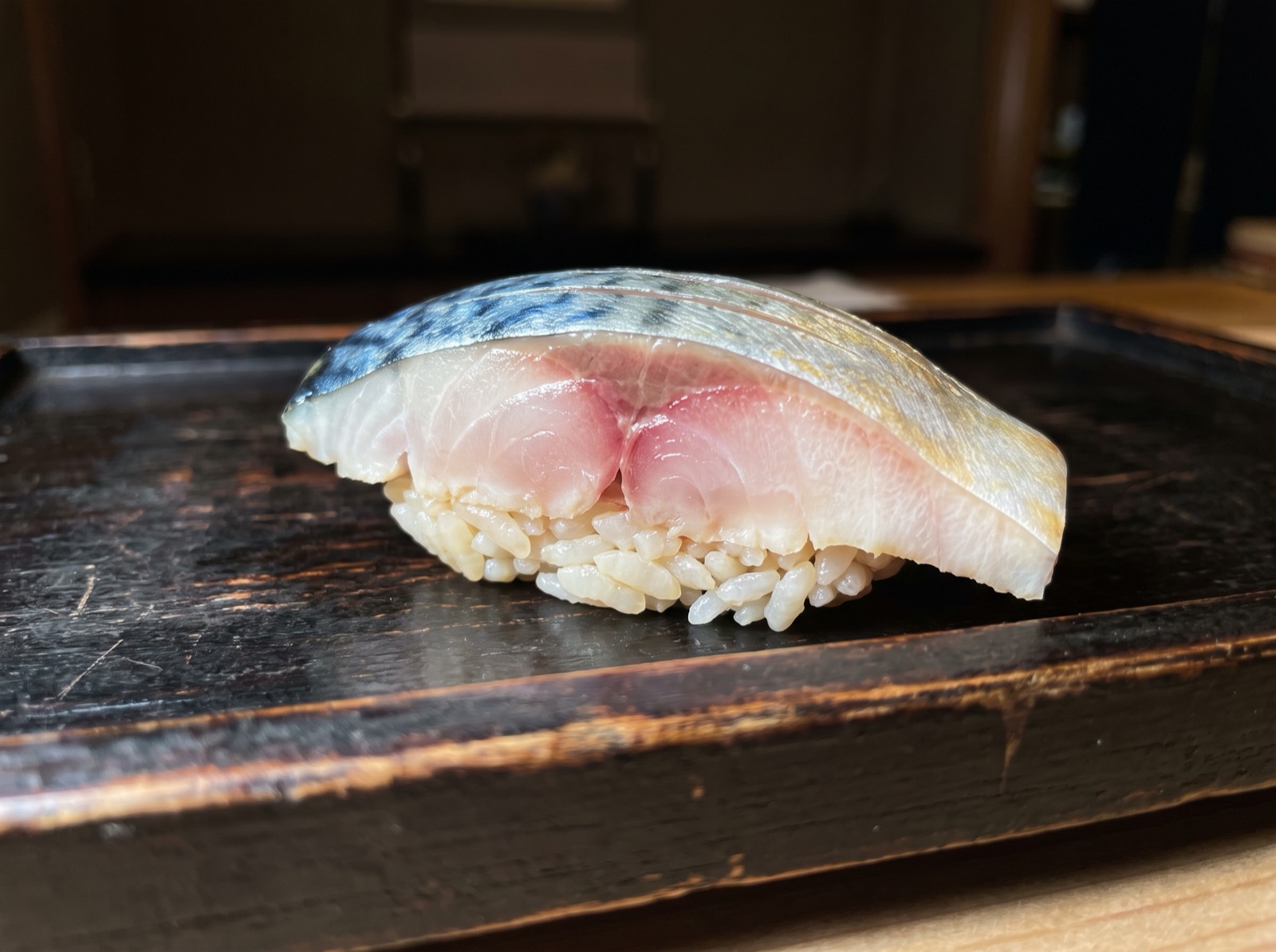
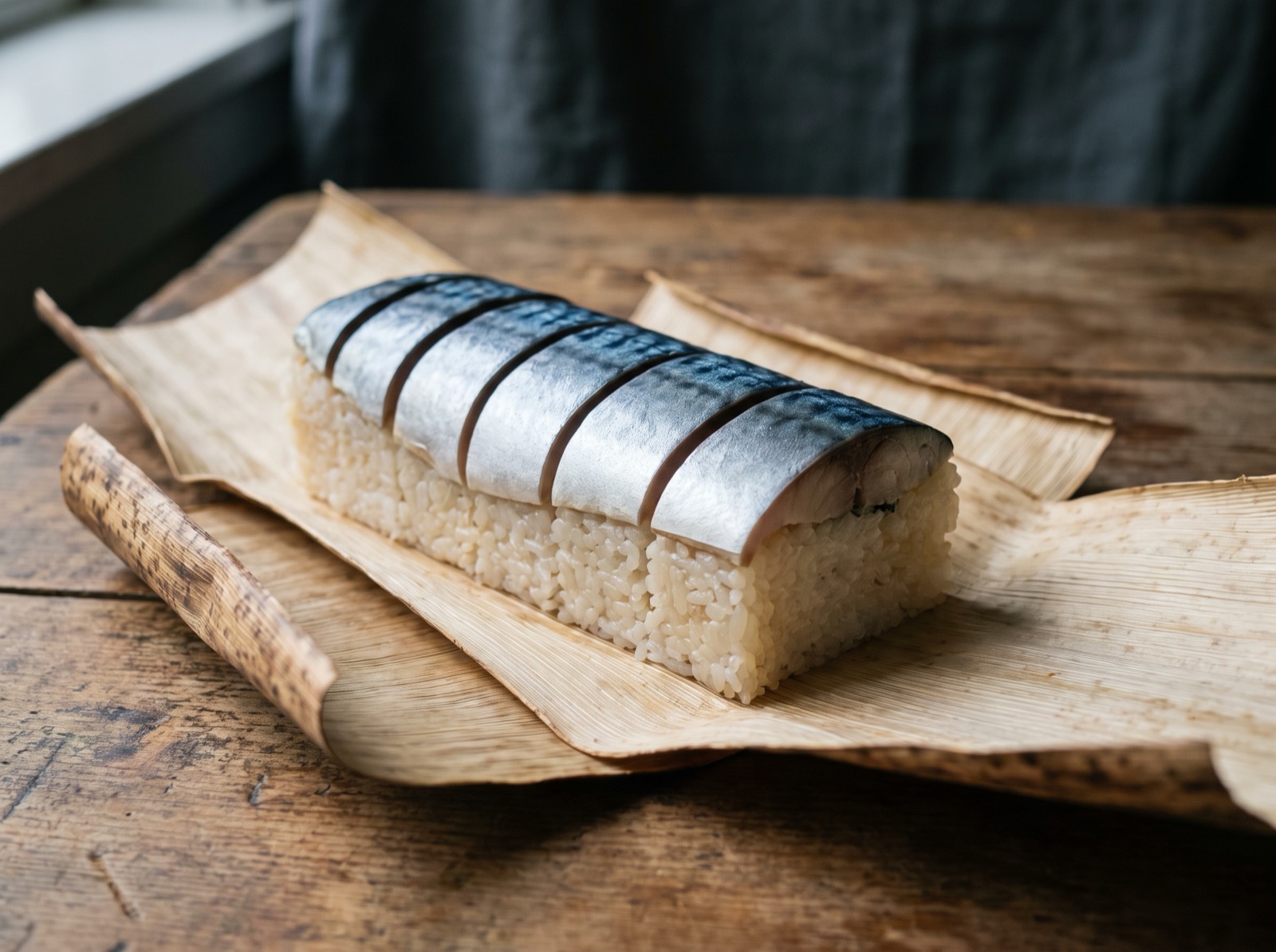
What came out of this is sabazushi: a bar of vinegared rice with a fillet of cured mackerel laid along its length, pressed, and cut across into thick slices. Japan's agriculture ministry lists it for the whole of Kyoto Prefecture and dates it, carefully, to the Edo period — it is said to have been born then, which is as far as the official record goes.
The same entry is precise about when it was eaten, and this is the part visitors usually miss. Sabazushi was food for a festival day. It still is. The ministry names the three great Kyoto festivals — Aoi in May, Gion through July, Jidai in October — along with the autumn festivals of the smaller towns, and describes households making it at home to feed guests, each family with its own version passed down. It was never counter food, and it is still bought from a shop more often than eaten at one. It is something you buy from a shop, or are given.
The method is domestic in the same way. Salted mackerel is filleted, the dark bloodline cut out, rinsed in vinegared water, then sat in enough vinegar to cover it for a little over half an hour. It is eaten the following day, once the flavour has settled. Nothing in that needs a professional, and that is rather the point of it.
The prefecture has a coast; the city does not
Kyoto Prefecture does have a shoreline — Tango, in the far north, on the same Wakasa Bay — but it is separated from the city by mountains and belongs to a different food culture. Its sushi is barazushi: mackerel grilled rather than salted, then broken into a floss and scattered over vinegared rice with shiitake, shredded omelette, kamaboko, gourd strips, bamboo shoot and pickled ginger, in shallow wooden boxes called matsubuta.
It is the sushi of weddings, New Year, sports days and any table with a crowd around it, and the local explanation of the name is that the toppings go on bara-bara, scattered. So when you are told that Kyoto sushi means sabazushi: true of Kyoto the city, incomplete about Kyoto the prefecture.
Japan's first central market
The modern answer to the inland problem was infrastructure, and Kyoto got there first. Japan's central wholesale market law passed in 1923. Kyoto opened the country's first market under it: the fresh fish, salted-and-dried fish and dry goods sections began trading on 11 December 1927, produce the following January. It was built as a platform market with a rail spur running into the site, and it became the model for every central wholesale market built in Japan afterwards.
It is worth holding that next to Toyosu, which opened in 2018 and which visitors now treat as the definitive Japanese fish market. Toyosu is the largest. Kyoto's is the oldest of its kind — because a city eighteen ri from the sea needed the supply problem solved permanently rather than every morning.
Where sushi sits in a kaiseki city
In November 2022 Japan entered kyō-ryōri, the cooking of Kyoto, on its national register of intangible cultural properties, naming a preservation association as the holder body. The official definition is unusual and worth reading closely: kyō-ryōri is the expression of Kyoto-ness through cooking, the setting of the room and the reception of the guest, and the technique is held jointly by the proprietor, the cook, and the okami and the servers.
Sushi is not in that definition. Kyoto is a kaiseki and kappō city that also has sushi. The counters here are real and some are very good, but the local hierarchy does not put them at the summit, and an itinerary that spends every dinner at one has eaten well and missed the city. This is the opposite of the advice we would give for Tokyo.
Where to eat, by area
Four parts of the city account for most of what a visitor will realistically consider.
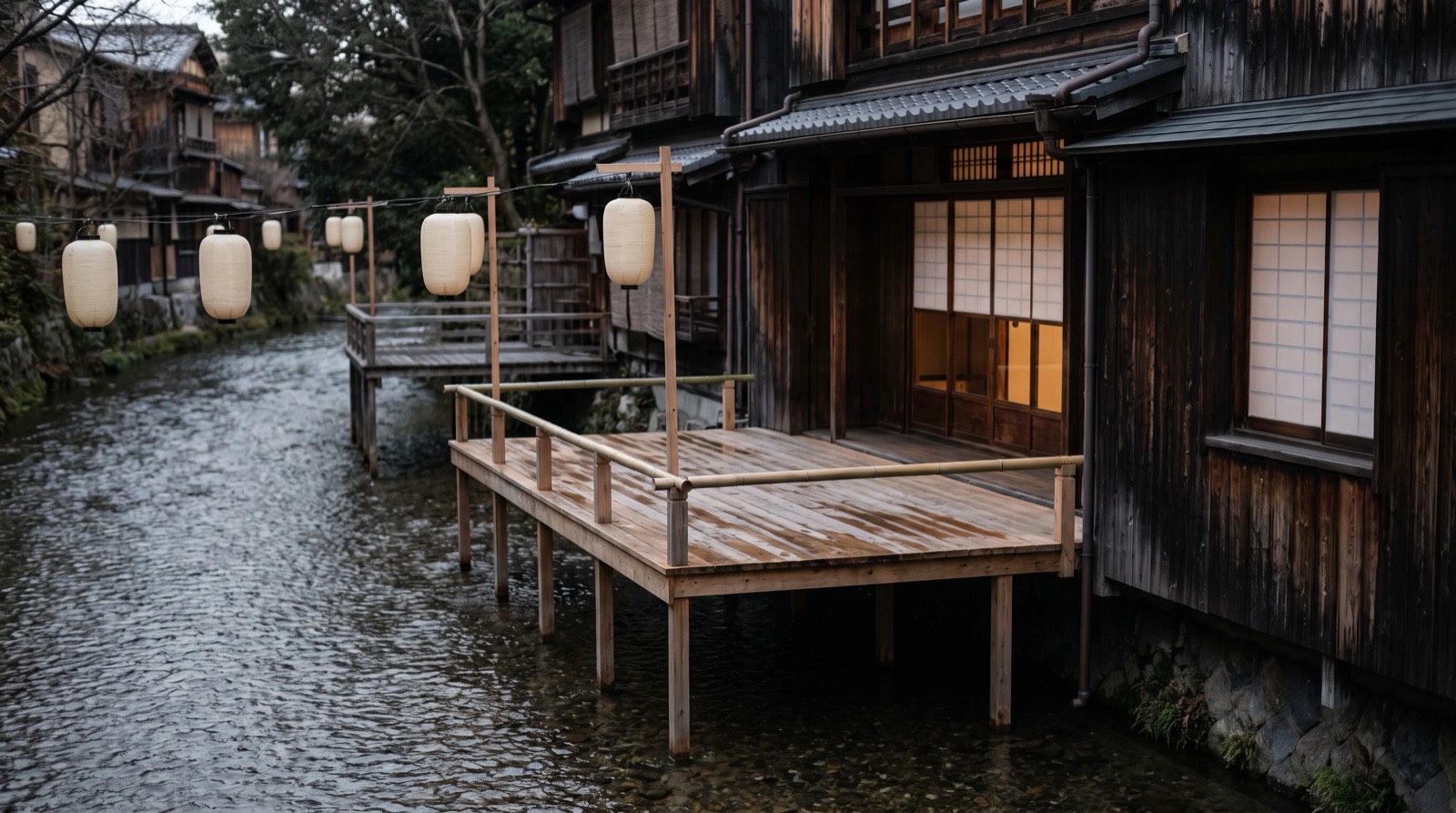
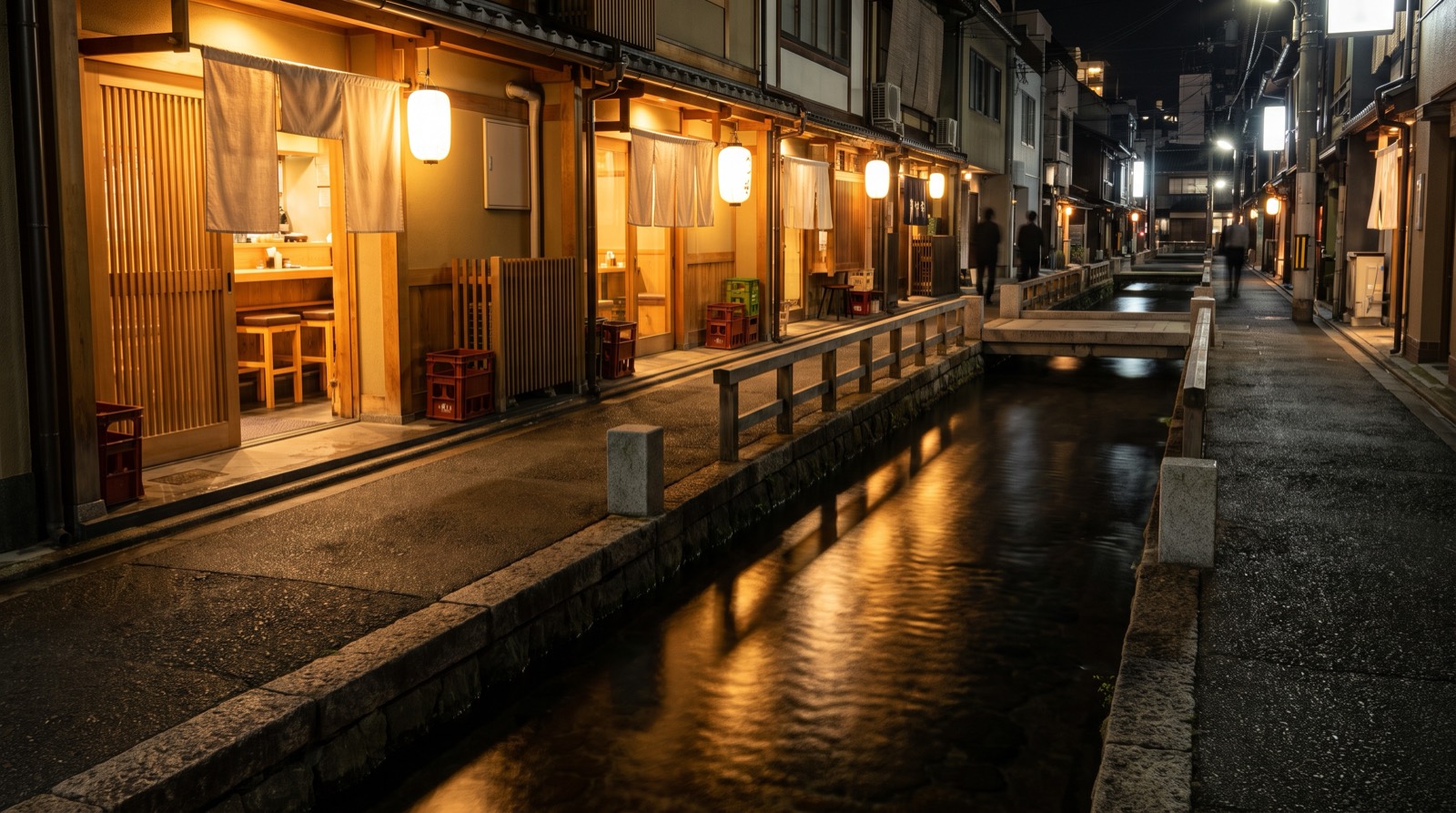
- Gion and Higashiyama. The old entertainment quarter east of the river. Small rooms behind unmarked frontages, the highest concentration of counters that expect an introduction, and the highest prices in the city. Bookings here are often made through a hotel rather than directly, and some rooms still do not take first-time guests.
- Kiyamachi, Ponto-chō and Kawaramachi. The dense eating quarter along and just west of the Kamo river. Most of the accessible counters are here — both straight Edomae rooms and the mixed sushi-and-kappō format that Kyoto does particularly well. The best odds for a visitor who wants a counter without booking far ahead.
- Around Nishiki. The market street and the blocks either side of it. Standing counters, lunch sushi, and the shops that sell sabazushi to take away. Not where you book an evening; very much where you find out what the city actually eats.
- Kyoto Station and south. Hotel and department-store sushi, mostly. Convenient on an arrival or departure day and priced for that. The thing it does better than anywhere else is a boxed sabazushi to take on the train.
Nishiki, and what a market is for
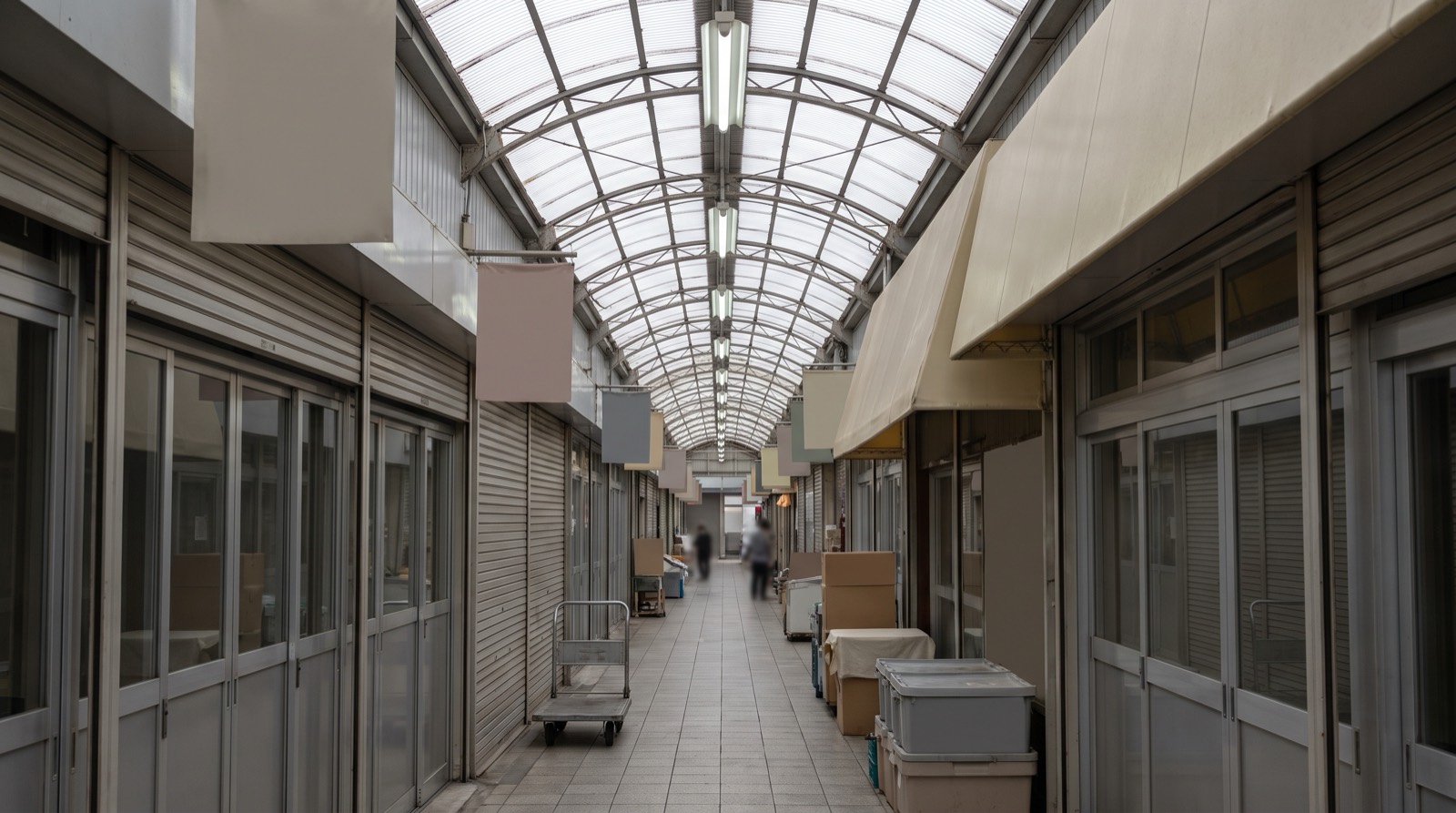
The city describes Nishiki as having opened in the Tenshō era, roughly four hundred years ago, and as having prospered through the Edo period as a fish wholesalers' quarter called Nishiki-no-tana. It runs about four hundred metres east to west, from Teramachi to Takakura, with something over a hundred and thirty shops, and it was stocked first for restaurants and inns rather than for households.
What it is now is a working market partly converted into a street of things eaten while walking. The conversion is widely complained about; it is also what has kept the street commercially alive. Two practical notes. Go in the morning, when the shops that still supply kitchens are working. And treat it as a supplement to a counter meal rather than a substitute — standing sushi eaten in a crowd is a different thing from a seat, and the comparison is a category error rather than a disappointment.
Hamo, and the month of July
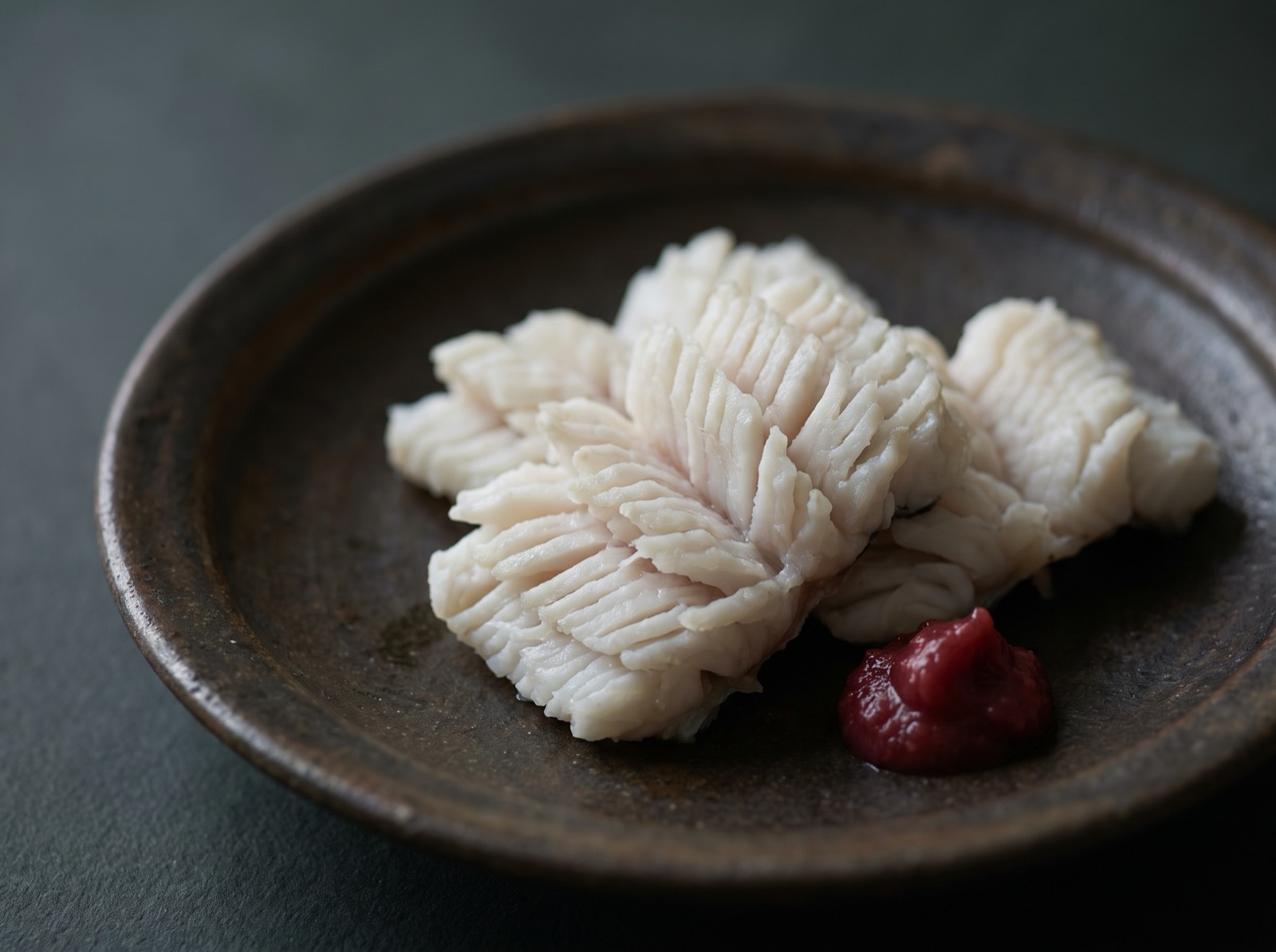
Kyoto's summer fish is hamo, the pike conger. The city's own tourism body records the connection plainly: the Gion Festival, which runs the whole of July and traces its founding story to an epidemic in 869, carries a second name — hamo-matsuri, the hamo festival — because the fish comes into season exactly as the rains end and the floats go out.
You will also be told that hamo became a Kyoto fish because it was the one thing that reached the capital alive over the mountains. That story is repeated everywhere and it is a good one. What the city's own material states is narrower: that the seasons coincide. We are marking the rest as a popular attribution rather than a documented fact, because that is what it is.
Practically: if you are in Kyoto in July, order hamo before you order anything else, and expect to meet it as otoshi in iced water, or in a clear soup, more often than on rice. It is a fish that belongs to the kitchen more than to the counter.
What it costs, and how far ahead to book
Kyoto does not price like Osaka. Where Osaka sits roughly a band below Tokyo for equivalent work, Kyoto sits alongside Tokyo and occasionally above it, and the reason is demand rather than fish. The city's own 2025 survey counted 62.79 million visitors, and 16.59 million people staying the night: 8.49 million Japanese against 8.09 million from abroad.
Just under half of everyone sleeping in Kyoto is a foreign visitor. For a room with eight or ten seats, that is the number that decides how hard it is to get in — you are not competing with the city, you are competing with everyone who flew in. Book earlier than instinct suggests: a month out for a good mid-range counter, considerably more for Gion. If you are booking from abroad and do not read Japanese, book through your accommodation.
Both figures are the city government's own. The foreign count is derived rather than counted directly, and the estimation method changed in 2025 with earlier years restated, so older headline numbers for Kyoto are not comparable with these.
Frequently asked questions
Is sushi in Kyoto different from Tokyo?
Yes, in origin rather than in the nigiri itself. Kyoto's own sushi is sabazushi — cured mackerel pressed onto a bar of rice — which came out of carrying salted fish about seventy-two kilometres inland from Wakasa Bay. The Edomae counters in Kyoto serve the Tokyo style, and serve it well, but they are a later import into a city whose food culture is built around kaiseki.
What is sabazushi?
A pressed bar of vinegared rice topped with the length of a cured mackerel fillet, cut across into thick slices. Japan's agriculture ministry lists it for the whole of Kyoto Prefecture and says it is thought to have emerged in the Edo period. It was, and largely still is, festival food: made at home for the Aoi, Gion and Jidai festivals and for local autumn festivals, each household with its own version.
Is sushi expensive in Kyoto?
It costs about what Tokyo costs, and sometimes more — which makes it more expensive than Osaka for equivalent work. The driver is demand, not fish. Kyoto recorded 16.59 million overnight visitors in 2025, just under half of them from abroad, against a small number of counter seats.
Should I eat sushi or kaiseki in Kyoto?
If you have limited dinners, spend at least one on kaiseki or kappō. Kyoto's cooking — kyō-ryōri — was entered on Japan's national register of intangible cultural properties in 2022; sushi is not part of that definition. Sushi in Kyoto is good. It is not what the city is for.
Is Nishiki Market worth visiting?
Yes, in the morning, and as a supplement rather than a meal. It runs about four hundred metres with something over a hundred and thirty shops, opened in the Tenshō era roughly four hundred years ago, and was a fish wholesalers' quarter through the Edo period. Much of it now sells food to eat while walking, but the shops that supply restaurants are still there and still working early.
Do I need to book sushi in Kyoto in advance?
Yes, and earlier than you would in Osaka. A month ahead is reasonable for a good mid-range counter; Gion needs considerably more, and some rooms there take reservations only through a hotel or an existing guest. Book through your accommodation if you do not read Japanese.