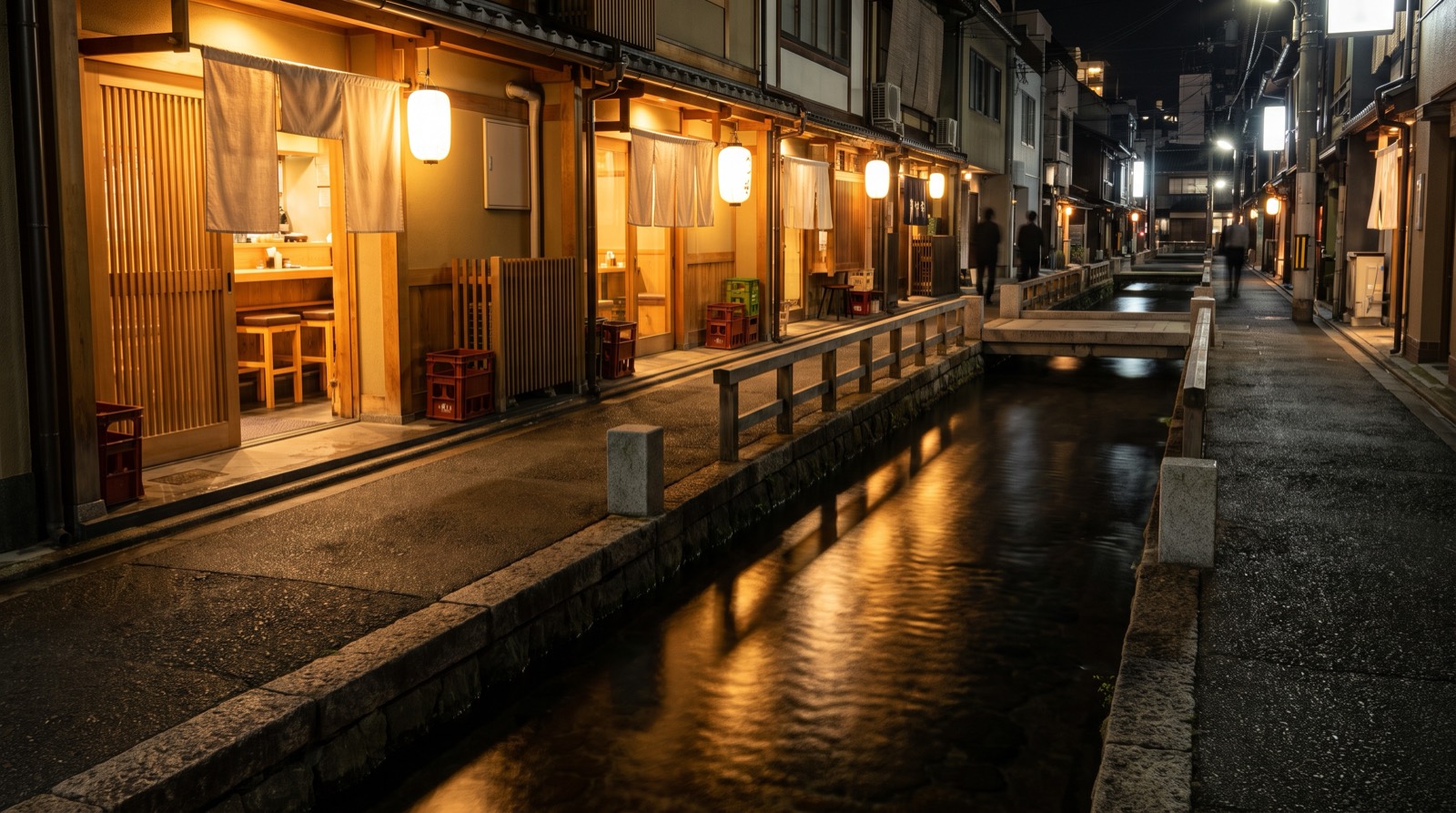
Thirteen streets, two cities, and every stop on this series so far has opened from the same floor: a shop publishes a page, and the question was what it said, or which of two pages to believe when they disagreed. Kawaramachi does not let that floor hold. Walk the few hundred metres between the Kiyamachi canal and the Shijo-Kawaramachi crossing and the first fact that changes from doorway to doorway is not a price or a phone number. It is how many pages exist at all.
Of the five counters below, one keeps no domain of its own; the only place its hours and its Tuesday closing appear is a directory page run by a shopping-street association a few doors down. One keeps exactly one domain, and that domain leaves the nearest station, the seat count, the founding year and any lunch price all unanswered. A third also keeps exactly one domain, thorough on almost everything — until the price, which sits behind a dead link and inside a menu image no browser will read as text. The last two each keep two domains carrying the same name, and the two domains disagree: one pair on a closed day and on what a fixed-price course actually contains, the other on a telephone number, on four days a week of opening hours, and on whether the room seats eighty or sixty-six. What follows is arranged by that count first — zero pages, then one, then two — and inside each count, by how well the pages that exist agree with each other. It is not a ranking of the food, or of the shops.
How this was put together
Everything below was read on 8 August 2026, from pages each shop publishes itself, or, where a shop publishes nothing of its own, from the one page that stands in for it. That single exception is Kinsen’s listing on the site of the Teramachi Kyogoku shopping-street association, a quasi-public operator rather than a review platform, and it is treated here as the shop’s de facto official source because no other exists. No listing site, no review service and no booking platform is quoted for a fact that belongs to a shop, even where one of them carries a figure the shop itself leaves out.
Where a shop’s own pages disagree with each other, both versions are printed as found, and neither is silently preferred. A small number of similarly named candidates were checked against the address printed under them and set aside before this list was fixed; the reasoning behind each is kept with the sources below rather than repeated here. There is no ranking here, and the order the five are given in is a count of pages, not a judgement of any of them.
Kinsen — the shop with no domain of its own
Kinsen sits inside the Teramachi Kyogoku covered arcade, at 406 Sakuranocho, Teramachi-dori Sanjo-sagaru, Nakagyo-ku. Nothing on the open web carries that address under the shop’s own name and its own design. What exists instead is a single directory page on the site of the Teramachi Kyogoku Shopping Street Promotion Association — footer credit COMPASSO TERAMACHI — which lists a shop name, a category, a phone number, a set of hours and a closing day among however many other member shops sit alongside it.
The page gives hours as 16:00 to 22:30 on weekdays and 12:00 to 21:30 on Sundays and public holidays, and a closing day of Tuesdays. It gives a phone number, 075-241-3366, with no note on whether a reservation is required, no online booking link and no stated reservation method beyond the number itself. It does not name a nearest station or a walk time, does not give a seat count, and does not give a founding year. The page states that the kitchen restocks daily from Nishiki Market, some minutes’ walk from this arcade rather than inside it.
On price the association’s page is narrower still. There is no lunch course and no dinner course listed at all — the only figure on the page is a per-piece one, for the shop’s named dish ばくだん (bakudan, a gunkan-maki of finely chopped tuna sinew topped with a raw quail egg): ¥50 plus tax, and up. A reader who wants a course price, in yen, for an evening at Kinsen will not find one anywhere on the open web, because the one page that speaks for the shop was never built to carry one.
- Where. 406 Sakuranocho, Teramachi-dori Sanjo-sagaru, Nakagyo-ku, Kyoto 604-8035, inside the Teramachi Kyogoku arcade. No nearest station or walk time is published anywhere.
- Booking. A telephone number only, 075-241-3366, on the shopping-street association’s page. Not published: whether a reservation is required, or any online booking route.
- Hours. Weekdays 16:00–22:30; Sundays and public holidays 12:00–21:30.
- Closed. Tuesdays.
- Price. Not published as a course, lunch or dinner. The only figure on the page is per piece: ¥50 plus tax, and up, for the shop’s ばくだん (bakudan).
- Seats. Not published.
Kiyamachi Ran — one domain that answers almost nothing
Kiyamachi Ran keeps a single domain, sushi-ran.com, with seven items in its own navigation — about the shop, the menu, the shop’s story, takeout, access, news, an online shop. The front page states that the business has been run across three generations, and names two dishes, thinly sliced tuna and pickled-vegetable sushi, among what it serves. The address is 212-6 Nabeyacho, Kiyamachi-dori Shijo-agaru, Nakagyo-ku, and the shop’s own access page gives no station name and no walk-time figure at all — only a description: two blocks east of Shijo-Kawaramachi, on the east bank of the Takase river, look for the large red lantern among the neon.
Seven pages, and across all of them the site never states a nearest station by name, never gives a seat count and never gives a founding year, despite the claim of three generations on the front page. There is no lunch menu anywhere on the site — dinner only, 17:00 to 22:00 with a last order of 20:30, closed Sundays.
The one course on the menu page is priced at ¥30,000 a head, plus tax and service charge — the only one of the five prices in this piece stated not to include tax, where every other published figure here either states tax is included or says nothing about tax either way. Booking is by telephone only, 075-221-0647; no reservation form or online booking link appears anywhere on the seven pages.
- Where. 212-6 Nabeyacho, Kiyamachi-dori Shijo-agaru, Nakagyo-ku, Kyoto. No station name or walk time is published; the site’s own directions read two blocks east of Shijo-Kawaramachi, on the east bank of the Takase river.
- Booking. Telephone only, 075-221-0647. No online reservation form or link anywhere on the site.
- Hours. 17:00–22:00, last order 20:30. Dinner only; no lunch menu is published.
- Closed. Sundays.
- Price. Omakase course ¥30,000, stated as plus tax and service charge.
- Seats. Not published.
Ginza Onodera Kaitenzushi Kyoto — one domain, and the price it never states
Of the five shops here, Onodera’s Kyoto branch keeps one domain, onodera-group.com, thorough across nearly every category in this piece: the address, 305 Junpu-cho, Shimogyo-ku, inside the Shijo-Kawaramachi building; a nearest station stated as one minute’s walk from Kyoto-Kawaramachi Station on the Hankyu Kyoto Line; a phone number; hours; a closing policy; a seat breakdown; and a dedicated booking page. An English page carries a Grand Menu; nothing on the site states that staff service or the booking process itself is available in English.
Hours are given as 11:30 to 22:30, last entry 21:30, last order 22:00, with no fixed weekly closing day — the page describes it as irregular. Seating is stated precisely: 36 counter seats, one four-person private room, two six-person private rooms, 52 seats in total. Booking runs through a dedicated page, onodera-group.com/reservation/, or by phone on 050-3184-3842.
The gap sits at price. A page built for it, /kaitensushi-kyoto/price/, returns a 404. The Grand Menu itself exists, but its prices are set inside a single image file rather than as text, so nothing on it can be read or quoted as a figure. Between the two, a domain that answers a nearest station, a seat count and a booking route down to the size of each room still leaves the one number most readers open the page for unanswered, in any form a browser will render as text.
- Where. 1F Shijo-Kawaramachi Bldg., 305 Junpu-cho, Shimogyo-ku, Kyoto. One minute’s walk from Kyoto-Kawaramachi Station, Hankyu Kyoto Line.
- Booking. Online, at onodera-group.com/reservation/, or by telephone on 050-3184-3842.
- Hours. 11:30–22:30, last entry 21:30, last order 22:00.
- Closed. Irregular; no fixed weekly day is published.
- Price. Not published as readable text. The dedicated price page returns a 404, and the Grand Menu’s prices exist only inside an image file.
- Seats. 36 at the counter, one four-person private room, two six-person private rooms — 52 in total.
Sushi Morigaku — two domains, one closed day between them
Sushi Morigaku keeps two domains under the same phone number, 075-741-8127. The first, sushi-morigaku.net, is the shop’s primary site; it links to the second, sushi-morigaku-kyoto.com, under a Japanese-language heading meaning for foreign visitors, click here. The text on that second, foreign-visitor-labelled domain is written in Japanese throughout — neither domain states that a menu, staff service or booking is available in English. The address, 489 Higashi-ikesucho, Kiyamachi-dori Nijo-sagaru, Nakagyo-ku, is the same on both.
Neither domain names a real nearest station. The access section of the primary site is built from ten photo captions rather than a written route, and one of those captions reads: get off at Oike-dori Station. Oike-dori is a Kyoto street, not the name of any train or subway station, and no sentence naming an actual station with a walk time appears on either domain. Hours are the one thing both sites state identically: lunch 12:00 to 14:00, dinner in two seatings, 18:00 to 20:00 and 20:30 to 22:30.
The two domains part ways on the closing day: sushi-morigaku.net does not state one anywhere, and sushi-morigaku-kyoto.com states Wednesdays. They also part ways inside a price that is otherwise identical. Both list lunch at ¥13,000 and dinner at ¥20,000, to the yen. But .net describes both meals with the same five single dishes, twelve pieces of nigiri, miso soup and dessert, with price the only variable between them, while .com gives lunch as two single dishes and thirteen pieces of sushi and dinner as four single dishes and twelve pieces — a different course at a different meal, on the very domain the primary site sends foreign visitors to.
- Where. 489 Higashi-ikesucho, Kiyamachi-dori Nijo-sagaru, Nakagyo-ku, Kyoto 604-0922. No genuine station name or walk time is published on either domain; one access photo caption names ‘Oike-dori Station,’ which is a street, not a station.
- Booking. Telephone, 075-741-8127 (same on both domains), or the contact form at sushi-morigaku.net/contact/. No online reservation system on either domain.
- Hours. Lunch 12:00–14:00; dinner in two seatings, 18:00–20:00 and 20:30–22:30. Identical on both domains.
- Closed. Not stated on sushi-morigaku.net. Wednesdays on sushi-morigaku-kyoto.com.
- Price. Lunch ¥13,000; dinner ¥20,000. The figures match on both domains, but the course each figure buys is described differently on each — five dishes and 12 pieces on .net for both meals; two dishes and 13 pieces at lunch, four dishes and 12 pieces at dinner, on .com.
- Seats. Not published as a number. Counter-only seating is stated on sushi-morigaku-kyoto.com; sushi-morigaku.net does not say.
One of Sushi Morigaku’s two official domains does not state a closing day at all. The other, linked from the first as its version for foreign visitors, states Wednesdays. Both are the same shop’s own pages.
Yonefuku Kiyamachi — two domains, three ways to disagree
Yonefuku’s Kiyamachi branch is a single physical restaurant with two official sources: its own microsite on the foodre.jp reservation platform, at komehukukiyamachi.foodre.jp, and a full branch profile published separately by the parent company on fun-no1.com. Both describe the same address, 1F Kizakura Kiyamachi Bldg., 174 Zaimokucho, Nakagyo-ku, and the foodre.jp page states a nearest station the parent site does not restate: three minutes’ walk, 210 metres, from Sanjo Station on the Keihan Main Line.
They disagree from there. The phone number is 050-5462-5301 on foodre.jp and 075-212-0003 on fun-no1.com. The seat count is 80 on foodre.jp — 25 on the first floor, 55 on the second — and 66, with no floor breakdown, on fun-no1.com. And the hours for every day but Sunday and public holidays run on two different clocks: Monday to Thursday closes at 23:00 on foodre.jp and at 24:00 on fun-no1.com; Fridays and the day before a holiday close at 23:30 against 24:00; Saturdays close at 23:30 against 24:00. Only the Sunday and public-holiday hours, 16:00 to 23:00, last order 22:30, are stated identically on both.
Price is published thinly on either side. foodre.jp gives a lunch budget of around ¥1,000 and no dinner figure; fun-no1.com states no price at all, in text, for either meal. Booking is likewise split: fun-no1.com links out to an online booking system run by ebica.jp, while the foodre.jp page’s own text carries no comparably explicit booking instruction beyond the platform it sits on. A closing-day policy appears only on foodre.jp, which states irregular closures; the fun-no1.com branch page does not restate one.
- Where. 1F Kizakura Kiyamachi Bldg., 174 Zaimokucho, Nakagyo-ku, Kyoto. Three minutes’ walk (210m) from Sanjo Station, Keihan Main Line, per foodre.jp; fun-no1.com does not restate a walk time.
- Booking. An online system run by ebica.jp, linked from fun-no1.com. The phone number is 050-5462-5301 on foodre.jp and 075-212-0003 on fun-no1.com — the two official sources disagree.
- Hours. Mon–Thu 17:00–23:00 (foodre.jp) or 17:30–24:00 (fun-no1.com); Fri/pre-holiday 17:00–23:30 or 17:00–24:00; Sat 16:00–23:30 or 16:00–24:00. Sun/holiday 16:00–23:00 on both.
- Closed. Irregular closures, per foodre.jp. fun-no1.com’s branch page does not restate a closed-day policy.
- Price. Lunch around ¥1,000 (foodre.jp only). Dinner not published on either source.
- Seats. 80 total (1F 25, 2F 55) on foodre.jp; 66 total, no breakdown, on fun-no1.com.
What the five have in common
None of the five is hiding anything, and the count of pages does not predict how much any one of them says. Kinsen has no domain and still states its hours, its closing day and a phone number, plainly, on the one page that speaks for it. Kiyamachi Ran has exactly one domain and still leaves a nearest station, a seat count and a founding year unanswered across all seven of its pages. Onodera’s Kyoto branch has exactly one domain too, and it is the most complete single page in this piece — short of the one figure locked inside an image file. Zero pages, one thin page, one thorough page: the number alone tells a reader nothing about what is on it.
Where the count does matter is at two and above. A shop with one domain can leave a fact unpublished; a shop with two domains can publish two different facts under the same name. Morigaku’s two domains agree on price to the yen and disagree on what that price buys, and on whether the shop closes on a fixed day at all. Yonefuku’s two domains disagree on a phone number, on the hours for six days out of seven, and on whether the room seats eighty or sixty-six — and agree, for reasons neither source explains, on the one day of the week when nobody is likely to be checking a diary against a closing day: Sunday.
Reading a Kawaramachi page in about a minute
- Count the domains before you read either one. Search the shop’s name and note how many results carry its own design, rather than a shopping-street directory, a parent company’s corporate site or a reservation platform’s microsite. Two of the five shops here have two; treat a fact from either as provisional until you have checked the other.
- If there is no domain at all, read who is publishing the page that stands in for one. Kinsen’s hours and phone number come from a shopping-street association, not from the shop, and the association did not build that page to carry a price.
- Check the price page separately from the menu page. One of these five has a price page that no longer exists and a menu whose figures are locked inside an image; neither failure is visible from the shop’s front page.
- When two domains give the same figure, check what the figure buys. Morigaku’s two sites agree on ¥13,000 and ¥20,000 and disagree on the dishes inside each course — agreement on the number is not agreement on the meal.
- Note which day of the week two domains do agree on. It is often the quietest one to check — Yonefuku’s only matching hours are Sunday’s — and it tells you nothing about the other six.
That is the first street in this city’s share of the series, and the question it opened is narrower than it looks: not what a shop’s page says, which was the question in every district before it, but whether there is a page to ask at all, and how many. Kawaramachi answers that differently five times over, on one short stretch between a canal and a crossing, before a single price or phone number is even compared.
If you want to book one of these
Several of the counters described above answer the telephone only in Japanese, and a few of them take bookings by no other route. AutoReserve is a Japanese reservation service with an English interface, and it states that it will place the call on a diner’s behalf where a restaurant takes reservations by telephone alone. We have not tested it against every restaurant on this page, and a listing there is not a guarantee of a seat — the doors described above are the doors either way.
Frequently asked questions
How many official pages does each of these five Kawaramachi shops have?
Zero, one, one, two and two. Kinsen has no domain of its own and is described only on a directory page run by the Teramachi Kyogoku shopping-street association. Kiyamachi Ran and Ginza Onodera Kaitenzushi Kyoto each keep exactly one domain, though Ran’s answers almost none of the six categories this piece checks while Onodera’s answers nearly all of them. Sushi Morigaku and Yonefuku Kiyamachi each keep two domains carrying the same name, and in both cases the two domains disagree with each other.
Which of the five has no website of its own?
Kinsen. Its address, phone number, hours and Tuesday closing day come from a single listing page on the site of the Teramachi Kyogoku Shopping Street Promotion Association (footer credit COMPASSO TERAMACHI), not from a page the shop built itself. That page states no lunch or dinner course price, no seat count, no nearest station and no founding year; the only figure it carries is ¥50 plus tax and up, for one piece of the shop’s ばくだん (bakudan).
Where exactly do Sushi Morigaku’s two domains disagree?
On the closing day and on what a fixed-price course contains. sushi-morigaku.net states no closing day anywhere; sushi-morigaku-kyoto.com, which the first site links to as its version for foreign visitors, states Wednesdays. Both domains price lunch at ¥13,000 and dinner at ¥20,000, to the yen, but .net describes both meals as five single dishes and twelve pieces of nigiri, while .com describes lunch as two dishes and thirteen pieces and dinner as four dishes and twelve pieces.
Where do Yonefuku Kiyamachi’s two sources disagree?
On the phone number, the seat count and most of the week’s opening hours. foodre.jp gives 050-5462-5301 and 80 seats (25 on the first floor, 55 on the second); fun-no1.com gives 075-212-0003 and 66 seats with no floor breakdown. From Monday to Saturday the two sources give closing times 30 minutes to an hour apart; only the Sunday and public-holiday hours, 16:00 to 23:00, match on both.
Can I find a price for all five shops?
Not consistently. Kinsen publishes only a per-piece figure for one dish, no course price. Kiyamachi Ran publishes one dinner course, ¥30,000 plus tax and service charge, and no lunch price at all. Ginza Onodera Kaitenzushi Kyoto publishes no price as readable text anywhere — its price page returns a 404 and its Grand Menu’s figures sit inside an image file. Sushi Morigaku publishes both a lunch and a dinner figure, identically, on both of its domains. Yonefuku Kiyamachi publishes only a lunch budget of around ¥1,000, on one of its two sources, and no dinner figure on either.