Pontocho is about five hundred metres long. It runs north to south along the west bank of the Kamogawa, from one street below Sanjo down to Shijo, and at its narrowest two people carrying umbrellas have to agree on which of them turns sideways. Three separate organisations publish a list of what stands on it. None of those lists agrees with the others about how many sushi restaurants are here.
That is not a footnote about clerical standards. It is a useful thing to understand before trying to eat in this part of Kyoto. In Gion and in Pontocho a restaurant very often does not own its own front door. Its address, its telephone number, its hours, its closing day and even the word used to describe what it serves are held in somebody else’s register — a trade association, a riverside cooperative, a national booking platform, a shopping street office. Those registers were compiled at different times, for different reasons, by different people, and nobody has ever reconciled them with each other.
The five counters below are all real, all currently trading, and all verifiable. What separates them is not the fish. It is which register each one lives in, and what that register has decided to say about it.
In Gion and Pontocho a sushi restaurant does not own its own front door. The address, the hours, the closing day and even the word for what it serves are all held in somebody else’s register.
There is no ranking here and no photographs of any of these rooms. Everything below was read from the organisations’ own pages and the restaurants’ own pages in the first days of August 2026. Where two pages contradict each other, both readings are given rather than one of them quietly dropped.
Three registers, one street
The first register belongs to the Kamogawa Noryo-yuka Cooperative Association, which administers the wooden platforms built out over the water each summer. Its list for the Pontocho stretch runs from number sixteen to number fifty-two with no gaps — thirty-seven establishments — and among all thirty-seven exactly one is classified as sushi.
The second belongs to the Pontocho Noren-kai, the shopkeepers’ association of the street itself. It was formed in November 1997 under the name of the society to protect Pontocho and renamed the Pontocho Noren-kai in April 1998. Its own text, repeated identically on the top page and the about page, states that seventy-four shops between Sanjo and Shijo belong to it as of February 2021. The site’s two directories disagree with that number and with each other: the full shop list returns seventy-eight entries and the alphabetical-order list returns seventy-seven. The single difference between the two is one izakaya that appears in the full list and not in the alphabetical one. The highest record number the site uses is 119, so at least a hundred and nineteen entries have existed at some point. Of the seventy-seven, exactly two are tagged sushi.
The third register is across the river. The Gion Shopping Street Promotion Association keeps the directory of the approach to Yasaka Shrine, and it currently lists a hundred and fourteen businesses. It has no sushi category at all. Its genres run from Japanese confectionery and kimono to pickles, galleries, a bank, a courier depot, a car park, a dentist, a pharmacy and a barber, and it includes one category translating roughly as in a class of its own, which contains exactly two members: the teahouse Ichiriki-tei and the Minamiza theatre.
Set the three side by side for the same few hundred metres of riverbank, and the number of sushi restaurants is one, or two, or none, depending entirely on whose paperwork you are holding.
- Kamogawa Noryo-yuka Cooperative Association — thirty-seven Pontocho-area establishments licensed to build a summer platform, of which one is filed as sushi.
- Pontocho Noren-kai — seventy-seven or seventy-eight members depending on which of its own two lists you read, of which two are tagged sushi, and neither of those two is the one the cooperative names.
- Gion Shopping Street Promotion Association — a hundred and fourteen businesses on the shrine approach, with no sushi category in its scheme at all.
Not one restaurant is tagged sushi in more than one of the three. There is no overlap whatsoever. Every sushi restaurant in this article is invisible to at least two of the three bodies that claim to describe where it stands.
Pontocho Kappa Zushi, and the ‘only sushi on the water’
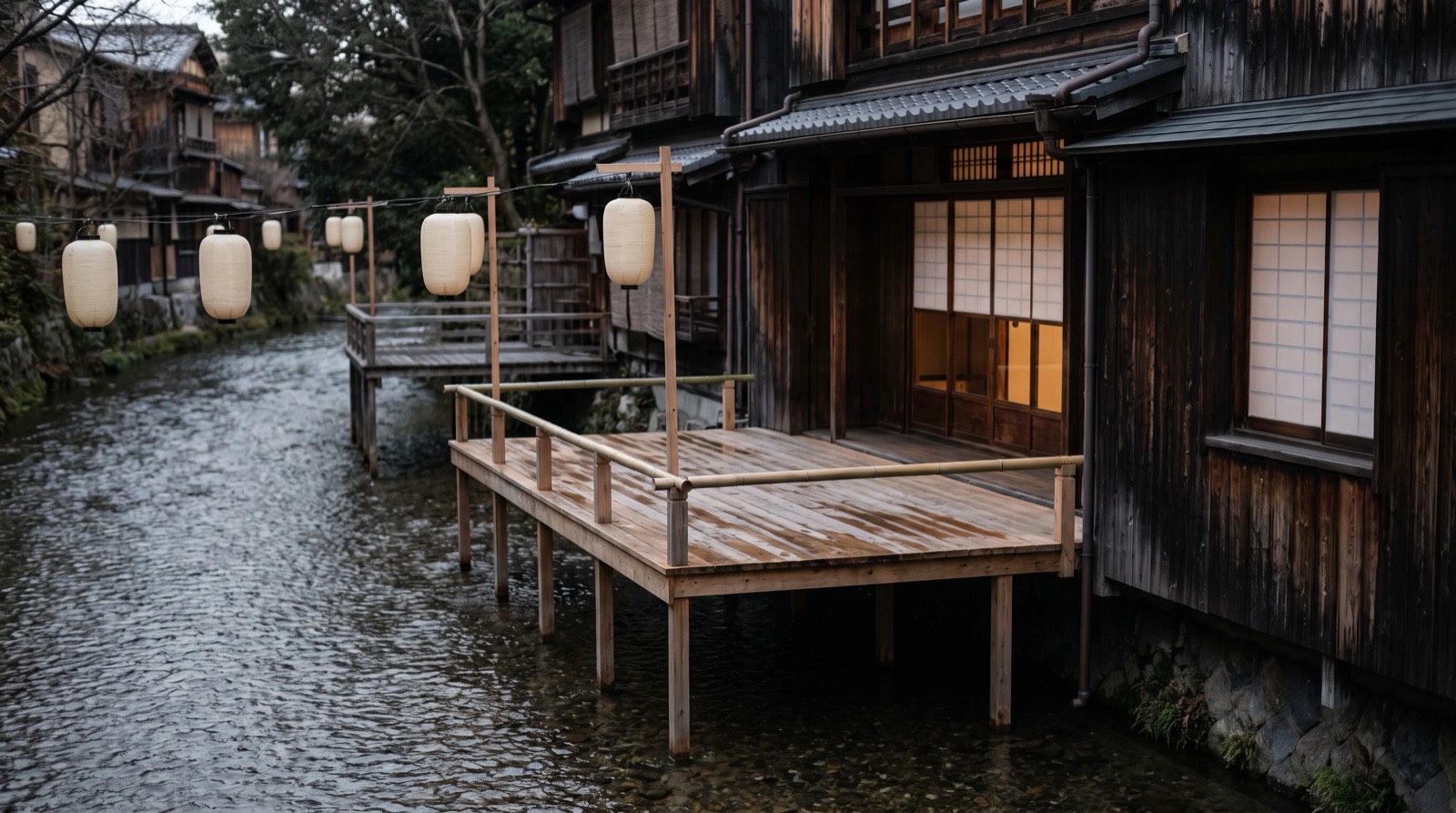
Every summer the restaurants along this stretch build a platform out over the water and serve on it. The cooperative lists thirty-seven of them for the Pontocho section in 2026, and its page for number thirty-four carries a headline that translates as the only sushi platform, followed by a sentence stating that the shop has been in Pontocho for more than forty years and is the only sushi restaurant with a riverside platform.
The platform is described as table seating that you walk onto with your shoes on, so it does not demand the floor-sitting that the older establishments do, and single items may be added to a course. The cooperative’s copy notes that the rice is finished with Chidorisu, a Kyoto rice vinegar, and that the fish is Edomae-style. The room seats thirty.
The platform menu consists of four set courses, and all four are named after rivers.
- Shirakawa, the lunch course, ¥4,400
- Takasegawa, ¥5,500
- Misosogigawa, ¥7,150
- Kamogawa, ¥8,800
The joke, if it is one, is precise. The platforms along Pontocho are not built over the Kamogawa at all; they stand over the Misosogigawa, the narrow channel that runs beside it. So the restaurant is literally standing on the middle course. The most expensive course is named for the river it is not on. And the cheapest, the lunch course, is named for the Shirakawa, which is on the far bank, in Gion, at the other end of this article.
The practical figures are unambiguous and were published by the cooperative rather than by the restaurant. Twelve until three, last orders at half past two; five until eleven, last orders at half past ten, with the platform itself closing at eleven. Lunch service on the platform runs from May to October and only on Saturdays, Sundays and public holidays. There is no closing day. The stated average spend is ¥4,400 at lunch and ¥5,500 at dinner, which is to say the cheapest course in each service. The room is entirely non-smoking. Reservations are described as advisable rather than required.
One line in the cooperative’s entry is worth more than the rest of them together: the platform seat charge is none.
That is not the norm here. Among the thirty-seven Pontocho establishments the cooperative lists, the charge simply for sitting on the platform is set at ¥300 by one, ¥500 by two more, ¥550 per head for anyone ordering a la carte at another, ¥600 by two, ¥700 at dinner only by another, ¥900 by another, ¥1,000 by another, ¥1,050 by another, and at one restaurant it is ten per cent of the whole bill. Two waive it if you take a course and charge it if you do not. One folds it into an ¥8,000 course and says so. Two more, including the sushi restaurant, do not charge it at all.
The cooperative’s entry also gives the shop a website field, labelled simply HP. Following it does not lead to a website belonging to the restaurant. It leads to a menu tab on a national gourmet listings platform, and specifically to the third tab of four. That third tab no longer exists: the address silently redirects to the first tab, and the tabs actually offered on the page are numbered one, two and four. The link in the cooperative’s register points at a page that was removed at some point and has not been noticed since.
The page it lands on is informative in its own right, and it is not the restaurant’s. Its telephone number begins 050, a booking-platform line rather than the shop’s own 075 number, and the page tells you to mention the platform when you call. It carries a rating of 4.2 from a hundred and ninety-eight reviews, and states in small type that both the score and the reviews are supplied by a third-party travel site.
The nigiri on that page is priced by the piece, in fourteen steps from ¥154 to ¥880, with a set of larger items above them: a mixed nigiri set at ¥2,145, a superior set at ¥3,190, ten pieces chosen by the chef at ¥3,630 and thirteen at ¥4,290, a conger eel roll at ¥1,980, an eel roll at ¥2,530 and a mackerel roll at ¥3,080. The note explaining that the figures are per piece rather than per pair sits at the very bottom of the page, underneath every price it applies to.
And this restaurant, the one the riverside cooperative calls the only sushi on the water, does not appear anywhere in the Pontocho Noren-kai’s directory of the street. It is not one of the seventy-seven. What is one of the seventy-seven is a bar on the third floor of the same building — the same street, the same block number, the same building name, two floors up.
The building is in the shopkeepers’ association. The sushi restaurant on its first and second floors is not.
Pontocho Yoshino-zushi, a Pontocho name at a Kiyamachi address
The noren-kai tags two of its members sushi. The first is the older of the two, and its entry is the most complete on the site: a Kyoto-style sushi shop, the description says, offering nigiri, mackerel sushi, box sushi, thick rolls and conger eel sushi. That is a list of the Kyoto repertoire rather than the Tokyo one, and it places the shop in the same tradition as the pressed and boxed sushi houses covered elsewhere in this journal.
A note on the name, because it collides with two shops in Osaka. The Yoshino of Pontocho is written with a different final character from Yoshino Sushi on Awajimachi — the house of 1841 that a national ministry names as the author of the modern box — and from Umeda Yoshino Zushi, the nine-seat counter in the Shin-Umeda Shokudogai corridor under the railway arches. Both appear in earlier articles here. They are three separate businesses that happen to share two syllables.
The register gives thirteen seats, opening at four in the afternoon and closing at ten, shut on Mondays and on irregular days besides, with nigiri from ¥3,500 a head. There is no website field. The telephone number and the fax number are the same number, which is a detail worth pausing on: it means one line, one machine, and a reservation taken by whoever is standing nearest to it. The same is true of the bar on the third floor of the sushi platform building, so it is a house style rather than a mistake.
The address is the interesting part. It reads: Kiyamachi, north of Takoyakushi, on the north side of the municipal bicycle park. That is not Pontocho. Kiyamachi is the next street west, along the Takasegawa, and the shop trades under the name of a street it does not stand on.
It is not alone. At least six of the noren-kai’s members give Kiyamachi addresses: a tempura restaurant, a soba house, a teppanyaki room, two izakaya and this sushi shop. The association is a subscription and a curtain, not a boundary survey. Whatever line it draws around itself does not correspond to any line on a street map.
Kubota, which has three names, two closing days and one domain
The other shop the noren-kai tags as sushi carries record number 118, near the top of the range, which suggests a comparatively recent addition. It appears in three of the registers discussed here, and it has a different name in each of them.
- To the Pontocho Noren-kai it is Temari-zushi to Kyo-tempura Kubota — hand-ball sushi and Kyoto tempura — and it is filed under Japanese food and sushi.
- To the riverside cooperative it is Kyo Izukaya Kubota, and it is filed under Japanese food and izakaya, with no sushi tag at all.
- On its own website it is Kyo Izakaya Kubota. The cooperative’s version of the name differs from the restaurant’s own by a single character.
The two associations agree on the address, in Wakamatsu-cho, on Pontocho below Sanjo, though the cooperative appends a sub-block number the noren-kai omits. They agree on the telephone number. They agree on the hours, eleven until half past two and five until ten, with the restaurant’s own site adding that the kitchen stops at two and at nine.
They do not agree on the closing day. The noren-kai says the restaurant is open every day except over the New Year. The restaurant’s own site says the closing days are irregular. Both were published by parties with an interest in getting it right, and there is no way to tell from the outside which is current.
The pricing is set out plainly on the restaurant’s own pages, which is more than can be said for most of the rooms in this article. Three dinner courses at ¥5,500, ¥7,000 and ¥8,500 before tax, which is ¥6,050, ¥7,700 and ¥9,350 with it. Three lunches: hand-ball sushi at ¥3,000, hand-ball sushi with Kyoto tempura at ¥4,000, and the house special at ¥5,000, or ¥3,300, ¥4,400 and ¥5,500 with tax. The hand-ball sushi is fifteen pieces. The restaurant has both a riverside platform and private rooms.
This is the only one of the five with a domain name of its own. It is registered to the restaurant, the pages are written in the restaurant’s voice, the courses and the tax-inclusive figures are all there, and the site describes the room accurately. And then the reservation button, the one element on the site that has to work, sends you to a third-party review platform.
The one restaurant here that owns its own website sends its reservation button to somebody else’s.
Across the river, a register with no sushi in it
Cross Shijo and walk east and the register changes hands. The Gion Shopping Street Promotion Association keeps the directory of the shrine approach, and it currently carries a hundred and fourteen businesses. Its classification scheme has no sushi in it. Not an empty sushi category — no such category was ever created.
The consequences are visible in the entries. Izuju, the mackerel sushi house opposite the shrine gate that appears in our article on the old saba-zushi shops of Kyoto, is filed under Japanese food and local speciality food. Yagura-zushi Shimaya, which has the word sushi in its trading name, is filed under Japanese food. There is no third sushi business on the list under any label.
What the register does contain, alongside the confectioners and the kimono shops, is two banks, a courier depot, a car park, a dentist, a pharmacy, a barber, hotels, convenience stores, a gallery and a museum. It is a street association rather than a restaurant guide, and it has never pretended otherwise. But it is the closest thing Gion has to an official list of itself, and neither of the two sushi counters below appears in it at all.
Gion Sushiyoshi, and three official sites of which two are dead
Search for this restaurant and three pages come back, each presenting itself as the official site. Two of them are gone. One returns a not-found error on a restaurant-page service; the other does not resolve in the domain name system at all, which means the name itself has lapsed. The surviving page is an owner-managed listing hosted by a national gourmet platform, and it is the only working source of information about the restaurant that the restaurant controls.
It gives an address in Tominaga-cho, on the second floor of a named building, and a Kyoto telephone number. Monday to Saturday, twelve until half past two and five until eleven; closed Sundays, with irregular closures besides. Seventeen seats, a maximum of seventeen people, no private room, a counter. Entirely non-smoking. No English menu. The stated dinner budget is ¥15,001 to ¥20,000, and the headline course, marked as a fourth-anniversary refurbishment, is ¥18,700 including tax.
Three consecutive notices on that page are addressed to guests coming from abroad, and together they describe a policy that nobody has written down anywhere else. Online booking is not available to guests travelling from overseas; the restaurant asks that you have the front desk of your hotel telephone on your behalf. Overseas guests may use only the platform’s advance payment method. And if no card has been registered in advance, the booking will not be accepted at all.
Read alongside the cancellation terms, that stops looking like unfriendliness and starts looking like arithmetic. Cancellation charges here begin at midnight on the day of the meal and are a hundred per cent of the course price per person; between 27 December and 4 January they are a hundred per cent whenever the cancellation is made. A seventeen-seat room selling an ¥18,700 course cannot absorb a table of four that does not arrive. It has responded by requiring a card, and by pushing the conversation to somebody who is standing in Kyoto and can be telephoned back.
It also means the hotel concierge is now performing the function that the two dead websites were built to perform. The registers have not disappeared; they have moved into the lobby of your hotel.
One small point in the restaurant’s favour, since this article is largely a catalogue of things that registers get wrong: its booking calendar is correct. Every Sunday in the month ahead is marked closed, exactly as the opening hours say, and the two days around the Obon holiday are offered as request-only rather than instant. Somebody maintains it.
Gion Sushi Taku, a Gion address with an Osaka telephone
The address is as central to Gion as an address gets: Hanamikoji, north of Shijo, in Kiyomoto-cho. The telephone number begins 06. That is the area code for Osaka, sixty kilometres away, and not the 075 that every other business on this street uses.
The explanation is further down the same page. The listing carries a block of ten related restaurants under the same operator: a sushi bar in Umeda, and beyond that yakitori, yakiniku, gyoza and izakaya rooms in Kawaramachi, in Takatsuki and in Kyobashi. This is a group restaurant, and the number you are given rings the group rather than the counter. Nothing is concealed about it; the related-restaurant list is published on the same page as the telephone number, so anyone who scrolls can work it out.
The stated terms are firm and clearly set out. Five until ten, food orders closing at nine and drinks at half past nine, closed Wednesdays. A ten per cent service charge every day of the week. No coupons or vouchers accepted in December. Omakase at ¥12,000 and ¥15,000. Cancellation charges begin at nine in the evening on the day before and are a hundred per cent of the course price, and arriving more than fifteen minutes late without calling is treated as an automatic cancellation.
Three fields on that same page cannot be reconciled with three others on it.
- The seating summary gives fourteen seats, six at the counter and eight at tables. The facilities list, thirty lines further down, gives counter: none.
- An average budget for lunch is published, in the ¥4,001 to ¥5,000 band. The opening hours contain no lunch service; the restaurant opens at five.
- The booking calendar offers every Wednesday in the month ahead as instantly bookable, although Wednesday is the stated closing day and the calendar’s own legend includes a symbol for closed that it never uses.
The point is not that this restaurant is careless. The point is structural. These owner-managed pages are generated from a template with more fields than any single restaurant has answers for, and an unanswered field does not stay blank — it inherits a default, or a value entered once by somebody at the group office who was filling in ten pages that afternoon. The counter exists. The Wednesday does not.
A form with more fields than the restaurant has answers for will fill them in anyway.
Two further details tell you who the room expects to serve. It accepts UnionPay, PayPay, Alipay and WeChat Pay, which is a specific set of payment methods aimed at a specific set of visitors. And it has no English menu.
The sixth room, and why it is not one of the five
There is a sixth sushi counter on Pontocho, at the Sanjo end, on the ground floor of a named building. It is easy to walk into, it opens at midday at weekends, it is the only room in this article that states it has an English menu, and it is left out of the five for a single reason: its own official page contradicts itself three times.
- The banner across the top of the page advertises nigiri at ¥216 for two pieces. The recommended-dishes block on the same page, four screens down, gives the same offer as from ¥308 for two.
- The seat count is given as fifty-two. The breakdown immediately beneath it lists four sunken-hearth tables of six, a counter of eighteen and one table for two, which comes to forty-four. Eight seats are unaccounted for.
- The caption under the photograph of the counter, after describing it as comfortable for solo diners, adds in brackets that reservations are accepted only for the tatami rooms and only for parties of four or more. The counter in the photograph cannot be booked.
The rest of the entry is precise enough. Monday, Tuesday, Thursday, Friday and public holidays from five until eleven; Saturdays and Sundays from midday until half past two as well. Closed on Wednesdays and on the second Tuesday of the month, and on 31 December and 1 January. A seat charge of ¥330 which brings with it an appetiser. No wireless internet. Non-smoking throughout. Like the platform sushi restaurant, it is not a member of the noren-kai.
So the one room on this street that advertises an English menu is also the one whose own page cannot agree with itself about the price of two pieces of nigiri. That is the trade being made here, and it is worth naming plainly rather than hiding it in a footnote.
What the platforms actually are
The summer platforms are the reason a great deal of this street exists in its present form, and almost everything commonly said about them is slightly wrong.
They are not built over the Kamogawa. They stand over the Misosogigawa, a narrow channel running between Kiyamachi Nijo and Gojo, and the cooperative says so plainly in the Japanese, English and Chinese versions of its own frequently-asked-questions page. The Misosogigawa is not a natural river either. It was cut during the Taisho period as part of flood control works, and the platforms moved onto it because the works had removed the ground they previously stood on.
Nor does a restaurant obtain permission to build one. The bed of the Kamogawa is a class one river and therefore national land, administered by the prefecture’s civil engineering office, and the permission is issued to the cooperative rather than to any individual shop. The cooperative applies once, for everybody, and distributes what it receives. This is why every answer to the question of how to open a platform begins with joining.
The published sequence for a new platform is a nine-month administrative process for four and a half months of trading.
- Join the cooperative by 25 December.
- Submit drawings by the end of January.
- Lodge the application, with the drawings carrying the cooperative’s seal of approval, before the general meeting in mid-March.
- The cooperative files every member’s application together in late March.
- Construction may begin on 15 April.
- Trading normally runs from 1 May to the end of September, and every structure must be removed by 15 October.
For the 2026 season the cooperative gives 1 May to 15 October as the period, with a note that individual restaurants differ on whether they serve at midday and on how long their own season runs. That is the second version of the dates. A third appears on the noren-kai’s own site, where one member describes its platform as running from May to September. All three are accurate about something slightly different, and none of them tells you whether the restaurant you want will have its platform open on the evening you arrive.
The house rules are stricter than the setting suggests, and the cooperative publishes them without softening.
- Bringing musical instruments onto a platform, and singing on one, are both prohibited.
- The platform is narrower than the room inside, and there is no partition between your table and the next.
- Cancelling on the day is described as a breach of manners rather than as a fee-bearing event.
- If it rains you eat indoors, and this is not a reason to cancel.
- Seating is either on the floor in the traditional posture or at tables with chairs, and which one you get depends on the restaurant.
And what it costs simply to sit out there is set by each restaurant with no coordination at all, from nothing to a tenth of the entire bill. The cooperative publishes each figure alongside each shop, which makes it one of the few restaurant registers anywhere that tells you the surcharge before you sit down.
A few of the thirty-seven are not restaurants in any ordinary sense. One is a shisha cafe that serves waterpipes on the platform. One gives an Osaka telephone number. Two of them publish the identical address, described as the eighth building up on the east side of the street from Shijo, and a third gives the seventh. Two more share an address as well, and it is the address of the noren-kai office, which is itself inside a member restaurant.
A platform that keeps being destroyed
The cooperative publishes a history of the practice, and read end to end it is mostly a list of the occasions on which the platforms ceased to exist.
- Mid-Edo period: around four hundred teahouses set benches out on the riverbed, and the number of benches each could set out was regulated.
- Meiji period: the season settles into the two months of July and August.
- 1894: the Kamogawa canal is cut.
- 1915: the Keihan railway is extended along the east bank and the platforms on that side disappear entirely.
- Taisho period: flood control works create the Misosogigawa, and the surviving platforms move onto it.
- 1929: platforms are restricted to semi-permanent raised structures.
- 1934 and June 1935: the Muroto typhoon and then a concentrated downpour wash away every platform then standing.
- 1942: wartime blackout regulations prohibit them.
- May 1951: a notice concerning the raised platforms of the Kamogawa is issued, and a handful reopen.
- 1952: formal permission standards for the platforms are drawn up.
- Around 1955: forty to fifty establishments.
- 1999: night platforms from 1 May to 15 September; daytime platforms in May only.
- 2000: night platforms extended to 30 September and daytime service added in September; the first purification ceremony is held and the platforms receive an urban design award.
- 2006: the preservation society is formally authorised as a cooperative association.
- 2007: the name Kamogawa Noryo-yuka is registered as a regional collective trademark.
- 2015: applications reach one hundred.
Two things follow from that list. The first is that nothing you can see on the water is old. The oldest continuously standing structure dates from a permission regime written in 1952, on a channel dug in the 1920s, under rules revised as recently as 2000. The second is that what actually survived three centuries is not the platform. It is the association that holds the permit. Every time the structures were destroyed, the body that could apply for them again was still there, and that is the only reason there is anything to sit on now.
What survived three hundred years is not the platform. It is the association that holds the permit.
The street, and the association that named it
The noren-kai’s history page dates the first water teahouses on this ground to 1712 and the official licensing of the geisha trade here to 1859. On the name it offers two explanations without choosing between them: that the street sits between the Kamogawa and the Takasegawa, and since the word for river also means the skin of a drum, a drum stretched between two skins sounds pon when struck; or that it comes from the Portuguese word for bridge. Both have been repeated for a century and neither has been settled.
The same page says the lanes running east and west off the street are numbered up to fifty. One member gives its address as being in the twenty-first lane, which is the only occasion in any of these registers where the numbering is used as a working address rather than as a piece of local colour.
Two claims to be the only one of something coexist on the two Pontocho registers without ever meeting. The cooperative has the only sushi platform. The noren-kai has a teppanyaki steak restaurant describing itself as the only proper teppanyaki steak house in Pontocho, and dating that claim to 1993. Since the two shops are in different registers, neither claim has ever had to be checked against the other.
One member of the noren-kai has an empty address field and gives only a mobile number. One describes its premises as a hundred and fifty year old townhouse. And every May, from the first to the twenty-fourth, the dance performance created in 1872 as an adjunct to the first Kyoto Exhibition runs three times a day at the theatre halfway along the street, at ¥7,000 for a special seat with tea, ¥6,000 without, ¥4,000 for an ordinary seat and ¥1,200 for the tea alone. The dances open on 1 May, the same day the platforms are allowed to start trading. That is not a coincidence, but neither register mentions the other.
At the bottom of both sites — the riverside cooperative’s and the shopkeepers’ association’s — is the same designer credit. The two registers that cannot agree about how many sushi restaurants are on this street were built by the same web studio.
How to read a Kyoto register
None of this is a reason to distrust the sources. It is a reason to know what each of them is for. Six working rules, drawn from the pages above:
- Trust the trade association for address, seat count, closing day and surcharge. Those are the fields it exists to collect, and it collects them in the same shape for every member, which makes them comparable.
- Trust the restaurant’s own page for price, and nothing else on it. Prices are the field the restaurant itself has a reason to keep current.
- A number beginning 050 is a booking platform, not the restaurant. A number beginning 06 means the office is in Osaka. A number that is also the fax number means one line and one machine.
- Absence from an association means nothing about the restaurant. Membership is a subscription. Two of the six rooms here are not members and one of them has been trading on the street for over forty years.
- Wherever a page names a season, work out which of the several seasons it means — the permit period, the trading period, or that particular restaurant’s own.
- Follow any link labelled as the official site before relying on it. In this article, three such links were dead and one redirected to a page that no longer contains what it promised.
Practical notes
For anyone actually planning an evening here rather than reading about the filing systems, the operational facts that matter most are these.
- Riverside platform service is a summer thing, roughly May to early October, and platform lunches are far more restricted than platform dinners — at the sushi restaurant, weekends and public holidays only.
- Cancellation terms in Gion are severe and start earlier than most visitors expect: midnight on the day at one of these counters, nine in the evening the day before at the other, and a hundred per cent of the course either way.
- Two of the five counters state that they have no English menu, and both of those are the expensive ones. The room that says it has one is the least expensive of the six.
- Card and mobile payment coverage is not uniform. One counter lists four international mobile payment systems. Another requires overseas guests to register a card in advance or it will not take the booking at all.
- Seat and platform surcharges are real money and they are published. Check them before you sit down, because at one restaurant here the surcharge is a tenth of the whole bill.
- Counters are small. Seventeen seats, fourteen seats, thirteen seats, thirty covers. A party of four is a substantial fraction of the room, and at one of these places the counter cannot be reserved at all.
If you want to book one of these
Several of the counters described above answer the telephone only in Japanese, and a few of them take bookings by no other route. AutoReserve is a Japanese reservation service with an English interface, and it states that it will place the call on a diner’s behalf where a restaurant takes reservations by telephone alone. We have not tested it against every restaurant on this page, and a listing there is not a guarantee of a seat — the doors described above are the doors either way.
Frequently asked questions
How many sushi restaurants are there on Pontocho?
It depends which organisation you ask, and the three that keep lists do not overlap at all. The cooperative that administers the summer riverside platforms names exactly one sushi restaurant among the thirty-seven Pontocho establishments it licenses. The shopkeepers’ association of the street tags two of its seventy-seven members as sushi, and neither of them is the one the cooperative names — one of those two is not even on Pontocho, giving an address on Kiyamachi, the next street west. A sixth counter at the Sanjo end belongs to neither list. So the honest answer for the five hundred metres between Sanjo and Shijo is at least four, of which no single register knows more than two.
What is the difference between a noryo-yuka platform and an ordinary terrace?
The permit. The platforms are built over the Misosogigawa, a narrow channel beside the Kamogawa, and that riverbed is a class one river and therefore national land. Permission is not issued to the restaurant; it is issued to the cooperative, which applies once on behalf of every member and distributes what it receives. The published sequence is nine months of paperwork for four and a half months of trading: join by 25 December, drawings by the end of January, application with stamped drawings before the March general meeting, filed collectively in late March, construction from 15 April, trading from 1 May, and every structure removed by 15 October. A restaurant cannot simply decide to build one.
Which of these counters is easiest for a visitor with no Japanese to book?
None of the five is straightforward, and the two expensive Gion counters both state plainly that they have no English menu. One of them will not accept an online booking from an overseas guest at all and asks that the front desk of your hotel telephone on its behalf; it also requires a registered card in advance. The other accepts UnionPay, PayPay, Alipay and WeChat Pay but likewise offers no English menu. The one room in this article that does state it has an English menu is the sixth counter, at the Sanjo end, which is also the least expensive — and its own page contradicts itself about its prices and its seat count, and says the counter cannot be reserved at all.
How much does it cost just to sit on a riverside platform?
Anything from nothing to a tenth of the entire bill, set by each restaurant with no coordination. Among the thirty-seven Pontocho establishments the cooperative lists, the surcharge is ¥300 at one, ¥500 at two, ¥550 a head for a la carte orders at another, ¥600 at two more, ¥700 at dinner only at another, and ¥900, ¥1,000 and ¥1,050 at three others; at one it is ten per cent of the bill. Two waive it if you take a course. The single sushi restaurant with a platform does not charge it at all. The useful part is that the cooperative publishes every figure next to every shop, which is more than most restaurant listings anywhere manage.
Why are the opening seasons quoted differently in different places?
Because three different things are being described and all three get called the season. The permit period for 2026 runs 1 May to 15 October, which is the window in which a structure may legally stand. The normal trading period is 1 May to the end of September, with the remaining fortnight reserved for dismantling. And each restaurant sets its own dates within that: one member of the shopkeepers’ association advertises May to September, and the sushi restaurant serves lunch on its platform from May to October but only at weekends and on public holidays. When a page names a season, work out which of the three it means before planning around it.