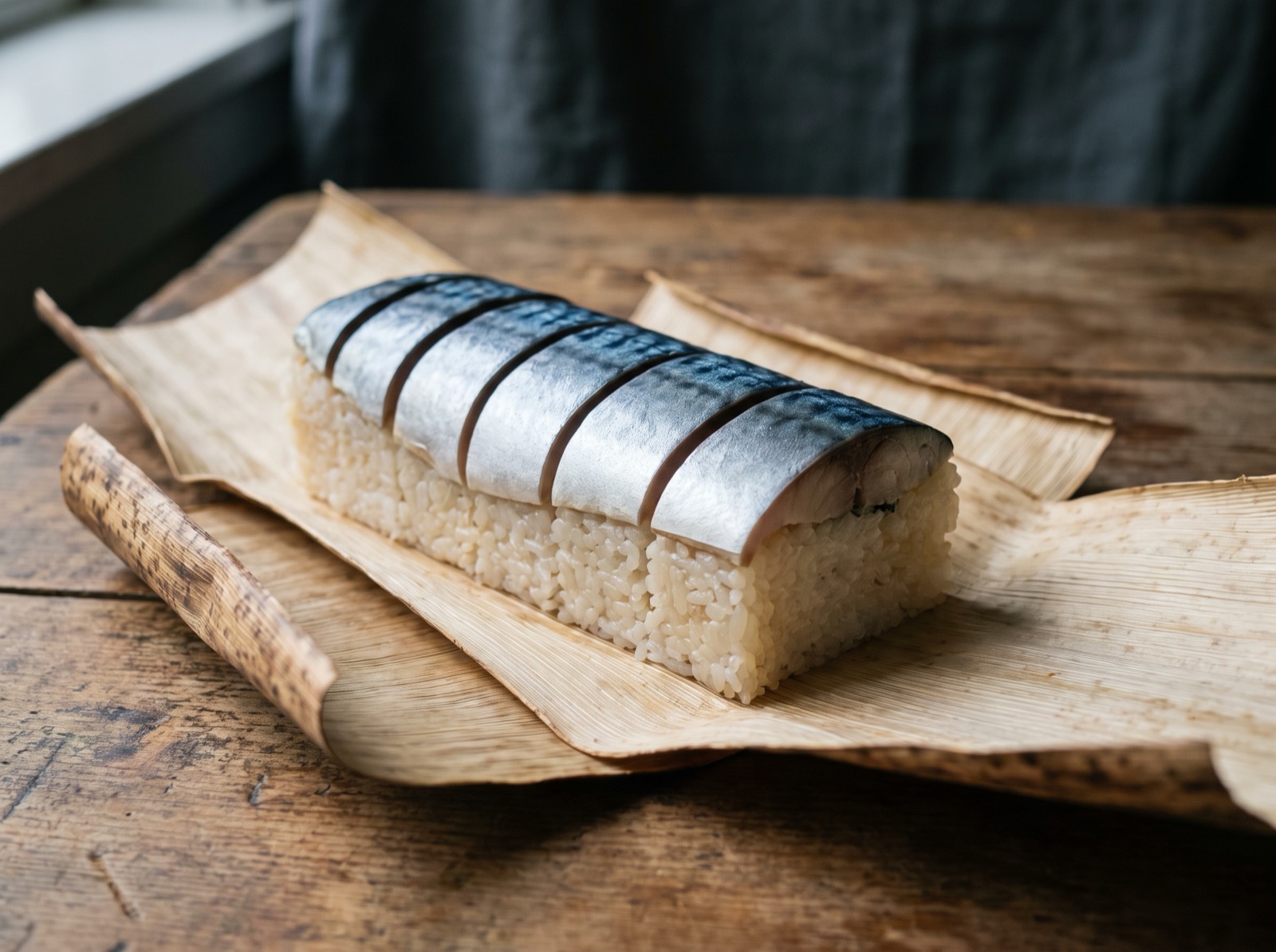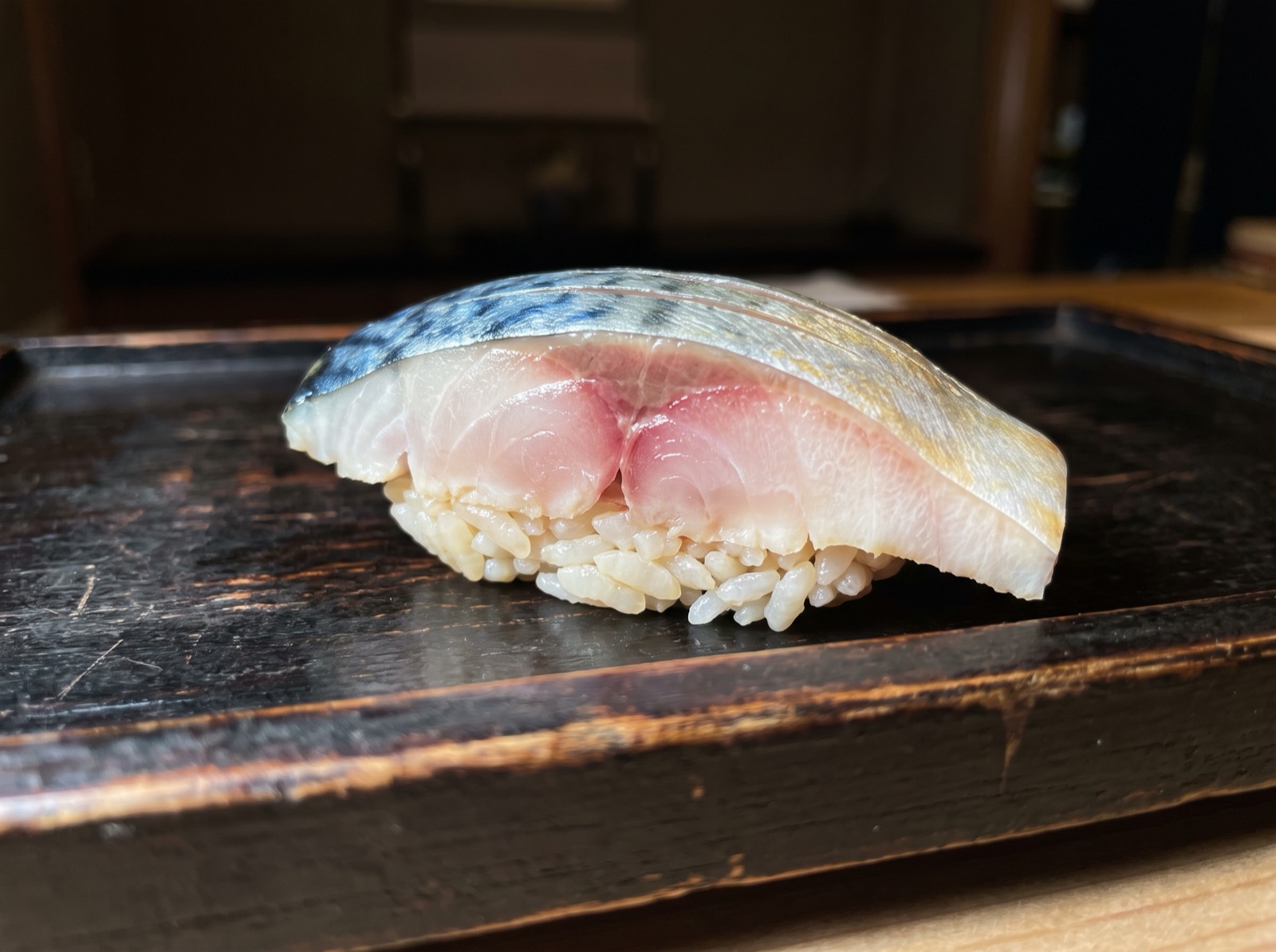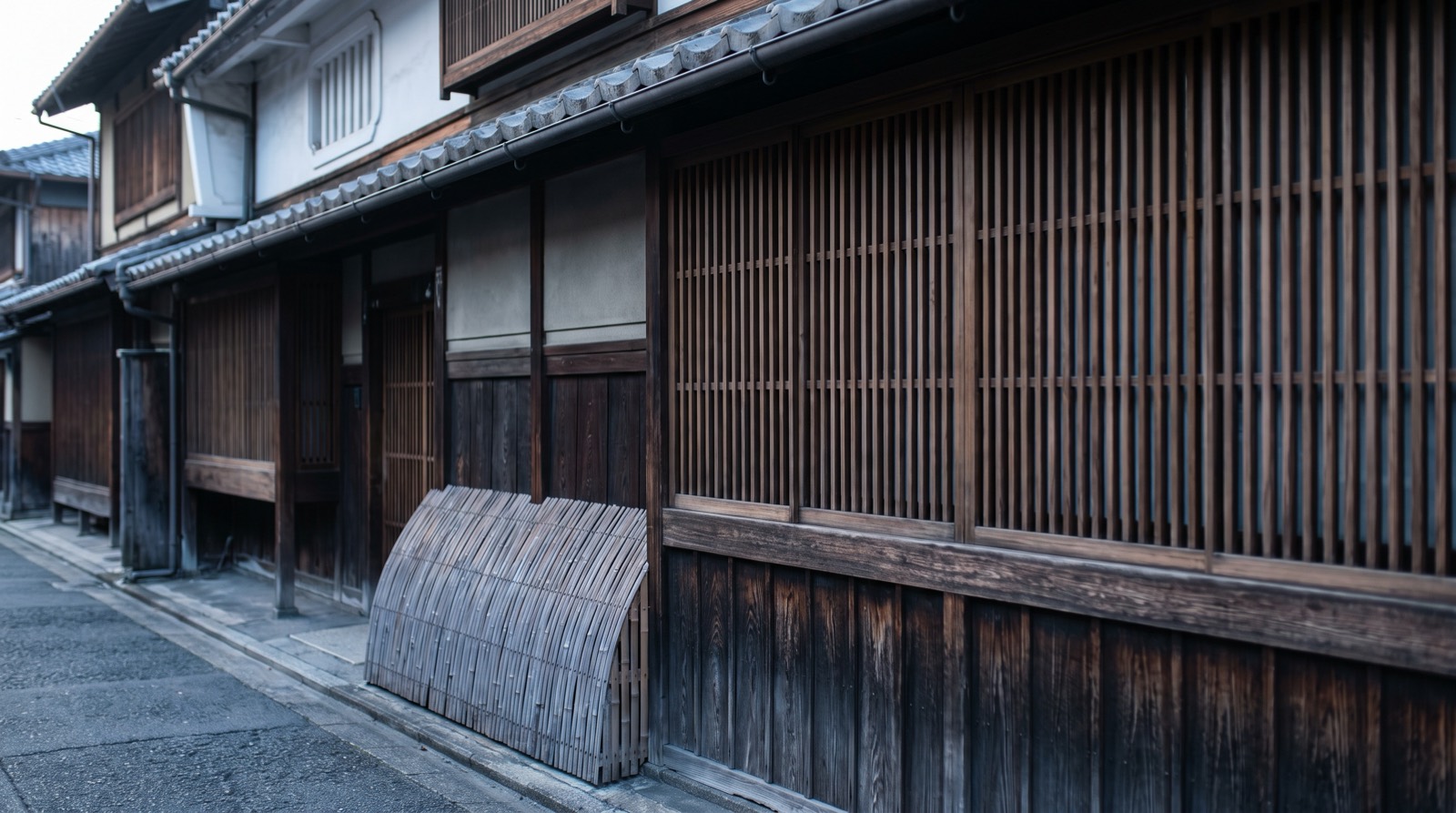
Almost everything written in English about Japanese sushi rests on one idea, and the idea is freshness. The fish was swimming, then it was cut, then it was eaten, and the shorter that sequence the better the sushi. It is a good idea and it is true in Tokyo. In Kyoto it is not the idea at all. Kyoto is sixty miles from the nearest useful sea and it has been sixty miles from the sea for twelve hundred years, and the sushi that grew up here was built for the opposite problem: how to make fish that has already travelled taste like something you would want, and then how to keep it wanted for a day, or two days, or three.
The result is a category of sushi in which elapsed time is not a defect to be minimised but a specification to be published. The five shops in this article all sell mackerel pressed onto rice and wrapped in kelp, and all five tell you, in writing, how long the thing is good for and when it is at its best. Those numbers are not the same. They range from “eat it today” to “three days including the day it was made”, and one shop publishes a table of what the sushi tastes like at three different ages, and recommends the oldest.
When the five are laid side by side, the pattern is not the one you would guess. The window is widest at the oldest shops and narrowest at the newest. The house founded in 1781 says its mackerel is at its best twelve hours to a day after it was made, and asks you to keep it at room temperature. The hotel shop that opened in this century says to eat it on the day of collection, and its collection times are booked in thirty-minute slots. Age of business runs one way, permitted age of sushi runs the same way, and both of those run against the assumption an English-speaking reader arrives with.
Two of the five state plainly that a refrigerator will ruin it. One of them puts it in language no product manual would use: the rice, it says, dies.
There is a second thing this article is about, and it emerged while the first was being checked. All of the instructions above exist in Japanese. In English they mostly do not. One of these shops runs an English page whose entire substantive content is five lines, and those five lines disagree with the Japanese page about which days it is closed. Another has a full English site with no prices anywhere on it, and an English list of stockists that adds a department store in Tokyo and removes one in Osaka. A third publishes the same product under two different names on two pages it controls. A fourth has no page of its own at all. What a visitor can learn about Kyoto mackerel sushi depends less on the shop than on who was writing, in which language, and for what purpose.
- Izuu, Gion Shinchi — founded 1781, seventh generation, sells a table of how the sushi tastes at three different ages and recommends the oldest
- Izuju, at the foot of the Yasaka shrine steps — founded at the end of the Meiji era, tells you the day you carry it home is the day it expires, and that a refrigerator kills the rice
- Hanaore — founded 1913, shop in Shimogamo and a workshop on the mackerel road itself, in the mountains of Shiga; says to rest the sushi a full day before eating it
- Masugataya, Demachi Masugata arcade — no website of its own, open 10:00 to 15:00 or until it sells out, cash and one phone payment app
- The Thousand Kyoto — a hotel kitchen in front of Kyoto Station, ¥3,800 a roll, collection only, eat it today, order three days ahead
There is no ranking here and there are no photographs of any of these shops in this journal. Prices are quoted as each shop publishes them, which in one case means a tax-exclusive list on one page and a tax-inclusive list on another page of the same site, with the two failing to reconcile. That discrepancy is not a footnote. It is one of the more interesting things in the article.
Why time is the specification
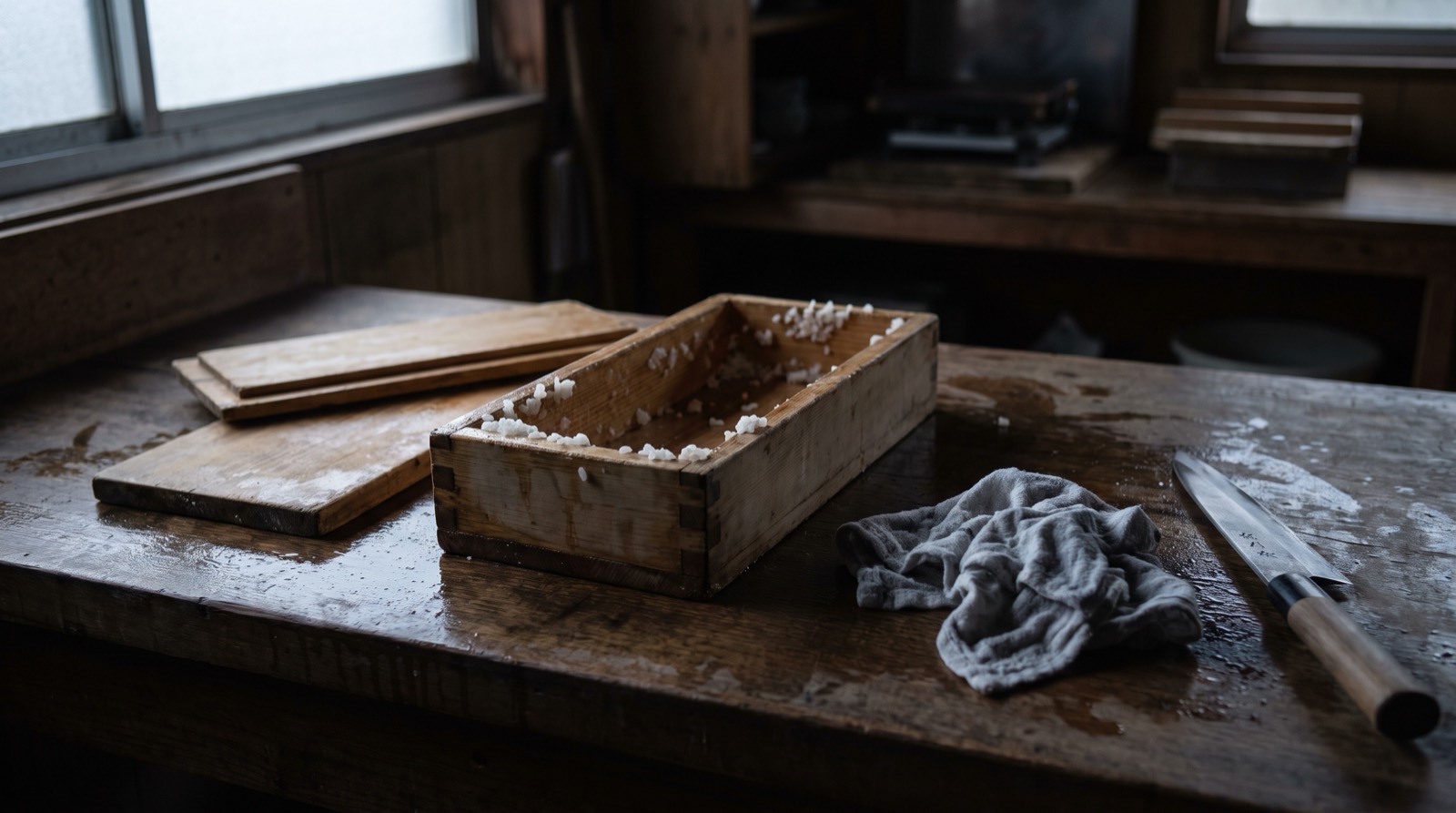
The mechanism is salt, vinegar and kelp, in that order, and the point of all three is to hold. A whole mackerel is salted, sometimes with a coarse first-run sea salt, then dressed in vinegar, then pressed onto seasoned rice and sheathed in a sheet of kelp. Nothing in that sequence is trying to preserve the sensation of a fish that was alive an hour ago. Every step is a negotiation with the clock, and once the negotiation is complete the object has a working life measured in hours and days rather than minutes.
That working life is the product. It is what allowed the sushi to exist in a landlocked capital, it is why it is the standard thing to carry to a family gathering or send to a relative, and it is the reason four of these five shops will sell you a whole roll to take away while only two of them will sit you down. The Kyoto style is a travelling sushi. Eating it at a counter is the exception, and at the oldest shop in this article the counter is a modern addition that was considered slightly disreputable when it was introduced.
Because the working life is the product, the shops specify it, and the specifications are worth reading against one another:
- Izuu: best from twelve hours to the following day, when the fat has risen and the flavour of an early fermented sushi has developed; store at room temperature, 18 to 23 degrees
- Izuju: in principle the day you take it home is the day it is good for; the large and top grades, left uncut in a cool place, will hold two to three days; never refrigerate
- Hanaore: three days including the day of manufacture for the pressed rolls, two days for the seared one; the best day is a full day after it was made
- Masugataya: no published figure; the shop closes when it has sold what it made that morning
- The Thousand Kyoto: collection day, as soon as convenient
Read down that list and the shape is unmistakable. The 1781 house gives you the widest window and the most specific instruction about temperature. The 1913 house gives three days and a resting period. The Meiji house gives you one day as a rule and three days as a concession, with a warning attached. The arcade shop gives you no number because it has no page on which to give you one. The 2019 hotel gives you the shortest window of the five and surrounds it with the most process.
Age of the business runs one way. Permitted age of the sushi runs the same way. Both run against what an English-speaking reader expects.
None of this is a quality ranking, and it would be a mistake to read it as one. What it measures is how much of the traditional method each operation still relies on, and how much risk each is willing to leave in the customer’s hands. A shop that tells you to keep vinegared mackerel on a shelf at 20 degrees for a day is making a claim about its own salting and about your good sense. A shop that tells you to eat it today has removed both variables.
The house from 1781, and the mountain on the wrapping paper
Izuu was founded in the first year of Tenmei, 1781, by a man trading as Izumiya Uhei. It is in Gion Shinchi, on a lane off the north side of Shijo, and the address it gives is 367 Kiyomotocho, Yasaka Shinchi, Higashiyama ward. The house rule it prints on its own site is four characters longer in Japanese than in English and reads, in the English the shop itself supplies, that business should be a size that fits inside both hands. Two hundred and forty-five years later it operates one shop, two department store counters and an online order page, which is roughly what that sentence would predict.
The wrapping paper carries Mount Fuji and the pine grove of Miho-no-Matsubara. This is a Kyoto shop, six hours on foot from any view of that mountain in the era it was founded, using a conspicuously non-Kyoto image. The shop’s explanation is not subtle and does not pretend to be: the mountain stands for a determination to make the best mackerel sushi in Japan, and putting Japan’s mountain on a Kyoto parcel was the way to say so. The other piece of graphic design is inside the food. Cut a roll across and the cross-section is meant to read as a rabbit, which is the founder’s name, the character for the fourth earthly branch, hiding in the geometry of the fish and the rice.
Each generation has added one thing, and the list of additions is the clearest short history of the shop:
- The fourth generation added yajikita-zushi, a set named after the two travellers of a comic Edo road novel
- The fifth added midaidokoro-zushi, an assortment named for the household of a shogun’s wife
- The sixth, around 1970, put a bench in the shop front and let people eat there
- The seventh added Kyoto inari-zushi, the fried tofu pouch
The third of those is the interesting one, and the shop says so itself. At the time, letting customers eat standing at your shop front was understood to be beneath a first-class house; a serious shop sold you the parcel and you took it away. The sixth-generation owner did it anyway. The bench is now called the oshiagari-dokoro, the place where you may eat, and it is the only way most visitors will ever eat this sushi at the shop that makes it, because Izuu has no dining room in the ordinary sense and no reservation system for one.
The trading hours are 11:00 to 22:00 with last orders at 21:30, and 11:00 to 21:00 on Sundays and public holidays with last orders at 20:30. It closes on Tuesdays, except when a Tuesday is a public holiday or a festival day, which in Gion is not a rare event. Souvenir orders placed in advance can be collected from the wooden gate at eight in the morning, which is a detail aimed squarely at people catching a train.
Three ages of the same sushi, and a sentence about killing freshness
The table Izuu publishes has three rows and it appears in both Japanese and English. Immediately after it is made, the sushi is soft. From five to eight hours, the flavour of the kelp has moved into the fish and the character of an early fermented sushi begins to appear. From twelve hours to the next day, the fat has risen to the surface and the flavour particular to that early fermented style is fully present. The shop then adds the operational note that makes the table more than decorative: this last stage, twelve hours to a day, is the condition in which the sushi arrives when it is shipped to another region or ordered online, as distinct from the counter demonstrations where it is sold fresh.
In other words the shop is not apologising for the delay in the post. It is telling you the delivered article is the one it considers best, and it has put a table on the site to prove the claim was not invented for the courier’s benefit.
The storage instruction follows from the table. Because the whole-roll sushi is a form of narezushi, an early fermented sushi, the shop says the correct temperature is ordinary room temperature, 18 to 23 degrees, and if the sushi has become cold it should be brought back to room temperature before eating. There is no version of that sentence that a food safety officer in London or New York would sign, and there is no version of Kyoto mackerel sushi that works without it.
The sentence that gives the whole category its shape is in the Japanese text, describing the difference from Tokyo sushi. It says the Kyoto method is a way of cooking that slaughters freshness, as opposed to Edomae sushi, in which freshness is the whole point. The English translation on the shop’s own site softens this considerably — it says the appeal lies in containing and dressing the freshness — and the softening is understandable, but the Japanese verb is violent on purpose. It is not that freshness has been lost. It has been deliberately put down, because something else was wanted in its place.
The Japanese says the Kyoto method slaughters freshness. The shop’s own English says it contains and dresses it. Both sentences describe the same fish.
The eating instructions are equally particular. A whole roll should not be sliced through in the middle; you cut about two centimetres at a time, alternating from the two ends, so that what is left keeps its shape and its moisture. If it has gone firm, the shop suggests putting the cut ends on a hotplate until they colour, which turns a day-old souvenir into a hot dish and is, incidentally, the same manoeuvre that produced the seared version another shop in this article now sells as a separate product with its own shorter shelf life.
Four pieces, four hundred and forty yen apart
Izuu publishes two price lists, one for parcels to take away and one for the bench, and they are internally consistent. The take-away list, tax included, starts at ¥6,480 for a whole mackerel roll described as two servings and ¥3,240 for a six-piece single serving. From there it climbs through the sparrow-sushi of small sea bream at ¥5,832, sea bream at the same price, tilefish at ¥12,960, and a summer-only pike conger at ¥14,904. There are also grilled sea eel at ¥4,320 for ten pieces, thick rolls at ¥3,456 for eight, thin rolls at ¥1,728 for eight, and the scattered, steamed and assorted boxes that scale from one serving to five, the largest of which is ¥25,056.
One line in that list rewards a second look. Alongside the ordinary mackerel roll at ¥6,480 there is a mi-saba roll at ¥7,776, and the difference between them is that the mi-saba has had the dark bloodline meat removed and uses only the pale flesh. Removing part of the fish makes it twenty per cent more expensive. This is not a Kyoto eccentricity — it is the same logic that prices a trimmed cut of beef above the whole muscle — but it is stated with unusual clarity here, and it is a useful thing to be able to read on a list you are choosing from.
The bench prices are a separate and much shorter list, quoted per four pieces. Mackerel is ¥2,200. The small sea bream and the sea bream are ¥1,980, tilefish ¥4,400, pike conger ¥5,060, grilled sea eel ¥1,760, thick roll ¥1,760. Sets and bowls run from ¥2,860 to ¥4,950. It is, by the standards of everything else this journal has covered in Kyoto and Osaka, a startlingly cheap way to eat something old and specific: four pieces of the house’s signature item, at the house, for the price of a bowl of good ramen.
Now compare the same four pieces at the branch. Izuu operates a counter in the basement of the Daimaru department store on Shijo, with its own eat-in area open 10:00 to 14:00 and 15:00 to 19:30. The mackerel there is ¥2,640 for four pieces. That is ¥440 more than the same item at the shop that makes it, a difference of twenty per cent, and it is the sort of gap that department store concessions almost never spell out because department store concessions almost never publish both numbers on the same website.
The gap is not the only difference. The two pages describe the rice differently. The main shop credits a proprietary blend it calls its own selected rice. The Daimaru page names a specific rice from Shiga prefecture. Whether that reflects a genuine difference in what is served in the two rooms or simply two different people writing two pages in two different decades is not something an outside reader can settle, and the shop does not address it. But it is there, in writing, on the shop’s own site, and it is the kind of detail that gets lost the moment a third-party listing flattens a business into one address and one price band.
- Izuu main shop, Gion — mackerel ¥2,200 for four at the bench; whole roll ¥6,480; open 11:00 to 22:00, closed Tuesdays
- Daimaru Kyoto basement — mackerel ¥2,640 for four; eat-in 10:00 to 14:00 and 15:00 to 19:30; shop hours 10:00 to 20:00
- JR Kyoto Isetan, second basement — 10:00 to 20:00
A smaller inconsistency, noted because it is the sort of thing that wastes a visitor’s afternoon: the telephone number given for the Daimaru counter on its own page is the department store’s main switchboard, while the shop list on the front page of the site gives a different, non-geographic number for the same counter. Two numbers, one counter, both published by the same shop.
The day you carry it out is the day it expires
Izuju is four minutes’ walk from Izuu and a different proposition entirely. It sits on the northwest corner of the crossing at the foot of the stone steps up to Yasaka shrine, which is the single most photographed corner in Gion, and it has been there since the end of the Meiji era. The founder was named Jukichi; the shop dates its box sushi to the year it opened at the end of Meiji and says its method has changed very little since. Where Izuu is a specialist that widened, Izuju is a Kyoto sushi shop in the general sense, and mackerel is one item among twenty.
Its storage policy is the strictest in this article and the most explicit. The shop states that it uses no preservatives of any kind, and that as a rule the day you carry the sushi home is the day it is good for. Then it gives the exception: the large and top grades of mackerel roll, left uncut and kept in a cool place, will hold for two to three days. The small grade, which comes already sliced, dries faster and should be finished by about the following day. Everything about that is a shelf life expressed in terms of what has been done to the object rather than a date printed on a label.
And then the refrigerator. The shop knows exactly what you are going to do, and says so: you will somehow feel like putting it in the fridge, and you must resist, because the sushi rice will die. Not spoil, not harden — the Japanese verb is to die. It is the plainest statement in any of the five sources of why this style of sushi does not survive contact with a modern kitchen, and it is the reason the instruction to keep it in a cool place has to be given twice on two different pages.
You will somehow feel like putting it in the fridge, says the shop, and you must resist, because the sushi rice will die.
The fish is Japan Sea mackerel from off Tsushima, and so is the tilefish. The kelp wrapped around the outside, the shop notes, is there for aroma and to stop the surface drying, and you are free to remove it before eating, which is a small kindness to anyone who has ever wondered whether the kelp was a test.
The practical details are these. The shop is at 292-1 Gionmachi Kitagawa, Higashiyama ward, telephone 075-561-0019, and it closes on Wednesdays and Thursdays. It cannot reserve a table — it says so in English — and its takeaway can be collected without an order, though ordering ahead saves the wait. Orders for same-day and next-day collection at the Gion shop cannot be placed online at all; those have to go by telephone, which is an unusual admission from a shop that runs a functioning web shop for everything else.
The most human page on the site is the notice on the front. Reopening on a Friday the fifth of September, the owner writes that the shop has never closed for so long in its recorded history except for the forced evacuations at the end of the war in 1945, apologises, and says the time was spent cleaning, tidying and putting the building right. That notice is still the most recent item on the front page.
Two price lists that do not agree
Izuju publishes prices in two places. The shop page carries a tax-exclusive list of what is made and sold at Gion. The collection page of its web shop carries a tax-inclusive list of what can be ordered in advance. They overlap heavily and they do not reconcile, and the mismatch is larger than the consumption tax can explain.
- Box sushi: ¥2,160 before tax on the shop page, which is ¥2,332 with tax; ¥2,916 including tax on the collection page
- Rolled sushi: ¥1,200 before tax, so ¥1,320 with tax; ¥1,728 including tax to collect
- Horse mackerel: ¥1,500 before tax, so ¥1,650; ¥2,160 including tax to collect, and the two pages even spell the fish differently
- Millet gluten roll: ¥600 before tax, so ¥660; ¥756 to collect
- Seaweed roll: ¥900 before tax, so ¥990; ¥1,080 to collect, under a different spelling again
- Inari: ¥950 before tax on the shop page for the item; ¥1,620 including tax for a box of five to collect
Some of that is explicable. A box of five is not one piece, and a collection order that has been made to a schedule is not the same transaction as buying what happens to be in the case. But the gaps are consistently in the region of twenty to thirty per cent above what tax alone would produce, and nowhere on either page is a reader told that pre-ordering costs more. A visitor who reads the shop page, walks to Gion and buys box sushi over the counter will pay one figure. A visitor who reads the web shop and orders the same box for collection will pay another. Both figures are published by the shop.
The pike conger is the reverse case and is more interesting still. On the shop page it is listed at market price, the classic formulation for an item whose cost moves, with a note that it runs from the rainy season to the turning of the leaves and that the fish is live conger from Nushima off Awaji. On the collection page the same item has a fixed number: ¥8,424 for one serving and ¥16,848 for two. The same shop, on the same site, prices the same fish as a variable in one room and a constant in the other. This journal has written about the gap between a published price and a market price in Osaka, and here both appear on one website.
There is one more oddity, and it is the sort of thing that only shows up if you read a commerce page as text rather than as a shop. Almost every item on the collection page is labelled as available all year, and almost every one of them also carries a sales period with two dates on it that cover about half the year. Box sushi is marked all year and then given a window from the fifth of May to the twenty-third of October. Rolled sushi is marked all year and given the first of January to the thirty-first of March. Several items are marked all year and given the twenty-third of October to the thirty-first of March. One item is marked all year with no dates at all. Whatever those dates were once for, they are not now describing when you can buy the food, and a reader who trusted them would conclude that half the menu was unavailable today.
The seasonal items, by contrast, are stated carefully and are worth knowing, because they are the reason to come back to a shop like this rather than to visit it once. Inari is suspended over the summer. A version with grilled Kujo leek is made from October to March. Steamed sushi runs from the first of December to the end of March, at ¥2,200 in the shop and ¥2,400 to take away in a container designed to be reheated. Sweetfish has been made every summer since 1994. And the herring roll, priced at ¥2,000 in a piece of shop-floor wordplay that only works in Japanese, has been suspended since July 2025 because the herring are not being landed.
What survives the translation, and what does not
Izuju has an English page. It is one page, it runs to a few hundred characters, and once the address and the map caption are stripped out the substantive content is five lines. They are worth setting out exactly as they appear, because they are what an English-speaking visitor planning a trip to Gion will be working from.
- Open: 10:30-11:00
- Close: 19:00 (18:30 Last Order)
- Closed every Wednesday
- Takeaway is available.
- We are sorry that reservation for table is not available.
The first line gives an opening time as a range, which presumably means the shop opens somewhere between half past ten and eleven and is a reasonable way to describe a small kitchen, though it will read to most English speakers as an error. The third line is the problem. The Japanese site closes on Wednesdays and Thursdays. The English site closes on Wednesdays. A visitor who reads only the English has a one-in-seven chance of walking to Gion on a day the shop is shut, having been told by the shop that it is open.
It should be said that the Japanese page has its own gap in the other direction: it gives the closed days and no opening hours at all. The hours only exist in English. Neither page alone is complete, and neither page tells you the other exists.
The site’s browser title, incidentally, still ends with the default tagline of the software it was built on, announcing itself as just another site of that kind. It has presumably been there since the pages were made in 2020. It is a small thing and it is also the whole point of this section: nobody is reading these pages as a stranger would.
Izuu’s English is a different failure and a more consequential one. The English site is complete, well written and, in the section that matters most to a buyer, empty: there are no prices anywhere on it. Every item that carries a figure in Japanese carries a description in English and nothing else. The three-stage table of how the sushi ages is translated in full, which is the right choice, and the sentence about slaughtering freshness is softened, which is a defensible one. But a reader in English cannot find out that a roll is ¥6,480 or that four pieces at the bench are ¥2,200. They have to arrive and ask.
The stockist lists are the sharpest example, because the two exist for the same purpose and do not match. The Japanese list of shops that carry Izuu names Kyoto Takashimaya, the platform area inside the Shinkansen gates at Kyoto Station, Shinjuku Takashimaya, JR Nagoya Takashimaya, Hankyu Umeda and Osaka Takashimaya. The English list names Kyoto Takashimaya, JR Kyoto Isetan, Kyoto Station, Shinjuku Takashimaya, Seibu Ikebukuro, JR Nagoya Takashimaya and Hankyu Umeda. The English adds a Tokyo department store the Japanese does not mention, drops the Osaka one, and moves JR Kyoto Isetan — which the Japanese site treats as a directly operated counter with its own page — into the list of third-party stockists.
The English list adds a Tokyo store the Japanese does not have, drops the Osaka one, and demotes a shop the same site elsewhere calls its own.
It is unlikely that any of this is deliberate. Two lists were written at different times by different people and only one of them has been maintained. But the effect on a reader is real: the English-language map of where to buy this sushi is not the Japanese map, and there is no way to know that from inside either page.
The road itself, and the workshop standing on it
The mackerel road is a real road. It is the route by which salted mackerel came from the bay at Obama, on the Japan Sea, over the mountains to Kyoto, and the phrase that goes with it is that the capital is far but only eighteen ri — about seventy-two kilometres — a distance a carrier covered in a day and a night, arriving with fish that had cured on the way. Every shop in this article is downstream of that road. One of them is on it.
Hanaore was founded in 1913 and is a limited company with a named representative director. Its shop is in Shimogamo, at 121 Miyazakicho, a ten-minute walk west of Demachiyanagi station, and its workshop is not in Kyoto at all. It is at 334 Kuzugawa Sakashitacho in Otsu, Shiga prefecture, in the mountain valley the old road runs through. The shop is named after the place. The fish is prepared where the fish used to pass.
The materials are specified more tightly than at any other shop here. The mackerel is a true mackerel from waters near Japan, salted with a first-run coastal salt. The rice is a proprietary blend of two Shiga varieties. The kelp is from Rebun island and a natural true kelp. And the instruction that comes with all of it is the one this article began with: the sushi is at its best a full day after it was made. The shelf life is three days from and including the day of manufacture for the pressed rolls, two for the seared one. So the good window is day two of three. You are being told, quite explicitly, not to eat it now.
The Shimogamo shop is open 10:00 to 17:00 with food served until 15:00, and it has no counter. It has three tables of four, twelve places in all, which is the smallest published seating of any restaurant covered in this journal so far and about a third of what the workshop in the mountains can hold. The closing days are given in a form that repeats itself — the first and third weeks on Tuesdays and Wednesdays, the second, third and fourth weeks on Wednesdays, with the third week appearing in both halves of the sentence — which is another instance of a page nobody has re-read from outside. There is no car park; the shop directs you to a municipal one and notes, presumably from experience, that the shrine car park at Shimogamo is not available for its customers.
The set meals are the cheapest sit-down mackerel sushi in this article by a wide margin. The mackerel set is ¥2,700, the seared version the same, the house set ¥2,300 — and that last one is ¥1,800 on production of a student card. A student discount on a dish of pressed mackerel that traces to a mediaeval supply route is not something the other four shops here would consider, and it tells you something about who Shimogamo is for. This is a residential quarter with two universities near it, not a temple district.
One roll, two names, and a landlord above the shop sign
Hanaore sells its whole rolls through two channels it controls, and the two channels disagree about what the products are called. On the shop’s own site the menu lists a ¥7,560 roll and a ¥5,670 roll and calls both of them, without qualification, mackerel sushi — distinguishing them only in a sentence of prose noting that one is slightly smaller than the premium grade. On the online shop the ¥7,560 item is named as the upper grade. Two names, one roll, both from the company.
The online shop also carries two items the menu page does not sell at all: a premium roll at ¥10,530 and a rolled variant at ¥5,400. The menu page refers to the premium roll in a comparison while not offering it. A customer reading the shop’s own menu learns of the existence of a product they cannot buy from that page, under a name that page does not use.
- Upper grade roll ¥7,560, about three servings, three days including the day of manufacture
- Mackerel roll ¥5,670, two servings, three days
- Ryuhi rolled mackerel ¥5,940, two servings, three days
- Seared mackerel ¥3,780, one and a half servings, two days
- Kyoto mackerel ¥3,650, one and a half servings, three days
- Premium roll ¥10,530 and a rolled variant at ¥5,400, online only
Who is actually publishing all this is the more useful question. The shop’s site is built on a free consumer website service, and the service advertises itself in a strip across the top of every page, above the shop’s own name, inviting you to make a homepage or blog of your own and offering a log-in link. The online shop is a separate system whose footer credits a company that is not Hanaore, whose copyright line stops several years before the current one on the main site, and whose order desk, sales department and press contact are all at an address in Osaka. The Instagram feed embedded in the main site has been failing to load for long enough that the error message has become part of the page furniture. The front page still describes the business as one hundred and ten years old, which was true in 2023.
The strip at the top of the shop’s own homepage is not the shop’s. It belongs to the free platform, and it sits above the name of a business trading since 1913.
None of this affects the sushi, which is made in a mountain valley by people who are not the ones maintaining the website. But it explains a great deal about why researching Kyoto food from outside Japan produces such uneven results, and it is the same finding this journal reached in Osaka from the opposite direction: a business that does not depend on its page for revenue does not maintain its page, and what fills the gap is whoever else has a reason to publish — a platform, a landlord, a trade association, a fulfilment contractor.
The shop with no page of its own
Masugataya has no website. It has a telephone number, an address in the Demachi Masugata arcade in the Kamigyo ward, and an entry on the site the arcade’s traders association runs for its members. That entry is the entire published record of the business, and it is about eighty words long.
What it contains: the address, the phone number, opening hours of 10:00 to 15:00 or until the day’s stock is gone, a Wednesday closing, wireless internet, and a payment line reading cash and one phone payment app, no cards. Then four sentences of description, written in the first person as the shop, saying it is the original mackerel road shop, that the popular orders are the whole roll and a set of two slices with a bowl of udon, that a seasonal matsutake set is also popular, and that it takes orders for shipping and for whole rolls at New Year.
What it does not contain: any price, and any seat count. Not omitted by the shop — the association’s template has no field for either. Compare that with the arcade under the railway in Osaka this journal covered in the last article, whose association publishes seat counts, last order times, card policy, smoking policy and an average spend for every one of its hundred tenants. Two shopping streets, two trade bodies, two entirely different ideas of what a member listing is for, and the consequence for a visitor is that one arcade can be planned in advance and the other cannot.
The closing rule is the one to internalise. Fifteen hundred, or when it sells out. A shop that makes a fixed number of rolls each morning and stops when they are gone is running a sell-until-it-is-gone inventory model, and the hours on the page are an upper bound rather than a promise. It is also, for what it is worth, the only shop in this article whose set of mackerel sushi and hot noodles suggests it expects you to sit down and have lunch rather than carry something away.
The association’s site offers itself in English and in two forms of Chinese by way of a machine translation widget, which is better than nothing and is not a translation. It is worth knowing what that means in practice: the shop’s own words about being the original mackerel road shop will come out differently on every reading, and the list of two hundred languages the widget offers is itself rendered on the page in Japanese.
Three thousand eight hundred yen, to be eaten today
The last of the five is not an old shop and does not pretend to be. The Thousand Kyoto is a hotel directly in front of Kyoto Station, and its Japanese restaurant sells one mackerel roll, take-away only, through the hotel’s online shop: ¥3,800 including tax, one roll, eight pieces, made by the kitchen of the hotel’s Japanese dining room. The description names a large domestic mackerel, sesame for aroma and texture, and a sheet of white kelp.
Its shelf life is the shortest here and the least equivocal: eat it on the day of collection, and soon. There is no room-temperature instruction because there is no expectation the sushi will still exist tomorrow.
The ordering process is where this one differs from every other shop in the article, and the contrast is instructive. It cannot be shipped anywhere. It must be collected at the hotel. Orders close three days before the collection date, and five days before if you want five or more. Anything later than that, including on the day, has to go by telephone, to a line staffed from ten in the morning to seven at night. Cancellation is possible until noon on the day before collection and impossible after that. Collection itself is booked as one of fifteen half-hour slots between 11:30 and 18:30. Payment online is by card only; if you want to pay cash, you telephone.
That is a considerable amount of process for a ¥3,800 parcel of fish and rice, and it exists because a hotel is not a sushi shop. A hotel has a kitchen with a production schedule, a front desk that has to hand the thing over, and a legal department that would prefer nobody posted vinegared mackerel to Hokkaido. The rules are the price of getting a serious kitchen to make you a traditional Kyoto item at a price well below what the same kitchen charges for dinner.
The seam shows in one place. The item is sold through a general-purpose online shop built for shipping, so the checkout has to be argued with: the customer is required to tick a box acknowledging that delivery is not available, and then instructed, in the product text, to proceed through the delivery address screen anyway and choose to send it to their own address. Underneath that, the page’s search keywords are printed in the body copy in plain sight — takeaway, souvenir, hotel, mackerel sushi, and the same word again in a different script. It is the tidiest shop of the five and the one where the machinery is most visible.
How to read the clock
The five shops in this article are separated by two hundred and forty-five years, by four wards and one prefecture, and by roughly a factor of three in price. What they share is that each has decided how long its sushi is allowed to live and has published the answer, and the answers are the most reliable guide to what you are actually buying.
- If you want the oldest form of the thing, buy a whole roll from the 1781 house, do not refrigerate it, and eat it the next day — the shop will tell you that is when it is best, and it is the one shop here that has published a table to support the claim
- If you want to eat it in the room where it was made, the bench at that same shop is ¥2,200 for four pieces, and the identical four pieces at its department store counter are ¥2,640
- If you want the widest choice of Kyoto sushi beyond mackerel, the shop at the shrine steps has twenty items and a genuine seasonal calendar — but check the Japanese page for the closing days, because the English page is missing one of them
- If you want to eat sitting down and cheaply, Shimogamo is ¥2,300 to ¥2,700 for a set and does not take reservations for a counter it does not have
- If you want lunch in a shopping arcade with a bowl of noodles, go before the middle of the day, carry cash, and accept that no price was published in advance
- If you are catching a train and want something good made this morning, the hotel in front of the station will sell you a roll for ¥3,800, provided you asked three days ago
One last observation, and it is the one that would change how a visitor plans. Four of these five shops sell mostly to people who are going somewhere else — home, a train, a family gathering — and only two of them have anywhere to sit. The default assumption an English-speaking traveller brings to sushi, that it is a meal eaten at a counter in front of the person who made it, is close to inverted here. In Kyoto the mackerel is a parcel with a clock running on it, and the skill being sold is the calculation of how long that clock is allowed to run.
That skill is why the numbers in this article are worth the space they have taken. A shop that says three days is making a larger claim about its own salting than a shop that says today. A shop that specifies 18 to 23 degrees is making a larger one still. And the shop that tells you the rice will die if you refrigerate it is, in six words, explaining the entire difference between the sushi of the capital and the sushi of the bay.
Frequently asked questions
How long does Kyoto mackerel sushi actually keep?
Each shop publishes its own figure and they do not agree, which is the subject of this article. The 1781 house says the sushi is at its best from twelve hours to the following day and asks you to keep it at ordinary room temperature, 18 to 23 degrees. The 1913 house gives three days including the day of manufacture for its pressed rolls and two for the seared one, and says the best day is a full day after it was made. The shop at the shrine steps says that as a rule the day you carry it home is the day it is good for, though an uncut large or top grade roll kept somewhere cool will hold two to three days. The hotel shop says to eat it on the day you collect it. Nothing here is designed to be eaten a week later, and nothing here is designed to be refrigerated.
Why do two of these shops tell you not to put it in the fridge?
Because cold makes seasoned sushi rice hard and dry, and this style of sushi depends on the rice staying supple for a day or more at room temperature. One shop puts it in unusually direct language, warning that you will feel like refrigerating it and that if you do, the sushi rice will die. The preservation is being done by the salt, the vinegar and the kelp, not by the temperature, and a refrigerator interferes with the first three without adding anything. The same shop states that it uses no preservatives at all, which is why the shelf life it publishes is short in the first place.
Can I turn up without ordering, or do I need to book?
None of the five takes a table reservation in the ordinary sense, and two of them have no tables to reserve. The 1781 house has a bench at the shop front where four pieces of mackerel are ¥2,200; you sit down if there is room. The shop at the shrine steps says plainly, in English, that it cannot reserve a table, but that you can take food away without ordering ahead. The Shimogamo shop has three tables of four and serves food until three in the afternoon. The arcade shop opens at ten and closes at three or when it sells out, whichever is first. Only the hotel requires an order in advance, and it requires it three days in advance, five if you want five or more rolls.
Is it worth ordering a whole roll to take away rather than eating in?
It is the normal way to buy this sushi, and in Kyoto the take-away roll is the primary product rather than a consolation. A whole mackerel roll runs from about ¥3,650 to ¥7,560 across these shops depending on grade and size, and is generally described as two to three servings. The practical constraints are the shelf life and the temperature: you want somewhere cool but not cold to keep it, and you want to eat it within the window the shop gives you. One shop also asks you not to cut a whole roll in half, but to cut about two centimetres at a time alternately from the two ends, so that the remainder keeps its shape.
Why does the English information about these shops disagree with the Japanese?
Mostly because the two versions were written at different times by different people, and only one of them has been kept up. The clearest case in this article is a shop whose English page lists one closing day where the Japanese page lists two, so a visitor reading only English can walk to Gion on a day the shop is shut. Another shop has a complete English site with no prices anywhere on it, and an English list of stockists that adds a Tokyo department store the Japanese list does not mention and drops an Osaka one that it does. A third has no site at all and appears only in a trade association listing whose template has no field for prices or seat counts. Where a number matters, it is worth checking the Japanese page even through a machine translation.