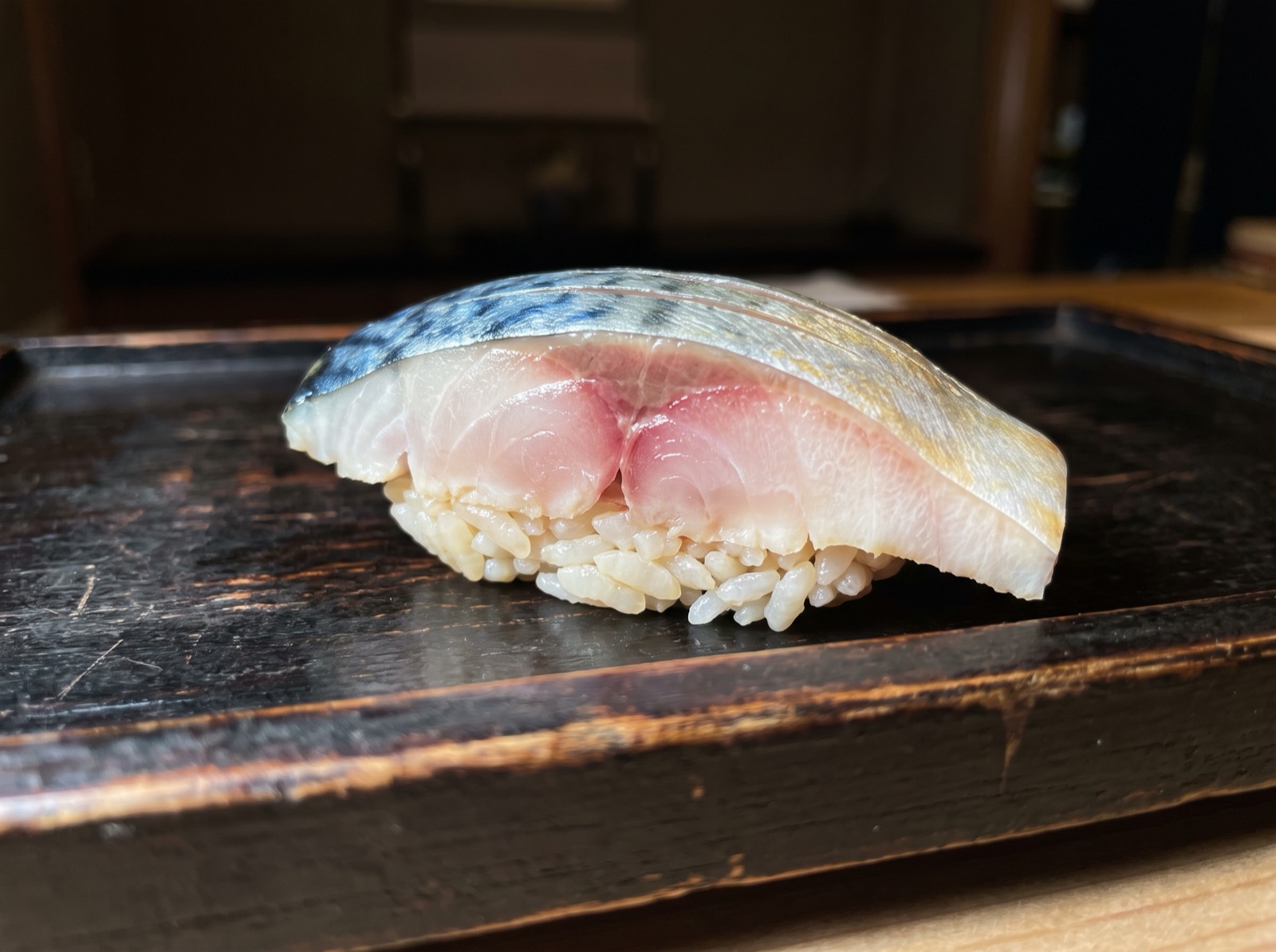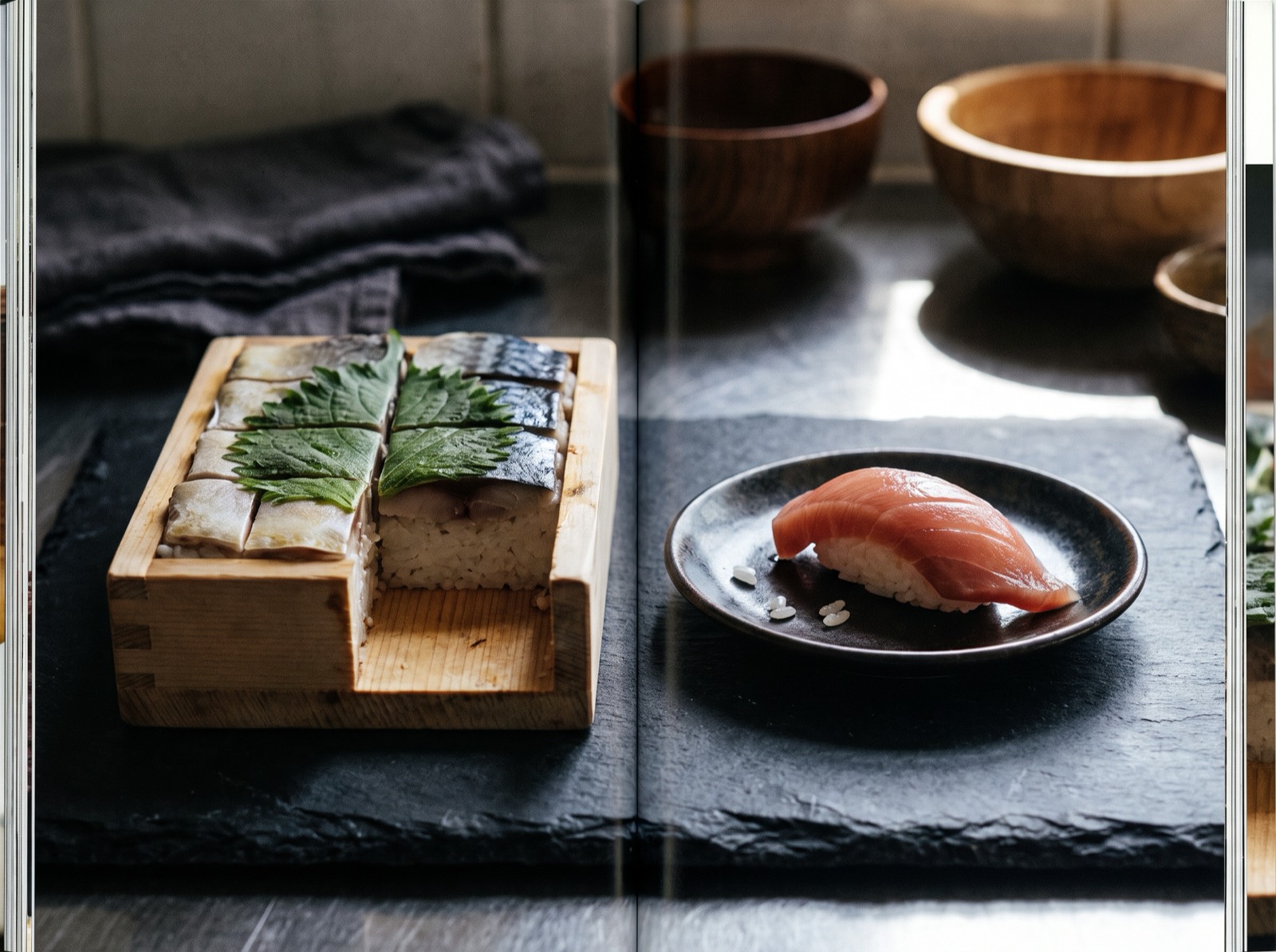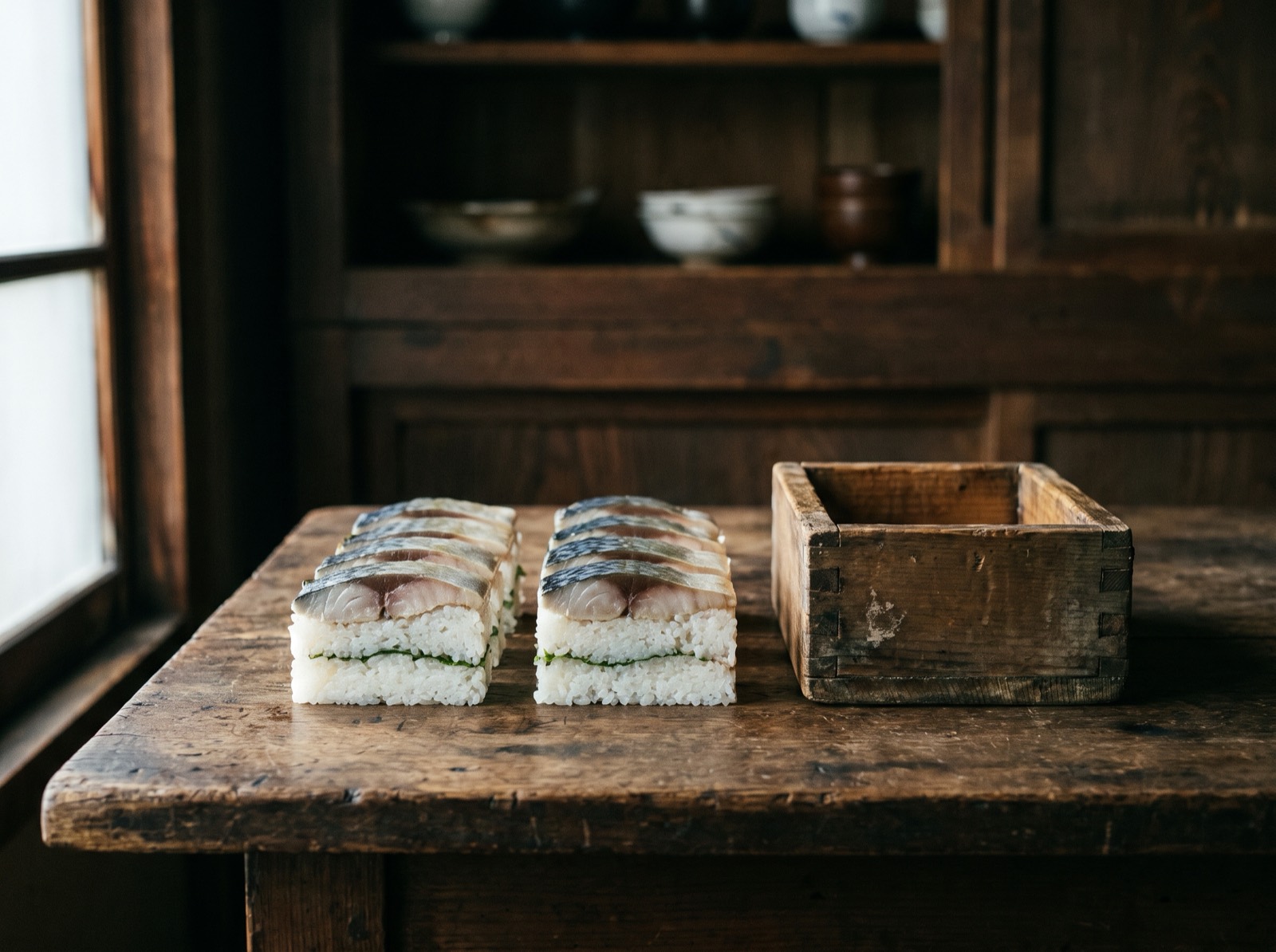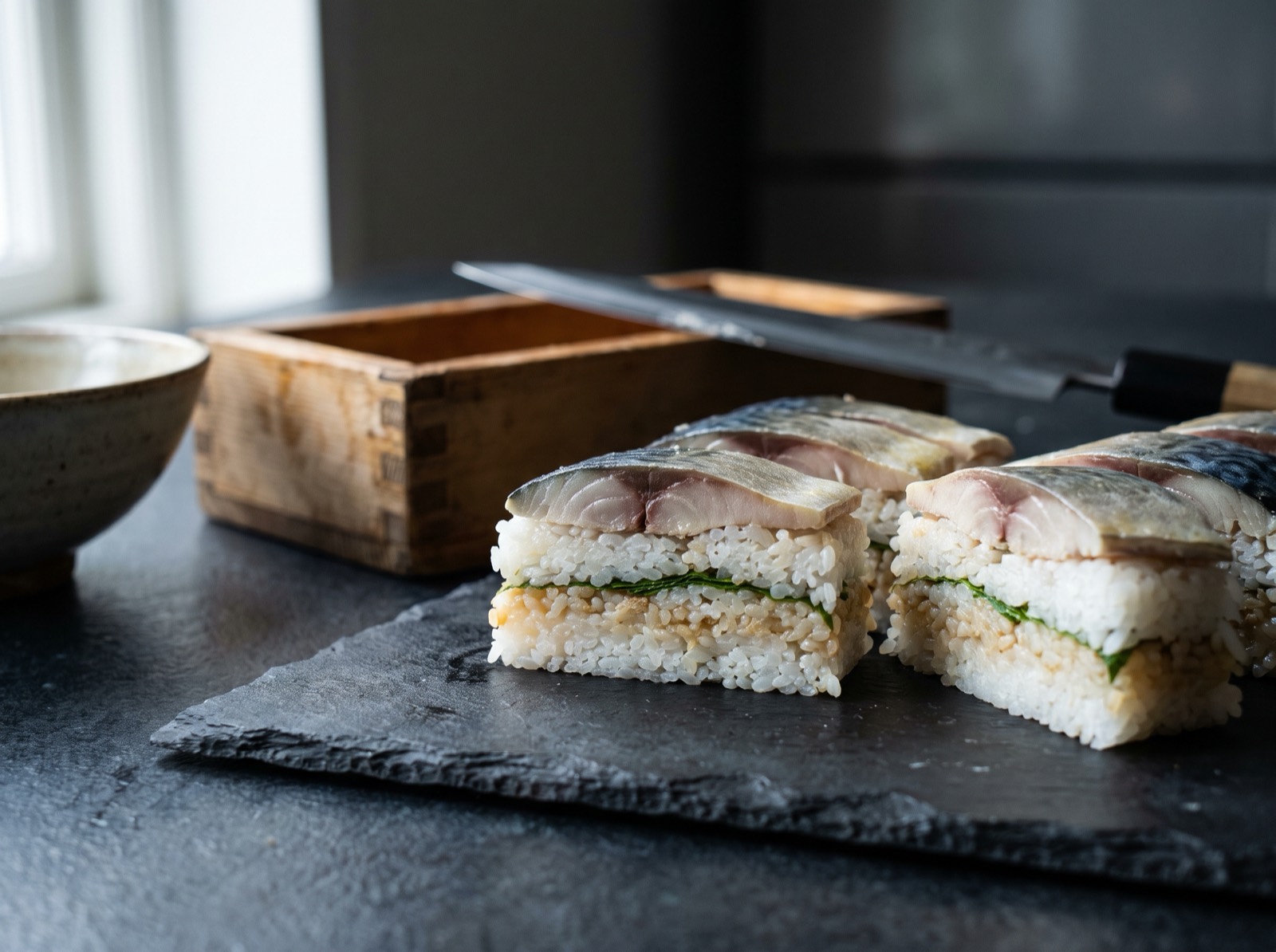
Oshizushi (押し寿司) is sushi assembled in a rectangular wooden mould: rice laid in, topping laid over, the lid pressed down, the block weighted, then turned out and cut into neat squares or bars. It is the sushi of Osaka and western Japan, it is older than the hand-formed kind, and almost everything about it follows from the fact that it is made before you arrive rather than in front of you.
What it is
The mould is an oshibako (押し箱) — a plain wooden box with a removable base and a lid that fits inside the walls, so that pressing the lid compacts the contents and lifting the base pushes the finished block out intact. Nothing about it is complicated; the skill is in the packing and the pressure.
In Osaka the form is also called hako-zushi (箱寿司), box sushi, and the whole western repertoire goes under the umbrella name Ōsaka-zushi. Toppings are things that survive being pressed and held: cured mackerel, cooked prawn, simmered conger, egg, sea bream, often layered so the cut face shows bands of colour.
It came first
This is the part most visitors have backwards. Hand-formed nigiri is an Edo invention of the early nineteenth century — fast food, made to order, sold at stalls. Pressed and packed forms are older by centuries, and they descend from a technique in which fish was preserved by being packed with salt and rice and left to ferment.
Once vinegar could do quickly what fermentation did slowly, the packing stayed and the waiting went. The wooden mould is the surviving piece of that older logic: sushi as something you make, keep and carry, rather than something a chef hands you across a counter. Our guide to the forms of sushi sets the whole family out.
Nigiri is what happens when sushi stops being a way of keeping fish and starts being a way of selling it fast.
The family
- Battera (バッテラ). Cured mackerel over pressed rice, finished with a translucent sheet of sweet-vinegared white kelp laid across the top. The name is from Portuguese bateira, a small boat, for the shape of the finished bar — one of the small pieces of sixteenth-century contact that survive in Japanese food vocabulary.
- Saba-zushi and bō-zushi (鯖寿司・棒寿司). Rolled and shaped by hand in a bamboo mat rather than pressed in a box, into a long bar. Kyoto’s version is thick, generous and a formal food. Not technically oshi, but the same idea.
- Kaki-no-ha-zushi (柿の葉寿司). Small pressed parcels of rice and cured fish wrapped individually in persimmon leaves, from the mountains of Nara and Wakayama — a food designed to travel inland.
- Masu-zushi (ますのすし). Trout laid over rice in a round bentwood tub lined with bamboo leaves, from Toyama, and one of the best-known station foods in the country.
- Hako-zushi proper. The layered Osaka box, cut into squares, often with several toppings in one mould.
What the chef does to it
- Wets the mould. A dry box tears the rice on the way out.
- Packs, does not crush. Enough pressure to make a block that holds its edges; more than that and the rice turns to paste. Pressed sushi eats denser than nigiri by design, but there is a line.
- Rests it under weight. The block sits so the layers set together and the seasoning moves between them. This is the step that makes the thing coherent, and it cannot be rushed.
- Wipes the knife between cuts. The cut face is the whole presentation, and a knife wiped with a damp cloth between strokes gives clean bands instead of smeared ones.
How to eat it
Cool, not cold, and generally with fingers or chopsticks as you prefer — there is none of the timing pressure that governs a counter. It does not need soy sauce: the topping is already cured, glazed or seasoned, and battera in particular has a sheet of sweetened kelp doing that job on top.
It also keeps for hours rather than seconds, which is why it is the sushi you find in station kiosks, department-store food halls and gift boxes, and why it travels on a train in a way nigiri cannot. If you are taking sushi anywhere at all, this is the form to take.
How it differs from what it is confused with
- Oshizushi and nigiri. Compacted versus aerated. Nigiri rice is handled so it holds together and then collapses; pressed rice is deliberately dense and holds its shape in the hand. They are different textures on purpose.
- Oshizushi and bō-zushi. Box versus mat. Both give a bar you slice, but one is moulded under weight and the other is rolled and shaped.
- Battera and saba-zushi. Both cured mackerel. Battera is thinner, pressed, and topped with kelp; Kyoto-style saba-zushi is thick, rolled and unadorned.
- Oshizushi and temaki. Opposite ends of the clock — one is made hours ahead and improves; the other has under a minute.
How to say it
o-shi-zu-shi, four even beats. Note the voicing: sushi becomes zushi in compounds, which is why the same food is sushi alone and -zushi attached to almost anything. Battera is ba-t-te-ra, with the double t held.
Edomae and Kansai
This is the cleanest statement of the split there is. Osaka pressed its sushi because it was a merchant city with a food culture of preparation, packing and keeping; Tokyo formed its sushi by hand because it was selling it from stalls to people standing up. Our comparison of the two cities works through what follows from that, and our piece on Osaka covers the city itself.
The practical consequence for a visitor: a Tokyo counter will rarely serve pressed sushi, and an Osaka one may serve both. If you want the western form, buy it where it is made — the department-store basements are, unglamorously, the best place to compare five versions in twenty minutes.
Where you will see it, and roughly what it costs
In Osaka and Kyoto, in station kiosks and department-store food halls nationwide, and in the regional versions in their home prefectures. It is sold by the box rather than the piece.
No figure from us. It is generally well below counter nigiri for the same fish, because the labour is batched and the service is not — which is exactly the trade the form was invented to make. Our guide to what sushi costs sets out the wider tiers.
Frequently asked questions
What is oshizushi?
Pressed sushi: rice and topping layered in a wooden mould, compacted under a lid, weighted, then turned out and cut into squares or bars. It is the sushi of Osaka and western Japan.
Is pressed sushi older than nigiri?
Yes. Hand-formed nigiri is an Edo invention of the early nineteenth century. Pressed and packed forms are older by centuries and descend from a preservation technique in which fish was packed with salt and rice and left to ferment.
What is battera?
Cured mackerel pressed over rice and finished with a translucent sheet of sweet-vinegared white kelp. The name comes from the Portuguese word for a small boat, after the shape of the finished bar.
What is the difference between battera and saba-zushi?
Both are cured mackerel. Battera is thinner, pressed in a box and topped with a sheet of kelp. Kyoto-style saba-zushi is thick, shaped by hand in a bamboo mat, and served plain.
Do you dip pressed sushi in soy sauce?
It does not need it. The topping has already been cured, glazed or seasoned, and battera has a sheet of sweetened kelp doing that job on top.
How long does pressed sushi keep?
Hours rather than seconds, which is the point of it. That is why it is sold in station kiosks and department-store food halls and why it travels on a train, where nigiri cannot.
Where can I try oshizushi in Japan?
Osaka and Kyoto for the classic versions, and department-store food halls anywhere in the country, which carry several styles side by side. Tokyo counters rarely serve it.