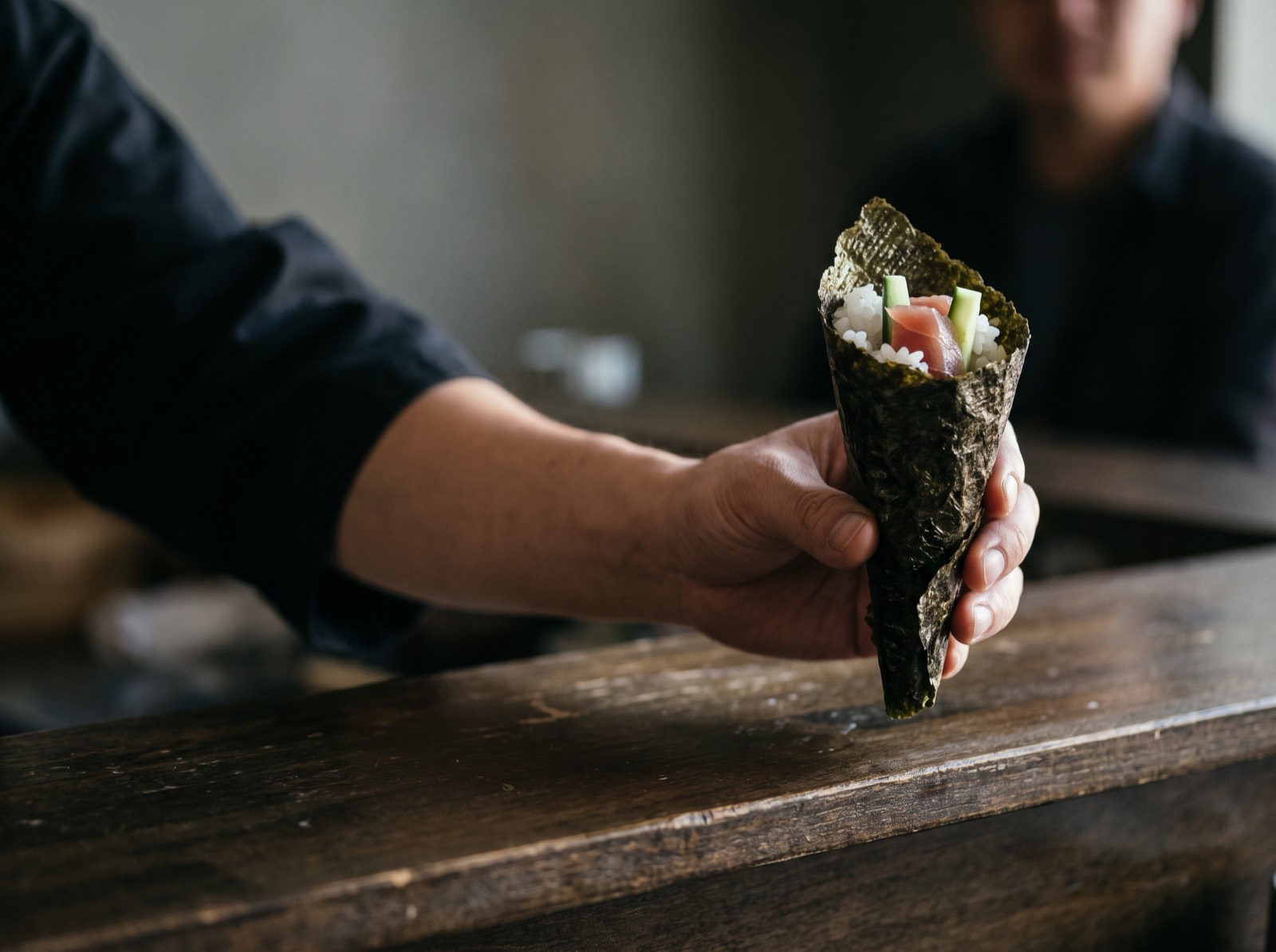
Temaki (手巻き) means “hand-rolled”: a sheet or half-sheet of nori rolled into a cone around rice and a filling, made to order and handed straight to you. It is the one item at a sushi counter that comes with a genuine deadline, and understanding why explains most of what it is for.
What it is
Structurally it is the simplest thing on the menu. Nori on the palm, a small quantity of rice spread on one end, filling laid diagonally across it, and the sheet rolled into a cone in a single movement. No mould, no mat, no press — which is where the name comes from and what separates it from the other rolled forms.
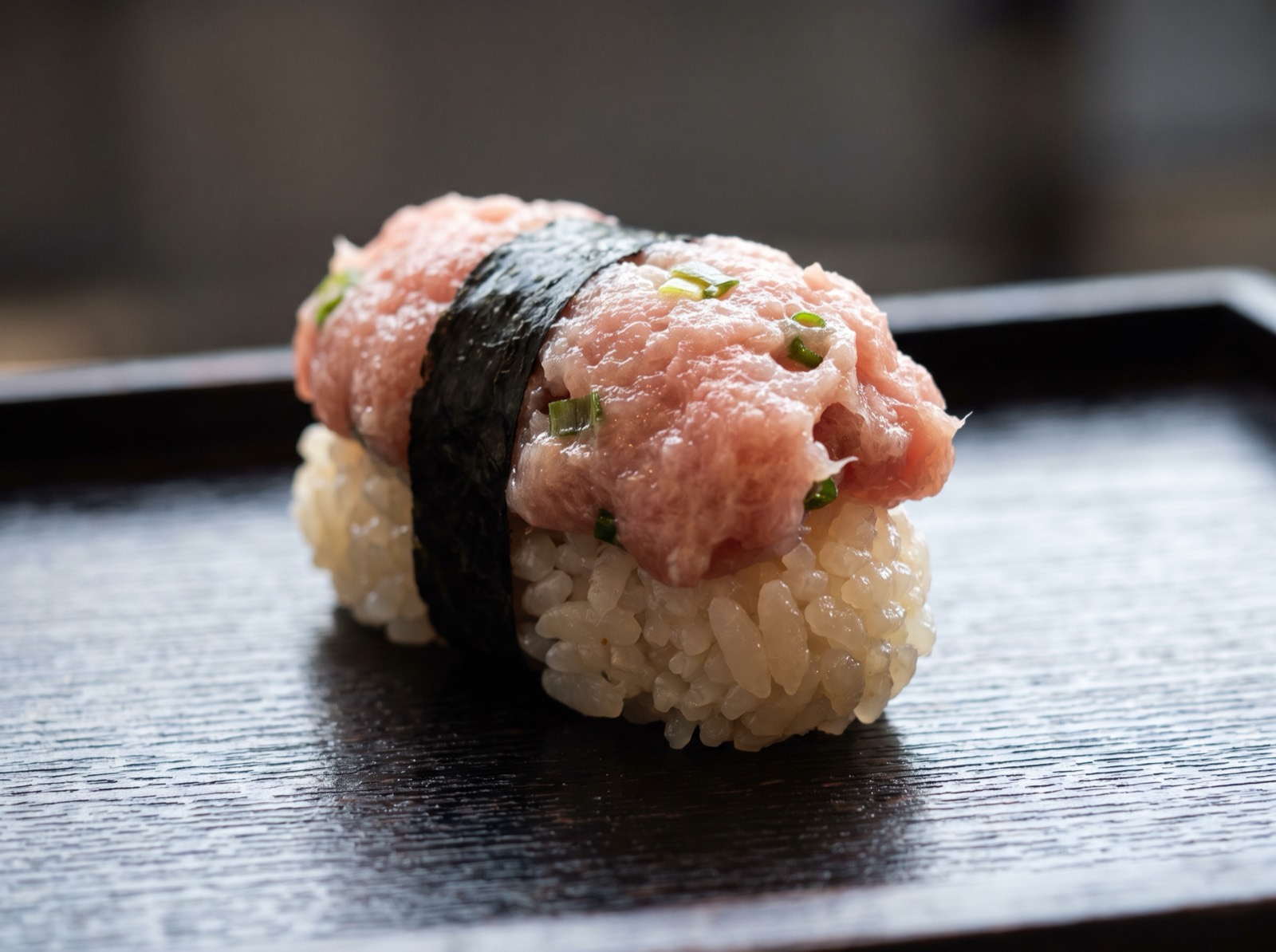
The fillings are open-ended in a way the rest of the Edomae repertoire is not: negitoro, ikura, uni, cucumber, natto, pickled radish, or a combination. Because it is not a formal piece, a chef has latitude here that a nigiri does not permit.
The sixty seconds
Nori is a dried seaweed sheet, and its entire textural appeal (the crackle, the way it shatters against the teeth) depends on being dry. Put warm, moist rice against it and it begins absorbing immediately. Within about a minute the crispness is gone; within a few, the sheet is leathery and pulls rather than breaks.
So the temaki is built to be eaten now, in the sense that no other piece quite is. A shop that makes one and lets it sit on a plate for two minutes has served a different, worse item. This is why counters make them one at a time, why they are often handed to you directly rather than placed down, and why it is entirely correct to start eating before your companions are served.
Almost every rule you are worried about at a sushi counter is softer than you think. This one is real, and it is about nori rather than manners.
How to eat it
- With your hands. Always. Chopsticks will not hold a cone and will tear the nori trying.
- Immediately. Before you photograph it, if you were going to. This is the single case where the delay actually costs you something.
- From the wide end down. The cone tapers; eating from the open end means the last bite is a small point of nori rather than a collapse.
- Without dipping. A counter will have seasoned the contents. Dipping a cone in soy soaks the nori and defeats the purpose, and in practice it is very difficult to do without losing the filling anyway.
Our broader guidance on this is in how to eat sushi: the general principle is that hands are correct for nigiri and hand rolls, and chopsticks are correct for sashimi and anything loose.
How it differs from what it is confused with
- Temaki and makizushi. Maki is rolled in a bamboo mat into a cylinder and then cut into rounds. Temaki is rolled in the hand into a cone and not cut. Different shape, different tool, different eating window.
- Temaki and hosomaki. Hosomaki is the thin, single-filling cut roll — tekka with tuna, kappa with cucumber. It survives being cut and plated in a way temaki does not.
- Temaki and a Western “hand roll”. The same object, and one of the few sushi terms that translated cleanly.
- Temaki and temaki-zushi at home. In Japan the word also names a domestic meal: bowls of rice, plates of fillings and a stack of nori on the table, with everyone rolling their own. It is a common family and party format and has almost nothing to do with restaurant sushi.
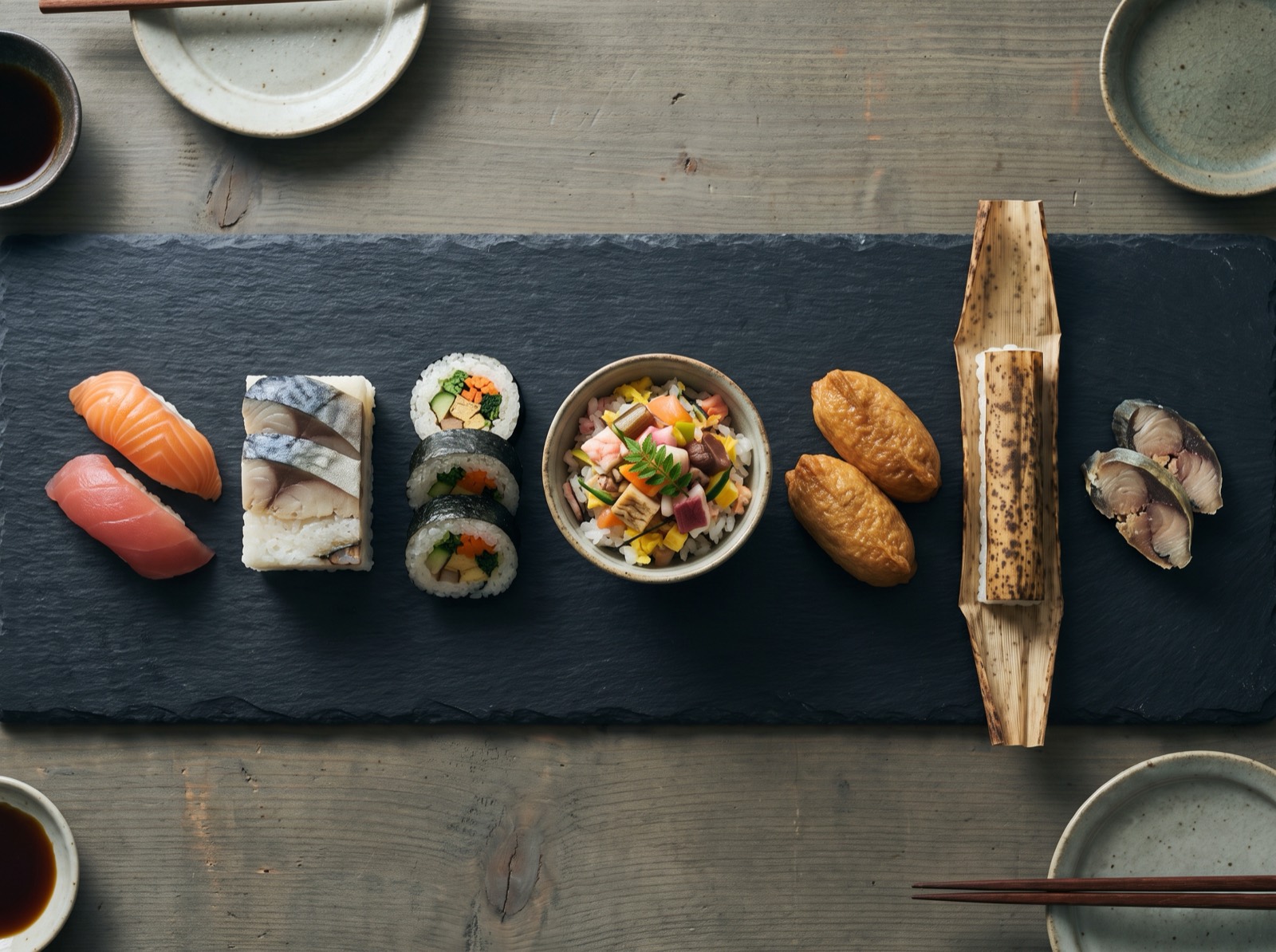
For the full set of forms, see types of sushi.
How to say it
teh-MAH-kee is understood. Three beats, te-ma-ki, and no stress. Te is “hand”, the same element as in temae and a great many other Japanese words.
Edomae and Kansai
Little regional divergence: it is a simple form and it is made the same way nationally. What differs is where it sits in a meal: at an Edomae counter a temaki often comes late, after the nigiri, as a way of finishing with something warm, rice-based and substantial. At a conveyor belt it is a standalone order.
Osaka's pressed tradition has no equivalent. A cone cannot be pressed, and the entire logic of hakozushi (make it in advance, let it rest, cut it later) is the opposite of a form that expires in sixty seconds.
Where you will see it, and roughly what it costs
Everywhere, at every level, and it is one of the cheapest things a counter makes because the ingredients are modest and the labour is a few seconds. The exceptions are the expensive fillings: a uni or otoro temaki costs what the filling costs.
It is also, worth noting, the best value item in most convenience stores, where Japanese manufacturers solved the nori problem with a packaging design that keeps the sheet separated from the rice until you open it. That piece of engineering is a small national achievement and it exists for exactly the reason described above. See omakase price tiers for the restaurant picture. The clock starts when the nori meets the rice.
Frequently asked questions
What is temaki?
A hand roll: nori rolled into a cone in the hand around rice and a filling, made to order and not cut. The name means 'hand-rolled', distinguishing it from maki, which is rolled in a bamboo mat and sliced.
Why do you have to eat a hand roll immediately?
Because nori loses its crispness as soon as warm, moist rice touches it, within about a minute. After that the sheet turns leathery and pulls instead of breaking. It is the only item at a sushi counter with a genuine deadline.
Do you eat temaki with your hands or with chopsticks?
Hands, always. Chopsticks cannot hold a cone and will tear the nori trying. This is one of the few points of sushi practice where there is a clear right answer.
Should you dip a hand roll in soy sauce?
No. The contents are already seasoned, the nori soaks immediately, and in practice the filling falls out. If a counter made it, it is finished as served.
What is the difference between temaki and maki?
Temaki is rolled by hand into a cone and eaten whole. Maki is rolled in a bamboo mat into a cylinder and cut into rounds, which lets it survive being plated in a way a hand roll cannot.
What is temaki-zushi at home?
A domestic Japanese meal format: rice, plates of fillings and a stack of nori on the table, with everyone rolling their own. It is a common family and party dish and is quite separate from restaurant sushi.