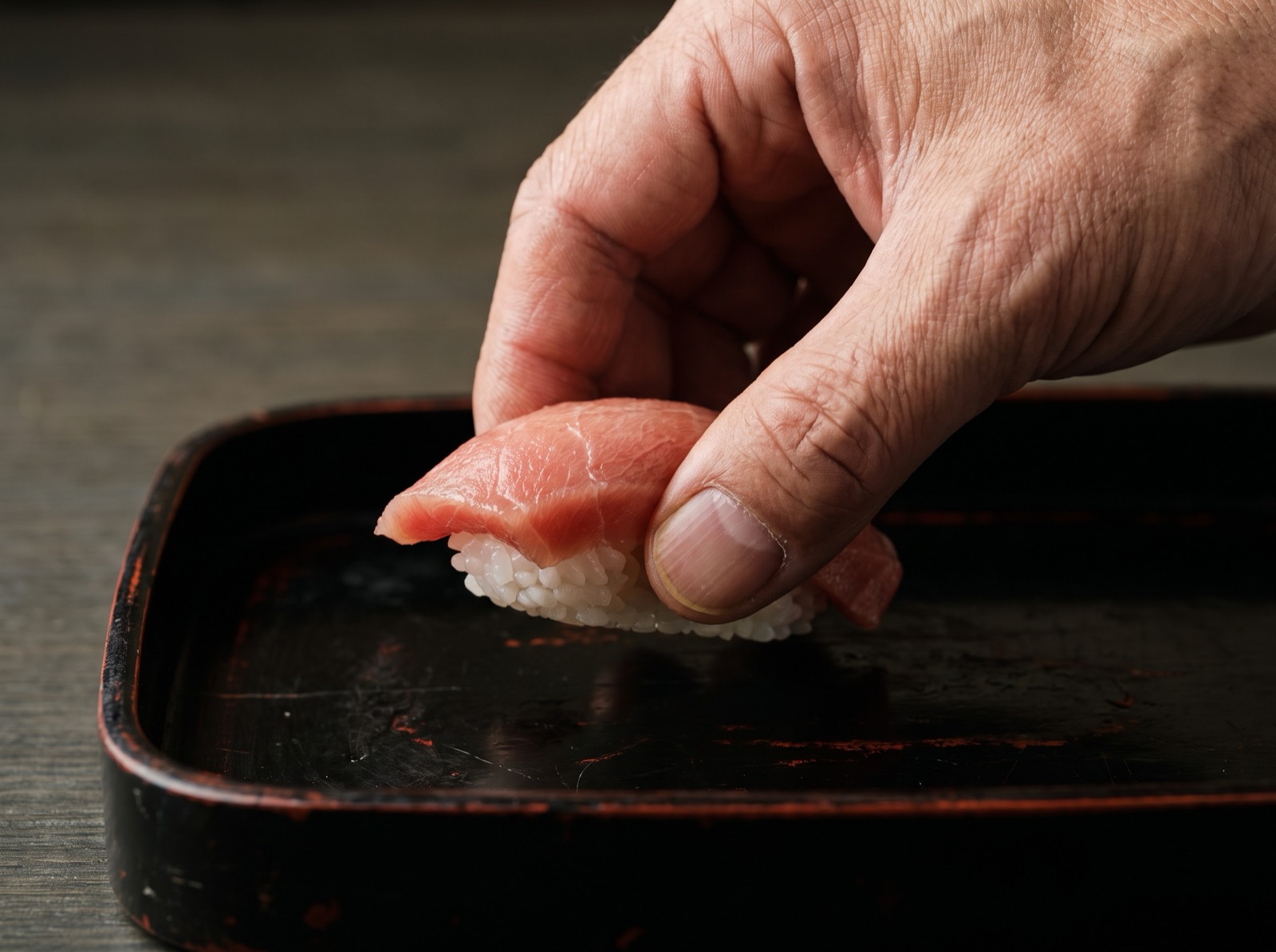
Pick up nigiri with your fingers or with chopsticks — both are correct. Turn it onto its side so the topping, not the rice, takes the soy sauce, and touch it briefly rather than dipping. Eat it in one mouthful, within about ten seconds of it arriving. At a traditional counter, do not add wasabi — it is already inside — and eat each piece as it is set down rather than waiting for the plate to fill. At a conveyor-belt shop the wasabi is on the table and you season your own.
The ten seconds that matter
Everything else on this page is technique. This one is physics.
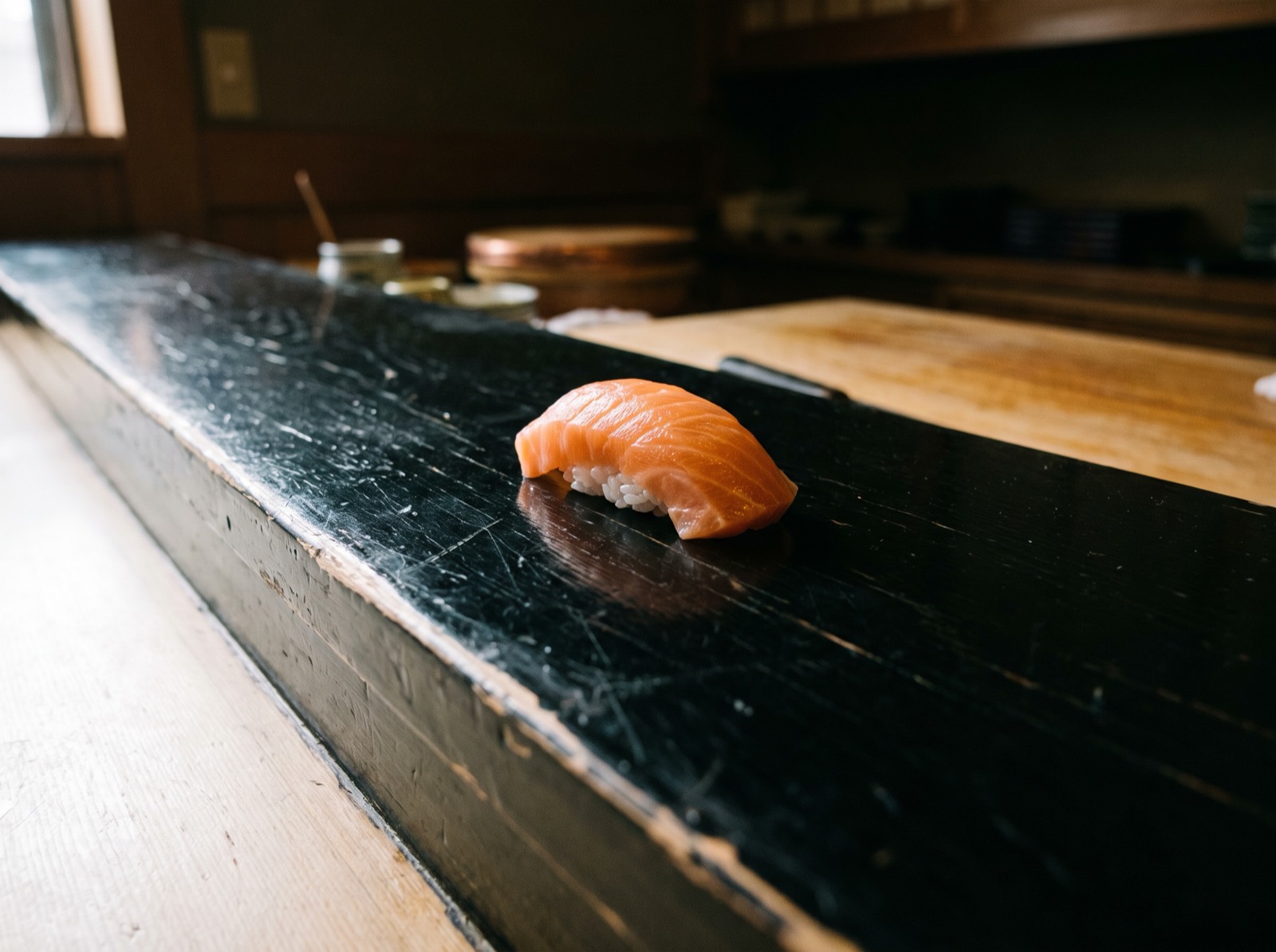
A piece of nigiri is assembled from two things at different temperatures: rice at roughly body heat, fish that is cool. From the moment it is set down, the fat in the topping starts to soften against the warm rice, the cut surface begins to dry, and the rice loses the loose, barely-cohering structure the chef pressed into it. Ten seconds is not a superstition. It is the window in which the thing you were served still exists.
Which means the most common mistake at a good counter is not a grip or a dip. It is waiting — for a photograph, for a companion to be served, for the conversation to reach a pause. If the chef is going faster than you can keep up, say so. Asking them to slow down is an ordinary request and they would far rather hear it.
Hands or chopsticks
Both are correct, and Japanese reference books say so plainly. The widespread English rule (that nigiri is finger food and chopsticks are a mistake) overstates a habit. Eating with your fingers is a survival from the era when nigiri was sold at street stalls and eaten standing up, and it is entirely proper. It is not compulsory.
If a shop expects hand-eating it will usually give you a second, smaller cloth for your fingers alongside the oshibori. That is the signal, and it is more reliable than any general rule.
With chopsticks, the technique is specific and worth two minutes of practice:
- Tip the piece onto its side rather than gripping it from above. From above, the tips close on the topping alone and peel it off the rice.
- Take it from the side, with your grip a little short of halfway along, so that you catch the topping and the rice together.
- Do not spear it, and do not scoop it.
- When you separate disposable chopsticks, hold the lower one still and lift the upper one quietly. Pulling them apart sideways is the visible beginner's move, more so than anything you do afterwards.
With fingers, the grip is the same idea: thumb underneath, index and middle finger on top, contacting the topping and the rice at once, and no more pressure than it takes to lift.
Which side goes into the soy sauce
Here the Japanese reference books split, and we would rather show you the disagreement than manufacture a consensus.
- Fish side only. One book is unambiguous: soy goes on the topping. Vinegared rice is a loose structure held together by almost nothing; put it in liquid and it swells, softens and comes apart in the dish.
- Both, lightly, at an angle. The other argues that a piece held with the fish facing up never actually gets any soy on the fish, so the taste stays flat. Tilt it sideways, touch topping and rice at the same moment, and lift.
They agree on the failure: a saturated piece. So the practical rule is about pressure, not surface. Turn it onto its side. Touch. Do not soak. And fill the dish about halfway; a brimming dish invites over-dipping, and the rest is thrown away.
Before any of that, look at the piece. At a counter working in the Edomae tradition much of the seasoning has already happened: the chef brushes on nikiri (煮切り), a soy sauce simmered with mirin and dashi, or on simmered toppings the thicker, sweeter tsume (ツメ). A piece that arrives glossy is finished. Eat it as it is. If you cannot tell, ask — “do I dip this?” is a normal question.
The argument is about which surface. The agreement is about how much. Touch it; do not soak it.
One bite or two
One. A piece of nigiri is built as a single mouthful, with the wasabi placed inside and the rice pressed to hold only until it is picked up. Cut it in half and you are eating two damaged objects.
If the pieces are genuinely too large, the answer is not to struggle through. Ask for smaller pieces, or for less rice. Both are normal requests, and giving a reason makes them easier still. A few traditional shops will decline, and that is their prerogative, but most will simply adjust.
The order the chef intended
There is no compulsory sequence. Ordering what you want when you want it is the point of a counter, and English guides that print a mandatory order have invented it. What does exist is a sequence that tastes better, and it runs from light to rich.
- White fish, then red fish, then the silver-skinned fish, then gunkan, then the sweet-glazed pieces, then tamago, then rolls.
- Within tuna: lean akami before fatty otoro.
- Among the silver-skinned fish: the raw ones before the vinegar-cured ones.
- Pieces brushed with sweet tsume come after the strongly flavoured ones, not before.
Shops vary. One omakase opens with chutoro; another starts with the most delicate white fish it has that day. Both are normal, and neither is a mistake being made by the other. The current view in the Japanese books is that you rinse with tea or a pinch of ginger between rich pieces rather than police the order, which is more useful advice and less work.
At some shops, rolls signal that the meal is ending. If you want more after that, say so before they arrive.
Gari and tea, and when they are actually for
Gari (ガリ) is sweet-vinegared ginger. Its job is to clear the last piece off your palate and cut oil, and a pinch does it. A heap does not do it better; it leaves your mouth burning for the next two pieces. It has a second, quieter job as a brush for putting soy sauce onto gunkan: hold a slice in your chopsticks and paint the top. That slice is then salty, so leave it.
Tea at a sushi counter is called agari (あがり). English guides often say it comes at the end; the word actually derives from agaribana, meaning freshly drawn tea, so ordering it at the start is completely normal. There is a reason to want it early: hot tea washes fat out of your mouth between pieces, and the catechins in green tea damp down the smell of fish. Keep a cup beside you even in summer, and ask for a refill when it goes lukewarm.
Sushi shops brew fine-cut teas, konacha or mecha, that infuse instantly, and they use oversized cups so the hot tea keeps coming. Gyokuro, the expensive one, is deliberately not used: it is too rich and fights the fish.
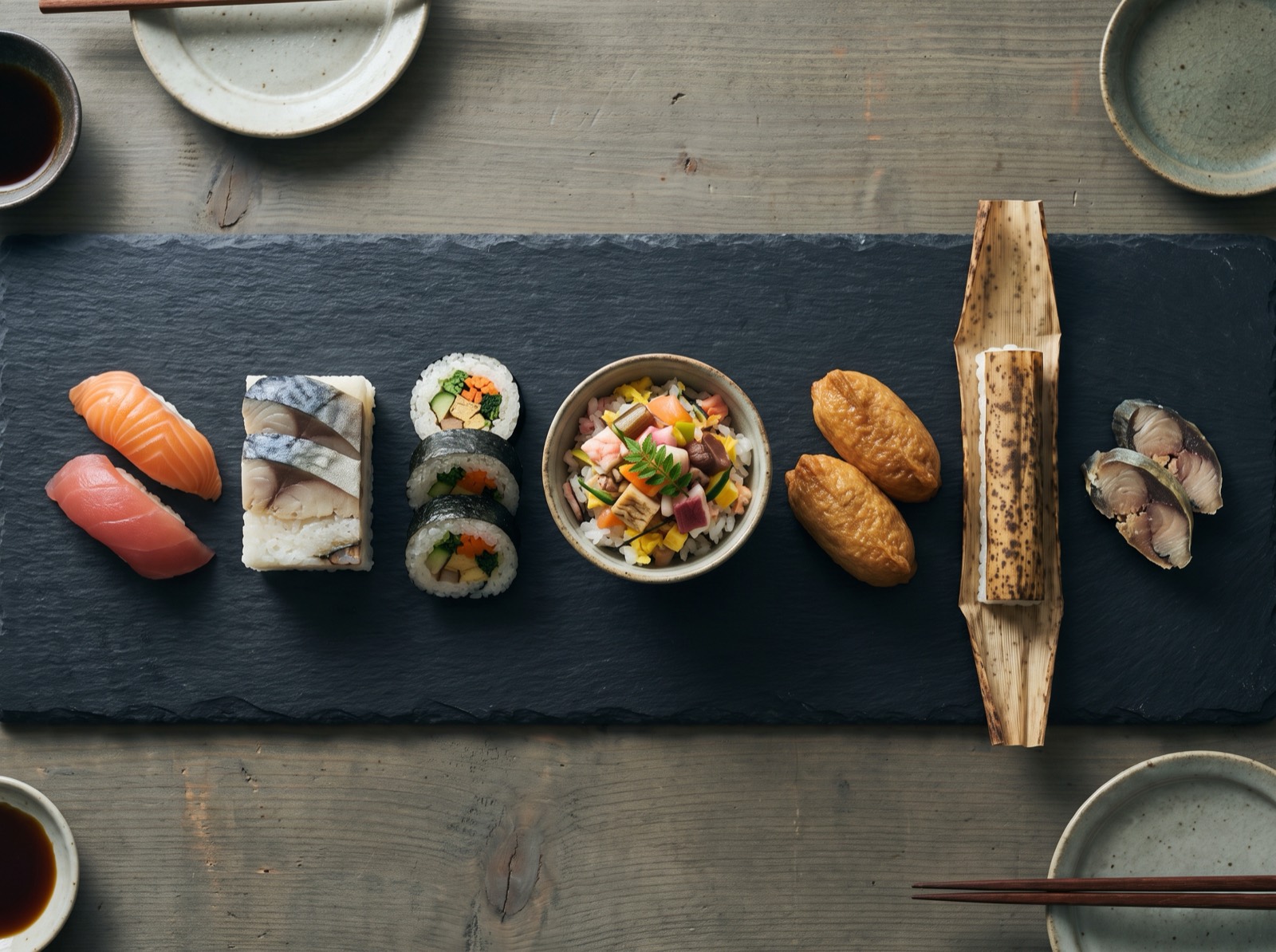
Nigiri, maki, gunkan, temaki: what changes
- Nigiri (握り): as above. Side grip, brief contact with the soy, one mouthful, immediately.
- Maki (巻き): take rolls from the side and eat them at once: nori softens fast once it meets the rice. Rolls with an already-seasoned filling, and cucumber kappa-maki, are eaten without soy sauce at all.
- Gunkan (軍艦): the nori band holds it together, so pick it up from the side. For soy, use one of three methods: brush it on with a slice of ginger, put a few drops on straight from the cruet, or hold the piece upright and touch just the bottom edge of the nori to the dish. Never dip it face down.
- Temaki (手巻き): a hand roll is a cone, made to be eaten with your hands, and it has the shortest life of anything at the counter. Nori that has gone limp is a different food. Eat it as soon as it reaches you.
One general point that covers all four: never let the spout of the soy cruet touch the fish.
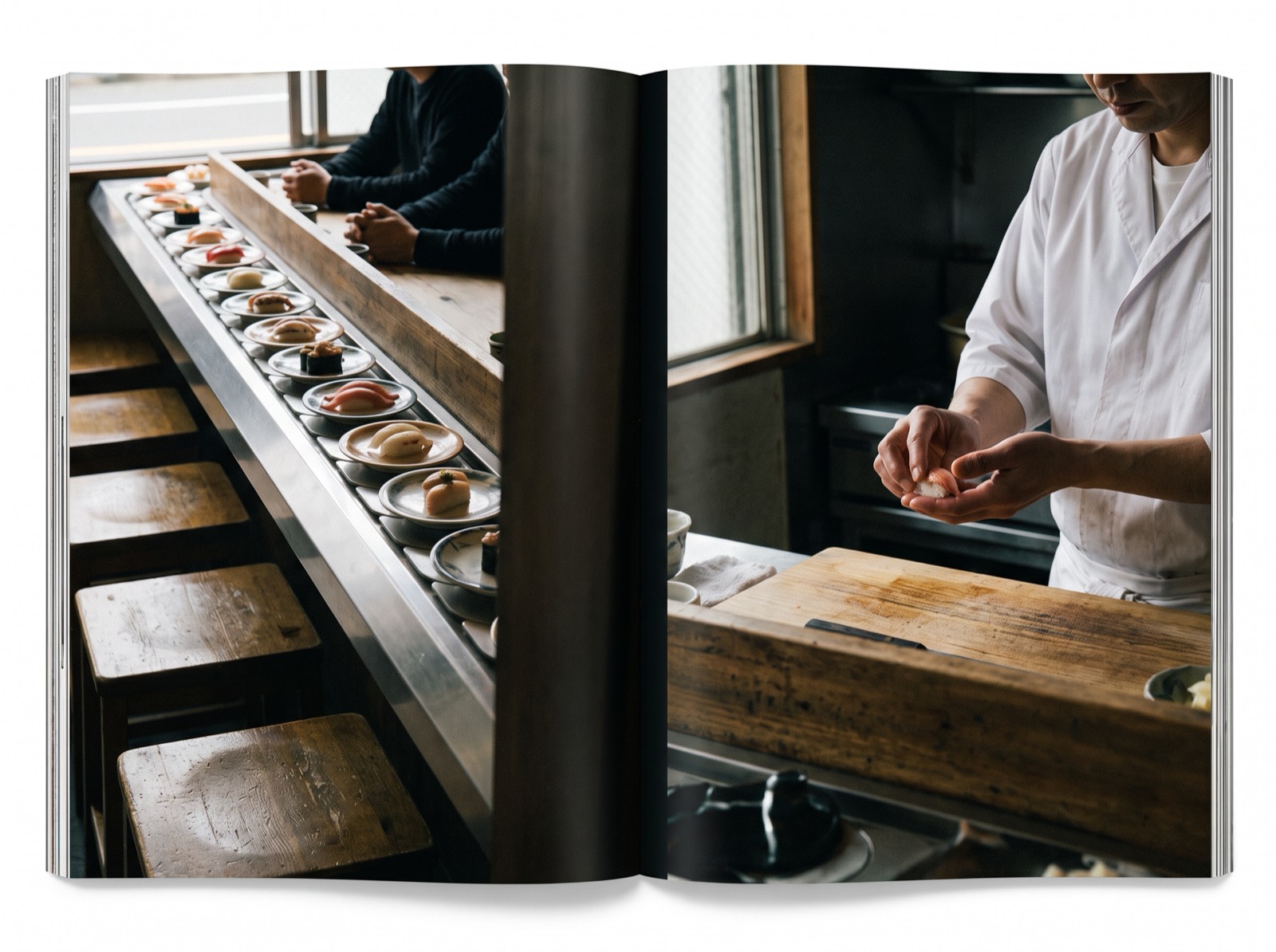
At a counter, and at a conveyor belt
Most people reading this in English will meet sushi first at a conveyor belt, and it is worth saying clearly that the conventions there are different — not lax, different.
At kaitenzushi (回転寿司), the shop is built for self-service. You take plates from the belt or order from a screen, you dip your own pieces because almost nothing arrives pre-seasoned, wasabi is usually on the table rather than inside the piece, and the price is read off the plate colour. Nobody is watching how you hold anything. The ten-second rule still applies for the same physical reasons, but the food was designed with a longer tolerance.
At a counter, the balance reverses. The chef is seasoning for you, timing to you, and setting the pace of the meal by watching you eat. The techniques on this page exist because that relationship exists. For the social side of it (booking, seating, budget, paying) see our guide to sushi etiquette. For the difference between the two kinds of shop, see conveyor belt versus counter.
Frequently asked questions
Do you eat sushi with your hands or chopsticks?
Both are correct. Japanese reference books treat fingers and chopsticks as equally proper. With chopsticks, tip the piece onto its side and take it from the side, gripping slightly short of halfway so you catch topping and rice together.
Which side of nigiri goes into the soy sauce?
Turn it onto its side. One Japanese reference says soy should touch the fish only, because dipped rice falls apart; another says to touch fish and rice at once at an angle, because fish kept facing upward never meets the soy. Both agree that soaking is the mistake.
Should you eat sushi in one bite or two?
One. Nigiri is built as a single mouthful and does not survive being cut. If the pieces are too large, ask for smaller pieces or less rice, a normal request at most shops.
Is there a correct order to eat sushi in?
No fixed order, but there is a sequence that tastes better: white fish, red fish, silver-skinned fish, gunkan, sweet-glazed pieces, tamago, rolls. Within tuna, lean akami before fatty otoro. Shops differ, and both starting with chutoro and starting with white fish are normal.
How do you eat gunkan without the soy sauce ruining it?
Three ways: brush soy on with a slice of ginger held in your chopsticks, put a few drops on directly from the cruet, or hold the piece upright and touch only the bottom edge of the nori to the dish.
When do you drink the tea?
Whenever you like, including at the start. The word agari comes from agaribana, freshly drawn tea, so it is not only the tea at the end. Hot tea between pieces rinses fat from the palate.
Is it different at conveyor-belt sushi?
Yes. At kaitenzushi you dip your own pieces, wasabi is usually on the table rather than inside the piece, and nothing is pre-seasoned for you. The habits on this page are written for a counter where the chef seasons and times each piece.