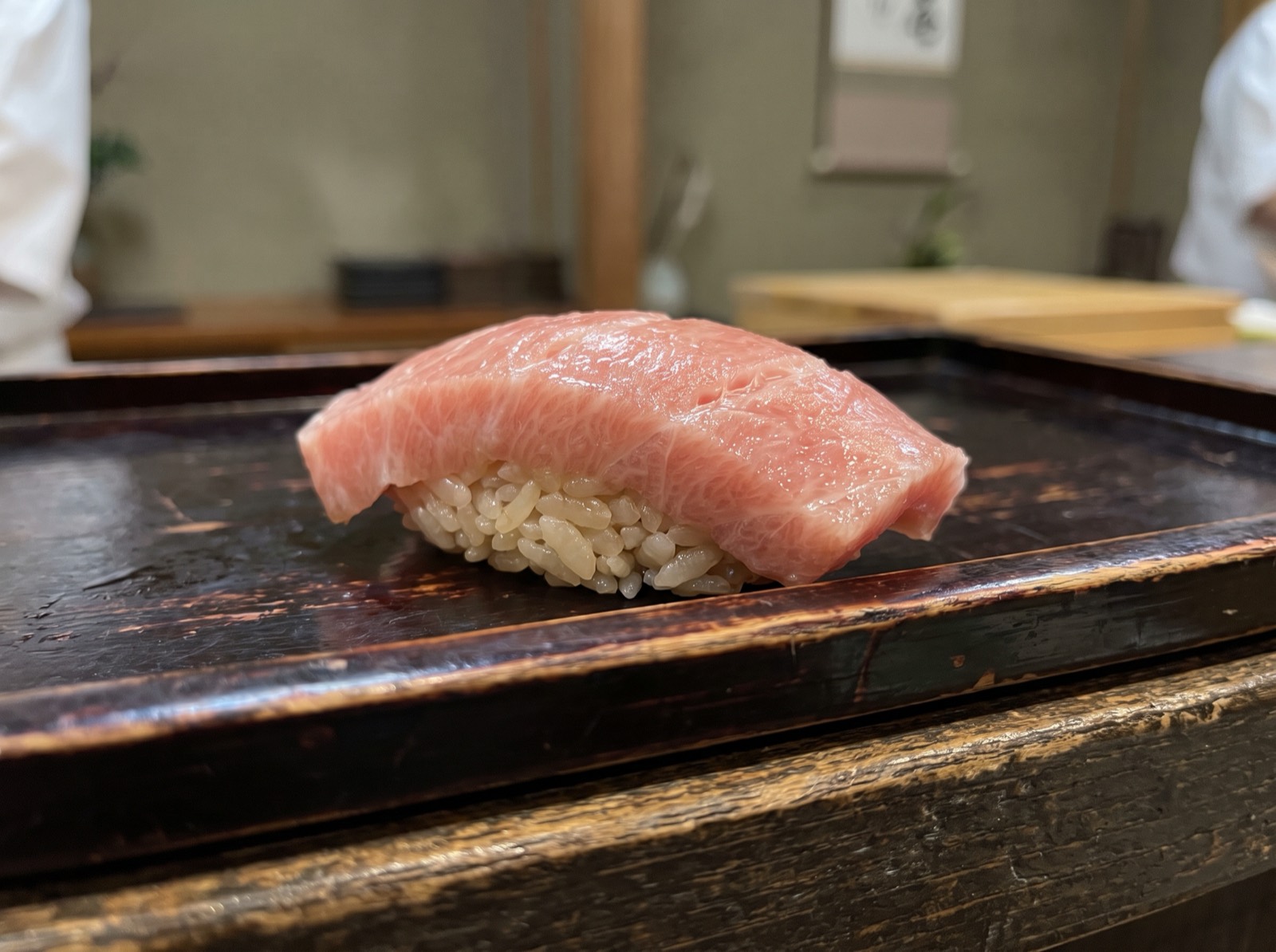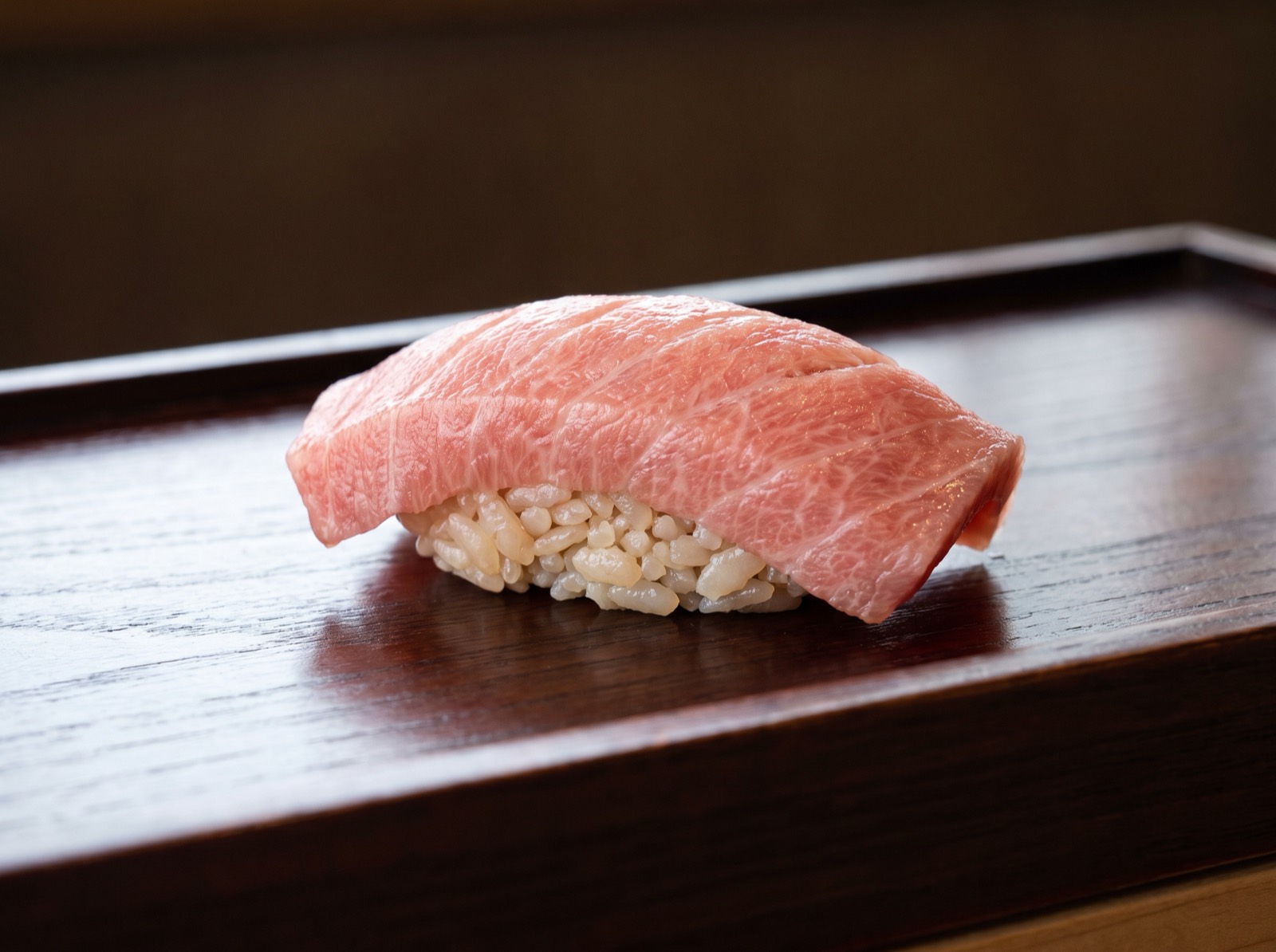
Chūtoro (中トロ) is medium-fatty tuna: the grade between lean akami and the rich belly of otoro. It is pink rather than red, marbled with fine parallel lines of fat, and at a great many counters it is the tuna people actually order twice. Nothing official defines it. The line between the three grades is drawn by the chef.
What it is
Position and fat, on the same animal. Chūtoro is taken from the transition zone — the upper belly where the fat thins out towards the back, and the back itself where a fatty seam runs above the loin. The lean core of the fish is akami; the lower belly is otoro; chūtoro is everything between, which is a large and vaguely shaped part of a very large fish.
What it tastes like follows from that: enough fat to coat the mouth and melt at body temperature, enough muscle left to hold structure and to taste of tuna rather than of richness alone. Otoro dissolves. Akami resists. Chūtoro does a little of both, which is the case people make for it.
The line that does not exist
There is no fat percentage at which akami becomes chūtoro, and none at which chūtoro becomes otoro. No standards body sets one, no label is regulated, and the grading is done by eye at the point where the block is cut down. Two competent shops working on halves of the same fish can hand you slices they have labelled differently.
The variables behind that judgement, roughly in order of how much they move it:
- The individual fish. A fat winter bluefin and a lean summer one produce different amounts of everything, and the boundaries move with them.
- Species. Bluefin, southern bluefin, bigeye and yellowfin carry fat differently. A yellowfin “chūtoro” and a bluefin chūtoro are not comparable propositions.
- Position along the belly. The trade divides the belly by length — harakami, haranaka, harashimo — and the fat gradient runs along it as well as across it.
- House policy. Some shops grade generously to justify a price; others grade conservatively so that the otoro they do serve is unambiguous. Both are defensible and neither is disclosed.
This is worth knowing before you decide a shop has short-changed you. A piece labelled chūtoro that looks fattier than the chūtoro you had last week is not necessarily an error, and a piece that looks leaner is not necessarily a slight.
Chūtoro is not a measurement. It is a decision somebody made with a knife, in the back, before you sat down.
When it is best
Winter, for wild bluefin in Japanese waters, on the same logic as the rest of the fish: cold-season tuna carries more fat. The seasonal swing is real but smaller than for otoro, because chūtoro is partly muscle and muscle changes less.
Two qualifications carried over from the belly grades. Bluefin is a global fish imported year-round from several oceans, so its presence on a menu tells you nothing about the season. And farmed bluefin, now produced at scale, carries a high and consistent fat level regardless of month — which tends to push farmed fish towards the fatty grades on any given cut.
What the chef does to it
Ageing and temperature, as with all tuna. Days of controlled rest soften the texture and build savour; the shop’s practice varies and is one of the few things that genuinely distinguishes one counter from another.
The slicing is where chūtoro is specifically handled. Fat lines run through the block in one direction, and the cut is made so those lines cross the bite rather than run along it — the same principle as cutting beef against the grain, and for the same reason. A chūtoro cut the wrong way eats stringy no matter how good the fish was.
Temperature does the rest. Tuna fat begins to soften below body heat, so a piece served straight from cold refrigeration is firmer and duller than the same piece a few minutes later. This is one of the arguments for a counter over a belt: the piece is cut, formed and handed over inside a minute, and the fat is where the chef wanted it.
Why it is the one to order
Not a rule, but a defensible position. Otoro is the most expensive piece at most counters and the least informative: it is bought rather than made, and fat flatters everything. Akami tells you the most about the shop but asks the most of the fish. Chūtoro sits where the tuna is still recognisably tuna and the richness is still there, and it is meaningfully cheaper than the belly.
At a counter running a tuna sequence you will usually get all three in order — akami, then chūtoro, then otoro — which is arranged to build richness and is worth eating in that order even when the pieces arrive together. If you are ordering à la carte and want one piece of tuna, this is the one most chefs would point at.
How it differs from what it is confused with
- Chūtoro and otoro. Fat and position, decided by eye. Otoro is fattier, paler, softer and dearer. There is no fixed line, and a generous grader’s chūtoro can out-fat a conservative grader’s otoro.
- Chūtoro and akami. The same fish at the lean end: firmer, deep red, iron-scented, no marbling. It is also the piece that shows a shop’s handling most clearly.
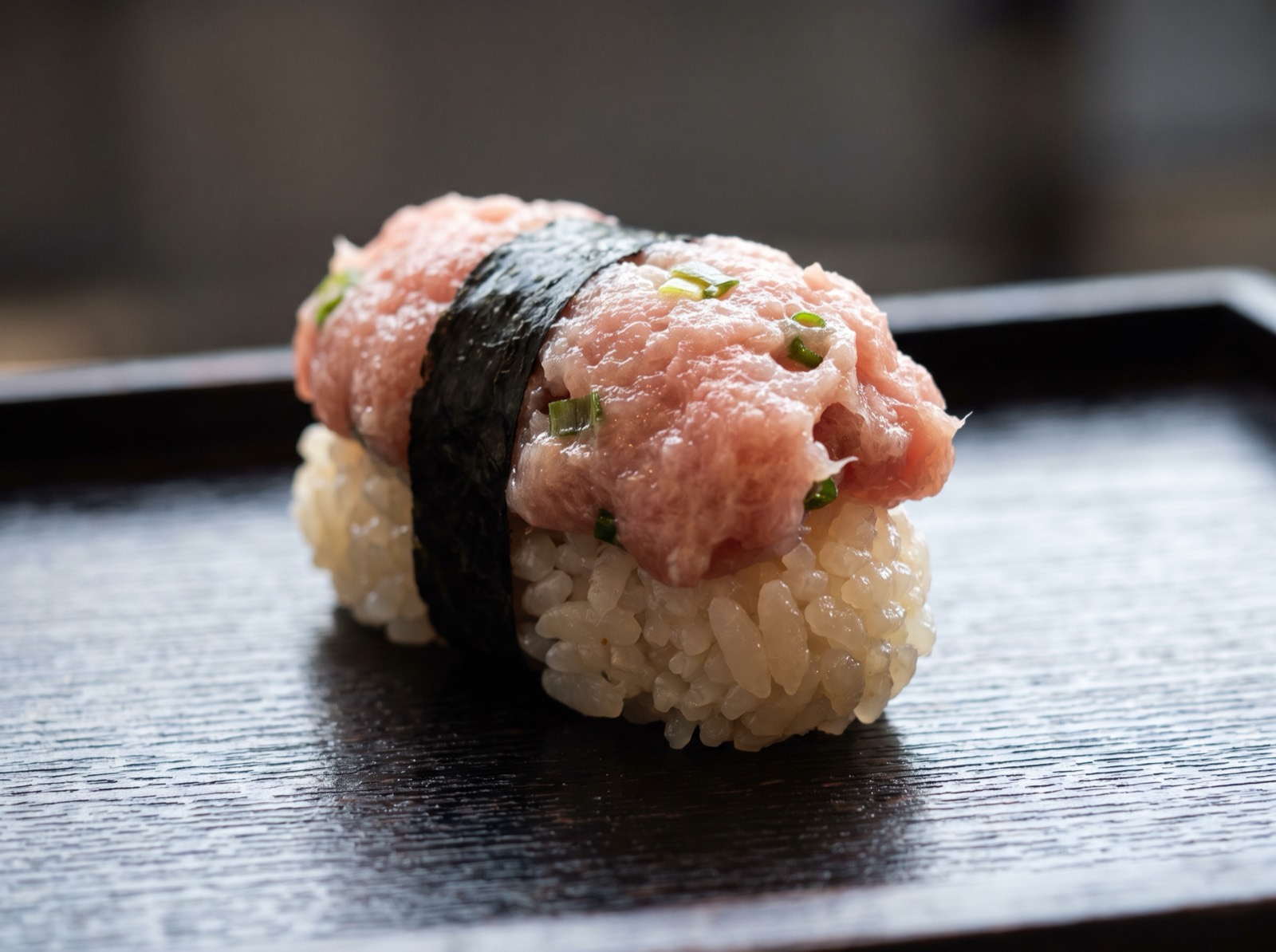
- Chūtoro and negitoro. Negitoro is scraped or minced fatty tuna, mixed and served in a roll or gunkan. What goes into it varies enormously by shop and by product, and it is not a grade of the fish.
- Chūtoro and seared or torched tuna. A blowtorched surface changes the flavour and hides the fat gradient. It is a preparation, not a cut, and it can be applied to any grade.
How to say it
chū-to-ro, three beats with the first one held long: choo-toh-roh. The 中 is “middle”, the same character used for medium sizes on any Japanese menu, and toro comes from torori (とろり), the word for something thick and slow-flowing. Shortening the first vowel is the usual mistake and it will still be understood.
Edomae and Kansai
Tuna is Tokyo’s fish. Edomae sushi formed in a city with the tuna trade at its centre, and the whole three-grade vocabulary is an Edo invention that spread nationally. Tokyo’s wholesale market at Toyosu remains the reference point for bluefin pricing worldwide.
Kansai built its sushi on pressed and cured fish rather than on raw red meat, and its historical repertoire runs to mackerel and sea bream; see our comparison of the two traditions. Osaka eats as much chūtoro as anywhere else today, but the grading language arrived from the east.
Where you will see it, and roughly what it costs
At every tier. On a belt it is a mid-to-premium plate and the tuna most likely to be worth ordering there; at a counter it is a fixture of the tuna run. It is the grade with the widest quality spread of the three, precisely because the label is elastic.
No per-piece figure from us. The number that tells you something is the spread between the three grades at one shop rather than the price of any one of them; our cost guide sets out the ranges by format.
Frequently asked questions
What is chūtoro?
Medium-fatty tuna, taken from the transition between the lean back muscle and the fatty belly. It is pink, finely marbled, and sits between akami and otoro in both richness and price.
What is the difference between chūtoro and otoro?
Fat content and position on the same fish. Otoro comes from the fattiest part of the belly and is paler, softer and more expensive. There is no fixed boundary between the two grades, only the chef’s judgement when the block is cut down.
Is chūtoro better than otoro?
Many people prefer it, and ordering it is not a compromise. Otoro is richer but tastes more of fat than of tuna; chūtoro keeps enough muscle to taste of the fish while still melting. It is also considerably cheaper.
Is there an official definition of chūtoro?
No. No regulator or trade body sets a fat percentage for any of the three grades. The line is drawn by eye when the tuna is broken down, and it varies with the individual fish, the species, the position along the belly and the shop’s own policy.
When is chūtoro in season?
Winter, for wild bluefin caught in Japanese waters, when the fish carries the most fat. The swing is smaller than for otoro. Bluefin is imported year-round from several oceans and farmed bluefin is fatty in any month, so availability tells you nothing about season.
In what order should I eat the tuna grades?
Akami, then chūtoro, then otoro. A counter running a tuna sequence will serve them that way, building richness rather than starting at the top and going flat.