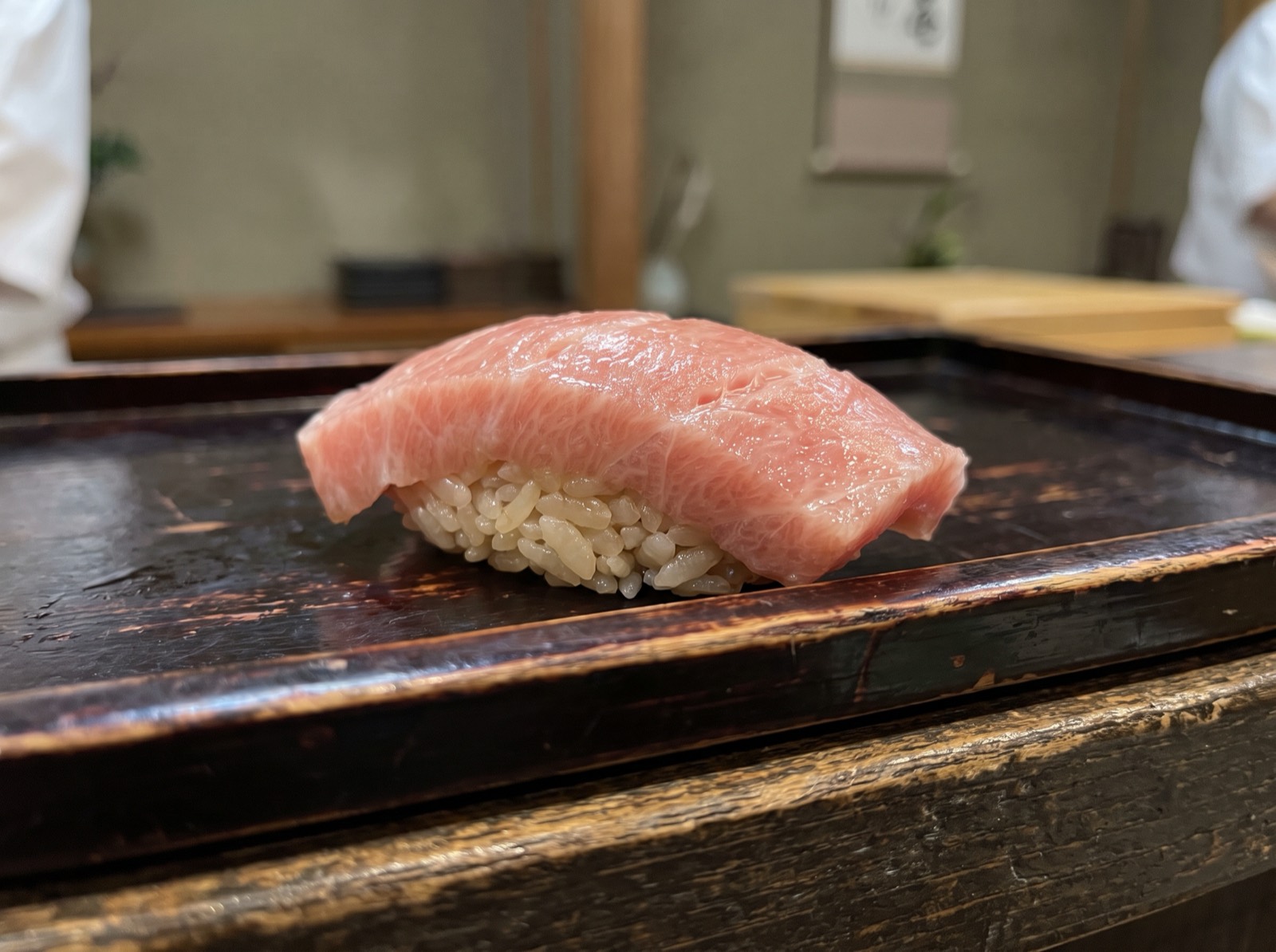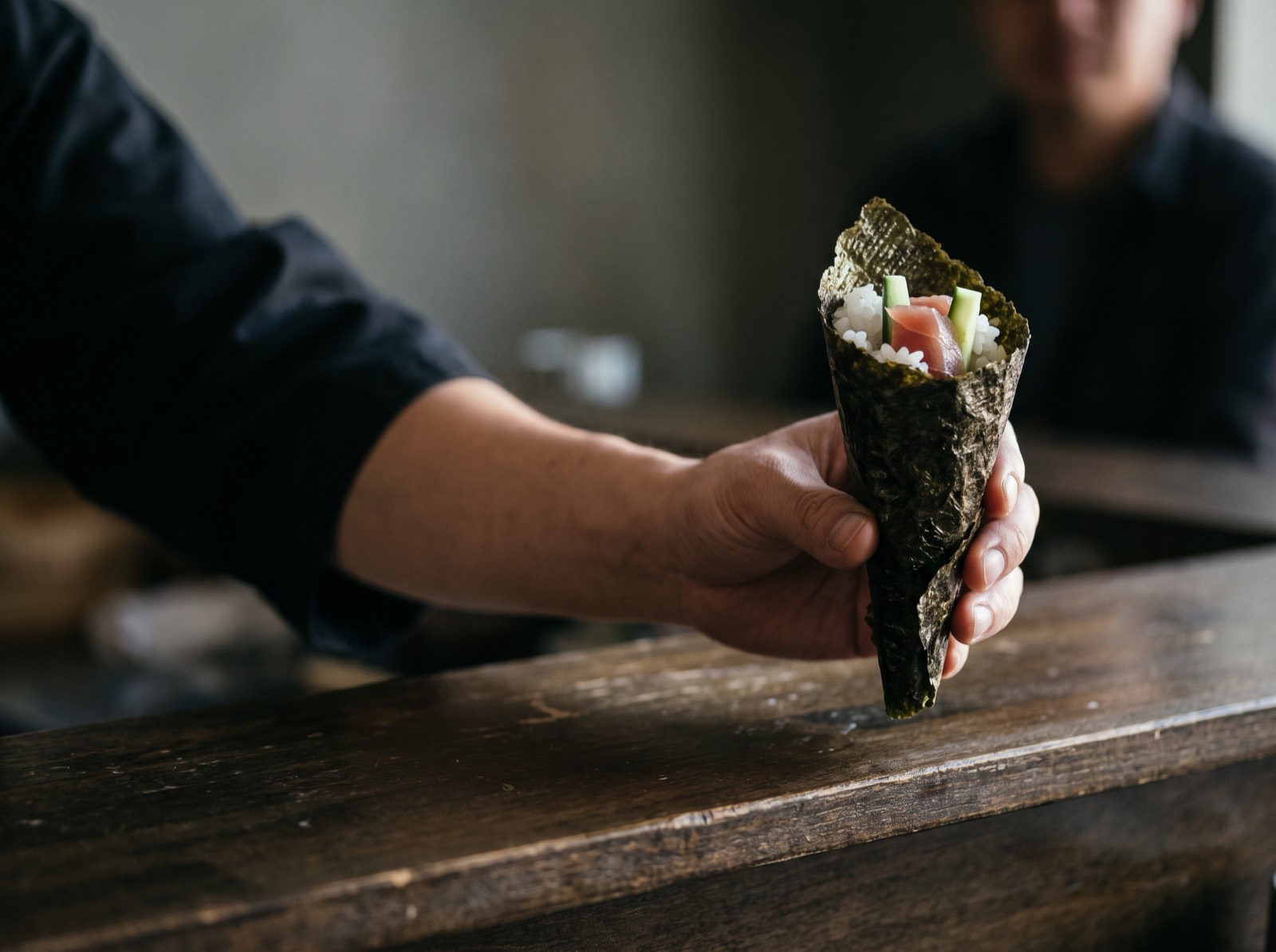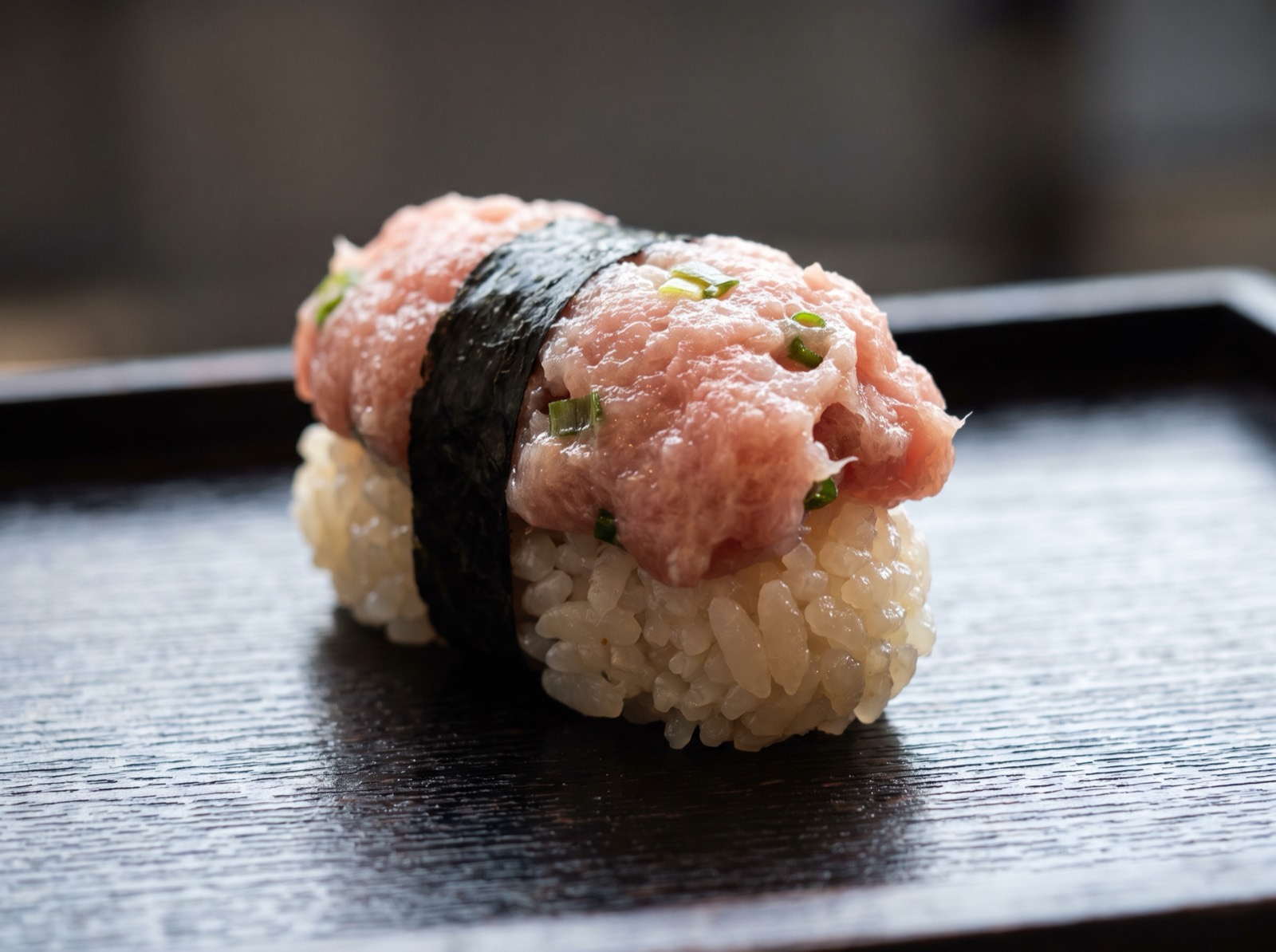
Negitoro (ねぎとろ) is chopped or scraped fatty tuna mixed with negi, spring onion, and served as gunkan, rolled in a hand roll, or spread over rice in a bowl. At a counter it is a piece of intelligent thrift. In a chilled supermarket case it is often an industrial product, and the two share a name and nothing else.
What it is
The honest version begins as a by-product. When a shop breaks down a tuna, meat remains attached to places a knife cannot follow: between the bones, against the skin, and through the heavily sinewed sections of the belly where the connective tissue would be unpleasant to eat in a slice. That meat is scraped off (traditionally with a shell or the back of a spoon, so the sinew is left behind), and the result is a soft, fatty, slightly loose paste of pure tuna.
The scraping from between the bones has its own name, nakaochi (中落ち). Combined with chopped spring onion, which cuts the fat and adds a green sharpness, it becomes negitoro.
Where the name comes from
Japanese sources give two derivations and do not agree.
- From the vegetable. Negi is spring onion, and it is in the dish. This is the obvious reading and the one most people assume.
- From the verb. Negiru or negitoru (ねぎ取る) in the sense of gouging or scraping out, describing the action of taking the meat off the bone. On this account the spring onion was added later and the name is a coincidence that stuck.
We print both because the sources print both. It is a small example of a pattern this site runs into constantly: English writing on sushi tends to pick whichever etymology sounds better and present it as settled, and the Japanese literature is more often undecided.
When it is best
It has no season of its own beyond tuna's, which peaks in winter for wild bluefin. In practice negitoro made at a counter is at its best whenever that shop has broken down a good fish that day, which is to say, it is a freshness question rather than a calendar one. See otoro for the tuna cuts.
What the chef does to it
Scrapes, chops, mixes, serves. There is no cure, no marinade and no cooking. The judgement is in what goes in: a shop making negitoro from genuine bluefin belly trimmings is producing something very close to otoro in flavour at a fraction of the cost, and a shop using it to dispose of tired fish is doing the opposite.
It is nearly always served in a form that can hold a loose filling: gunkan with a nori wall, a temaki hand roll, a thin roll, or over rice as negitoro-don.
At a counter it is the best possible use of an expensive fish. In a pack it is frequently not that fish at all.
What is in the supermarket version
This is the part worth knowing, and it is well documented in Japan while being almost absent from English coverage.
Commercially produced negitoro is not required to be made from bluefin belly, and generally is not. It is commonly built from lower-grade or lower-priced tuna, yellowfin or bigeye rather than bluefin, and a substantial share of the products on sale have added fat, typically a vegetable oil, blended in to reproduce the mouthfeel that genuine belly trimmings would provide. This is legal, it is disclosed in the ingredients list, and almost nobody reads it.
The practical consequences: cheap negitoro is smoother and more uniform than the real thing, which is scrappy and irregular by nature. If a ¥100 plate of negitoro tastes richer than the tuna next to it, that is the tell. And a shop that makes its own will usually be pleased to be asked.
How it differs from what it is confused with
- Negitoro is not otoro. Otoro is a whole slice of belly, cut and served. Negitoro is scraped material, and the word toro in the name describes the fattiness rather than the cut.
- Negitoro is not tuna tartare. No seasoning, no oil, no acid in the counter version: only tuna and spring onion.
- Negitoro is not nakaochi, strictly. Nakaochi is the scraped meat itself, sometimes served on its own; negitoro is that meat with spring onion in it.
- “Spicy tuna” is a different dish entirely: a North American creation with chilli mayonnaise, and no relation.
How to say it
neh-ghee-TOH-roh is understood. Four beats, ne-gi-to-ro, a hard g, and no stressed syllable.
Edomae and Kansai
No meaningful regional split. It is a modern item, considerably younger than the Edomae repertoire, and it spread nationally with the conveyor-belt and supermarket trades that produced it. Osaka's pressed sushi tradition has no version of it, for the same reason it has no uni: a loose filling cannot be pressed.
Where you will see it, and roughly what it costs
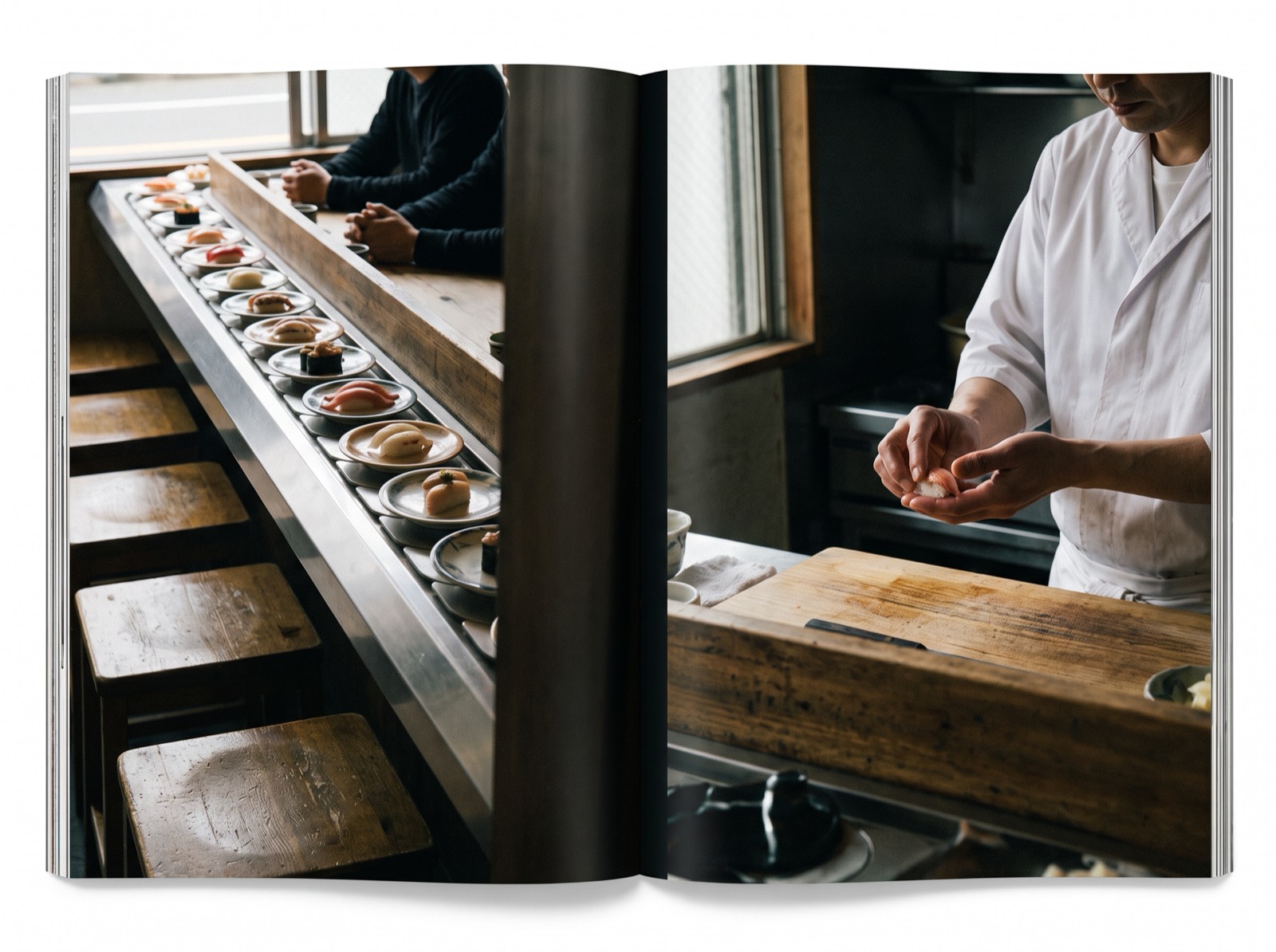
Everywhere, and at the cheap end more than anywhere. It is a fixture of conveyor belts, convenience stores, supermarket bowls and hand rolls. At omakase counters it turns up less often as a named piece, because a shop breaking down whole tuna generally has better uses for the customer's attention, though many will make it for a regular at the end of a meal.
No per-piece figure from us. The price signal here is unusually informative in the other direction: negitoro that costs almost nothing is telling you what is in it. See omakase price tiers. Read the price as an ingredient list.
Frequently asked questions
What is negitoro?
Scraped or chopped fatty tuna mixed with spring onion, served as gunkan, in a hand roll, or over rice. At a sushi counter it is made from the meat that cannot be cut into slices: from between the bones and out of the heavily sinewed belly.
Is negitoro made from real toro?
At a counter, usually yes: belly trimmings scraped off the sinew. Commercially, often not. Supermarket and conveyor-belt negitoro is frequently made from yellowfin or bigeye rather than bluefin, and a substantial share of products have vegetable oil blended in to imitate the fat of genuine belly.
Why does the name include negi?
Japanese sources give two derivations and disagree. One is simply the spring onion in the dish. The other is the verb negitoru, to gouge or scrape out, describing how the meat is taken off the bone; on that account the spring onion came later.
What is the difference between negitoro and otoro?
Otoro is a whole slice cut from the fattiest belly. Negitoro is scraped material (the meat a knife cannot reach) mixed with spring onion. The word toro in negitoro describes richness rather than a specific cut.
How can you tell good negitoro?
Texture and irregularity. Real scraped tuna is scrappy and uneven. If it is unusually smooth and uniform, or tastes richer than the sliced tuna beside it at a fraction of the price, it very likely contains added fat.
Is negitoro traditional Edomae sushi?
No. It is a modern item, much younger than the Edomae repertoire, and it spread nationally with the conveyor-belt and supermarket trades. Counters make it, but it is not part of the classical course.