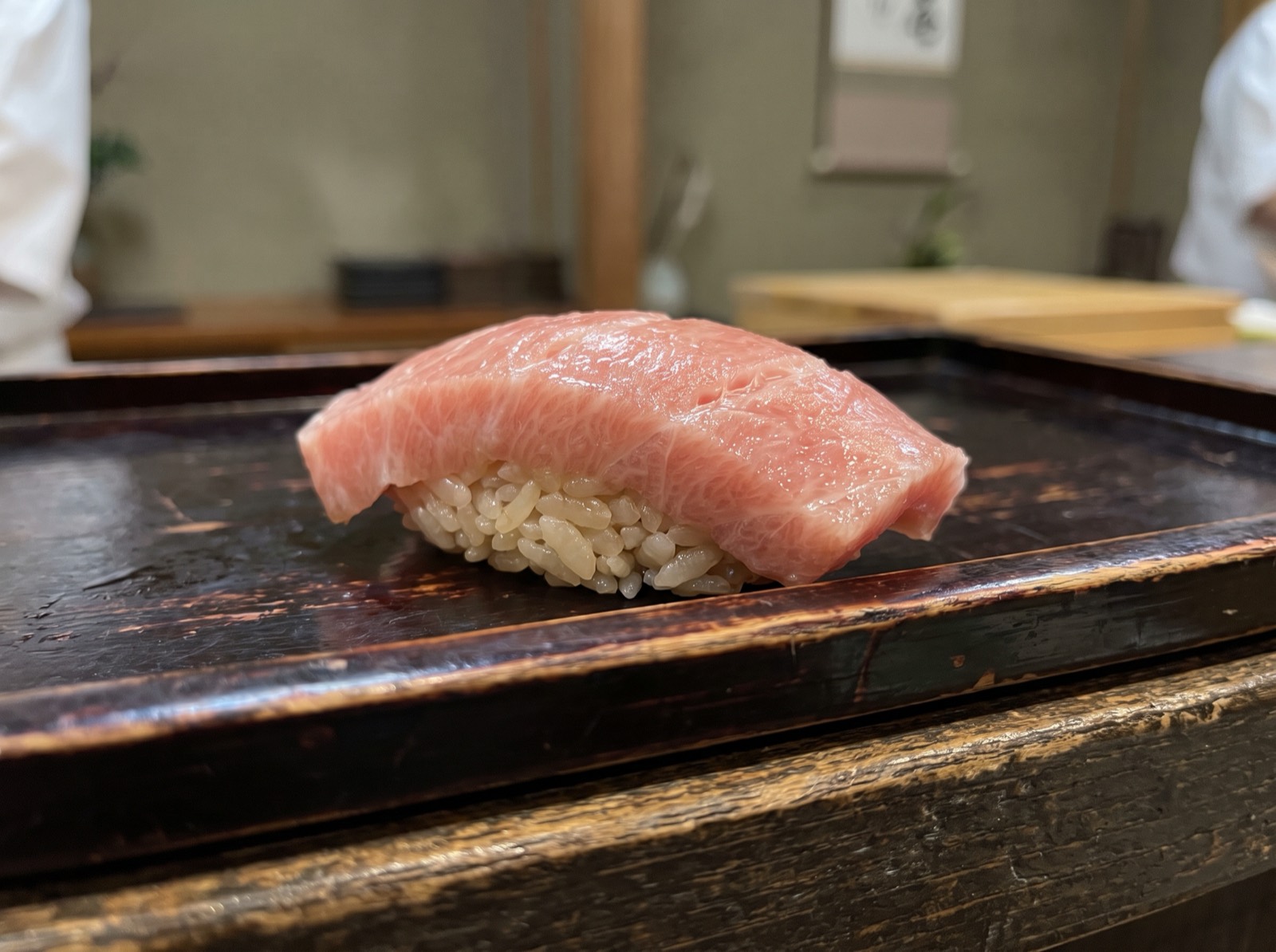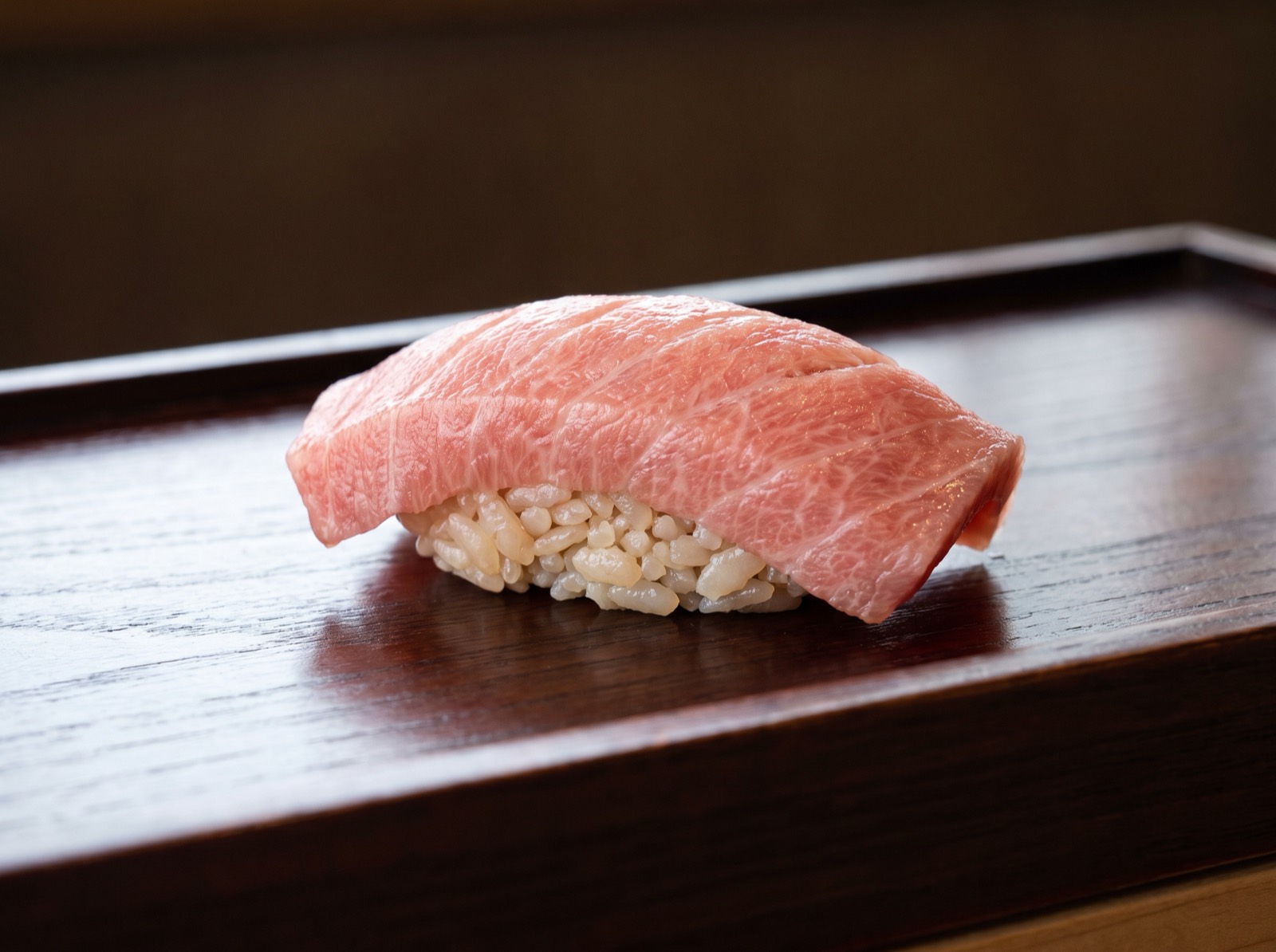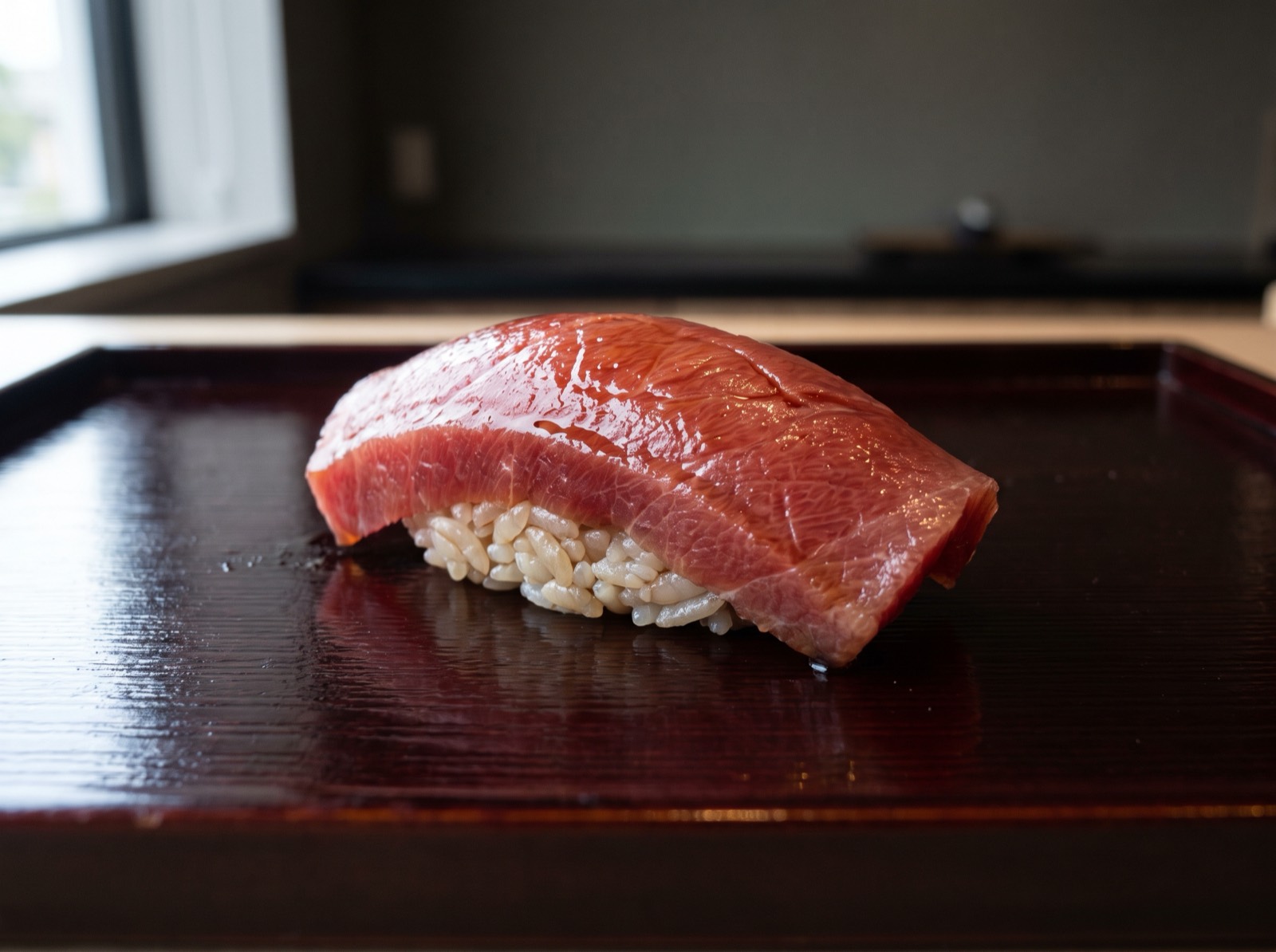
Akami (赤身) is the lean red muscle of the tuna — the loin along the back and the core of the fish, as opposed to the fatty belly grades chūtoro and otoro. It is the cheapest of the three and by a long way the oldest: for most of the history of Edomae sushi, akami was tuna, and the belly was thrown away.
What it is
Tuna is graded at the counter by fat and position, and akami is the lean end of the scale: firm, deep red, close-grained, with a clean iron note and very little richness. It comes from the swimming muscle along the back and through the core of the animal — the part that works hardest.
The colour is the reason it works hard. Tuna is a warm-bodied fish that never stops moving, and its muscle is loaded with myoglobin, the oxygen-storing protein that makes red meat red. That is also why tuna behaves more like beef than like white fish: it darkens in air, it improves with rest, and it carries a mineral flavour that no flatfish has.
One thing akami is not: chiai (血合い), the dark brown-red band running along the lateral line. Chiai is a separate muscle with far more myoglobin again, strong and distinctly metallic, and it is trimmed out before the fish reaches a counter. If a piece sold as akami tastes aggressively of blood, you have been handed trim.
The marinade that came before refrigeration
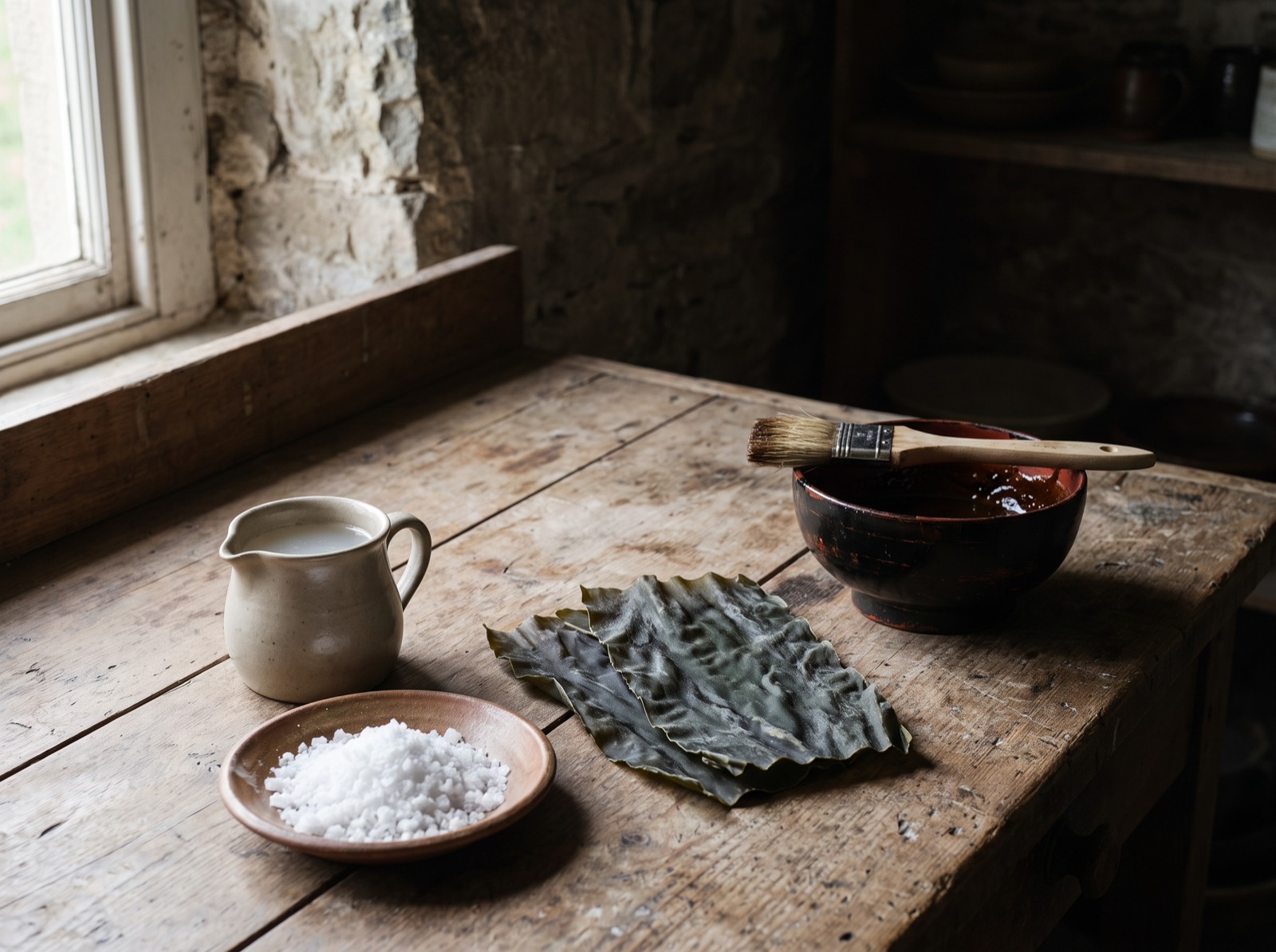
Edo had tuna and no ice. The answer was zuke (漬け): the lean meat was steeped in soy sauce, usually cut with sake and mirin, often after a brief pass through hot water to set the surface. Soy is salt, and salt draws water out, so the marinade both held the fish for a day or two and concentrated what was left.
What zuke does, in order:
- Draws out water. The flesh firms and the flavour concentrates. This is the preservation half of the job.
- Puts salt and savour back in. Soy carries glutamate, so a well-timed piece comes back tasting more of itself rather than of soy sauce.
- Changes the colour. Marinated akami turns a darker, browner red with a lacquered surface. It looks cured because it is.
- Works on the surface only. A short steep affects the outer few millimetres. A long one drives through the whole slice and hardens it, which is the usual failure.
The technique went to the lean meat and not to the belly for a blunt physical reason: soy does not penetrate fat, and fat without cold turns rancid fast. Lean meat could be kept. The belly could not, and was discarded — which is the origin of the trade joke, still current, that the tuna belly was neko-matagi, the thing a cat steps over.
The expensive part of the fish is the part they used to throw away. The cheap part is the part they built the cuisine on.
When it is best
Winter, for wild bluefin in Japanese waters, in the same sense as the belly grades: cold-season fish are in better condition overall. But akami swings much less across the year than otoro does, because what you are eating is muscle rather than stored fat.
The variable that matters more than the month is the individual fish and how long it has rested. A well-aged akami in an ordinary week beats a straight-off-the-boat akami in the best week of the year, and most chefs will say so without much prompting.
What the chef does to it
Ageing, mostly. Tuna is the fish most transformed by controlled resting — days under precise refrigeration soften the texture and build savour — and the effect is far more legible in lean meat than in fatty meat, because nothing else is going on. A shop’s ageing practice is one of the genuinely individual things about it, and akami is where you taste the decision.
Beyond that: the bloodline and any trace of chiai are trimmed away, the block is squared, and the slice is cut a shade thicker than for the fatty grades, because lean meat needs body in the mouth to read as anything at all. Then nikiri, the brushed soy glaze, if the shop is serving it plain.
Some counters serve zuke instead, as a deliberate historical choice rather than a necessity. When they do it is usually early in the sequence and usually announced. Ordering it is not nostalgia: a well-judged zuke is denser and longer in the mouth than the plain version, and it is one of very few pieces on a modern counter doing exactly what it did two centuries ago.
Why chefs judge tuna on it
Because fat forgives. A rich piece of a mediocre fish still tastes rich, and richness reads as quality to almost everybody, which is precisely why the belly commands the price it does. Lean meat forgives nothing. Poor tuna, badly thawed tuna, tuna rested too long or not long enough — all of it shows in akami, and almost none of it shows in otoro.
This is the same logic that makes kohada and the egg the pieces to order when you are trying to read a shop. Akami is the tuna version of that test, with one practical advantage: it is cheap, so the test works at any price tier, including a conveyor belt.
How it differs from what it is confused with
- Akami and chūtoro. Fat content and position on the same fish, not different species. Chūtoro sits at the transition into the belly and is marbled; akami is the muscle above and behind it. No fixed boundary exists between them.
- Akami and chiai. Chiai is the dark lateral band, a different muscle with far more myoglobin and a metallic edge. It is trimmed out of counter sushi and turns up in cheap products and cooked dishes.
- Akami and katsuo. Bonito is a relative and also red-fleshed, but it is a smaller fish with a softer, more acidic, more openly oily flavour, and it is nearly always served with ginger or another sharp aromatic rather than plain.
- Akami and “maguro”. マグロ is the animal; akami is a cut of it. A menu that says only maguro usually means akami, but the species underneath — bluefin, southern bluefin, bigeye, yellowfin, albacore — is a separate question with a large effect on what arrives.
How to say it
a-ka-mi, three even beats, no stressed syllable. The word is ordinary Japanese rather than counter jargon: 赤 is red and 身 is flesh, and the same word is used for the red meat of other fish and of animals. Zuke is zu-ke, two beats, with a hard z as in “zoo”.
Edomae and Kansai
Tuna is Tokyo’s fish and zuke is Tokyo’s technique. Edomae sushi grew up in a city with the tuna trade at its centre and no refrigeration to speak of, and every part of the akami tradition — the marinade, the ageing, the ranking of lean above fat — is an Edo answer to an Edo problem.
Kansai’s historical sushi is pressed and cured rather than red and raw, and its defining fish are mackerel and sea bream; see our comparison of the two traditions. Osaka eats plenty of tuna today, but it inherited the vocabulary rather than inventing it.
Where you will see it, and roughly what it costs
Everywhere, at every tier, and usually the least expensive tuna on any given menu. On a belt it is among the cheapest plates; at a counter it is the piece most likely to open the tuna run, going akami, then chūtoro, then otoro, lean to rich.
No per-piece figure from us. The useful thing about the price is comparative rather than absolute: the gap between akami and otoro at one shop tells you more about that shop’s buying than either number alone. Our cost guide sets out the ranges by format.
Frequently asked questions
What is akami?
The lean red muscle of the tuna, taken from the back and the core of the fish. It is firm, deep red and iron-scented, with very little fat, and it is the cheapest of the three tuna grades served at a sushi counter.
Is akami better than otoro?
Different rather than lesser. Otoro is richer and far more expensive; akami tastes more of the fish and shows the shop’s handling more clearly. Many chefs and long-time eaters prefer it, and ordering it is not settling.
Why is akami red?
Myoglobin. Tuna is a warm-bodied fish that swims continuously, so its muscle carries a high concentration of the oxygen-storing protein that makes red meat red. This is also why tuna behaves more like beef than like white fish, darkening in air and improving with rest.
What is zuke?
Lean tuna steeped in soy sauce, usually cut with sake and mirin. It was the Edo-period method of holding tuna without refrigeration: the salt draws out water, firms the flesh and concentrates the flavour. Some counters still serve it by choice rather than necessity.
What is chiai?
The dark brown-red band of muscle along the lateral line of the fish. It carries far more myoglobin than akami, tastes strongly metallic, and is trimmed away before the fish reaches a sushi counter.
Why do chefs judge a shop’s tuna on akami rather than otoro?
Because fat disguises faults. A rich piece of mediocre tuna still tastes rich, while lean meat shows poor fish, careless thawing and bad ageing immediately. Akami is also cheap, so the test works at any price level.