Katsuo (鰹, skipjack tuna, Katsuwonus pelamis) is a red-fleshed relative of the tuna that passes Japan twice a year. It goes north on the warm current in spring, lean and sharp, and comes back south in autumn carrying fat. Japanese has separate names for the two runs, treats them as different foods, and prefers them for different reasons.
What it is
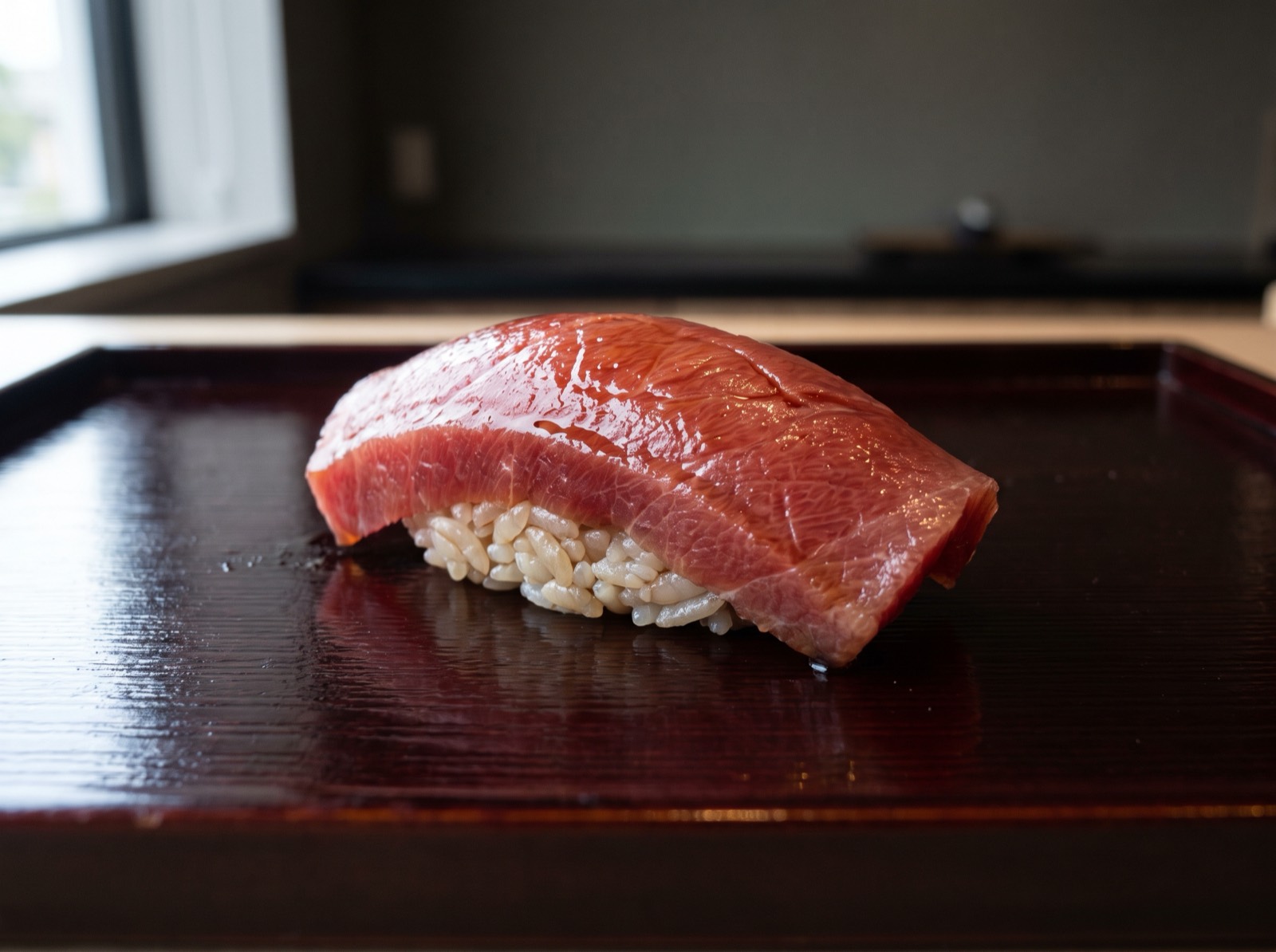
A fast, warm-bodied, open-ocean fish, smaller than a tuna and built the same way: dark red muscle, high myoglobin, no white flesh to speak of. It tastes softer and more acidic than akami, with an oily edge that shows up plainly and that most preparations are designed to answer rather than to hide.
The two runs, and the words for them:
- Hatsu-gatsuo (初鰹), the first bonito. Spring, moving north on the Kuroshio. Lean, firm, clean, faintly sour. This is the one Edo lost its head over.
- Modori-gatsuo (戻り鰹), the returning bonito. Autumn, heading south again after a summer of feeding. Much fatter, softer, rounder. Sometimes sold as toro-gatsuo.
They are the same animal at two points in one migration, and the difference between them is larger than the difference between many pairs of species. If you eat katsuo twice in a year, six months apart, you are effectively eating two things.
What Edo paid for the first one
Hatsu-gatsuo was a status object in Edo, and the record of that is not folklore but literature and price. The haiku everyone still quotes is Yamaguchi Sodō’s, from the late seventeenth century: green leaves for the eyes, the mountain cuckoo for the ears, the first bonito for the mouth — three sensations standing in for early summer, with the fish as the taste of the season.
The other line that survives is a proverb rather than a poem, and it is cruder: that a man would pawn his wife to buy the first bonito. It is quoted in Japan as an illustration of Edo excess, and the excess was real. Being first mattered more than the fish did, which is why the lean spring run — objectively the less delicious of the two — is the one that got the poetry.
The first bonito was never about flavour. It was about being the person who had eaten it.
Modern Japanese eating has quietly reversed the ranking. Ask around now and most people will tell you the autumn fish is better, and the price usually agrees with them. The spring run keeps the prestige and the poems; the autumn run gets eaten.
When it is best
Twice, and choose your criterion. Spring for the lean version with the clean edge, autumn for the fat one. The timing moves with the water and with how far north you are, because the whole point of this fish is that it is travelling.
Kōchi on Shikoku, facing the Pacific, is the prefecture most associated with it, and Tosa — the old name for that province — is attached to the defining preparation.
What the chef does to it
Two answers, depending on the shop.
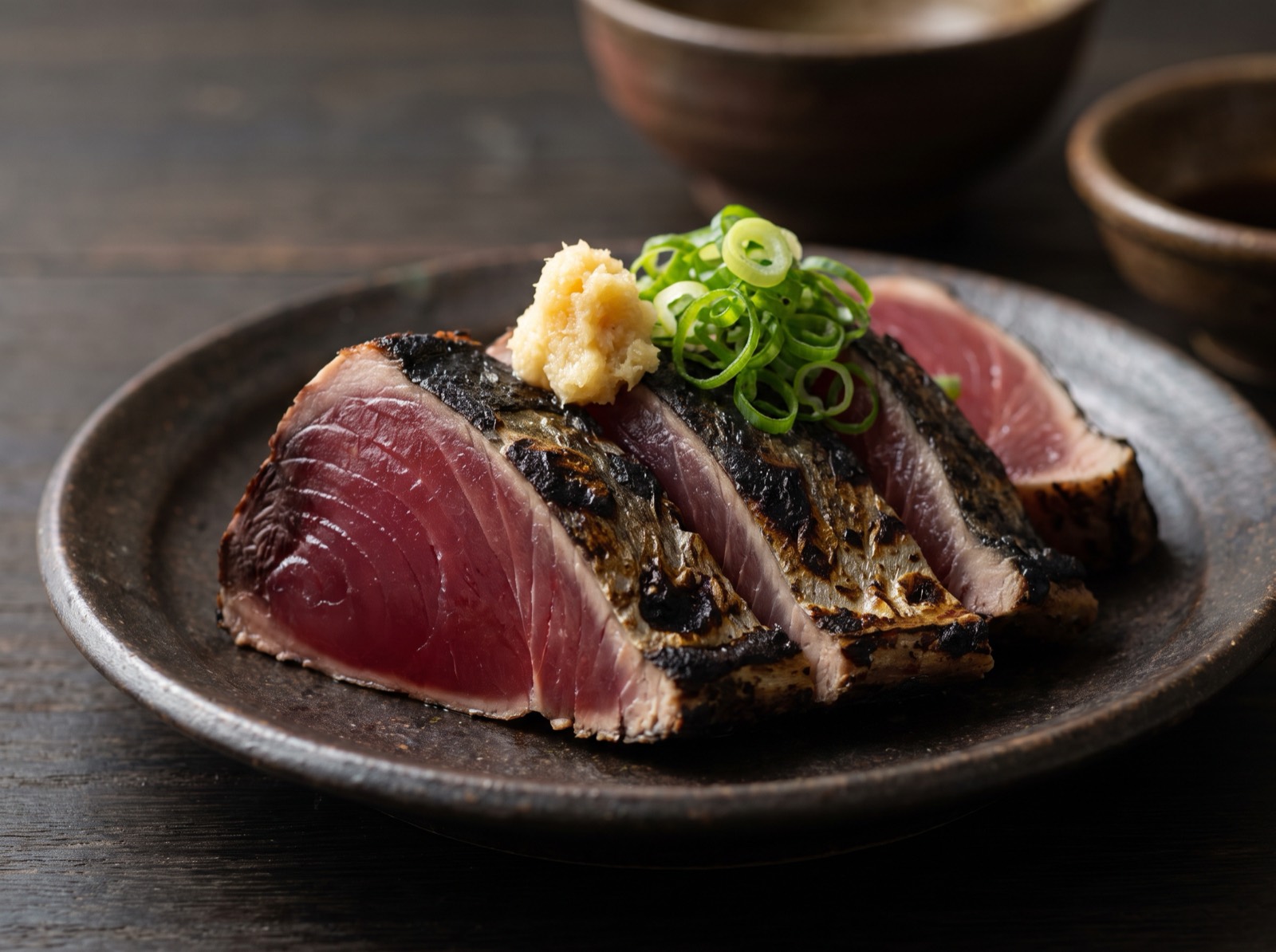
The famous one is tataki (たたき): the fillet is seared hard on the outside and left raw within, then cut thick. In Kōchi the searing is traditionally done over burning rice straw, which burns fast and hot and puts a smoke note into the surface that gas does not. The purpose is not decoration. Katsuo skin is tough and the surface fat is strong; a hard sear makes the skin edible and burns off the top note that people who dislike this fish are usually reacting to.
The second is the sushi answer: raw, sliced as nigiri, and dressed. Katsuo is one of the few pieces that routinely arrives with something on top — grated ginger, thin-sliced garlic, spring onion, myōga or shiso — and with soy already applied rather than a plain nikiri glaze. The aromatics are structural. They are answering the oil.
Both approaches share a third element that is easy to miss: the fish is usually rested. Katsuo goes off faster than most, and a shop serving it well is buying it late and using it quickly rather than holding it.
The parasite, stated plainly
Japan’s Ministry of Health, Labour and Welfare names bonito among the species in which Anisakis larvae are found, along with mackerel, horse mackerel, saury, sardine and squid. The larvae are 2–3 cm long and visible.
The ministry is equally explicit about what does not deal with them: vinegar, salting, soy sauce and wasabi do not kill the larvae. What does is freezing at −20°C for 24 hours or more, or heating to 70°C (60°C for one minute), together with removing larvae by eye during preparation. This is worth knowing because the English-language internet repeats the opposite, and because it explains why a good kitchen’s handling of this particular fish is deliberate rather than casual. Our safety guide sets out the regulatory picture in full.
The other thing this fish becomes
Katsuo is also the raw material for katsuobushi (鰹節), the fillet that is simmered, smoked over weeks, inoculated with mould, dried until it is hard enough to strike, and then shaved into the flakes that make dashi. Which means the same animal supplies both a piece of raw fish on the counter and the savoury base underneath most of the rest of Japanese cooking, including the broth in the egg and the seasoning in the rice.
Nothing else on a sushi menu has that double role, and it is a reasonable answer to the question of why this fish, rather than a better-tasting one, ended up with the poems.
How it differs from what it is confused with
- Katsuo and akami. Both red, both members of the same family, but bonito is smaller, softer, more acidic and more openly oily, and it is dressed with aromatics rather than served plain.
- Katsuo and tataki. Tataki is a preparation, not a fish. It happens to be applied to katsuo more than to anything else, but beef and horse mackerel get the same treatment, and the word also refers to a chopped preparation, which is a different thing entirely.
- Hatsu-gatsuo and modori-gatsuo. One fish, two points in a migration. Lean and firm in spring; fat and soft in autumn. Menus distinguish them and prices follow.
- Katsuo and saba. Both strongly flavoured, both on the ministry’s parasite list, but mackerel is a cured fish in the Japanese repertoire and bonito is a seared or raw one. They are not interchangeable in any preparation.
How to say it
ka-tsu-o, three beats, no stress, with the tsu as a single sound rather than t plus su. In compounds the k softens to g: hatsu-gatsuo, modori-gatsuo. Tataki is ta-ta-ki, three even beats.
Edomae and Kansai
The first-bonito cult was an Edo phenomenon, tied to a city that could afford to compete over being first and to the fish arriving on the Pacific side. The poems, the proverb and the price mania all belong to Tokyo’s ancestor.
The cooking, though, belongs to the south-west. Straw-fired tataki is Kōchi’s, and the dried-fillet industry that turns this fish into dashi has its own regional centres. Osaka eats katsuo without any particular claim on it; Kansai’s cured-fish tradition runs to mackerel, as our comparison of the two cities sets out.
Where you will see it, and roughly what it costs
Widely and seasonally. On a belt it appears in season, usually with ginger and spring onion already on it. At a counter it will show up when it is running, and a shop that cares will tell you which run it is. Outside those windows its absence is a good sign rather than a bad one.
No per-piece figure from us. It is not an expensive fish by counter standards; the price gap between the spring and autumn runs is the number that actually says something. Our season calendar covers what else is running alongside it.
Frequently asked questions
What is katsuo?
Skipjack tuna, a red-fleshed relative of the tuna that migrates past Japan twice a year. It is softer, more acidic and more openly oily than tuna, and it is usually served either seared as tataki or raw with sharp aromatics.
What is the difference between hatsu-gatsuo and modori-gatsuo?
They are the same fish at two points in one migration. Hatsu-gatsuo is the spring run heading north: lean, firm and clean. Modori-gatsuo is the autumn run heading back south after a summer of feeding: much fatter and softer. Most people today prefer the autumn fish.
Why is katsuo seared?
Because the skin is tough and the surface fat is strong. A hard sear — traditionally over burning rice straw in Kōchi — makes the skin edible and burns off the top note that people who dislike this fish are usually reacting to. The interior stays raw.
Is katsuo safe to eat raw?
Japan’s Ministry of Health, Labour and Welfare lists bonito among the species in which Anisakis larvae are found. The ministry states that vinegar, salt, soy sauce and wasabi do not kill them; freezing at minus 20C for 24 hours or more, heating, and visual removal during preparation do. Kitchens handling this fish do so deliberately.
What is katsuobushi?
The same fish, simmered, smoked over weeks, inoculated with mould and dried hard, then shaved into flakes to make dashi. It is the savoury base of most Japanese cooking, which means one animal supplies both a raw sushi topping and the broth underneath everything else.
When is katsuo in season?
Twice. Spring for the lean run, autumn for the fatty one. The timing shifts with the water temperature and with latitude, because the fish is migrating.