Yes, with one qualification worth knowing. Japan treats fish sold for raw consumption as a legally defined category with a bacterial limit and a storage rule, and since 1 June 2021 every food business in the country has been required to run HACCP-based hygiene management. Those rules are aimed at bacteria. What they do not remove is a parasite — and vinegar, salt, soy sauce and wasabi do not kill it.
The rule that governs every counter
Since 1 June 2021, under the revised Food Sanitation Act promulgated on 13 June 2018, all food businesses in Japan are in principle required to carry out hygiene management in line with HACCP. Small operators are permitted a simplified approach, following a handbook written for their sector rather than building a system from scratch. A two-seat stand-up counter in a market arcade and a hotel kitchen are held to the same framework at different scales.
This is worth stating plainly because the English-language version of the question (how can a country serve this much raw fish safely) usually gets answered with atmosphere: the fish is fresher, the chefs are more careful, the culture is more exacting. Those things may be true, but they are not the mechanism. The mechanism is a statutory hygiene requirement with a date on it.
“Sashimi-grade” is not a legal term
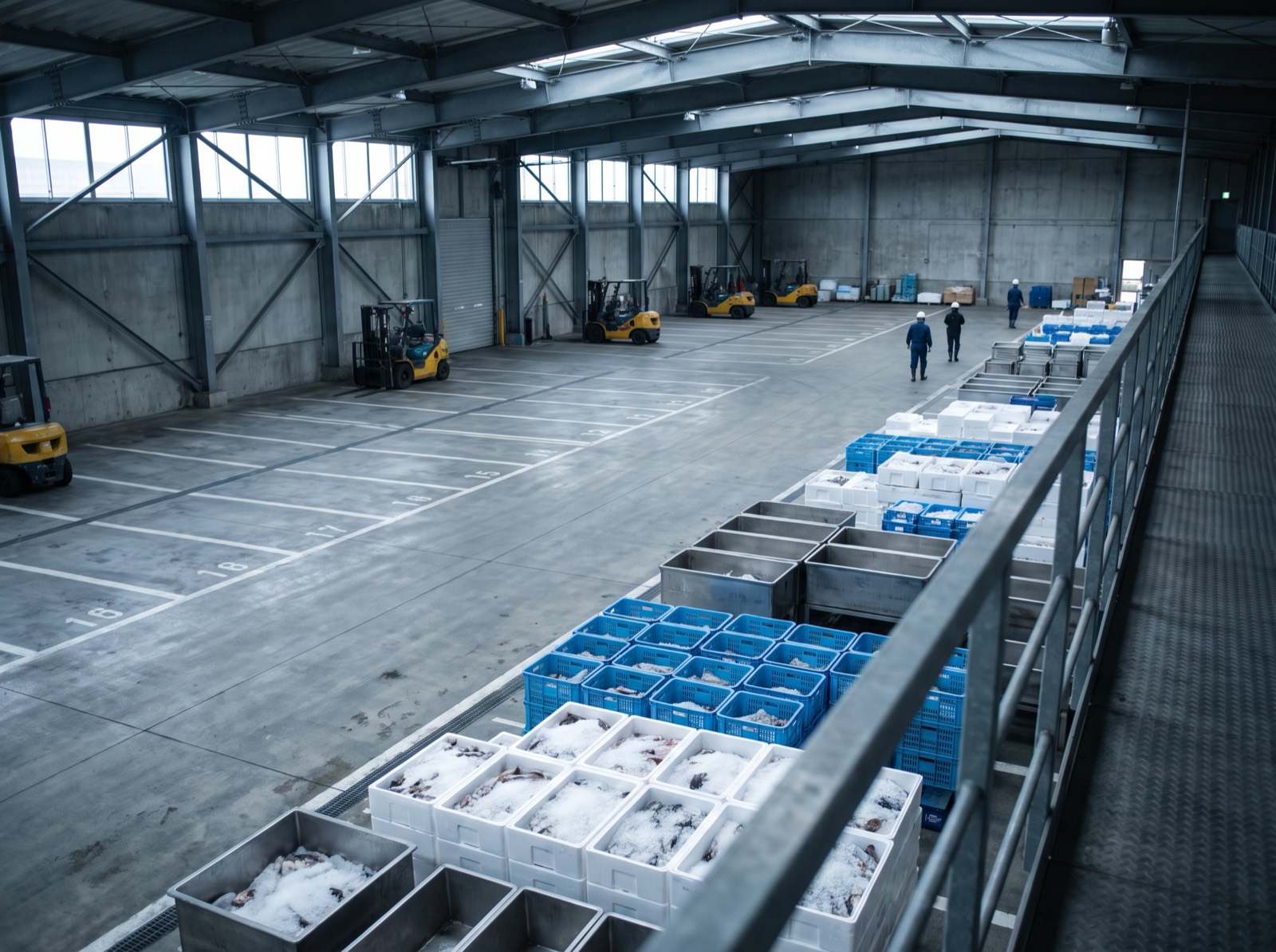
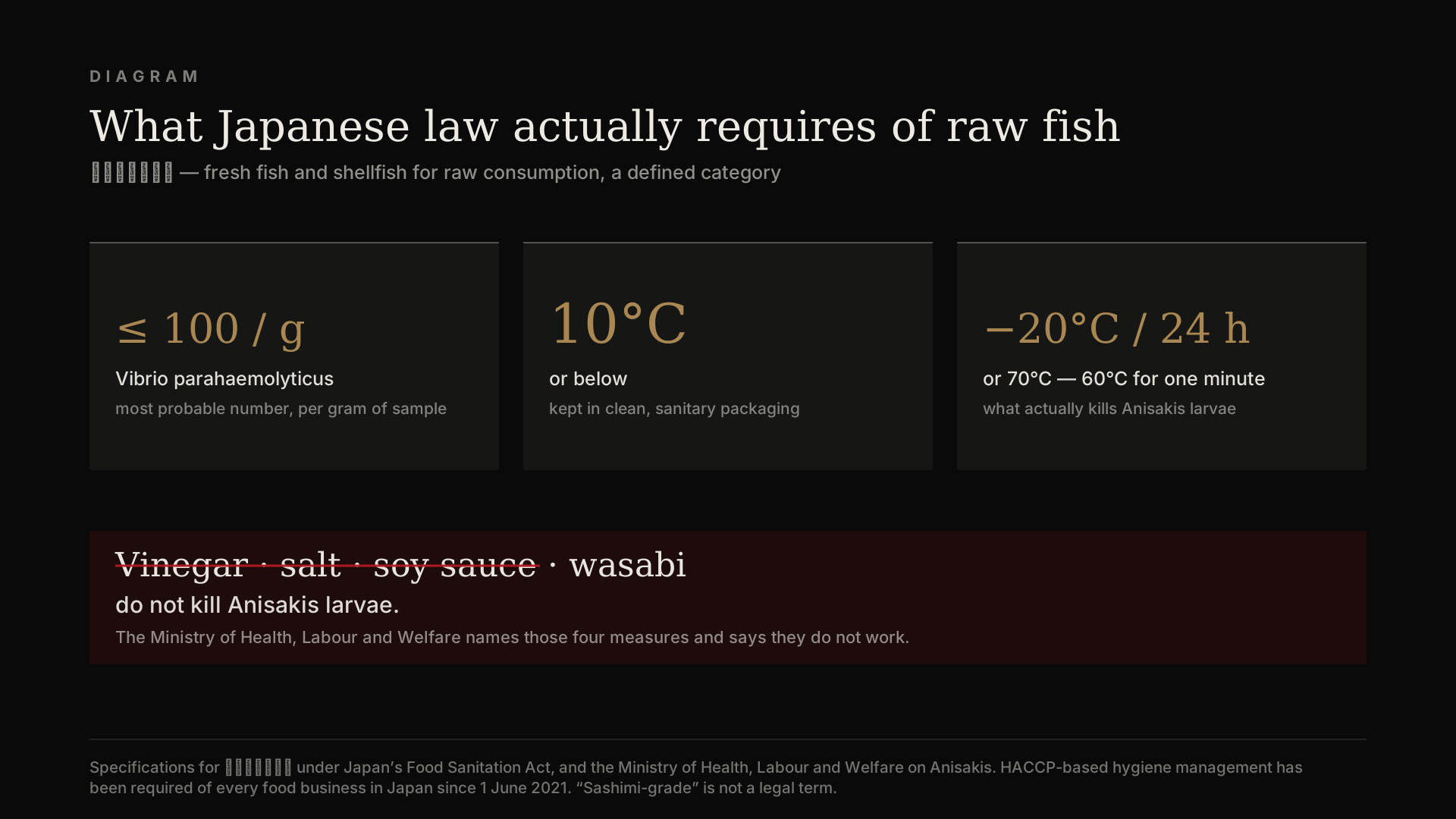
The phrase circulates widely in English and has no standing in Japanese law. What does exist is a regulated category, 生食用鮮魚介類, fresh fish and shellfish for raw consumption, with specifications attached to it.
- A bacterial limit. The most probable number of Vibrio parahaemolyticus must be 100 or fewer per gram of sample.
- A storage rule. It must be kept in clean, sanitary packaging at 10°C or below.
- A water restriction. Water used in processing is limited to potable water for food manufacturing, sterilised seawater, or artificial seawater made with that water.
- A raw-material condition. The starting fish must be in good condition.
So when a shop outside Japan tells you a fish is sashimi-grade, it is making a trade claim, not citing a standard. Inside Japan there is a standard, and it is a number.
The parasite, and the four things that do not kill it
Anisakis is a nematode. The larvae are roughly 2–3 cm long and 0.5–1 mm wide (visible, if you are looking), and they are found in mackerel, horse mackerel, saury, bonito, sardine and squid. That list is not incidental: it is a list of fish that appear on Edomae counters constantly.
Japan’s Ministry of Health, Labour and Welfare states explicitly that treating fish with ordinary culinary vinegar, salting it, or adding soy sauce or wasabi does not kill Anisakis larvae. This is the direct refutation of the most repeated claim in English-language sushi writing: that the wasabi is antibacterial protection, or that the vinegar in the rice makes the fish safe. It is not a matter of interpretation. The ministry names those four measures and says they do not work.
Wasabi is not a safety device. It is a seasoning that English-language writing promoted into a safety device.
What does work is also stated, and it is short: freezing at −20°C for 24 hours or more, or heating to 70°C or above (60°C for one minute), together with removing larvae by eye during preparation. Two temperatures and a pair of trained eyes.
Which means frozen is not a downgrade
A great deal of English-language writing treats never-frozen as a mark of quality and frozen as a compromise. Officially, freezing is one of the two measures that reliably works. Deep-freezing at sea is standard practice for tuna and has been for decades, and a counter serving it is not cutting a corner.
The useful distinction is not frozen versus fresh but handled versus unhandled: whether the fish went through the treatments the craft is built on. See what Edomae actually means, where curing, marinating and ageing are described as the work they are rather than as historical decoration.
What it feels like, and when
Two forms, distinguished mainly by timing. Acute gastric anisakiasis produces severe pain below the breastbone, nausea and vomiting, from a few hours to about a dozen hours after eating. Acute intestinal anisakiasis produces severe lower-abdominal pain and symptoms of peritonitis, from a dozen hours to several days later.
The practical point for a traveller is the interval. Onset can be slow enough that the meal is no longer the obvious suspect, which is why it is worth knowing the pattern before you need it. A larva lodged in the stomach is usually removed endoscopically; when it has travelled further down, the case is handled differently. Either way it is not a condition to sit out — see a doctor, and say what you ate and when.
How common is it, actually
Japan recorded 1,037 food-poisoning incidents in 2024, with 14,229 patients and 3 deaths, across the whole country and every kind of food business. Anisakis accounted for the largest share of incidents at 31.8 percent, ahead of norovirus at 26.6 percent and campylobacter at 20.1 percent.
Read the second number before drawing a conclusion. By patients rather than by incidents, norovirus accounts for 60.8 percent and Anisakis for 2.4 percent. Anisakis leads the incident count precisely because it typically affects one person at a time — one diner, one larva, one report. It is the most frequent cause and among the smallest in scale, and those two facts are the same fact seen from two directions.
Who the advice is actually for
The English-language answer to whether you can eat sushi while pregnant in Japan is usually imported from American or British guidance, and it has little to do with anything Japan publishes. Japan does have a formal advisory for pregnant women, issued on 2 November 2005 and revised on 1 June 2010 by a subcommittee of the Pharmaceutical Affairs and Food Sanitation Council. It is not about raw fish. It is about mercury, and it takes the form of a table.
The table gives a frequency per species against a standard portion of about 80 g. Alfonsino, swordfish, Pacific bluefin and bigeye tuna sit at up to once a week; southern bluefin, striped marlin, blue shark and クロムツ at up to twice. Two entries are stricter still, though neither of them reaches a sushi counter: short-finned pilot whale at up to once a fortnight, and bottlenose dolphin at up to once every two months. The advisory then supplies the conversion that makes it legible at a counter: one piece of sushi or one slice of sashimi is about 15 g, and a serving of sashimi about 80 g. Once a week for bluefin therefore works out, in the ministry’s own arithmetic, at something like five or six pieces.
It is a table of frequencies, not a list of things to avoid. The advisory says so in its own text.
What the document declines to say matters as much. It states that it is not asking pregnant women to avoid the fish listed. It records that average mercury intake through food in Japan runs at around 60 percent of the tolerable level the Food Safety Commission set for pregnancy. It exempts yellowfin, albacore, メジマグロ — juvenile bluefin — and canned tuna outright, as low enough to eat normally. And the fetal effect under discussion is described in the text as something on the order of a response to sound delayed by under a thousandth of a second.
Children are not covered at all, and neither are nursing mothers or adults who are not pregnant. The reasoning is set out rather than assumed: infants show lower exposure, children excrete methylmercury as adults do and the effect on the brain is similar to an adult’s, and the Seychelles Child Development Study found no demonstrated methylmercury-related harm to children’s neural development. Mercury reaching an infant through breast milk is low. On the ministry’s own reading, a child may eat any tuna normally.
There is also a documented reason Japan’s list looks different from the American one. Shrimp, salmon and cod carry intake guidance in the United States and appear nowhere in Japan’s advisory. Japan built its table from a survey of what is actually sold here — about 450 species and roughly 16,400 samples — in which those three measured low. The gap between the two countries is not a gap in caution. It is a gap in which fish were on the counter when somebody went to measure.
The group Japan does warn separately
One more population appears in Japanese guidance, and the food named is not sushi. Listeria monocytogenes grows at refrigeration temperature and in high salt, where most foodborne bacteria cannot, and the health ministry’s consumer notice identifies pregnant women, people aged 65 and over, and people with reduced immune function — diabetes, kidney disease, cancer, HIV, steroid treatment — as those who become seriously ill. People aged 65 and over account for 77.6 percent of listeriosis patients.
The foods that notice names are unpasteurised natural cheese, cured ham, meat and fish pâté, and smoked salmon: chilled, ready to eat, and often weeks old by the time they are. That is a different category of food from a piece of fish cut to order in front of you, and the two are worth keeping apart rather than folding into a general unease about anything uncooked.
Radioactivity, since it gets asked
Japan’s limit for radioactive caesium in food is 100 becquerels per kilogram. The Fisheries Agency has run continuous sampling of seafood in Fukushima and neighbouring prefectures since 2011, in coordination with local authorities and industry bodies; the cumulative total stood at 233,821 samples as of 1 July 2026, and the share exceeding the limit has trended downward over time.
What this adds up to at a counter
- The framework is statutory, not cultural: HACCP-based management has been required of every food business since June 2021.
- Raw fish is a defined category with a bacterial specification and a 10°C storage rule behind it.
- The real risk is a parasite, and the seasonings on your plate are not the defence against it.
- Freezing is a legitimate control, not an admission of lower quality.
- The advice for pregnancy is about mercury, is a frequency table rather than a prohibition, and does not extend to children.
- Know the symptom pattern and its delay, and see a doctor rather than waiting it out.
For what happens before the fish reaches the counter, see Toyosu Market; for the treatments applied to it afterwards, Edomae sushi; for the conventions of eating it, sushi etiquette.
Frequently asked questions
Is it safe to eat raw fish in Japan?
Yes. Fish sold for raw consumption is a legally defined category in Japan with a bacterial specification (a Vibrio parahaemolyticus most probable number of 100 or fewer per gram) and a storage rule of 10°C or below, and every food business has been required to run HACCP-based hygiene management since 1 June 2021.
Does wasabi kill parasites in sushi?
No. Japan's Ministry of Health, Labour and Welfare states explicitly that wasabi, soy sauce, salting and ordinary culinary vinegar do not kill Anisakis larvae. The measures that work are freezing at −20°C for 24 hours or more, heating to 70°C (or 60°C for one minute), and removing larvae by eye.
What is Anisakis?
A parasitic nematode whose larvae are about 2–3 cm long and 0.5–1 mm wide. It is found in mackerel, horse mackerel, saury, bonito, sardine and squid. Eating a live larva can cause acute gastric or intestinal anisakiasis.
How soon do symptoms appear?
Gastric anisakiasis brings severe pain below the breastbone, nausea and vomiting from a few hours to about a dozen hours after eating. Intestinal anisakiasis brings severe lower-abdominal pain and peritonitis symptoms from a dozen hours to several days later.
Does 'sashimi-grade' mean anything?
Not legally. It is a trade phrase with no standing in Japanese law. What Japan has is the regulated category of fresh fish and shellfish for raw consumption, with specifications for bacteria, storage temperature, processing water and raw-material condition.
Is frozen fish lower quality at a sushi counter?
No. Freezing at −20°C for 24 hours or more is one of the two officially recognised measures against Anisakis, and deep-freezing at sea has been standard practice for tuna for decades. The meaningful distinction is how the fish was treated, not whether it was frozen.
Is seafood from Japan tested for radioactivity?
Yes. Japan's limit for radioactive caesium in food is 100 Bq/kg, and the Fisheries Agency has sampled seafood in Fukushima and neighbouring prefectures continuously since 2011: 233,821 cumulative samples as of 1 July 2026, with the share exceeding the limit trending downward over time.
Can you eat sushi while pregnant in Japan?
Japan's advisory for pregnant women is about mercury rather than raw fish, and it is a table of frequencies rather than a prohibition — it states in its own text that it is not asking pregnant women to avoid the fish listed. A standard portion is about 80 g, and the ministry counts one piece of sushi or one slice of sashimi as about 15 g. Alfonsino, swordfish, Pacific bluefin and bigeye tuna are listed at up to once a week; yellowfin, albacore, meji and canned tuna are exempt.
Which fish does Japan tell pregnant women to limit?
Up to once a week at a portion of about 80 g: alfonsino, swordfish, Pacific bluefin tuna, bigeye tuna, Japanese Babylon whelk, Baird's beaked whale and sperm whale. Up to twice a week: yellowback seabream, striped marlin, yumekasago, southern bluefin tuna, blue shark, Dall's porpoise and kuromutsu. Stricter still, though neither reaches a sushi counter: short-finned pilot whale up to once a fortnight, and bottlenose dolphin up to once every two months. Shrimp, salmon and cod are not on the list at all — Japan's survey of about 450 species found their mercury low.
Can children eat sushi in Japan?
Japan's mercury advisory does not cover children. The Food Safety Commission identified the fetus as the high-risk group, and concluded that children excrete methylmercury as adults do with a similar effect on the brain; the Seychelles Child Development Study found no demonstrated methylmercury-related harm to children's neural development. The ministry states that children may eat any tuna normally. That is a statement about mercury, not about raw fish in general: the parasite described above does not distinguish by age, and the freezing rule that manages it applies to everyone equally.
Does Japan warn older or immunocompromised people about raw fish?
The separate warning Japan publishes concerns Listeria, which grows at refrigeration temperature and in salt. It names pregnant women, people aged 65 and over, and people with reduced immune function, and the foods it names are unpasteurised natural cheese, cured ham, meat and fish pâté and smoked salmon rather than sushi. People aged 65 and over account for 77.6 percent of listeriosis patients.