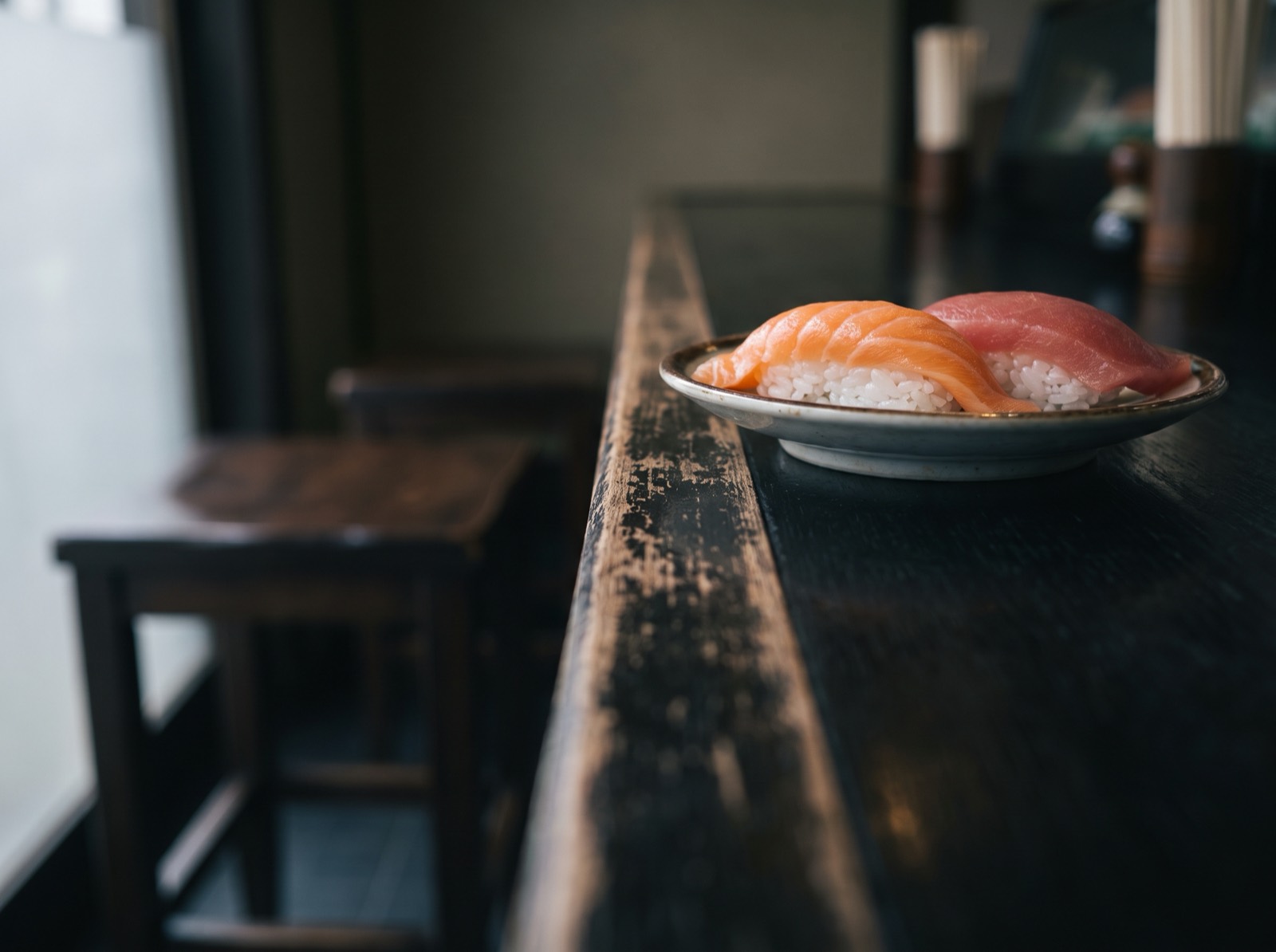
Wasabi (山葵) is the rhizome of a plant grown in cold running water, grated to a fine paste and used in tiny quantity between fish and rice. At a counter it is already inside the piece before it reaches you. Almost everything else visitors believe about it — that you mix it into soy sauce, that more is better, that it makes raw fish safe — is wrong, and the last one matters.
What it is
Eutrema japonicum, a plant of the mustard family, grown along mountain streams in gravel beds fed by constant cold water. The part used is the thickened stem, the rhizome, which grows slowly — the good ones take years — and which is sold whole, still green, with the leaf stalks trimmed.
It is called hon-wasabi (本わさび), “true wasabi”, specifically to distinguish it from what is usually in the tube. There are two growing methods: sawa-wasabi (沢わさび), grown in flowing water, which is the premium product, and hatake-wasabi (畑わさび), grown in damp fields, which is coarser and mostly goes into processing.
Where it grows
Shizuoka’s wasabi terraces are the reference case. The Japanese agriculture ministry records the region’s cultivation as running back roughly four hundred years and recognised the system internationally in March 2018 as a Globally Important Agricultural Heritage System.
What is being recognised is a piece of hydraulic engineering rather than a crop. The tatami-ishi (畳石式) method builds the beds in graded layers — large stones at the bottom, progressively finer material above — so that spring water passes continuously through the bed, holding a steady temperature and carrying away waste while it goes. The ministry notes that the system needs very little fertiliser, because the water itself does the work.
What the chef does to it
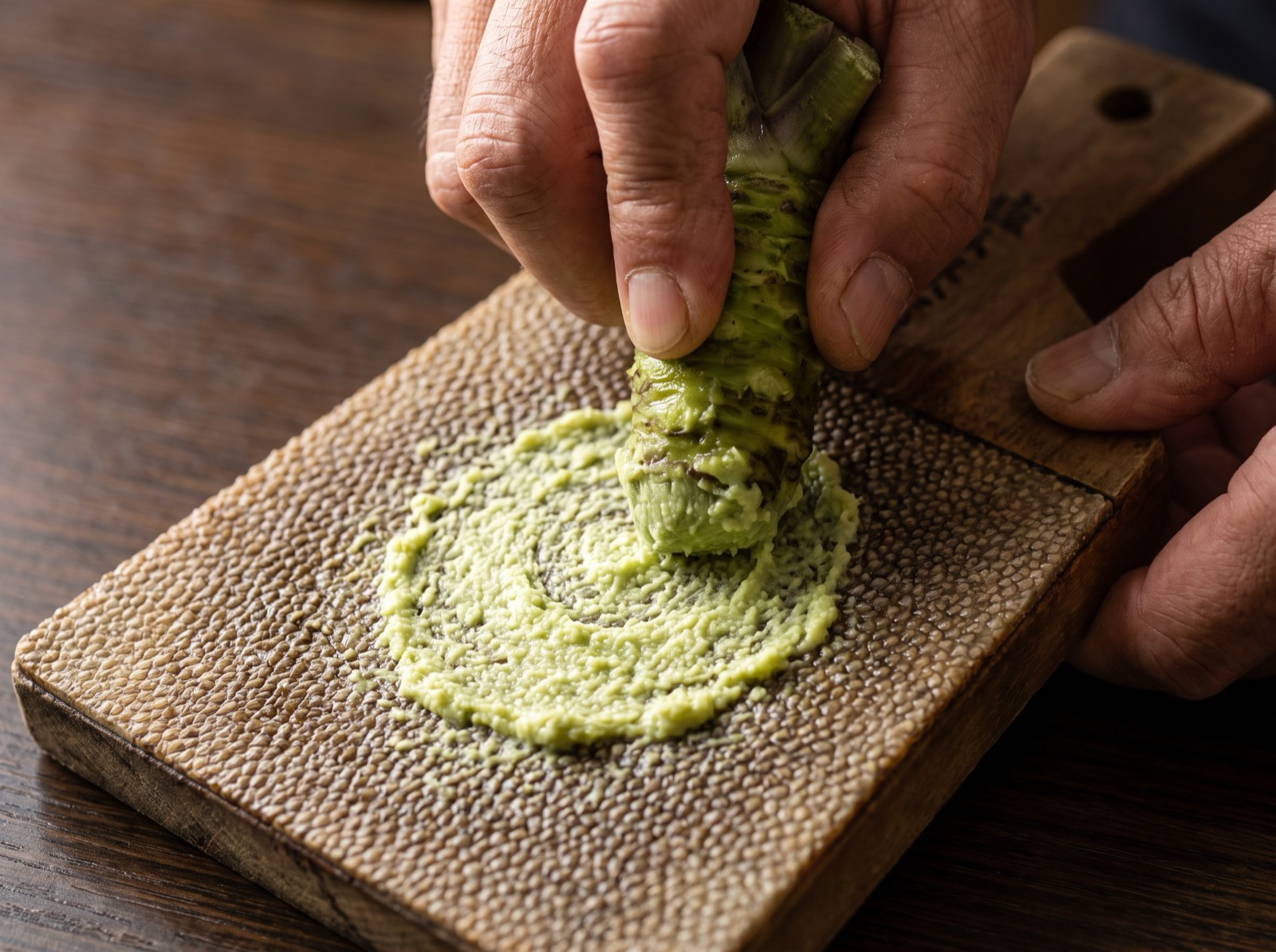
Grates it, seconds before the piece is made, and not before.
- The grater. Traditionally same-gawa (鮫皮), a paddle faced with dried sharkskin. The fine, irregular tooth ruptures the cells rather than shredding them, which is what produces the aroma; a metal grater produces something coarser and hotter and less interesting.
- The motion. Slow circles, with the rhizome held nearly upright. Speed makes it hot and crude.
- The end used. The stem end — the top, where the leaves were — is the sweeter, finer part and is grated first.
- The clock. The pungency is generated at the moment of grating, peaks within a couple of minutes and then fades. This is not a flavour that keeps, which is the entire argument for grating to order.
Chemically, the heat does not exist in the intact plant. Grating breaks the cells and lets an enzyme act on a stored compound, producing the volatile that goes up the nose rather than across the tongue — which is why the sensation clears in seconds, and why chilli heat and wasabi heat behave nothing alike.
The pungency is not an ingredient. It is a reaction, and it starts when the grater does.
What it does not do
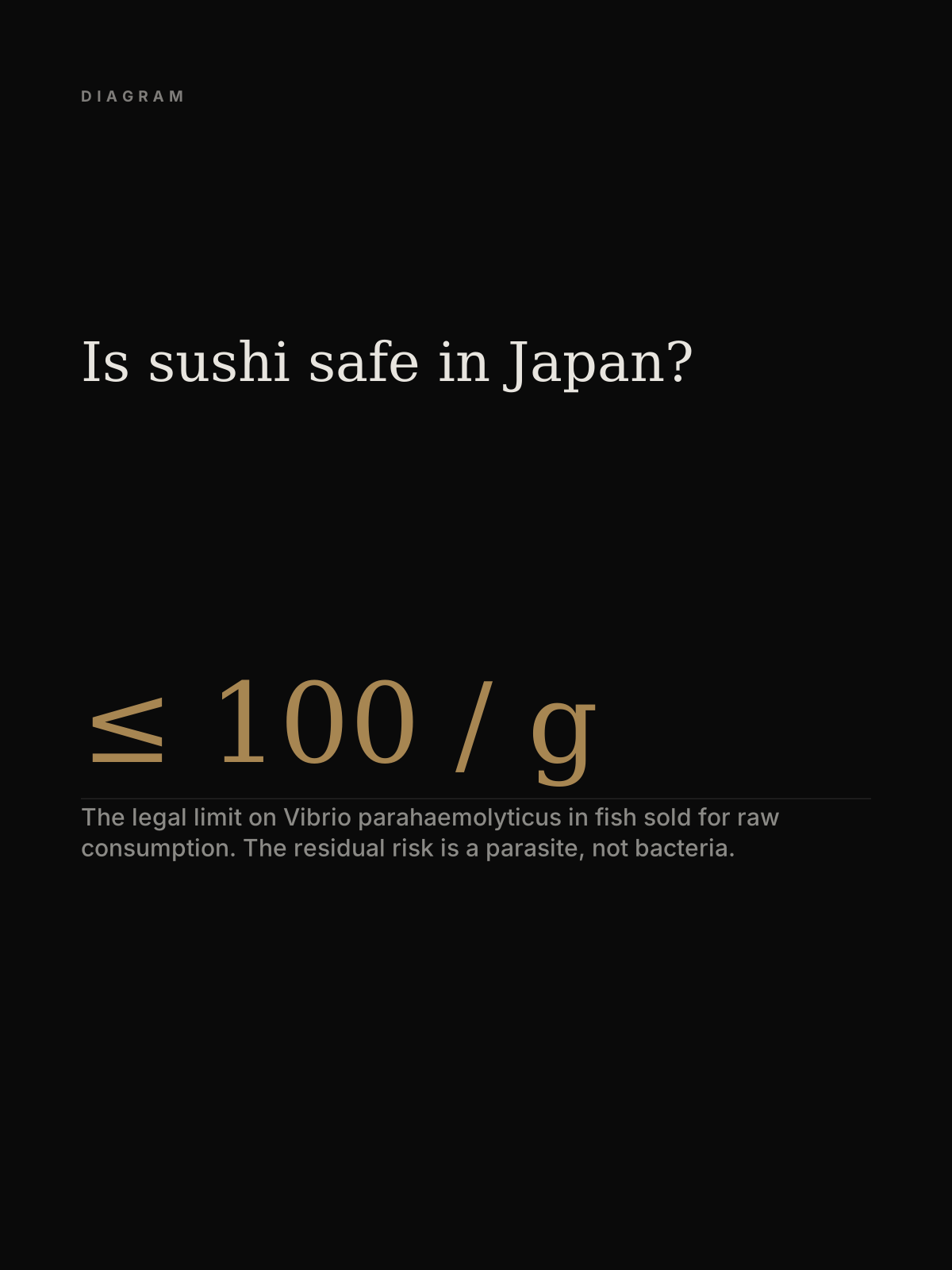
It does not make raw fish safe. The Japanese Ministry of Health, Labour and Welfare states plainly that wasabi, along with vinegar, salting and soy sauce, does not kill anisakis larvae. What works is freezing at −20°C for at least 24 hours, or heating to 70°C, plus visual removal by the person handling the fish. The full account is in our guide to whether sushi is safe in Japan.
This matters because the folk explanation — that wasabi was traditionally used as a disinfectant for raw fish — is widely repeated, including by people who ought to know better. Wasabi is there because it tastes right against fish and because it cuts fat. That is enough of a reason. It is not a safety measure and should not be eaten as one.
How it differs from what it is confused with
- Hon-wasabi and tube wasabi. Most wasabi sold worldwide, and a great deal of it in Japan, is horseradish — seiyō-wasabi (西洋わさび), “western wasabi” — with mustard and green colouring. It is hotter, flatter, and lacks the sweetness and the aroma. Japanese labelling distinguishes the two, and a shop grating the real thing will usually let you see it happen.
- Wasabi and karashi. Karashi is Japanese mustard, yellow, and belongs with entirely different food.
- Wasabi paste and wasabi powder. Powder is reconstituted with water and is almost always horseradish-based.
- Wasabi and the leaves and stalks. Both are eaten in Japan, pickled or dressed. They are a vegetable dish, not a condiment, and they will not appear on a sushi counter.
How to say it, and how to ask about it
wa-sa-bi, three even beats, flat — not wa-SAH-bee. At a counter the trade word for it is namida (なみだ), “tears”, which is the kind of jargon that is charming when a chef uses it and slightly odd when a visitor does.
The phrase that is genuinely useful is sabi-nuki (さび抜き) — “without wasabi” — said politely and at the start, before the first piece rather than after it. It is an entirely normal request, it is what parents order for children, and no chef will think anything of it. Asking for extra wasabi mid-sequence, on the other hand, reads as a comment on the seasoning; our guide to counter etiquette covers the register.
Do not mix it into the soy sauce. The piece already contains the amount the chef chose, dissolving it into the dish flattens both, and it is the single most visible tourist tell at a counter. What not to do has the rest.
Edomae and Kansai
Wasabi inside the piece is Edomae practice and is standard at counters in both cities. The visible difference is upstream: Shizuoka, the reference growing region, is close enough to Tokyo that fresh rhizome has always been a Tokyo ingredient, and the Edomae system of curing and marinating fish described in our guide assumed it.
Kansai’s pressed and boxed forms lean more often on other aromatics — kelp, vinegar, citrus peel, ginger — because a form that is made in advance cannot rely on something that fades in two minutes. See the two traditions compared.
Where you will see it, and roughly what it costs
Freshly grated rhizome at counters from the middle tier upward; tube product below that, and on almost every conveyor belt. Whole rhizome is genuinely expensive by weight, which is the honest reason for the substitution rather than any conspiracy.
No per-gram figure from us. What is worth watching for is the grater: if there is a sharkskin paddle in view and a green stub sitting on it, you are getting the real thing, and the sweetness on the finish will tell you before the heat does. Our guide to what sushi costs covers where those lines fall.
Frequently asked questions
Is most wasabi real wasabi?
No. Most wasabi sold worldwide, and a great deal of it in Japan, is horseradish with mustard and green colouring. Real wasabi — hon-wasabi — is a rhizome grated fresh, and it is sweeter, more aromatic and much more expensive.
Does wasabi kill parasites in raw fish?
No. The Japanese Ministry of Health, Labour and Welfare states explicitly that wasabi, vinegar, salting and soy sauce do not kill anisakis larvae. Freezing at −20°C for at least 24 hours or heating to 70°C is what works.
Why is wasabi grated fresh?
Because the pungency does not exist in the intact plant. Grating ruptures the cells and triggers the reaction that creates it; the aroma peaks within a couple of minutes and then fades. Grated in advance, it is a different and duller thing.
Why is wasabi grated on sharkskin?
A sharkskin paddle has a fine, irregular tooth that ruptures the cells rather than shredding them, which produces a smoother paste and more aroma. A metal grater gives something coarser and hotter.
Should I mix wasabi into my soy sauce?
No. The chef has already put the intended amount inside the piece. Mixing it into the dish flattens both the wasabi and the soy sauce, and at a counter it is the most visible sign that someone does not know the form.
How do I order sushi without wasabi?
Say sabi-nuki, politely and before the first piece rather than after it. It is a completely ordinary request — it is what is ordered for children — and no chef will mind.
Where is wasabi grown in Japan?
In gravel beds fed by cold running mountain water. Shizuoka is the reference region: the agriculture ministry dates cultivation there to roughly four hundred years ago and recognised the system internationally in March 2018 as a Globally Important Agricultural Heritage System.