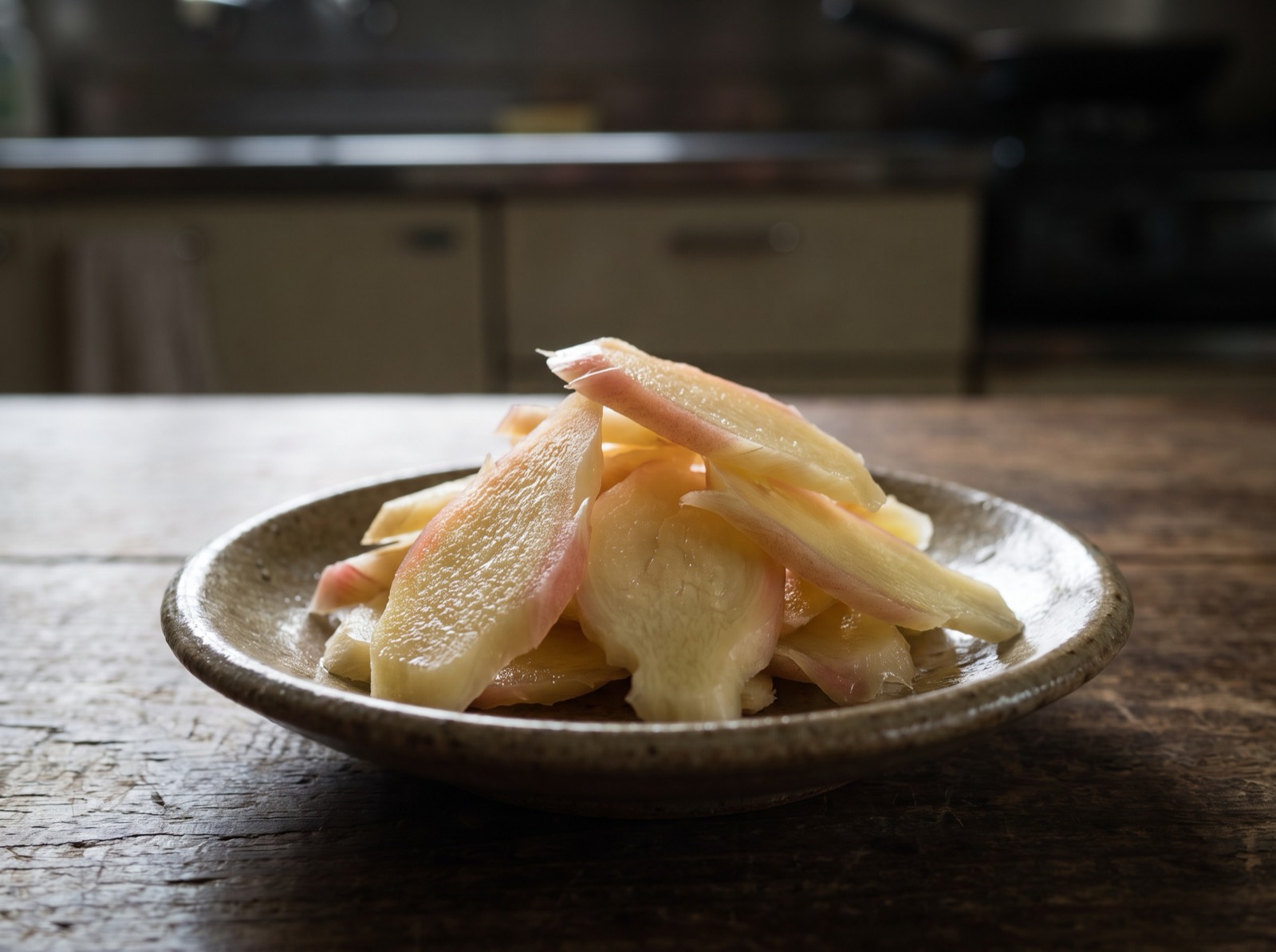
Gari (ガリ) is young ginger sliced paper-thin and steeped in sweetened vinegar. It sits in a small heap on the corner of the plate, it is refilled without being asked, and it has exactly one job at a counter: to clear the mouth between one piece and the next.
What it is
The ordinary Japanese name is amazu-shōga (甘酢生姜), sweet-vinegared ginger. Gari is the counter word, and like shari it started inside the trade — it is onomatopoeic, from the noise the stuff makes when it is scraped and when it is eaten.
The ginger is shin-shōga (新生姜), new-season ginger, harvested young while the flesh is still pale and the fibre soft. Mature ginger is too hot and too stringy for this; the difference between the two is most of what separates good gari from the kind that fights back.
How it is made
- The young rhizome is peeled and shaved into wide, translucent slices, along the grain rather than across it.
- The slices are salted or briefly blanched, which softens the raw burn and draws out water.
- They are steeped in amazu — vinegar, sugar and salt — and left to take it up.
- They are drained and served in small quantity, cool.
That is the whole of it. The interesting variable is the sweet-to-sharp balance, which in practice tracks the shop’s rice: a counter whose shari is sharp and salt-forward will generally serve gari to match, and a sweeter house will sweeten both.
The pink
Young ginger has a natural blush at the stem end, where the shoot was, and that pigment reacts with vinegar to give a pale, uneven pink concentrated at the cut ends. Real gari is therefore mostly ivory with a faint flush.
A uniform, saturated pink through every slice is colouring, and it is entirely standard in the mass-produced product that supplies most conveyor belts and supermarkets. It is not a scandal. It is simply a reliable, one-second read on which end of the market you are sitting in.
Ivory with a blush at the ends is ginger. Pink all the way through is a decision made in a factory.
What it is for
Between pieces. A single slice, chewed and swallowed, in the pause while the next piece is being made. The vinegar and the ginger together strip fat and aftertaste off the palate, which is what lets a lean white fish read as something after otoro, and it is why the sequence a chef builds is even possible.
It is not a topping and not a garnish. Piling it on the fish adds a strong sweet-sour flavour to a piece that has already been seasoned, and eating a heap of it as a side dish — which happens — blunts everything that follows. Our guide to what not to do puts it alongside the other short list of tells.
The other use: gari as a brush
This one is worth knowing because it looks like a party trick and is not. Some pieces cannot be dipped: a gunkan with sea urchin or roe in it will fall apart, and turning it over into a dish of soy sauce is a small disaster.
The answer is a slice of gari. Take one, dip the edge in soy sauce, and paint the topping with it. At counters the chef has already done this with a brush of nikiri, the house soy glaze, and you should not be dipping anything at all — but where soy sauce is in front of you and the piece is a gunkan, this is the correct move rather than an improvisation.
How it differs from what it is confused with
- Gari and beni-shōga. Beni-shōga (紅生姜) is a different pickle entirely: mature ginger cut into red shreds, cured in the brine left from making pickled plums, and much sharper and saltier. It belongs on noodles and fried food, not at a sushi counter.
- Gari and the ginger in a supermarket sushi tray. Same idea, industrial execution, and almost always dyed.
- Gari and wasabi. Different jobs. Wasabi is inside the piece and is part of the seasoning; gari is outside the piece and is between pieces.
How to say it
ga-ri, two beats, hard g as in “go”, flat. Asking for more is gari o mou sukoshi, but in practice a small gesture at the empty corner of the plate is the whole transaction; it is refilled freely everywhere.
Edomae and Kansai
Gari is universal and one of the few items on this list without a real east–west split. What varies is sweetness rather than geography, and it varies with the house rice: the sharper Edomae style described in our guide is generally matched by a sharper pickle, and Kansai’s sweeter rice by a sweeter one. See the two traditions.
Where you will see it, and roughly what it costs
Everywhere, at every tier, free. It is one of the two or three things in Japanese dining that is simply given to you and refilled without comment, along with tea and hot towels.
Nothing to pay, then, but it does report on the kitchen. Hand-shaved gari of varying slice thickness, ivory with pink only at the ends, is made on the premises. Identical uniform slices in a saturated pink came in a bag, which tells you something true about the rest of the plate without anyone having to say it.
Frequently asked questions
What is gari?
Young ginger shaved thin and steeped in sweetened vinegar, served alongside sushi. The ordinary Japanese name is amazu-shōga; gari is the sushi trade word, from the sound it makes when it is eaten.
Am I supposed to eat gari with the sushi or between pieces?
Between pieces. A slice in the pause between one piece and the next clears fat and aftertaste from the palate. Putting it on top of the fish adds a strong sweet-sour flavour to a piece the chef has already seasoned.
Why is some pickled ginger bright pink?
Because it is dyed. Young ginger has a natural blush only at the stem end, so real gari is mostly ivory with an uneven pink at the cut ends. A uniform saturated pink through every slice is colouring, standard in the mass-produced product.
Can I use gari to apply soy sauce?
Yes, and for a gunkan it is the correct move — dip the edge of a slice in soy sauce and paint the topping, rather than turning the piece over and losing the contents. At a counter the chef has usually already applied the house soy glaze, so nothing needs dipping at all.
What is the difference between gari and beni-shōga?
Beni-shōga is mature ginger shredded and cured in the brine from pickled plums: red, sharp and salty. It goes on noodles and fried food. Gari is young ginger in sweet vinegar and belongs with sushi.
Is gari free at sushi restaurants in Japan?
Yes, at every tier, and it is refilled without being asked. A small gesture at the empty corner of the plate is enough.