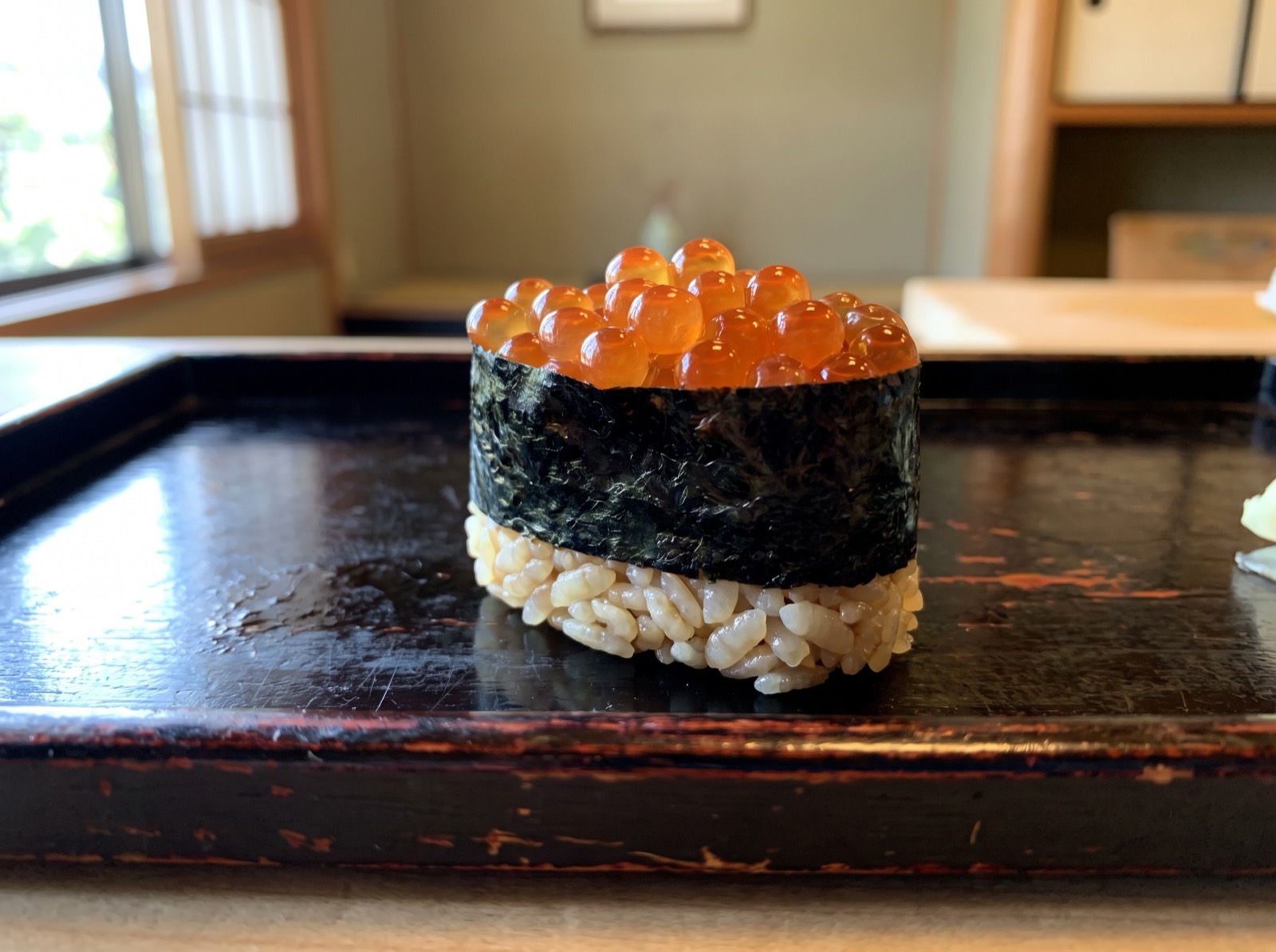
Ikura (イクラ) is salmon roe: individual eggs, separated from the ovarian membrane that held them, then cured. It is served as gunkan, a band of nori around the rice, because loose eggs will not sit on a hand-formed piece. It is one of the few sushi words that is not Japanese in origin: it is a borrowing from the Russian ikra, meaning roe, and it entered Japanese from the northern fisheries.
What it is
The eggs are large by roe standards, around five millimetres, translucent orange to deep red, with a skin firm enough to resist the tongue for a moment before it gives. That moment is the whole sensory point of ikura, and it is what every stage of the processing is trying to protect.
Almost all of it comes from Pacific salmon, and the great majority of Japan's supply is from chum salmon returning to spawn in the autumn, with Hokkaido the principal region. Imported roe, largely from Russia and Alaska, makes up a substantial share of what is on sale.
When it is best
Autumn, and this one really is a season rather than a tendency. Salmon return to the rivers in the cold half of the year, and the roe is harvested from those returning fish as they arrive on the Hokkaido coast.
Within the season there is a further distinction that specialists care about. Roe taken earlier in the run, from fish that have not yet fully matured, has a thinner, softer skin and eats more delicately. Later in the run the skin toughens as the eggs prepare for actual spawning. Neither is wrong, and there are people who prefer the resistance of the later roe, but the early-run product is what commands the higher price.
What the chef does to it
Two jobs: separating and curing. The first is mechanical and the second is where the decision lies.
Separating. The roe arrives as a skein, the eggs held together in a membrane. Loosening them without bursting them is done with warm salted water, which relaxes the membrane so the eggs can be worked free by hand, followed by repeated rinsing to remove every trace of the membrane and any blood. It is unglamorous, slow work and it decides whether the finished product is clean or faintly bitter.
Curing. Then the choice that English-language writing on sushi almost never mentions:
- Shōyu-zuke (醤油漬け), the soy cure. Soy sauce with sake and often mirin, a few hours to overnight. Produces a darker, glossier egg with a rounded savoury flavour and visible sweetness. This is what most sushi counters serve, and what most visitors have eaten.
- Shio-zuke (塩漬け), the salt cure. Salt alone, no soy. The older method and still the northern one. Produces a brighter, clearer egg with a firmer skin, a more concentrated marine flavour, and none of the soy’s sweetness. It keeps considerably longer.
- The practical difference at the counter. Soy-cured ikura tastes of the cure as much as of the roe; salt-cured tastes of the roe. If you have found ikura sweet and slightly one-note, you have most likely been eating the soy version, and the salt version will read as a different food.
Neither is a compromise. The soy cure is the counter standard for good reasons: it is more forgiving of roe that is not perfect, and it sits well against seasoned rice. But asking a shop which one they use is a reasonable question and will usually be well received.
If ikura has only ever tasted sweet to you, you have been eating the cure rather than the roe.
How it differs from what it is confused with
This is the section this entry exists for. Four words, four different animals, routinely used as though they were grades of the same thing:
- Ikura (イクラ), salmon. Individual eggs, separated from the membrane and cured. Large, about 5 mm, translucent orange-red, bursting texture. Served as gunkan or over rice.
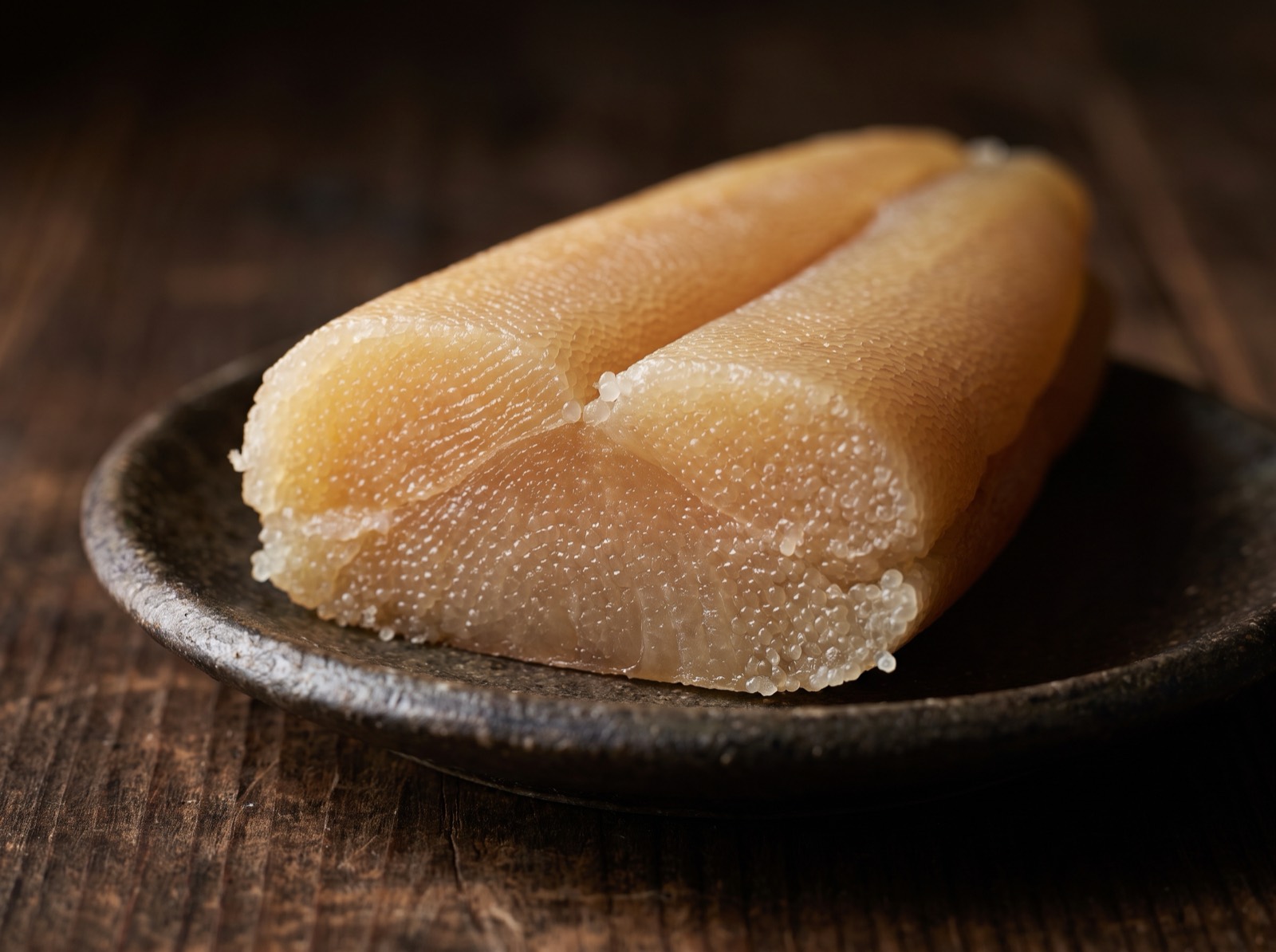
- Sujiko (筋子): salmon, again. The same eggs, but left in the skein and cured whole in the membrane, usually with salt. Sold as a slab, cut into pieces. Much saltier and more concentrated. Not a lesser ikura: a different preparation of the identical raw material, and the older of the two.
- Tobiko (とびこ), flying fish. Small, roughly 0.5–1 mm, bright orange, and distinctly crunchy rather than bursting. Frequently coloured — wasabi green, squid-ink black, yuzu yellow. Used as a texture and a garnish more than as a topping in its own right.
- Masago (まさご), capelin. Smaller and softer than tobiko, paler, almost always dyed to an orange that capelin roe is not naturally. It is the cheapest of the four and is what a great deal of the world’s roll sushi is actually decorated with.
The practical test: size and texture. If the eggs are large and burst, it is salmon roe: ikura if loose, sujiko if in a slab. If they are tiny and crunch, it is tobiko or masago, and if they are tiny, soft and uniformly bright orange, it is most likely masago. Herring roe is a fifth case entirely and does not resemble any of these; see kazunoko.
How to say it
ee-KOO-rah is understood everywhere. Three beats, i-ku-ra, evenly weighted, with no stressed syllable. The u in the middle is barely voiced in ordinary Japanese speech, so a fast native pronunciation can sound close to “ik-ra”, which is a reminder of where the word came from.
Edomae and Kansai
Little regional divergence, since the supply is northern regardless of where it is eaten and the gunkan form is national. What varies is context rather than treatment: a Tokyo Edomae counter serves ikura as one gunkan within a course, whereas in Hokkaido it appears in volume over a bowl of rice, and that ikura-don is a regional dish rather than a sushi one.
Osaka's pressed-sushi tradition has no place for loose roe, for the same reason it has none for uni: it cannot be pressed.
Where you will see it, and roughly what it costs
Everywhere. Ikura is on every conveyor belt, in every supermarket case in autumn, and in the middle of most omakase courses. The quality range is enormous and the visual difference is small, which makes it one of the harder items to judge by looking.
What separates the good from the ordinary, in rough order of importance: how completely the membrane was removed, whether the eggs were handled gently enough to stay intact, the point in the run at which the roe was taken, and the cure. Price tracks those. See omakase price tiers for the whole-meal picture.
Frequently asked questions
What is ikura?
Salmon roe: individual eggs separated from the ovarian membrane and cured, served as gunkan with a band of nori around the rice. The word is borrowed from the Russian ikra, meaning roe, and entered Japanese through the northern fisheries.
What is the difference between ikura and sujiko?
The same salmon eggs at different stages of processing. Ikura is separated from the membrane and cured loose; sujiko is left in the skein and cured whole, usually with salt, then cut into slabs. Sujiko is saltier and more concentrated, and is the older preparation.
What is the difference between ikura, tobiko and masago?
Different fish. Ikura is salmon roe, about 5mm, and bursts. Tobiko is flying fish roe, under 1mm, and crunches; it is often dyed green, black or yellow. Masago is capelin roe, smaller and softer than tobiko, nearly always dyed orange, and the cheapest of the three.
What is the difference between soy-cured and salt-cured ikura?
Soy-cured ikura, made with soy, sake and often mirin, is darker, glossier and noticeably sweet-savoury, and it is the counter standard. Salt-cured ikura uses salt alone: brighter, firmer-skinned, more concentrated marine flavour, no sweetness, and it keeps longer. Salt is the older method.
When is ikura in season?
Autumn, when salmon return to the Hokkaido rivers to spawn. Roe taken earlier in the run has a thinner, softer skin and commands a higher price; later-run roe has a tougher skin.
Why is ikura served as gunkan?
Because loose eggs will not stay on a hand-formed piece of nigiri. The gunkan form (a band of nori wrapped around the rice to make a wall) exists precisely to carry toppings that cannot be shaped, including ikura and uni.