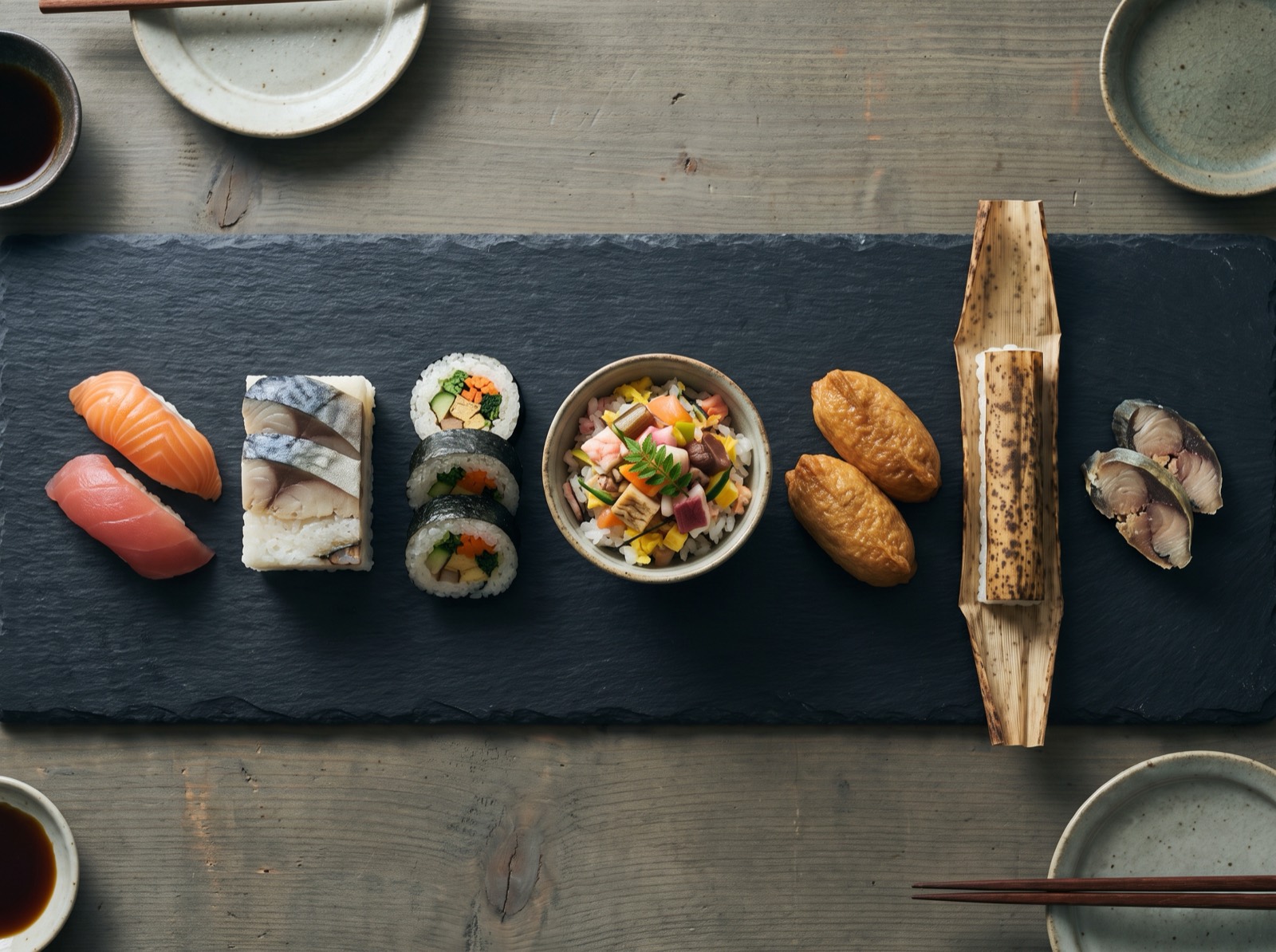
There are seven principal forms of sushi: nigiri (hand-formed), maki (rolled), gunkan (wrapped in a nori collar), temaki (hand rolls), chirashi (scattered over a bowl), oshizushi (pressed in a box) and narezushi (fermented). What makes them sushi is the rice — vinegared in every modern form, fermented in the oldest. The fish is a variable, not the definition.
That single fact reorganises the whole subject. English lists of “types of sushi” are usually lists of toppings (salmon, tuna, eel, California), which in Japanese would be a list of neta, not a list of sushi. The Japanese categories describe the construction, and they arrived in a definite order over about twelve hundred years.
The seven forms, at a glance
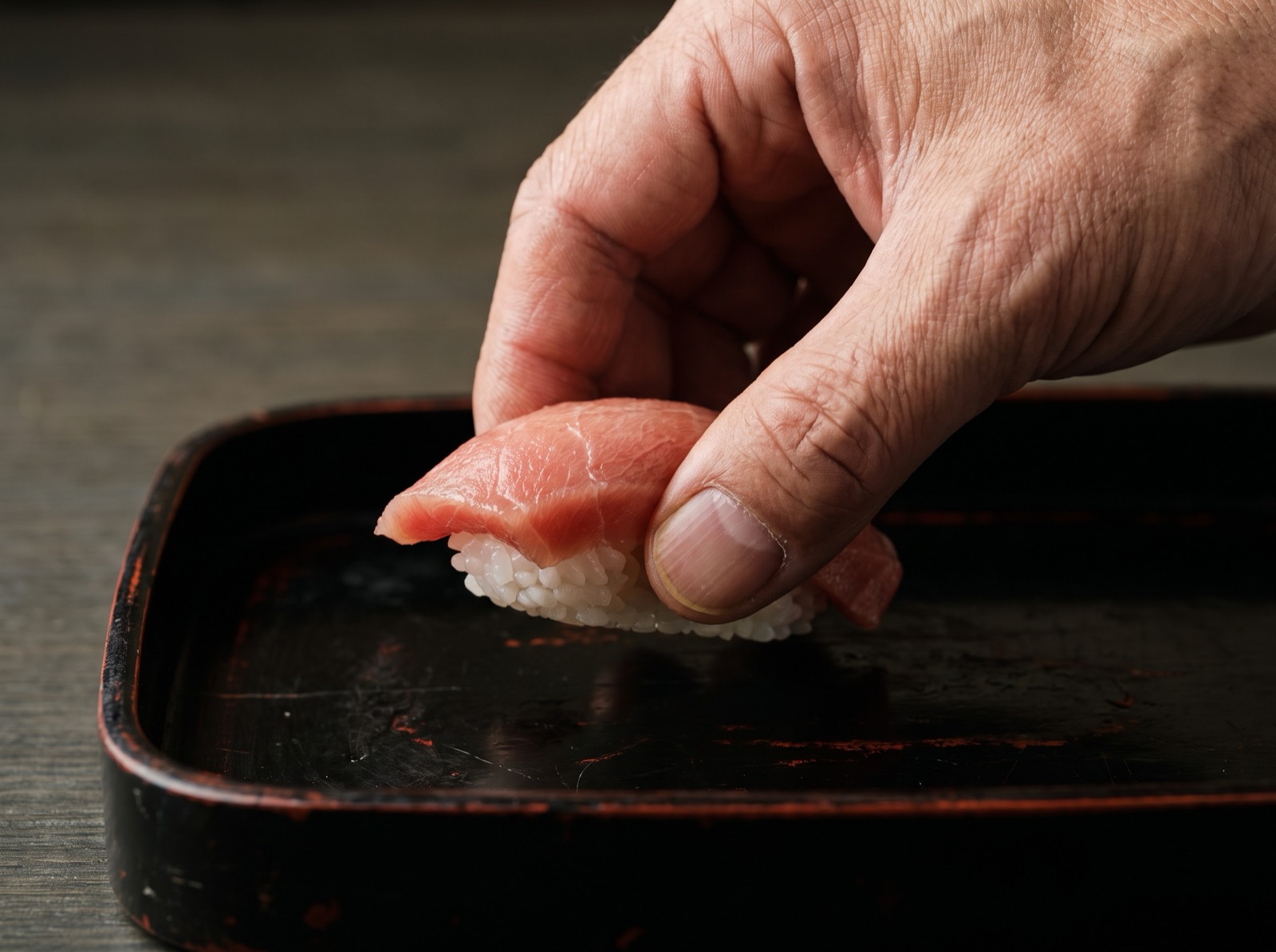
- Nigiri (握り). A hand-formed finger of rice with a topping laid over it. The image most people have of sushi, and the newest form on this list.
- Maki (巻き). Rice and filling rolled in nori and cut into rounds. Thin rolls are hosomaki, thick ones futomaki.
- Gunkan (軍艦). A nigiri wrapped in a standing collar of nori so it can hold something loose, like roe or sea urchin.
- Temaki (手巻き). A cone rolled by hand, eaten immediately, with the fingers. More on temaki.
- Chirashi (ちらし). Toppings scattered over a bowl of vinegared rice rather than formed into pieces.
- Oshizushi (押し寿司). Rice and topping pressed together in a wooden box, then cut. The older Osaka style.
- Narezushi (なれずし). Fish packed in rice and fermented for months or years. The original, and still made.
An eighth, inarizushi, sits slightly outside the scheme: vinegared rice packed into a pouch of sweet-simmered fried tofu, with no fish at all. It has been eaten since the mid-Edo period and remains common.
Narezushi: where all of it starts
Sushi began as a method of preservation in Southeast Asia, and reached Japan around the Nara period as narezushi: fish packed in rice and left to ferment through lactic acid for months, sometimes years. The rice was not food. It was the medium. By the time the fish was ready the rice had broken down, and it was scraped away and discarded.
Funazushi from Shiga Prefecture (crucian carp salted, then packed with rice) is regarded as the starting point of Japanese sushi, and it is still made today. It is intensely sour and pungent, and tasting it is the fastest way to understand that sushi is not, historically, a fish dish.
Namanare: the moment rice became food
Between the Kamakura and Muromachi periods someone shortened the fermentation. The rice survived it, still in grains, and for the first time people ate the rice and the fish together. That is the hinge of the entire history: sushi stopped being a preserve and became a dish.
Oshizushi: pressed in a box
Once vinegar was being produced, the fermentation could be skipped entirely: you could simply sour the rice. This produced hayazushi, fast sushi, and with it a form: rice and topping packed into a wooden box, pressed, and cut into squares.
Oshizushi (also called hakozushi, box sushi) became the Osaka style and remains so. Because it is pressed and often uses cured or cooked toppings, it travels and keeps in a way nigiri does not, which is why the boxed sushi sold at Japanese railway stations is usually this and not nigiri. It is covered further in our guides to Osaka and Tokyo sushi and eating in Osaka.
For most of its history, sushi was a way of keeping fish. It has only been a way of serving fish for about two hundred years.
Nigiri: two hundred years old
Nigiri sushi was invented in Edo around 1820. Two men are named as its inventor and the accounts disagree, which is itself worth knowing: this is recent enough to argue about. It was street food, eaten standing at a stall, and each piece was considerably larger than a piece today.
Two twentieth-century events made it national. Chefs displaced by the 1923 Great Kanto earthquake returned to their home regions and took the technique with them. Then, after the Second World War, food controls restricted restaurants, but sushi shops were permitted to trade under an arrangement that turned a fixed measure of a customer's rice into a fixed number of pieces. That ration is said to have set the size of a modern piece.
The piece counter is kan. Today it means one piece; historically it could mean two, which is why old sources and modern menus occasionally seem to disagree about quantities.
Maki: rolled, and the smallest thing on the menu
Makizushi is rice and filling rolled in a sheet of nori using a bamboo mat, then cut. The two main sizes are hosomaki, thin rolls with a single filling, and futomaki, thick rolls with several. A cucumber hosomaki is a kappa-maki, named after the river spirit said to love cucumber.
At a counter, rolls usually appear near the end of the meal, which is a useful signal: if you want more nigiri, say so before the rolls arrive. Nori is called kusa in the trade, from asakusa-nori, the seaweed of the Asakusa shoreline.
Gunkan: the newest form here
Gunkan-maki, “battleship roll”, is a finger of rice wrapped in a standing collar of nori, making a wall that can hold something loose: salmon roe, sea urchin, chopped scallop, minced tuna. It exists because those ingredients cannot sit on a plain finger of rice.
It is a twentieth-century invention and the youngest form in general use. It also has its own etiquette: because you cannot turn it over to dip it without losing the contents, the conventional method is to use a piece of gari as a brush, or to have the chef season it for you.
Temaki: made for one person, immediately
A hand roll is a cone of nori filled with rice and one or two other things, handed to you the moment it is made. Every part of its design is about the nori being crisp, which it stops being within about a minute of touching rice.
This is the one form that everyone agrees should be eaten with the fingers and eaten at once. It is also, unlike everything else on this list, genuinely easy to make at home. See temaki.
Chirashi: scattered
Chirashizushi is a bowl of vinegared rice with toppings scattered over it rather than formed into pieces. It is a category rather than a recipe, and it varies enormously by region and by household: an Edo-style bowl is sliced raw fish over rice, while in much of western Japan chirashi means cooked and seasoned vegetables and egg mixed through the rice, often for a celebration.
It is also, at a sushi counter, frequently the best-value item on the menu at lunch: the same fish, without the labour of forming each piece.
What is not sushi
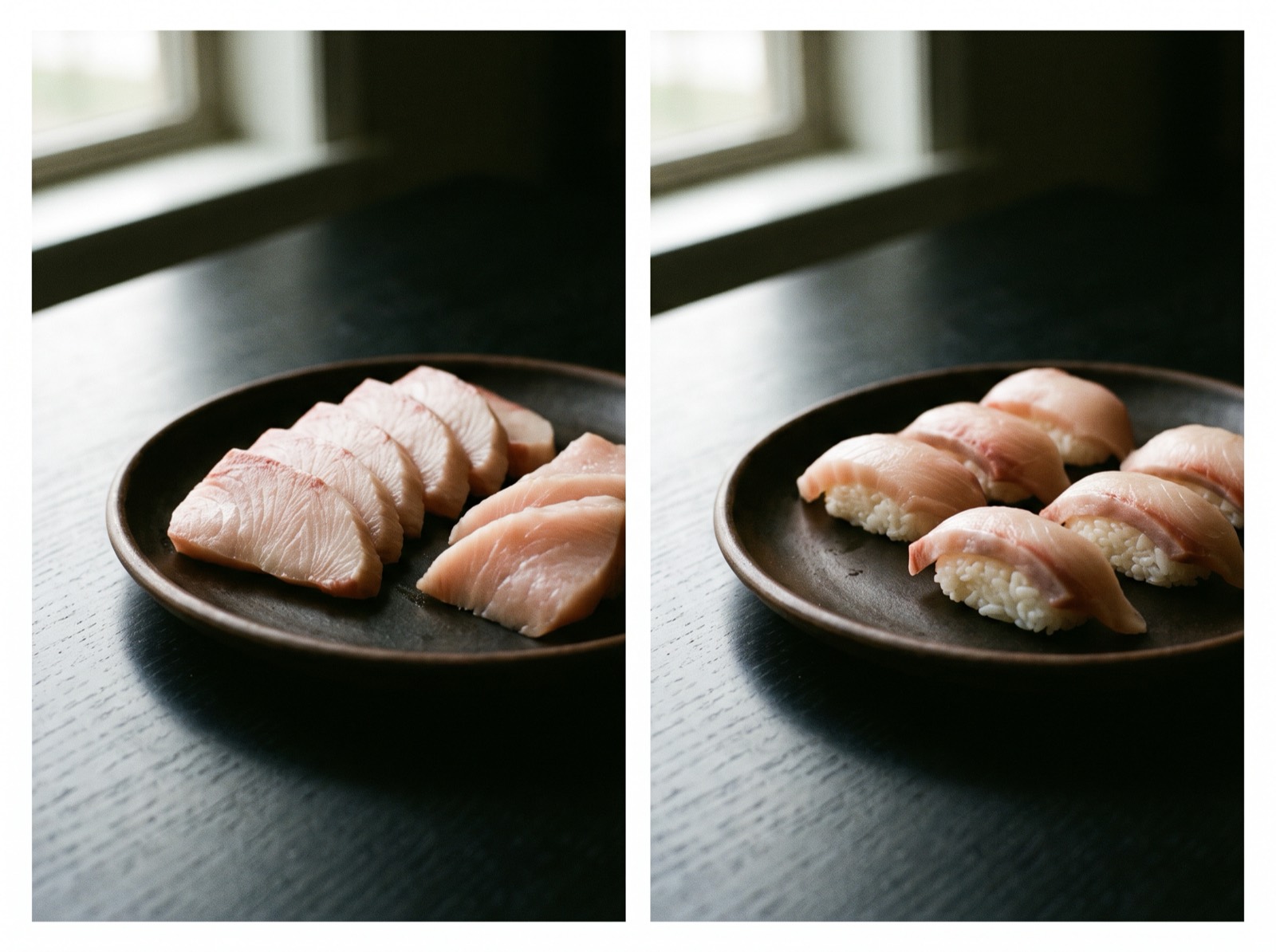
Sashimi is not sushi. It is sliced raw fish, served without rice. Since the rice is what makes sushi sushi, sashimi sits outside the category entirely, and a sashimi course at a sushi counter is a different part of the meal. We deal with this at length in sushi versus sashimi and nigiri versus sashimi.
“Raw fish” is not sushi either. Raw fish is a fairly recent luxury within sushi. Before mechanical ice, every topping was cured with salt and vinegar, simmered, or marinated in soy, because it had to be. Those techniques did not disappear when refrigeration arrived; they are exactly what a serious counter is still judged on, and they are the subject of Edomae sushi. What makes raw fish servable now is regulatory rather than culinary; see is sushi safe to eat in Japan.
One more thing sushi is not: a UNESCO World Heritage site. What was inscribed, in December 2013, is washoku — and on the Intangible Cultural Heritage list rather than the World Heritage one. Both halves of the familiar sentence are wrong, and we take it apart here.
The order they arrived in
- Nara period. Narezushi arrives from the continent. Fermented, the rice discarded.
- Kamakura–Muromachi, namanare. Rice and fish eaten together for the first time.
- Muromachi. Vinegar production makes hayazushi possible; box sushi appears.
- Mid-Edo. Box sushi is widespread and inarizushi is being eaten.
- Around 1820. Nigiri is invented in Edo, as street food.
- Meiji. Manufactured ice makes raw toppings practical.
- Twentieth century. Gunkan appears; the 1923 earthquake and postwar rationing spread nigiri nationally.
- 1980s. Conveyor-belt sushi expands in Japan; the first sushi boom hits the United States.
Nigiri sushi is about two hundred years old. Sushi is about twelve hundred. Any list of “types of sushi” that begins and ends with nigiri is describing the last sixth of the subject.
Frequently asked questions
What are the main types of sushi?
Seven: nigiri (hand-formed), maki (rolled), gunkan (wrapped in a nori collar), temaki (hand rolls), chirashi (scattered over rice), oshizushi (pressed in a box) and narezushi (fermented). Inarizushi, rice in a sweet tofu pouch, is a common eighth.
What makes something sushi?
The vinegared rice, not the fish. Any preparation built on seasoned rice is sushi, including forms with no fish at all; sliced raw fish without rice is sashimi and is not sushi.
What is the difference between nigiri and maki?
Nigiri is a hand-formed finger of rice with a topping laid on it. Maki is rice and filling rolled inside a sheet of nori and cut into rounds; thin rolls are hosomaki, thick ones futomaki.
What is gunkan sushi?
A finger of rice wrapped in a standing collar of nori, creating a wall that holds loose toppings such as salmon roe or sea urchin. It is a twentieth-century invention and the newest form in general use.
Which type of sushi is the oldest?
Narezushi: fish packed in rice and fermented for months or years. It reached Japan around the Nara period, and funazushi from Shiga Prefecture, still made today, is regarded as the starting point of Japanese sushi.
Is sashimi a type of sushi?
No. Sashimi is sliced raw fish served without rice, and the rice is what defines sushi. They are frequently served in the same meal, which is why the two get confused.
What is the difference between oshizushi and nigiri?
Oshizushi is pressed in a wooden box and cut into squares; nigiri is formed one piece at a time by hand. Oshizushi is the older Osaka form and travels well, which is why boxed station sushi is usually pressed rather than hand-formed.