Gunkan (軍艦) is what a menu reaches for when a topping will not behave: a finger of rice standing inside a wall of nori, built so that something loose can sit above the rice rather than fail on top of it. Gunkan-maki means “battleship roll”, and the name is a description of the silhouette, not a claim about who first made one.
What it is
A finished piece does read like a small vessel riding low in the water: a rectangular base with a wall standing around it, loaded above the rice line. Japanese food writing gives the resemblance as the reason for the name, and more than one source repeats it independently. None of them attaches it to a particular kitchen or year, and neither does this entry.
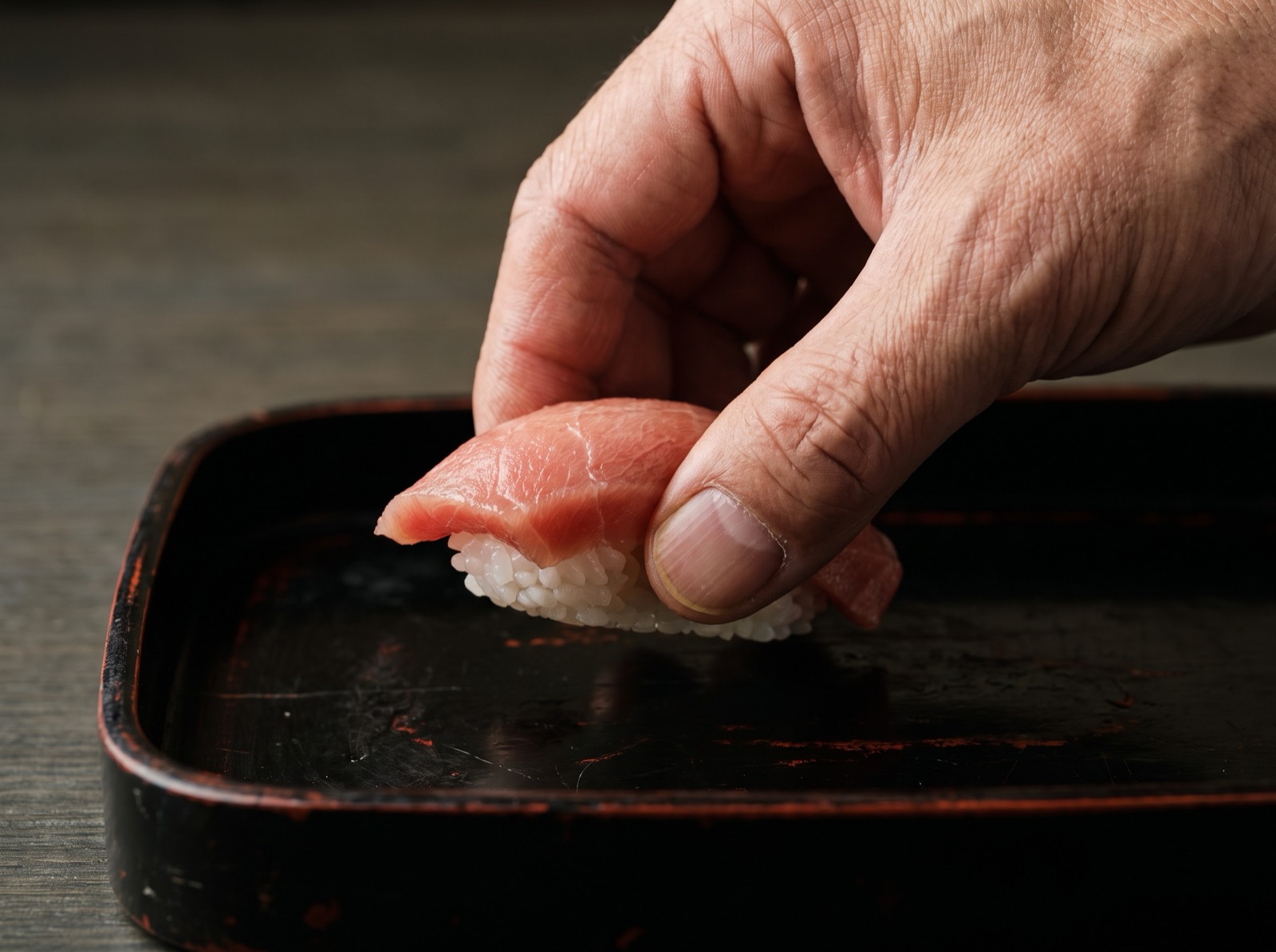
It starts from the same material as a nigiri — rice measured and shaped by hand — but the shaping itself is different from the first motion. Rather than being worked into the long oval of a nigiri, the rice for a gunkan is pressed into a shorter, more rectangular block, handled less than a nigiri’s rice is. It does not need the finished curve a nigiri needs, because no part of it is going to be seen once the collar and the topping are on.
What the collar is for
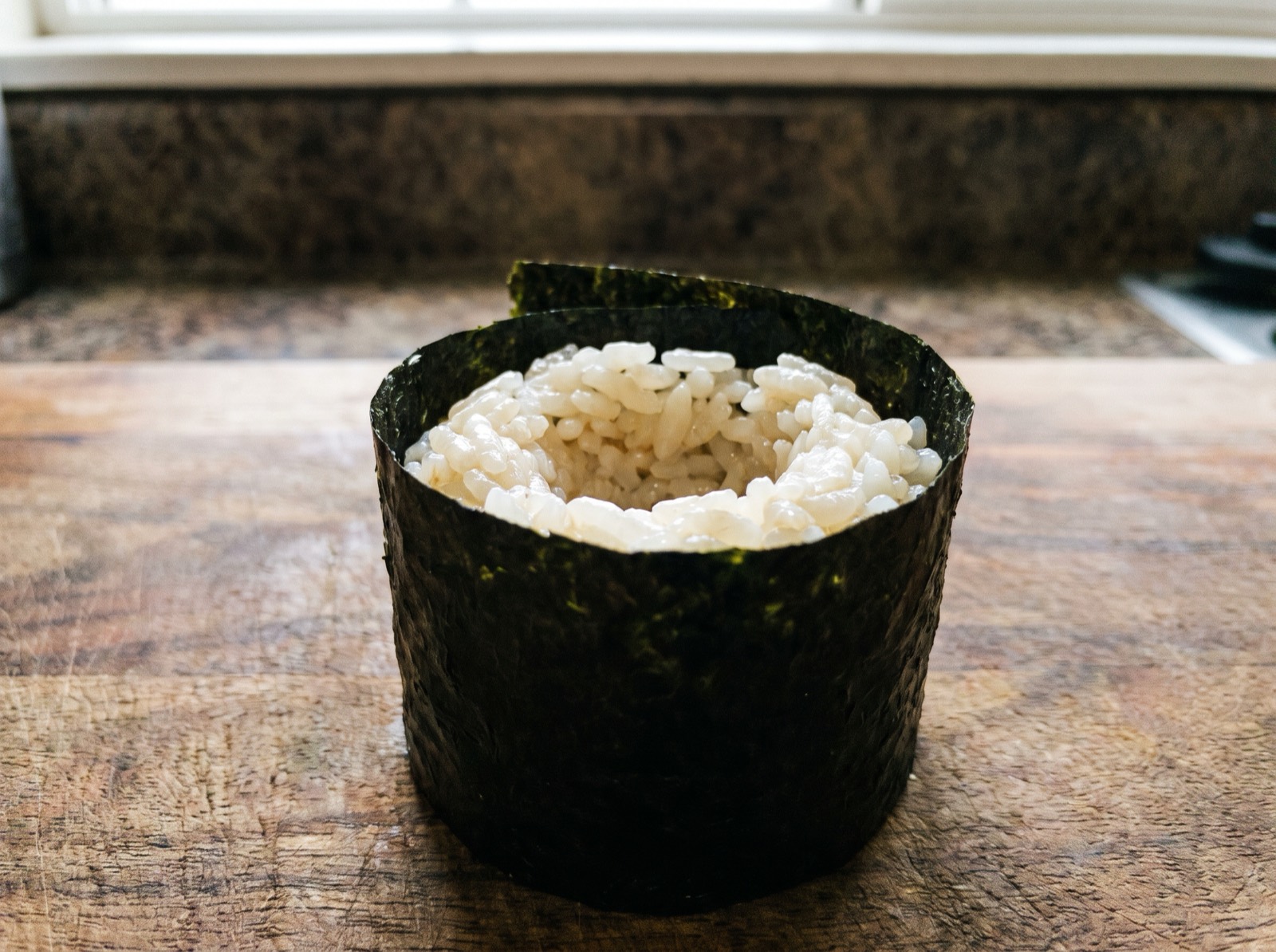
An ordinary nigiri works because the topping is one piece, cut and draped so its own shape holds it against the rice. That stops working the moment a topping is not one piece: loose roe, something as soft as sea urchin, anything minced or scraped will slide or drop off a plain finger of rice before it clears the counter. The collar exists to solve exactly that failure and nothing more — it is a wall, not a wrapper, and it is doing a job the rice cannot do on its own.
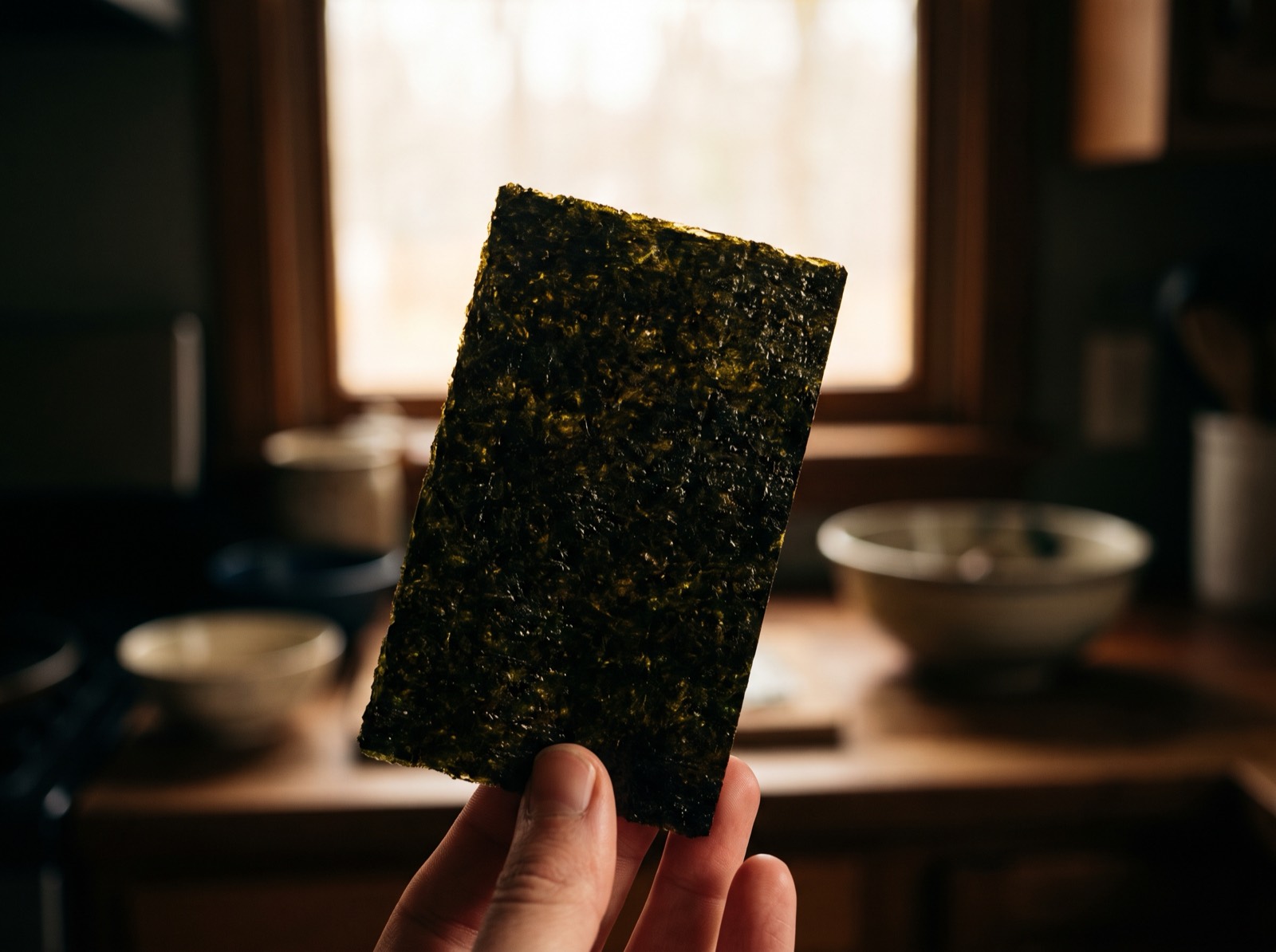
Because the wall is the whole point, it has to be nori: nothing else on the counter is rigid, foldable and edible in one material. What lets it stand up straight when it is wrapped is also what ends it — a dry sheet against warm rice starts softening within about a minute, so a gunkan is built once, close to the moment it is served, rather than in advance. That clock, and what it does to the rest of the sheet, is nori’s own story.
A gunkan’s collar is a wall, not a wrapper: it exists to do a job a plain finger of rice cannot do on its own.
What the chef actually does
The rice is shaped first, briefly, in the hand — pressed into that shorter rectangular block rather than an oval — and then, unlike a nigiri, it is set down on the cutting board rather than finished entirely in the palm. A nigiri never leaves the chef’s hands until it is served; a gunkan does, because wrapping a standing band of nori around a block of rice takes both hands braced against a surface, not one hand shaping against the other.
On the board, a touch of wasabi goes onto the rice, and the strip of nori is wrapped around the outside of the block and closed, standing above the rice line. Only once the collar is closed does the topping go in, nested inside the wall it has just been given rather than piled on first and wrapped around afterward — loading it any earlier would mean building a wall around a topping that is already sliding.
None of it is slow. It is a short, practiced sequence — shape, set down, wasabi, wrap, fill — repeated the same way for every gunkan a counter serves, which is part of why the results are so consistent piece to piece even though each one is built individually rather than pre-formed.
How it differs from what it is confused with
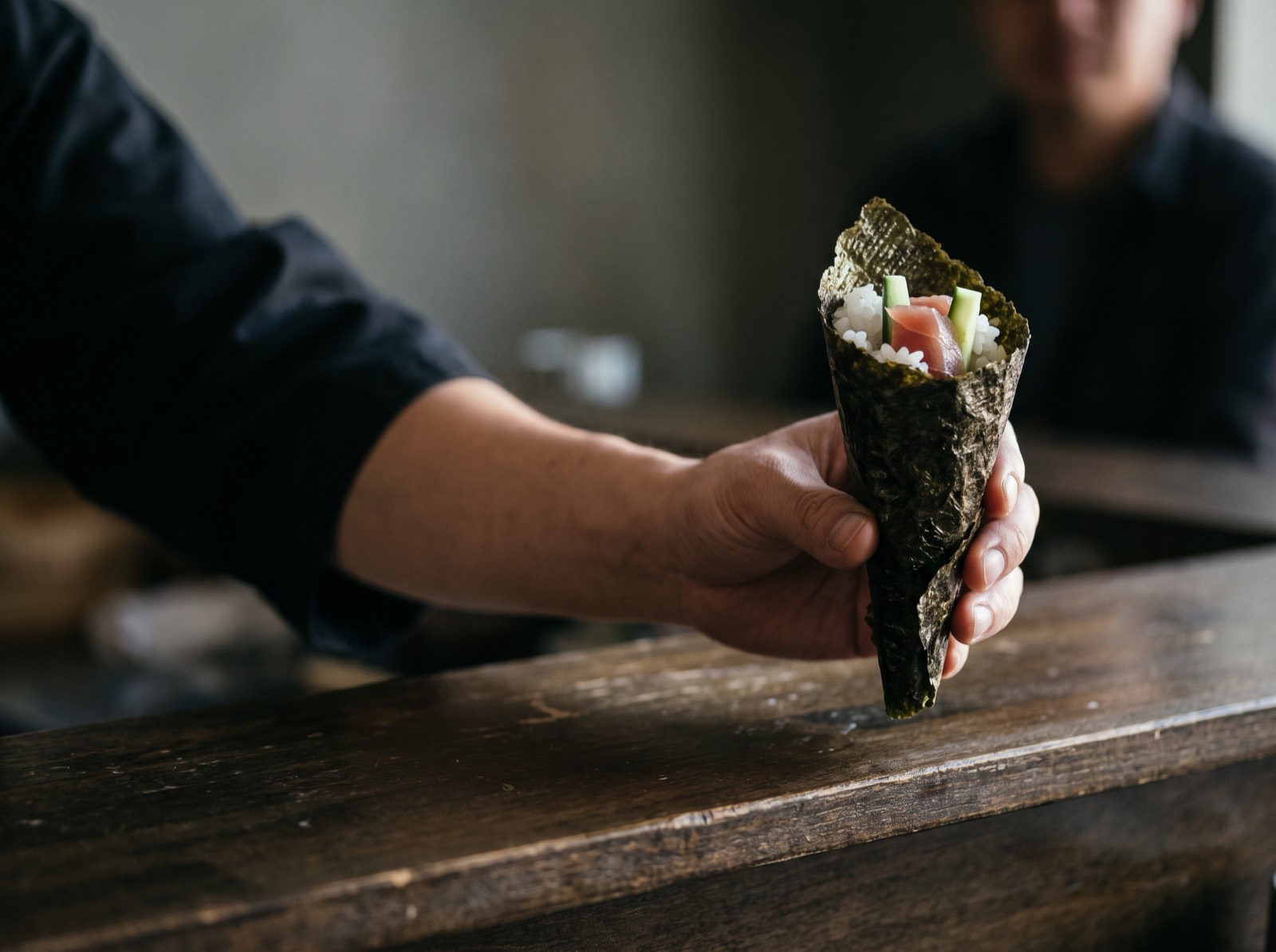
- Gunkan and temaki. Both stand nori up around rice rather than laying it flat, but a temaki is a cone rolled fresh in the hand around a filling and eaten before it goes soft; a gunkan is a closed collar built to hold something loose, and it is the topping rather than the nori that is at risk of failing.
- Gunkan and nigiri. A gunkan is a nigiri with one extra step: the same hand-shaped rice, plus a wall added because the topping cannot do without it.
- Gunkan and maki. A roll is built around a bamboo mat and cut into rounds once it is finished; a gunkan is never cut, and the nori is never rolled around anything — it only stands up. See the forms of sushi for the full set.
It is also a twentieth-century form, and by some distance the youngest of the ones in standard use; for where it sits in the fuller history of the shapes, see the forms of sushi.
How to say it
GOON-kahn is close enough. Two beats, gun-kan, evenly weighted, with no stress on either syllable — English tends to put a stress on the first half of a compound word, which is not how it works in Japanese. Maki, in gunkan-maki, is the same “roll” element as in makizushi and temaki.
Edomae and Kansai
Little regional divergence in the form itself: the collar-and-wall construction is national, not a Tokyo invention defended against an Osaka alternative. What does not travel is the context. At an Edomae counter a gunkan is one piece within a run of nigiri, built to order like the rest of the course.
Osaka’s pressed tradition has no version of it, for the same reason it has none for temaki: a standing wall of nori cannot be pressed flat in a box, and the whole logic of pressed sushi (assemble it, weight it, cut it later) runs the opposite direction from a shape that has to be closed and served at once.
Where you will see it, and roughly what it costs
Everywhere a counter serves nigiri, in a narrower range of fillings than the fish case suggests, because not everything needs the collar — only what cannot be draped over rice on its own. Price follows the topping rather than the form: a gunkan costs what is inside it, not what is wrapped around it.
How you actually pick one up, and how it is seasoned without dipping the collar itself into the soy dish, is covered in how to eat sushi, along with where it tends to fall in the order of a course. See omakase price tiers for what a whole meal costs.
Frequently asked questions
What is gunkan?
A finger of rice standing inside a wrapped collar of nori, built to hold a topping too loose to sit on a plain nigiri. The name, gunkan-maki, means ‘battleship roll’, after the shape of the finished piece.
Why is gunkan shaped differently from a nigiri?
Because the topping cannot behave like a nigiri topping does. An ordinary nigiri topping is one piece that holds itself against the rice; loose roe or anything soft or minced will not, so a standing wall of nori is added to give it something to rest against.
How does a chef actually make a gunkan?
The rice is pressed into a shorter, more rectangular block than a nigiri’s, set down on the cutting board rather than finished in the hand, dabbed with wasabi, and wrapped in a standing strip of nori. Only once the collar is closed does the topping go in, nested inside it.
Why is gunkan rice set on the cutting board instead of being shaped entirely by hand?
Because wrapping a standing band of nori around a block of rice takes both hands braced against a surface, unlike a nigiri, which is shaped and finished without ever leaving the chef’s hands.
What does gunkan-maki mean, and who invented it?
It means ‘battleship roll’, from the resemblance of the finished piece to a small vessel riding low in the water. Trade accounts attribute the design to a specific counter and date; we do not repeat that attribution, since it is not consistent enough across sources to treat as established.
How do you eat gunkan, and can you dip it in soy sauce?
Pick it up rather than turning it over, and season it without submerging the nori collar in the dish. The specific methods a counter expects are covered in our guide to how to eat sushi.