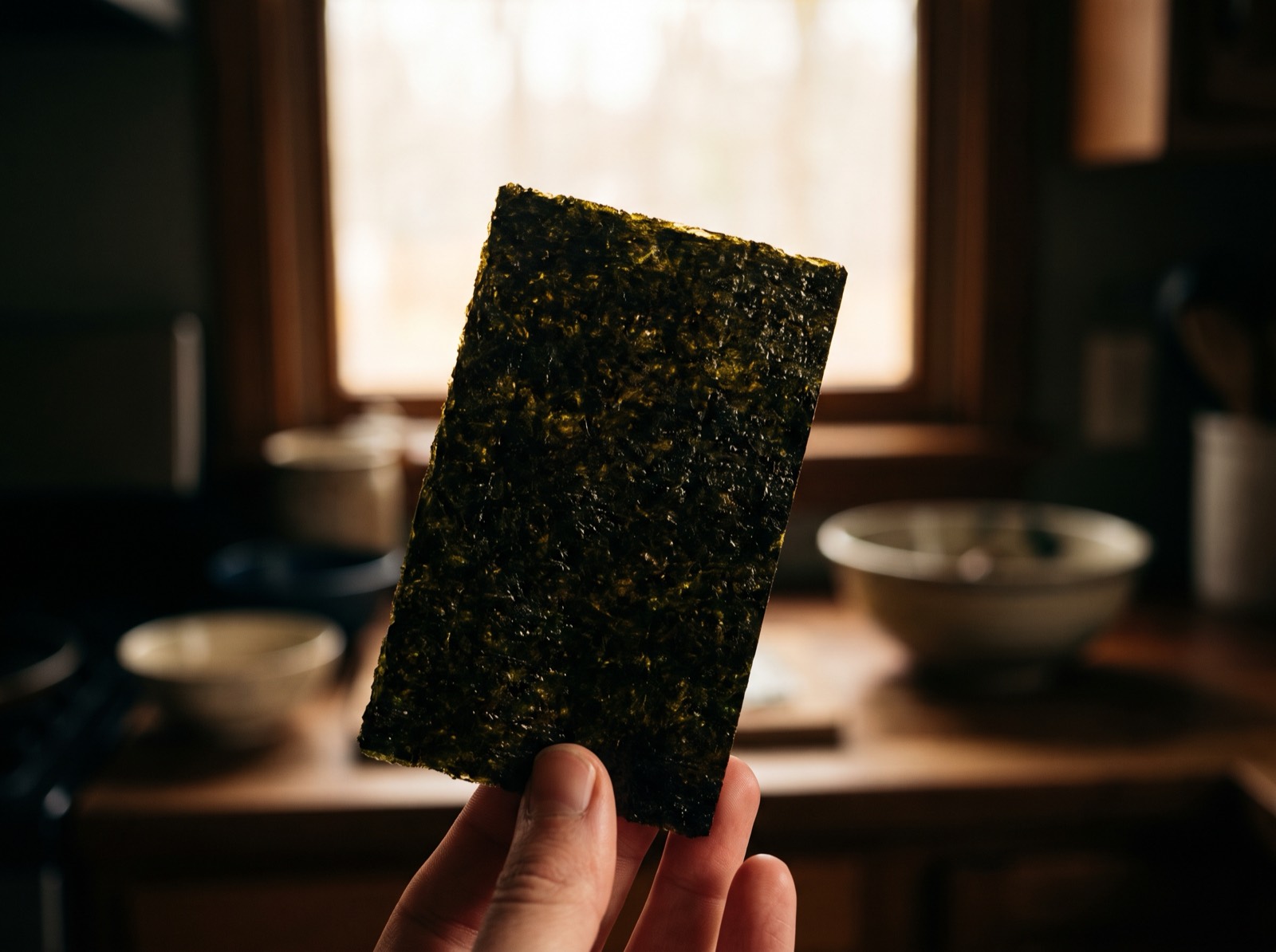
Nori (海苔) is cultivated red algae, washed, chopped, poured into moulds and dried into thin sheets. It wraps rolls, forms the collar of a gunkan, and appears in strips or shreds on other pieces. It is also the most perishable thing on the counter in the short term: crisp when it arrives, limp within about a minute of meeting rice.
What it is
The seaweed is grown on nets suspended in shallow, cold coastal water — the Ariake Sea in Kyushu and the Seto Inland Sea are the major producing regions — and harvested through the winter. The processing is genuinely papermaking: the harvested weed is washed in fresh water, chopped fine, suspended in a slurry, poured onto a screen in a frame, pressed and dried. A standard sheet is a fixed size, and the trade grades and prices by the bundle.
The first cut of the season, ichiban-zumi (一番摘み), is the prized one. The blades are young, thin and tender, and a sheet made from them dissolves against the tongue rather than tearing. Later cuts are tougher and are what most of the world has eaten.
Toasted, and toasted again
The sheets used for sushi are yaki-nori (焼き海苔), toasted plain. This matters because the other supermarket staple, ajitsuke-nori (味付け海苔), is seasoned with soy sauce and sweetener and is a breakfast item — it is far too sweet to put anywhere near a piece of sushi, and using it is one of the more common mistakes in home rolling.
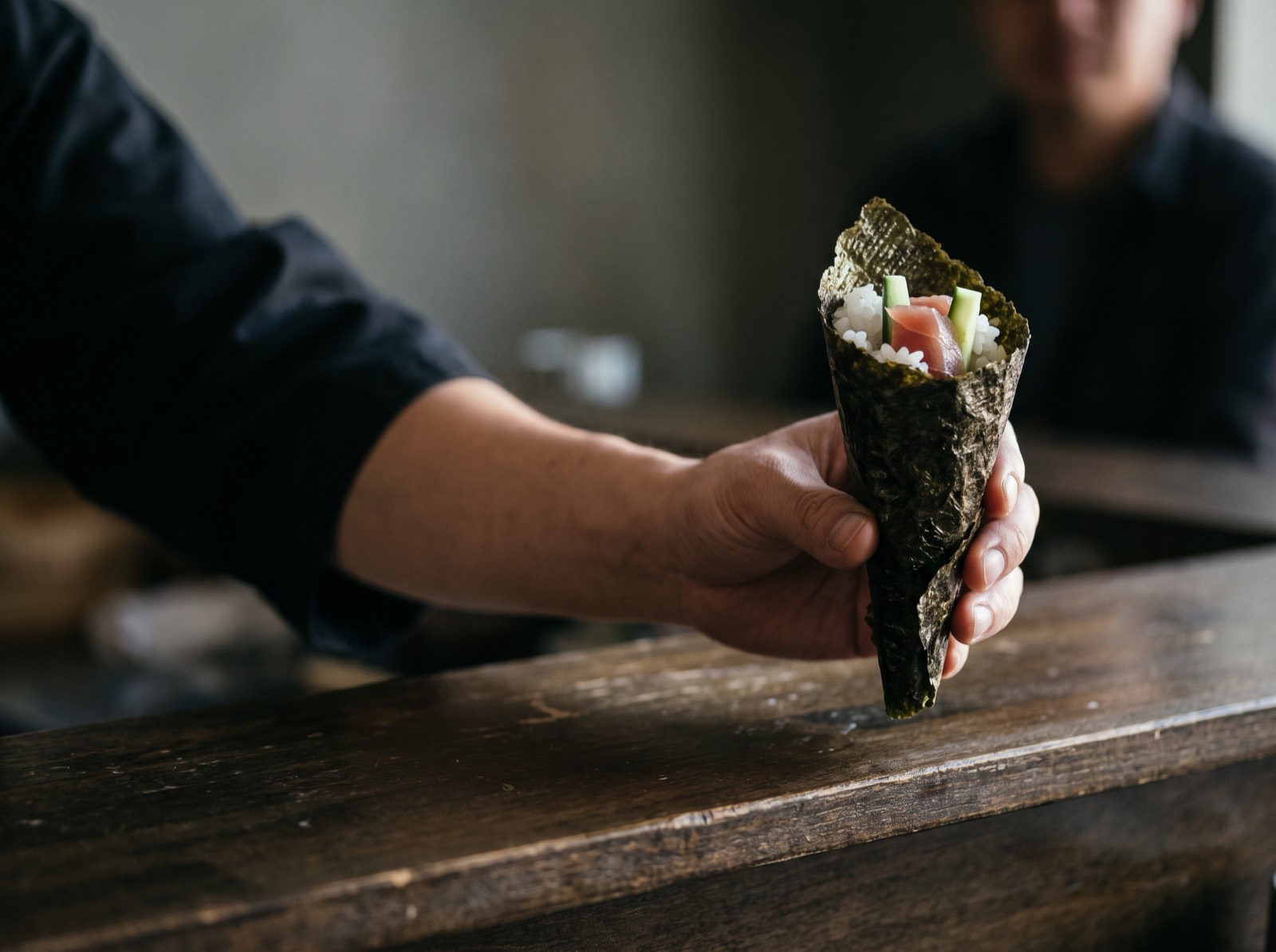
At a counter the sheet is toasted a second time, immediately before use, over a small flame or a warmer kept beside the board. A few seconds of heat drives off moisture the sheet has taken up from the air, and the difference is not subtle: the aroma lifts, the colour goes from black to black-with-green, and the sheet snaps instead of bending. If you hear a distinct crack when you bite a hand roll, that is why.
The clock
Dry nori is hygroscopic and rice is wet. From the moment the two meet, the sheet begins absorbing water from the rice, and within roughly a minute it has gone from crisp to leathery. Nothing stops this. Every serving convention around nori is an accommodation to it.
- Temaki are handed over one at a time and are meant to be eaten immediately — not assembled in advance, not set down while you finish a drink.
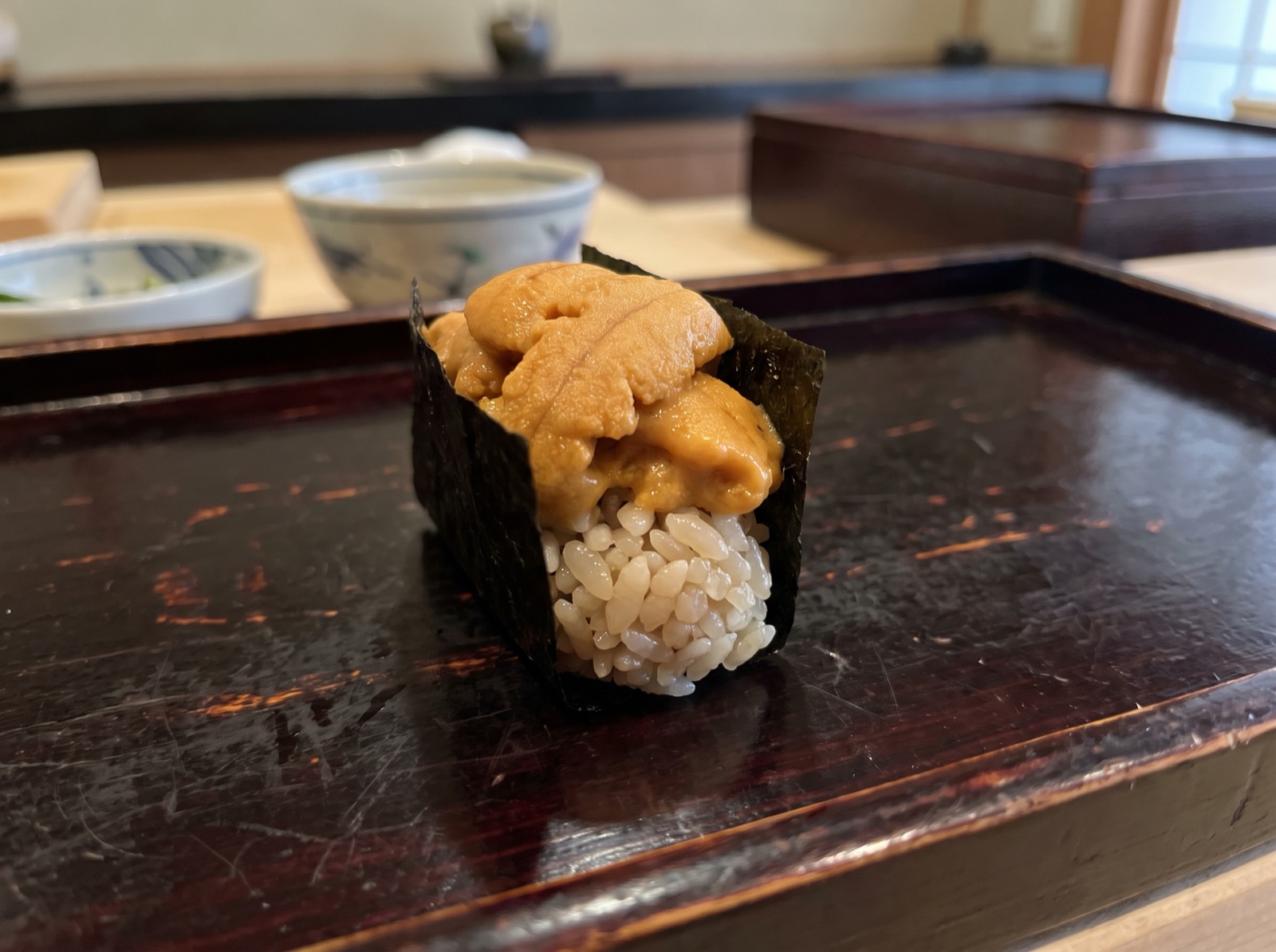
- Gunkan are built at the last moment, the collar wrapped and filled in one movement.
- Rolls are cut and served straight away, which is also why a maki roll that has been sitting in a chilled case tastes like nothing in particular.
- Convenience-store rice balls solved the same problem with a plastic sleeve that keeps sheet and rice apart until you pull the tab — an ordinary object that is really a piece of engineering aimed squarely at this.
Everything about how nori is served is an argument with a sheet of paper that is losing.
What the chef does with it
- Rough side in. A sheet has a smooth side, which faced the screen, and a slightly textured side. The textured side goes against the rice; the smooth side faces out and takes the gloss.
- Cut, not torn. Gunkan collars and roll wrappers are cut to size with a knife, against the grain of the sheet, so the strip does not split while it is being wrapped.
- Sized to the filling. A gunkan collar has to stand above the rice by enough to hold a loose topping such as sea urchin or salmon roe without spilling — which is the entire reason the form exists. The collar-and-cup shape is generally credited to a Ginza counter, as a way of serving toppings that could not simply be laid over rice. The account is the trade’s own rather than a documented one.
- Kept dry. Sealed, away from steam, often with a desiccant. A shop that leaves nori open beside a rice tub is undoing its own work.
How it differs from what it is confused with
- Nori and wakame. Different seaweeds entirely. Wakame is used soft and rehydrated, in soup and salads; nori is dried into sheets.
- Nori and kombu. Kombu is thick kelp, used to make stock and to cure lean white fish such as flounder. It is never a wrapper.
- Yaki-nori and ajitsuke-nori. Plain-toasted versus soy-and-sugar seasoned. Only the first belongs in sushi.
- Nori and gim. The Korean product is a related seaweed, usually brushed with sesame oil and salt before toasting. It is excellent and it is not interchangeable with sushi nori.
How to say it
no-ri, two beats, flat, with a light Japanese r. Ichiban-zumi is i-chi-ba-n-zu-mi. Yaki-nori and ajitsuke-nori are the two words on a supermarket shelf that decide whether your home rolls work.
Edomae and Kansai
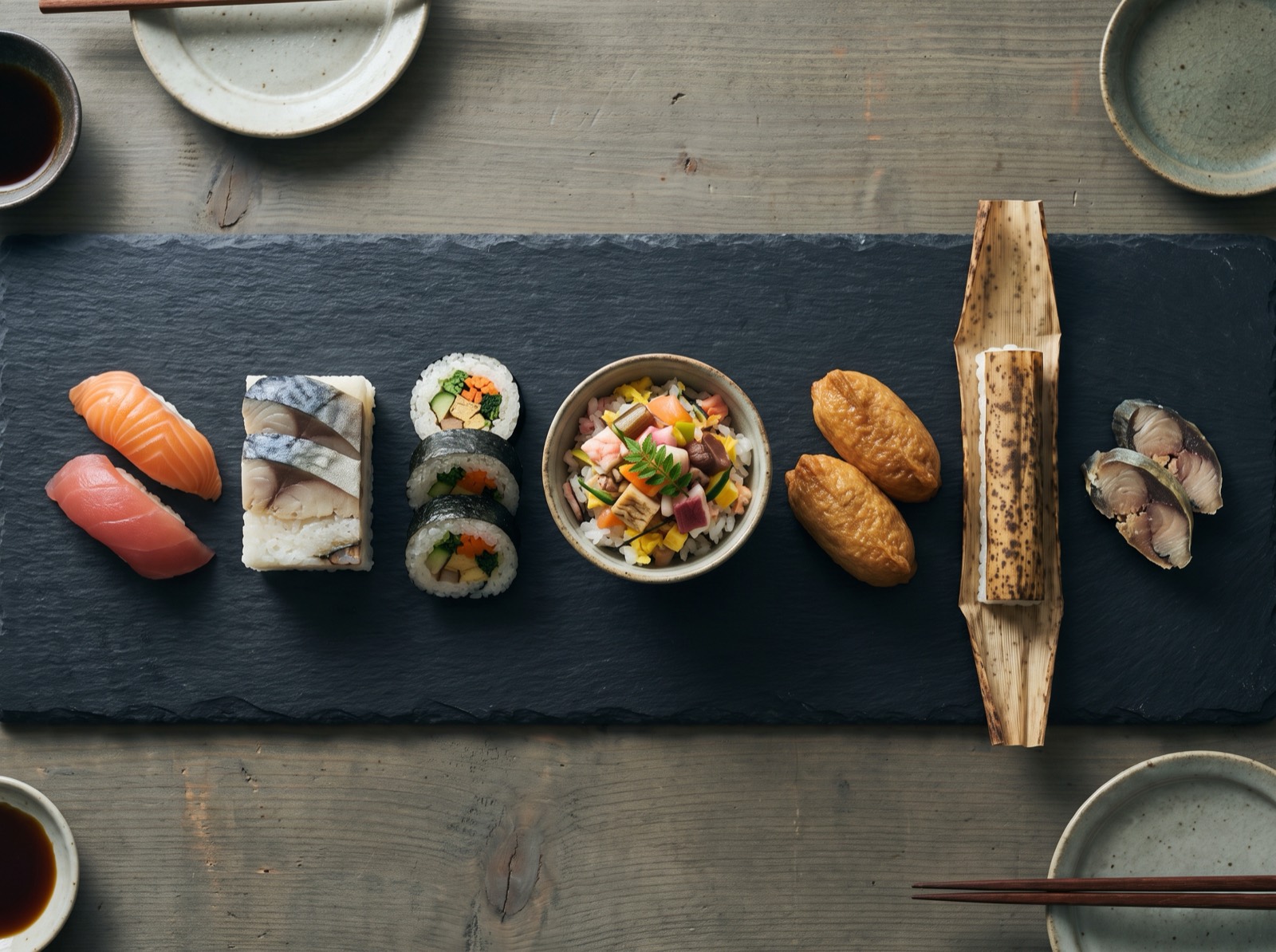
Nori is where the two traditions diverge in shape rather than in ingredient. Tokyo’s use is the thin, quick one: gunkan collars, hand rolls, slim hosomaki such as tuna or gourd, all made and eaten inside the clock described above.
Osaka’s signature roll, futomaki, is thick, made in advance, cut into fat wheels and eaten cool — a form in which the sheet is expected to soften and is chosen accordingly. The same logic runs through the pressed and boxed forms; see oshizushi and the two cities compared.
Where you will see it, and roughly what it costs
In every roll and every gunkan, at every tier. As an ingredient it is inexpensive relative to fish, which is precisely why the quality gap goes unnoticed: the difference between a first-cut sheet and a commodity one is next to nothing on the bill and a completely different mouthful.
No per-sheet figure from us. What is worth doing is a single deliberate test: order a hand roll early rather than late, take the first bite within seconds, and notice whether it cracks. That one observation tells you more about a shop’s standards than the fish does. Our guide to the forms of sushi sets out where nori appears in each.
Frequently asked questions
What is nori?
Cultivated red algae, washed, chopped, poured into moulds and dried into thin sheets — the process is essentially papermaking. It is used to wrap rolls and to form the collar of a gunkan.
Why does nori go soft so quickly?
Dry nori absorbs moisture, and sushi rice is wet. From the moment the two meet the sheet begins taking up water, and within about a minute it has gone from crisp to leathery. Nothing prevents it, which is why hand rolls are handed over one at a time.
Why do sushi chefs toast the nori again before using it?
A few seconds of heat drives off moisture the sheet has taken up from the air. The aroma lifts, the colour deepens, and the sheet snaps rather than bends. It is the reason a good hand roll cracks when you bite it.
What is the difference between yaki-nori and ajitsuke-nori?
Yaki-nori is toasted plain and is what sushi uses. Ajitsuke-nori is seasoned with soy sauce and sweetener and is a breakfast item — far too sweet for sushi, and a common mistake in home rolling.
What is ichiban-zumi nori?
The first cut of the season. The blades are young and tender, and a sheet made from them dissolves against the tongue instead of tearing. Later harvests are tougher, and that is what most people have eaten.
Which side of the nori goes against the rice?
The rough side. A sheet has a smooth face, formed against the drying screen, and a slightly textured one; the textured side takes the rice and the smooth side faces out.
Is nori the same as wakame or kombu?
No. All three are different seaweeds. Wakame is used soft in soups and salads, kombu is thick kelp used for stock and for curing lean white fish, and only nori is dried into sheets for wrapping.