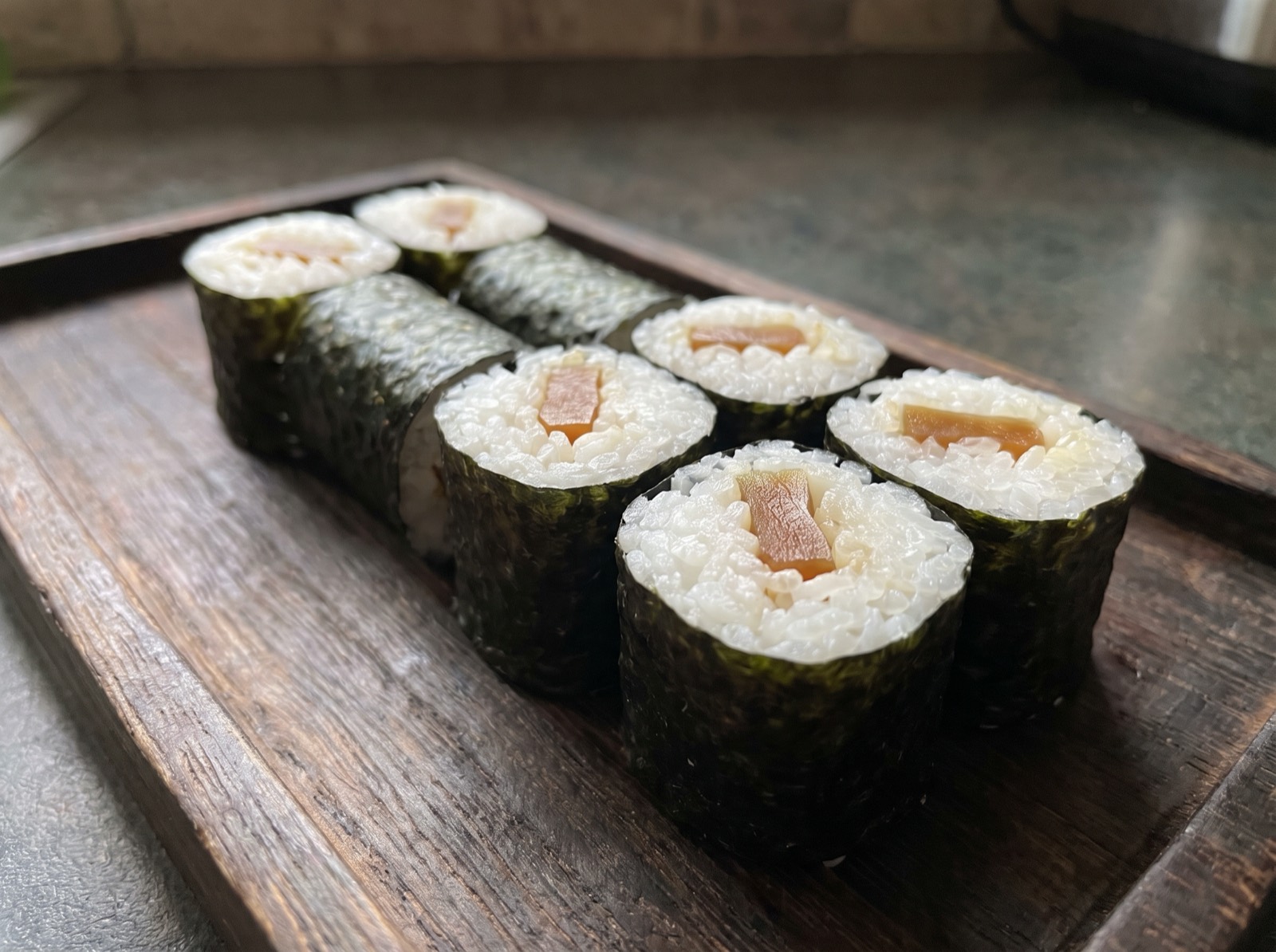
Kanpyō (干瓢) is dried gourd: long ribbons of calabash flesh, peeled off the whole fruit in a continuous strip, sun-dried, and then rehydrated and simmered in soy sauce, sugar and mirin until dark, soft and glossy. Rolled in rice and seaweed it becomes kanpyō-maki, the plainest item on a sushi menu and one of the oldest.
What it is
The gourd is yūgao (夕顔), a bottle gourd grown as a field crop, not the ornamental kind. A mature fruit is mounted and turned against a blade so that the flesh comes away as one long ribbon, which is then hung to dry. The great majority of Japan’s production comes from a single prefecture on the Kantō plain north of Tokyo, which is a large part of why the ingredient is Edo food.
Dry, it is stiff, pale and inedible. Everything it becomes happens in the kitchen.
What the chef does to it
- Washes and rubs it with salt. This softens the fibre and takes off the surface of the dried strip. Skipping it leaves the finished roll faintly rough.
- Soaks and boils it until it is fully soft and pliable, then drains it hard.
- Simmers it in soy sauce, sugar and mirin until the liquid has almost gone and the strips are dark, sweet and savoury at once. This is the flavour of the roll and it is entirely a house recipe.
- Lays it in a thin roll, hosomaki, and cuts it into six. Some Tokyo counters put a line of wasabi in with it, which cuts the sweetness and is worth asking for if it is not standard.
There is no fish in any of this, and that is the interesting part. The piece is rice, seaweed and a simmered vegetable, so all three have to be right — the rice seasoned properly, the nori toasted and crisp, the gourd simmered to the point where sweet and salt hold each other. Nothing rich is available to cover any of it up.
It is the cheapest thing on the menu and it is what chefs order in each other’s shops.
Why it comes at the end
The thin rolls traditionally close an Edomae sequence, after the nigiri, with tea. The reasoning is straightforward: after twenty pieces of fish, a small, plain, slightly sweet roll resets the mouth and finishes the meal on rice rather than on protein.
Ordering one is also, quietly, a way of taking a shop’s measure. It costs almost nothing, it is entirely house-made, and by the time it arrives you already know what the kitchen’s rice and seaweed are like — so the only new information is whether somebody in the back still simmers gourd properly. Plenty of places do not, and buy it in.
Two practical notes
Bleaching. Dried kanpyō is commonly treated with sulphur to keep it pale during drying. Unbleached product exists, is browner, and is labelled as such (無漂白). People with a sulphite sensitivity should know the treatment is standard rather than exceptional.
Vegetarians. Kanpyō-maki looks like the obvious plant-based order, and often is — but the simmering liquid at some shops contains dashi made with dried bonito, which would make it not vegetarian. It is a reasonable thing to ask about, and it is a much more useful question than asking whether a piece contains fish, which is visible anyway. The other reliable options are cucumber rolls and, at some counters, gourd’s neighbour on the list, pickled radish.
How it differs from what it is confused with
- Kanpyō-maki and tekka-maki. Both thin rolls, both classical, both cut into six. One is simmered gourd; the other is raw tuna. They are the two poles of the hosomaki repertoire.
- Kanpyō and takuan. Pickled daikon radish, also yellow, also rolled thin, but crunchy and sharp rather than soft and sweet.
- Kanpyō and futomaki filling. Simmered gourd is one of the standard components inside a thick roll, alongside egg, mushroom and vegetables — so you will meet it there as well as on its own.
- Kanpyō and kampyo. Same word, two romanisations. Both appear on menus.
It also has a second life as string. Softened kanpyō is used to tie kelp rolls and parcels of sushi wrapped in thin egg, where it is structural as much as edible.
How to say it
ka-n-pyo-o, with the n as its own beat and a long final vowel — four beats in all. Kanpyō-maki adds two more. If you want the wasabi version, the word is sabi-iri (さび入り), the opposite of the sabi-nuki covered in our piece on wasabi.
Edomae and Kansai
This is Tokyo food, about as squarely as anything on this list. The gourd is grown just north of the city, the thin roll is an Edo form, and the convention of closing a meal with it belongs to the Edomae sequence described in our guide.
Kansai uses simmered gourd too, but more often inside things: as one filling among several in thick rolls and in the pressed and boxed forms that the western tradition is built on. See oshizushi and the two cities compared.
Where you will see it, and roughly what it costs
On every counter menu in Tokyo, on most belts, and in every supermarket roll assortment. It is among the cheapest items available anywhere sushi is sold.
No per-roll figure from us, because it is close enough to the bottom of every price list that the number is not the interesting part. What is worth doing is ordering it deliberately rather than accepting it as filler: it is the one item where the price is trivial and the information is not. Our guide to the forms of sushi places it among the rolls.
Frequently asked questions
What is kanpyō?
Dried gourd. Ribbons of calabash flesh are peeled off the whole fruit in one continuous strip and sun-dried, then rehydrated and simmered in soy sauce, sugar and mirin until dark and soft. Rolled thin in rice and seaweed it becomes kanpyō-maki.
What does kanpyō-maki taste like?
Sweet and savoury at once, soft, with a faint vegetal note underneath. There is no fish and no fat in it, so the flavour comes entirely from the simmering liquid and from the rice and seaweed around it.
Why do sushi chefs order kanpyō-maki?
Because it costs almost nothing and cannot be faked. It is rice, seaweed and a simmered vegetable, so all three have to be right and nothing rich is available to cover any of it. Plenty of shops buy the gourd in ready-simmered rather than making it.
Is kanpyō-maki vegetarian?
Usually, but not always. The simmering liquid at some shops contains dashi made with dried bonito. It is worth asking, and it is a more useful question than asking whether a roll contains fish, which you can see.
Why is kanpyō-maki served at the end of a meal?
A thin roll after the nigiri resets the palate and finishes on rice rather than on more fish. It is the traditional close to an Edomae sequence, taken with tea.
What is the difference between kanpyō and takuan?
Both are yellow and both are rolled thin, but kanpyō is dried gourd simmered soft and sweet, and takuan is pickled daikon radish — crunchy and sharp.