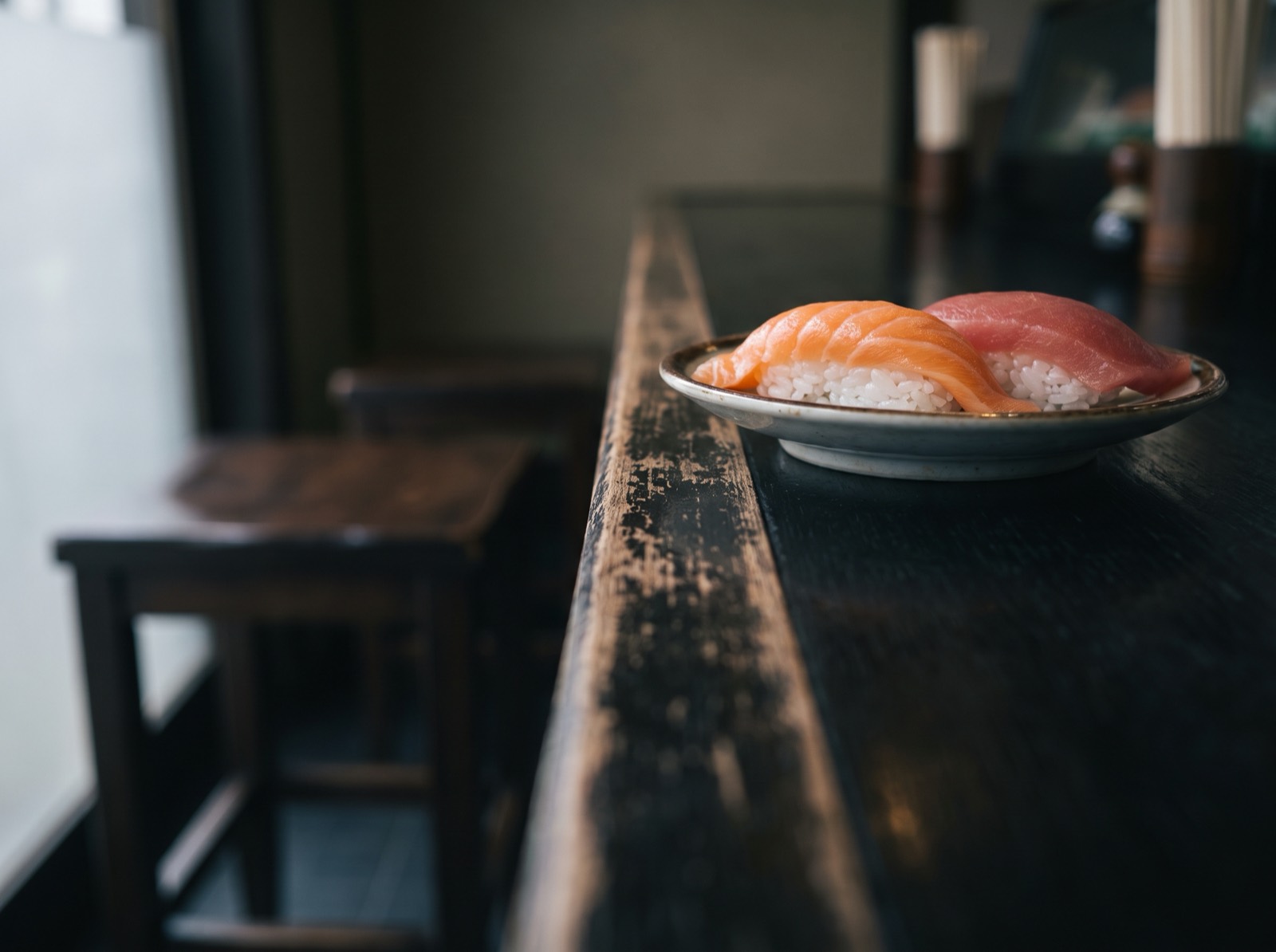
At a traditional sushi counter in Japan, three things actually matter: do not soak the rice side of nigiri in soy sauce, do not mix wasabi into the soy sauce, and do not let a piece sit — eat it within about ten seconds. Using your hands is fine. Asking the chef questions is fine. Tipping is not expected in Japan and is better not attempted.
Three things that matter, and everything else is noise
We want to put the conclusion first, because the length of the usual list is itself the problem. A twenty-item catalogue of prohibitions makes people tense at exactly the moment they should be tasting something. So:
- Do not soak the rice. It falls apart, and half the piece ends up in the dish.
- Do not mix wasabi into the soy. There is already wasabi in the piece, in a quantity chosen for that fish.
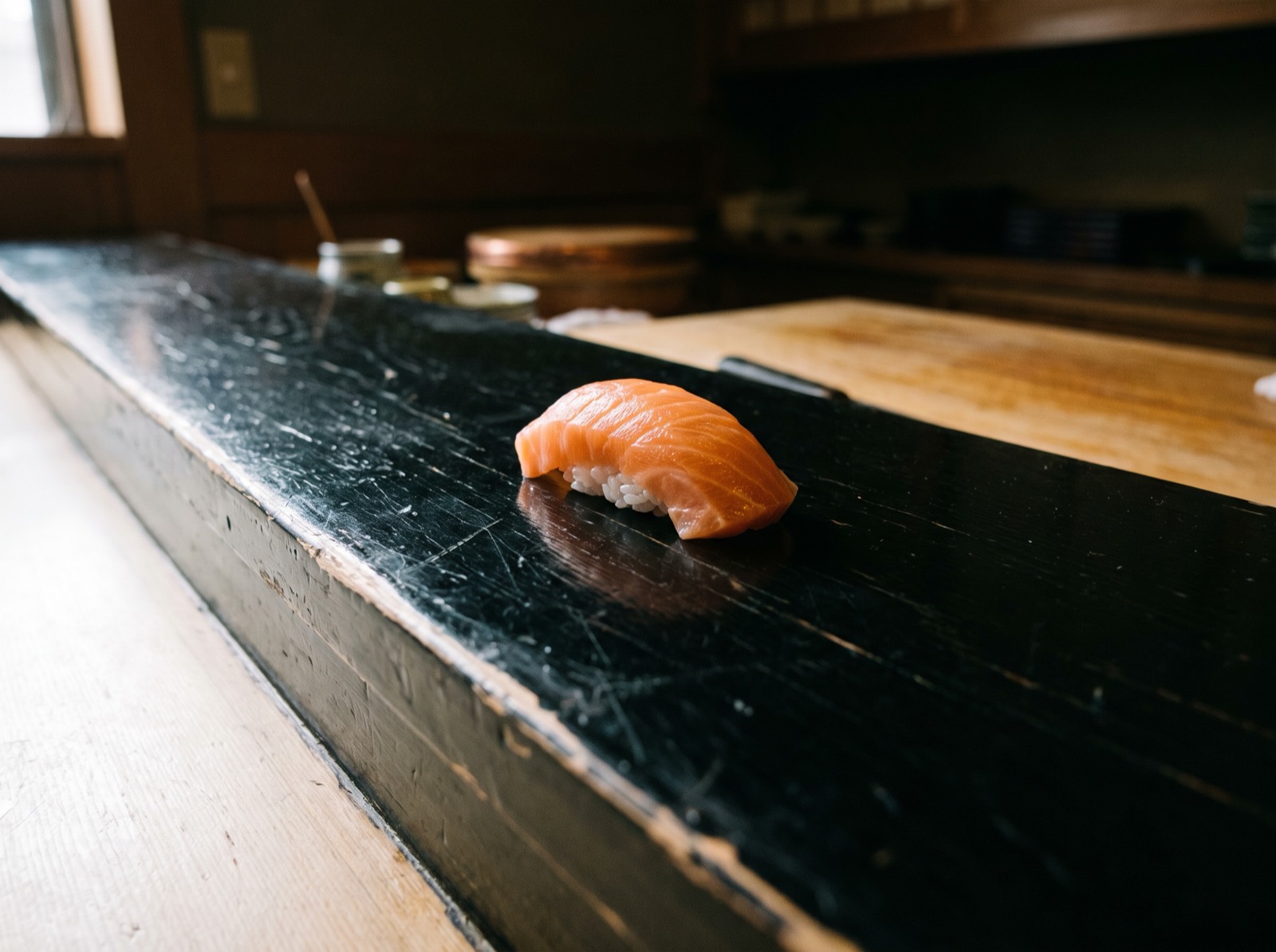
- Do not let it sit. The piece changes measurably within a minute of being set down.
Everything after this is either a consequence of those three, a point of consideration for the people around you, or something you have been told that is not true.
Do not dip nigiri rice-side down
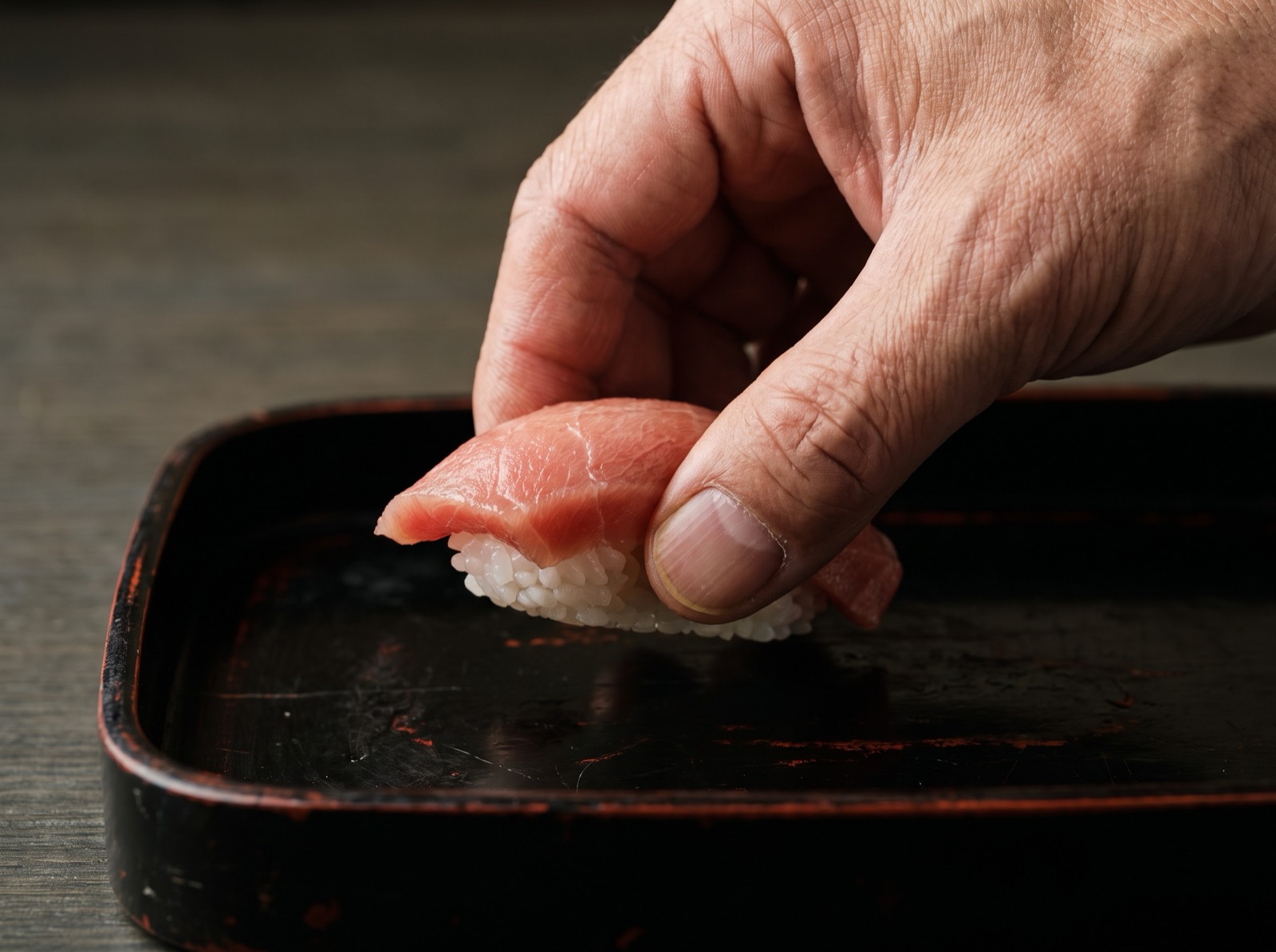
Vinegared rice at a counter is pressed just firmly enough to survive being lifted. That looseness is deliberate (it is what lets the piece come apart in your mouth instead of arriving as a compressed block), and it is also why it cannot survive immersion. The grains take up liquid, swell, and lose what little is holding them together. Put a piece in the dish rice-first and you will be retrieving it with chopsticks.
The reliable move is to turn the piece onto its side and touch it to the soy briefly. Japanese reference books actually differ on whether the rice should meet the soy at all (one says fish only, another says a light angled contact with both is better because otherwise the fish never gets seasoned), but they agree completely on the failure mode. Contact, not immersion. And fill the dish only halfway, which makes over-dipping physically harder.
Better still: check whether you need to dip at all. At a shop working in the Edomae tradition the chef has already brushed the piece with nikiri, a soy sauce simmered with mirin and dashi, or with the thicker sweet tsume on simmered toppings. Those pieces are finished. In the original Edo-period practice the customer never dipped anything.
Do not add wasabi to the soy sauce
The green paste is already inside the piece, between the fish and the rice, and the amount is a decision — more for oily fish, less for delicate white fish. Dissolving another spoonful into the soy overrides that, and it also flattens the wasabi itself, which is volatile and loses its edge in liquid.
If you do not like it, the fix is upstream: say sabi-nuki de onegai shimasu when you order, and it will be left out. Asking for less is equally normal. This is one of the few adjustments almost every shop will make without comment.
Do not let it sit
Nigiri is served at two temperatures at once: rice at around body heat, fish cool from the case. That contrast is the point of the piece and it has a short half-life. Fat softens against the warm rice, the cut surface dries, the rice compacts. A minute is long. Two minutes is a different piece of food.
The photograph will still be there in an hour. The piece will not.
This is also the only item on the list that a chef will genuinely register, because they are timing the meal to how fast you eat. If they are outpacing you, say so. It is a normal thing to say and it solves the problem instantly.
Do not order a California roll at an Edomae counter
Not because it is beneath anyone. Invented rolls are a real and well-loved American form, and the people who made them were solving a real problem with real skill. But an Edomae counter in Tokyo does not stock avocado, does not have crab stick, and is not set up to make them, so the request lands as a misunderstanding of what kind of shop you are in rather than as an insult.
The general version of this point: a sushi counter is not a menu of everything. It is a shop that bought a specific quantity of specific fish that morning. Requests inside that scope are welcome. Requests outside it cannot be met however willing the chef is.
Do not wear strong perfume
You are sitting within arm's reach of raw fish and of the people eating it. Scent carries along a counter and it does not stop at the person wearing it. Japanese reference books list this alongside loud conversation as the two things that make a counter unpleasant for everyone else, and neither has anything to do with technique.
In the same category: take off your watch and rings before you eat. They scratch the counter, which at a serious shop is a single piece of wood being maintained across decades.
Do not photograph other guests
Photographing your own food is generally tolerated and at many shops entirely normal, though it is worth asking at the most traditional counters. Photographing the room, the chef's hands or the person two seats along is a different matter: a counter is a small space and everyone in it is visible. Ask first, and accept a no without negotiating.
The other half of this is the ten-second rule above. If a photograph costs you the piece, it was expensive.
Do not be late — and do not be very early
Japanese reference books name turning up late without calling as the worst breach of manners at a sushi counter, ahead of anything you might do with the soy sauce. The reason is structural: the shop bought fish for a specific number of people at a specific time, and at a counter serving one seating, a late arrival displaces the whole evening.
Arriving well before your time is its own problem, because the seat is not free and the shop now has to accommodate you standing in a room the size of a corridor. On time means on time.
And arrive hungry. Eating or drinking beforehand is considered poor form in the Japanese books, and beyond manners, it is a straightforward waste of a meal you booked.
Do not tip
Tipping is not part of how restaurants in Japan are priced, at any level. Leaving cash on the counter is likely to produce a staff member following you into the street to return it, which is a worse outcome for everyone than simply not doing it.
Two related points for visitors. Do not ask for the bill by saying oaiso: it is staff slang whose root means something close to “lost patience with you.” Say okanjo onegai shimasu. And do not assume you can pay by card: a great many sushi shops in Japan still take cash only, and it is a question to ask when you book, not at the end of dinner.
What is fine, despite what you have read
This is the part that gets left out, and it is the part that actually relaxes people.
- Eating with your hands is fine. So are chopsticks. Japanese books treat both as correct; the English rule that fingers are mandatory is an overstatement of a habit from the street-stall era.
- Asking the price is fine. Market-rate items can be expensive, and asking before you order gets you a straight answer. Giving a budget when you book is standard practice.
- Asking questions is fine. “What fish is this?” and “do I dip this?” are ordinary counter conversation.
- Eating gari whenever you want is fine. It is a palate rinse, not a ceremony with a fixed position in the meal.
- Sitting at a table is fine. English guides insist on the counter; Japanese books say a group that came to drink and talk is being more considerate at a table.
- Sake with sushi is fine. The English notion that rice wine with rice is redundant is not a Japanese idea: the books recommend the pairing and give the shared grain as a reason for it.
- Ordering tea at the start is fine. Agari is not only the tea at the end; the word comes from agaribana, freshly drawn tea, and debana carries the same idea.
- Not talking is fine. Answering when the chef speaks to you is enough.
If you want the whole social frame rather than the negative list, see our guide to sushi etiquette. For the physical mechanics (grip, angle, order, one bite or two) see how to eat sushi.
Frequently asked questions
What is the biggest mistake at a sushi restaurant?
Letting the piece sit. Nigiri is built from warm rice and cool fish and starts changing the moment it is set down. Japanese books separately name arriving late without calling as the worst breach of manners; neither is about chopsticks.
Is it rude to eat sushi with your hands?
No. Both hands and chopsticks are correct in Japanese reference books. Eating with your fingers is a survival from when nigiri was street food, and remains entirely proper.
Is it rude to put wasabi in soy sauce?
At a traditional counter, yes: the chef has already put wasabi inside the piece in a quantity chosen for that fish. Ask for sabi-nuki if you would rather have none.
Should I tip at a sushi restaurant in Japan?
No. Tipping is not expected anywhere in Japan and staff will often chase you to return the money. Service is included in how the business is priced.
Can I order a California roll in Japan?
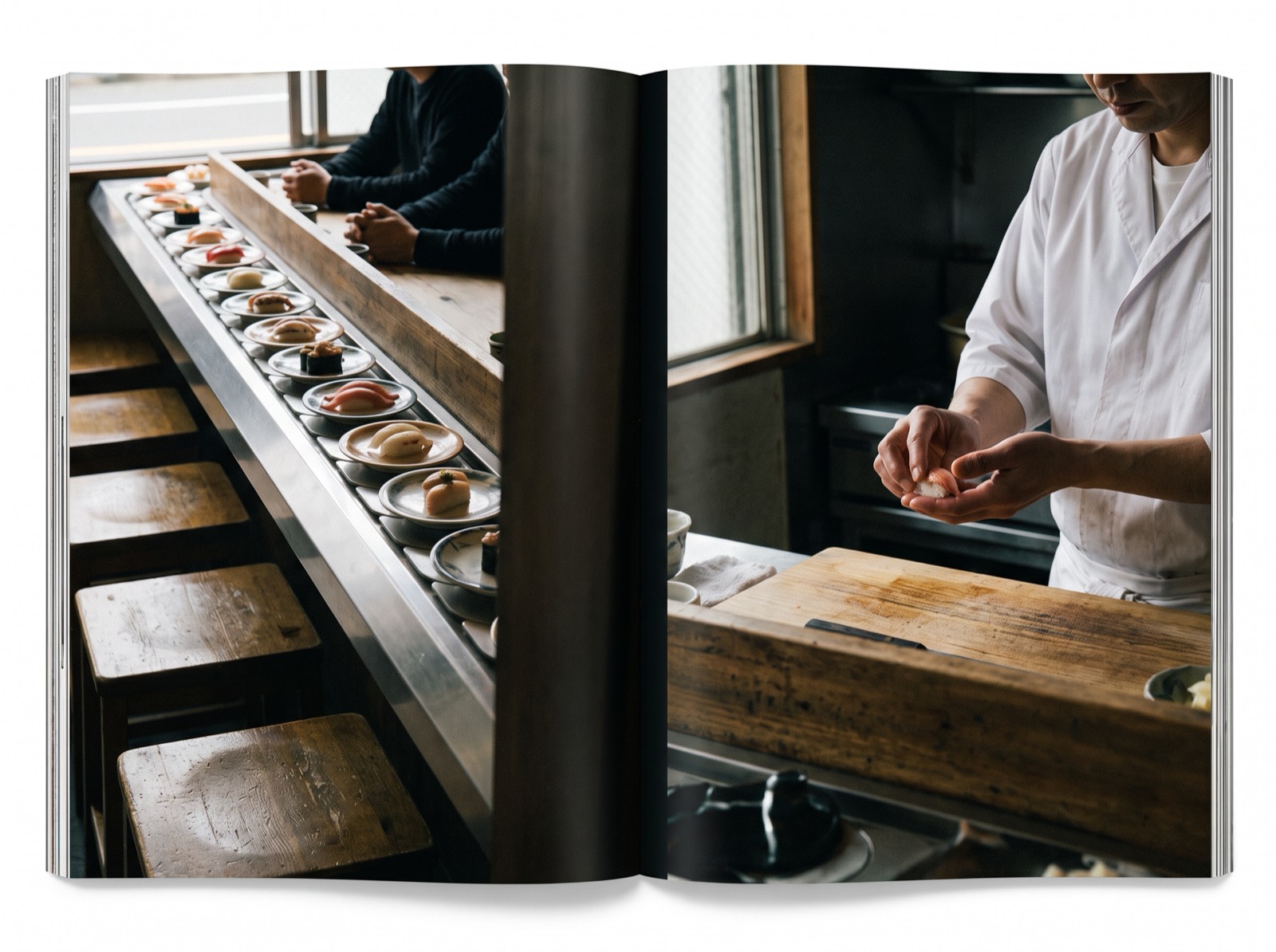
At a conveyor-belt shop, sometimes. At an Edomae counter, no: the shop does not stock the ingredients. It is a mismatch of venue rather than a breach of etiquette.
Is it rude to take photos of sushi?
Photographing your own food is usually fine and worth confirming at the most traditional shops. Photographing other guests or the chef without asking is not. Either way, do not let the piece sit while you frame the shot.
Can I ask the chef questions?
Yes. Asking what a fish is, whether a piece is already seasoned, or what the price of a market-rate item is are all ordinary questions at a Japanese counter.