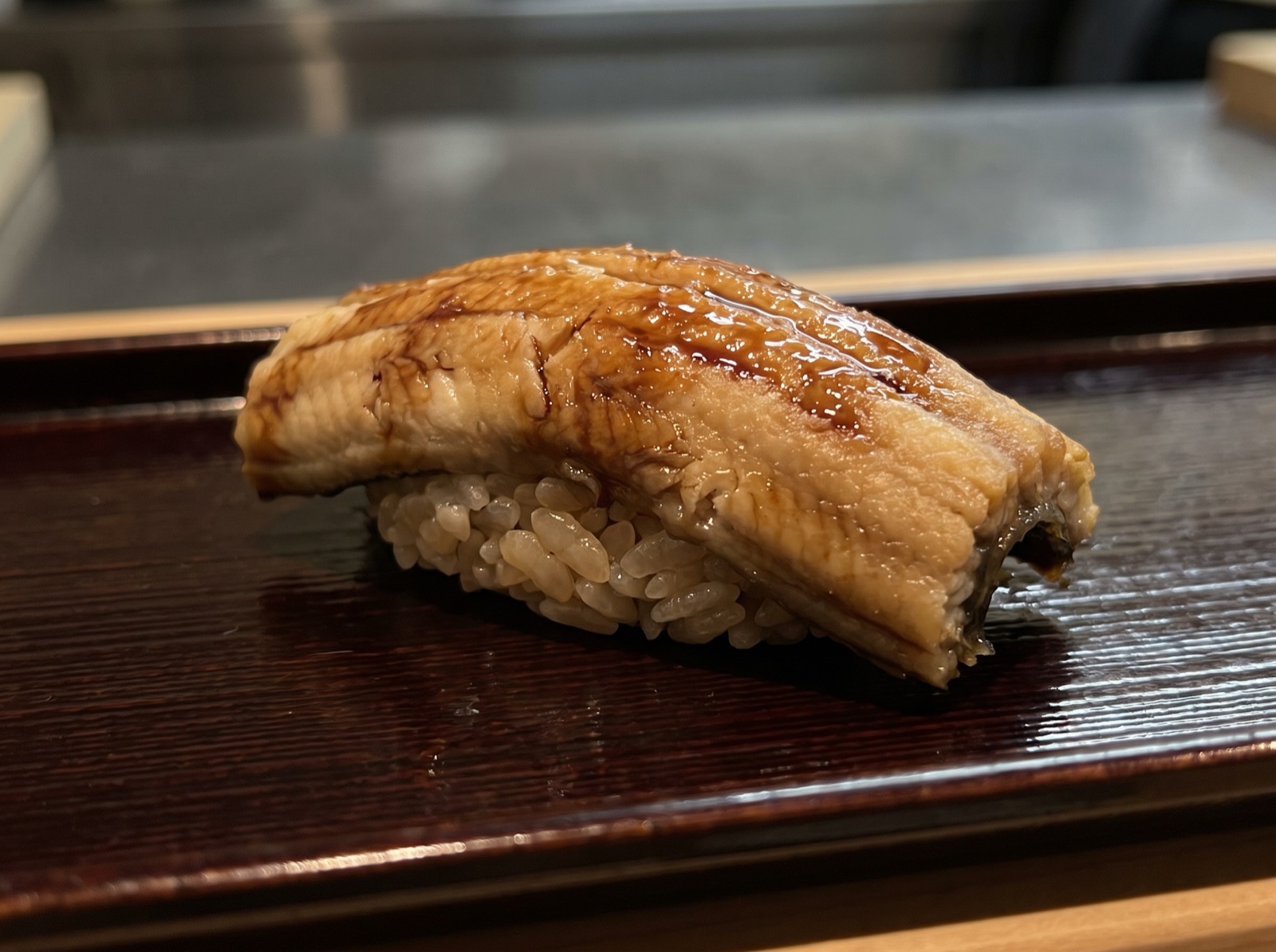
A small flat brush touches the top of a piece of nigiri for under a second, and by the time the piece reaches the counter the seasoning decision has already been made. Anyone who has eaten more than once at a counter working in the Edomae style has watched this happen, usually without hearing the word for it: nikiri (煮切り), the dark, glossy coat that is a large part of why the soy dish beside your hand may not get used all evening.
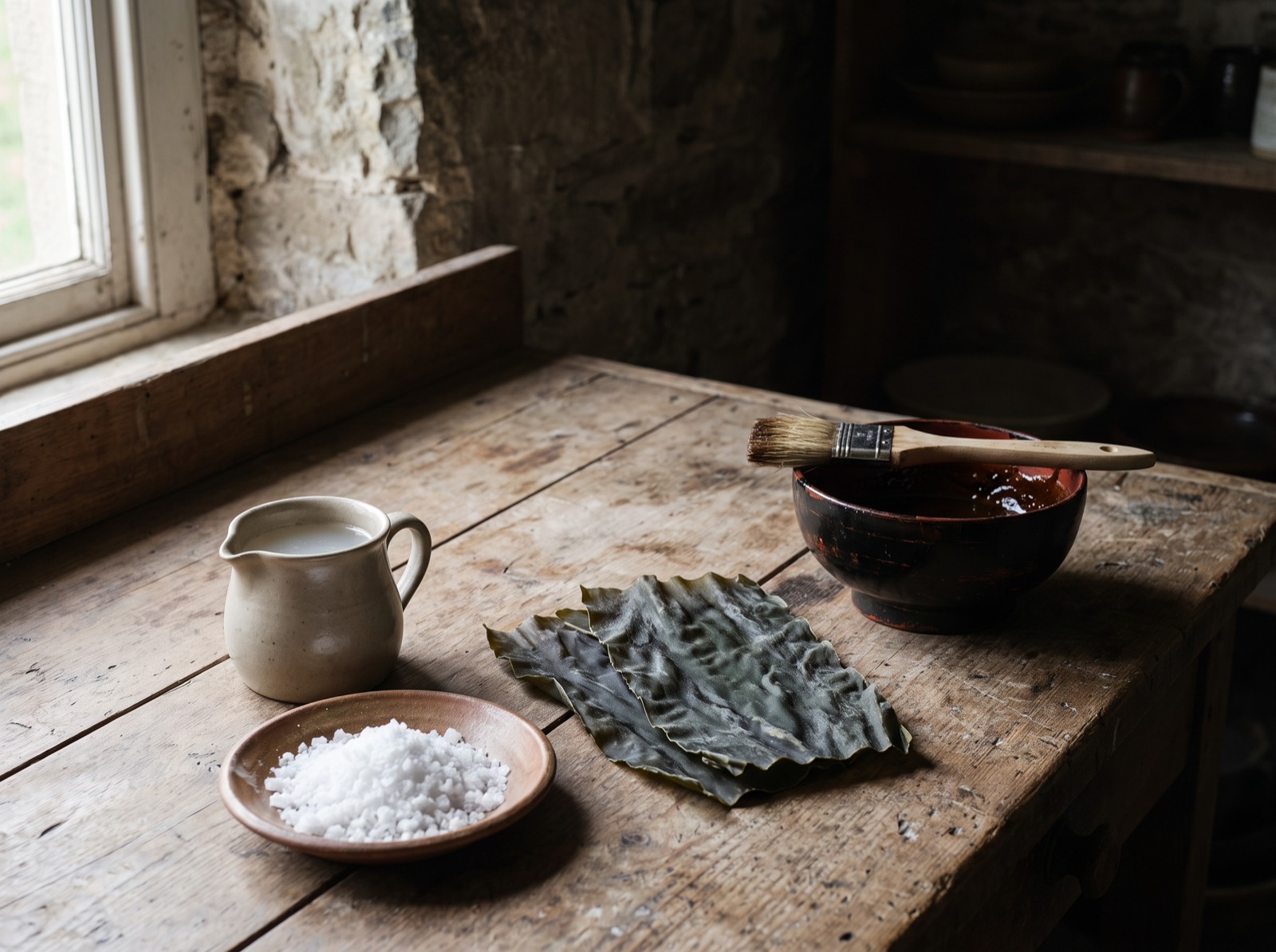
Nikiri is dark soy sauce — koikuchi shoyu (濃口醤油), the type Kanto simply calls soy sauce — simmered briefly with mirin and dashi, then brushed onto the fish in a single stroke. Every shop mixes its own, and none of them will tell you the ratio.
What it is
The word describes what happens in the pot before it describes what ends up on the fish. Nikiru (煮切る) means to boil something down, and here what is being boiled off is the alcohol in the sake or mirin. Once the alcohol has cooked away, the soy, sweetener and dashi are left to settle into a sauce that is thinner and less concentrated than the soy sauce that came out of the bottle. The process is the name.
There is no fixed formula, and the reference literature is explicit that none exists: some kitchens build it from soy, sake and mirin; others swap the sake for dashi. What stays constant is the base — koikuchi shoyu, the dark soy that came to dominate Edo's kitchens (see what Edomae actually means) — and the fact that the finished sauce has been diluted and reduced, not used straight.
When it is used
Nikiri is the last thing that happens to a piece before it leaves the chef's hand, not the first stage of a longer process the way curing or marinating is. It appears on most of what is not already seasoned by some other method: raw fish, salt-and-vinegar-cured fish such as kohada, and the cuts of tuna a shop is not serving as zuke.
It is not universal. Some pieces, particularly squid and the more delicate white fish, are finished with a pinch of salt and a few drops of citrus instead — a different branch of the same idea, seasoning decided by the chef rather than the diner, just without soy in it at all. And it is rarely printed on a menu, in either language: a shop that brushes nikiri onto most of its nigiri is unlikely to say so. The piece is expected to announce it by arriving glossy.
What the chef actually does
The base is mixed and simmered ahead of service, sometimes in a small batch that lasts a single evening, sometimes in a pot that is topped up over a longer stretch. Soy sauce goes in with mirin, or with sake and dashi, and the mixture is brought to a brief boil — enough to cook off the alcohol and let the flavours settle together, not enough to reduce it toward the thickness of tsume. It is then cooled and kept within reach of the cutting board for the rest of service.
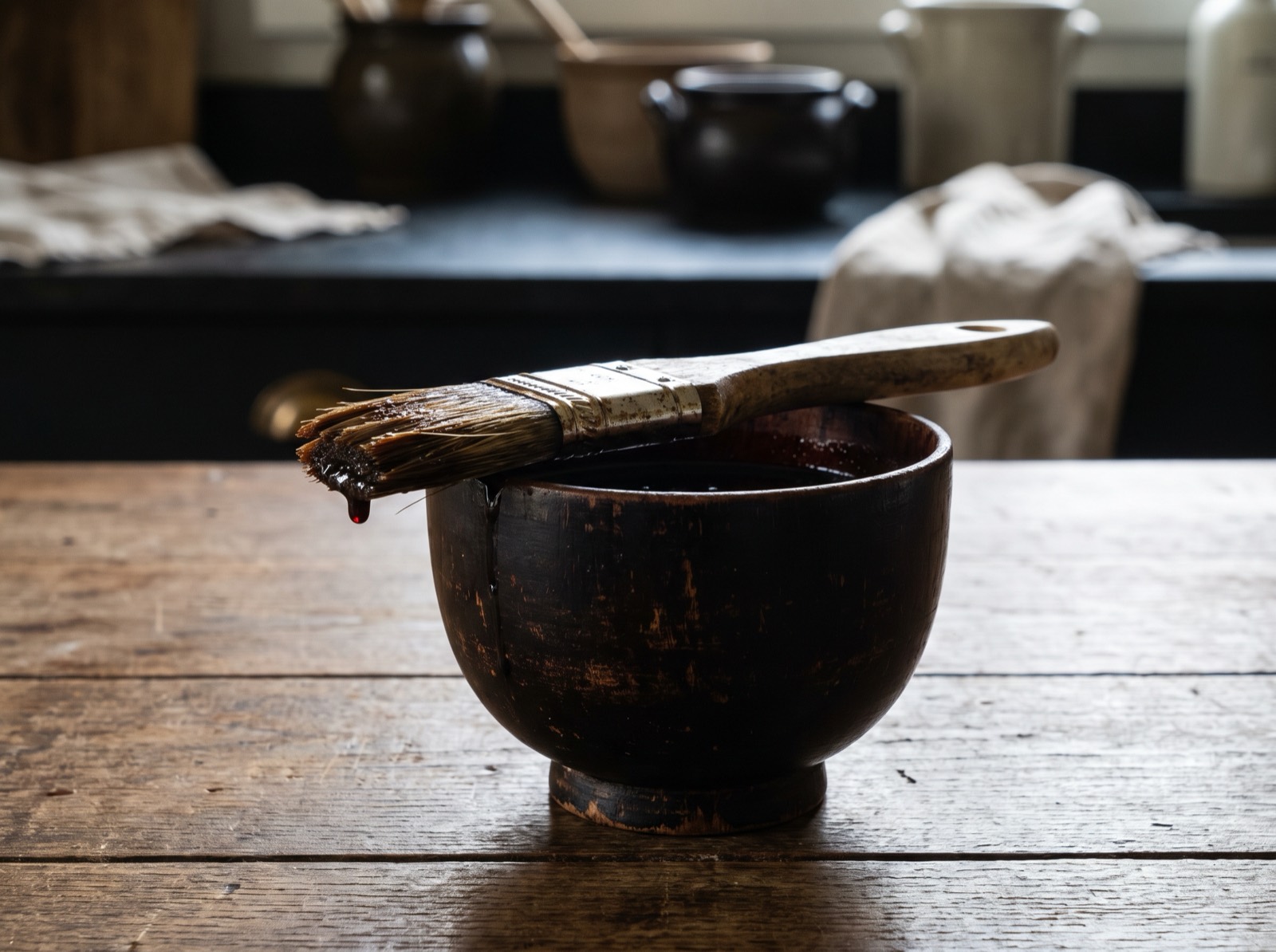
Application is a single motion: a small flat brush, dipped and drawn once across the surface of the fish, immediately before the piece is handed or set down. The amount is judged by eye against the fish underneath it — enough to season, not enough to cover what the fish itself is doing. A shop calibrates the strength of its nikiri to its rice as much as to its fish, because the two are tasted together in the same mouthful.
This is also, practically, why it is brushed rather than poured: a measured coat seasons the fish without soaking the rice underneath it, which is not built to hold soy sauce well. For what that means at the table, see sushi etiquette.
Why it is done
Street stalls in nineteenth-century Edo could not hand every customer their own dish of soy sauce, so the fish arrived seasoned already; that history is covered in full in what Edomae actually means. What nikiri adds to that history is a name for the specific liquid that made it possible, and a reason the habit outlived the stalls that needed it. Once soy sauce is simmered with mirin and dashi, it stops being a condiment a diner reaches for and becomes an ingredient a chef measures, the same way salt is measured into a cure rather than left on the table in a bowl.
The result is a transfer of one decision — how much this piece of fish needs — from the person eating it to the person who bought it, cut it and tasted the sauce before it went anywhere near the rice. A shop that brushes nikiri onto nearly everything has made that call, piece by piece, on your behalf, and the soy dish on the counter becomes closer to a formality than a tool.
The soy dish is not where the seasoning happens. It already happened, with a brush, before the piece was set down.
How it differs from what it is confused with
Three things get folded into nikiri in casual English writing about sushi, and each of them is a distinct piece of work.
- Nikiri and tsume (煮ツメ) are both soy-based and both applied with a brush, which is most of why they are confused. But tsume is not simmered soy, mirin and dashi — it is built from the cooking liquid of a simmered topping such as anago or clam, reduced with soy and sugar into something thick, dark and sweet enough to sit on the surface rather than sink in. Nikiri seasons raw and lightly cured fish; tsume finishes what has already been cooked. A shop's tsume can be years old, topped up rather than remade; its nikiri is mixed fresh for service.
- Nikiri and zuke (漬け) share an ingredient family — zuke's marinade is also soy-based, sometimes cut with dashi — but not a method. Zuke is a soak: sliced tuna sits in the liquid long enough to firm and darken, the way a cure does. Nikiri never soaks anything. It touches the surface once, seconds before the piece is plated, and does not return.
- Nikiri and the soy sauce in the dish beside you are not the same liquid. What is in that dish, if a shop puts one in front of you at all, is unheated soy sauce, whatever grade the kitchen has chosen for the table (see 紫, murasaki, in our words at a sushi counter). What is on the fish has already been simmered with mirin and dashi and tasted by someone before it touched the rice. At a counter working the Edomae way, the dish on the counter is the backup plan, not the default.
- Nikiri is not a single recipe, and it is not a brand. Every shop's version is different, and a chef who trained somewhere else brings a different nikiri when they open their own counter. The one thing that does not vary is what it is for.
How to say it
nee-KEE-ree will be understood. Strictly it is three even beats, ni-ki-ri, none of them stressed — the same rhythm as ko-ha-da in our kohada entry. It is worth remembering the word is a plain Japanese verb form before it is kitchen jargon: nikiru, to boil down, applied here to burning the alcohol out of sake or mirin. A chef using the word is naming an action, not a product on a shelf.
Where you will see it
At any counter that takes the Edomae style seriously, on most of what comes across it: the raw fish, the vinegar-cured silver skin, the tuna not otherwise marinated. It is part of why the case in front of you can look almost matte before a piece is cut, and faintly glossy by the time it reaches you.
It is almost never printed on a menu, in either language, because it is not an item you order — it is a default, the same way rice is a default. The clearest way to check whether a shop uses it is the one already covered in sushi etiquette: watch what happens to the soy dish. If a full evening of pieces goes by and nobody has touched it, nikiri, or something in its family, is doing the work instead.
None of this makes plain soy sauce wrong, or the dish on the counter decoration in every case — plenty of good counters still set down a saucer and mean for you to use it. What nikiri tells you, once you know to look for it, is which decision a particular shop has chosen to make for you, and which one it has left in your hands.
Frequently asked questions
What is nikiri?
A soy-based sauce — koikuchi shoyu simmered briefly with mirin and dashi — brushed onto a piece of nigiri just before it is served. Every shop mixes its own, and the recipe is not standardized.
Is nikiri the same as tsume?
No. Tsume is a thicker, sweeter reduction built from the cooking liquid of simmered toppings such as anago or clam. Nikiri is thinner, is not built from any one topping's cooking liquid, and is used mainly on raw and lightly cured fish rather than cooked ones.
What is the difference between nikiri and zuke?
Zuke is a soak: usually tuna left in a soy-based marinade long enough to firm and darken. Nikiri is a single brushed coat applied just before serving, and it is never used as a marinade.
Why does the soy dish at a sushi counter sometimes go unused?
Because the piece has already been seasoned, with nikiri on raw and cured fish or with tsume on cooked toppings. At a counter working in the Edomae style, dipping again can mean seasoning the piece twice.
What does the word nikiri mean?
It comes from the verb nikiru, to boil something down — here, to cook the alcohol out of the sake or mirin used in the sauce. The name describes the process rather than the ingredients.
Is nikiri the same as regular soy sauce?
No. Regular soy sauce is unheated and used straight; nikiri is simmered with mirin and dashi first, which dilutes and rounds it out before it ever touches the fish.