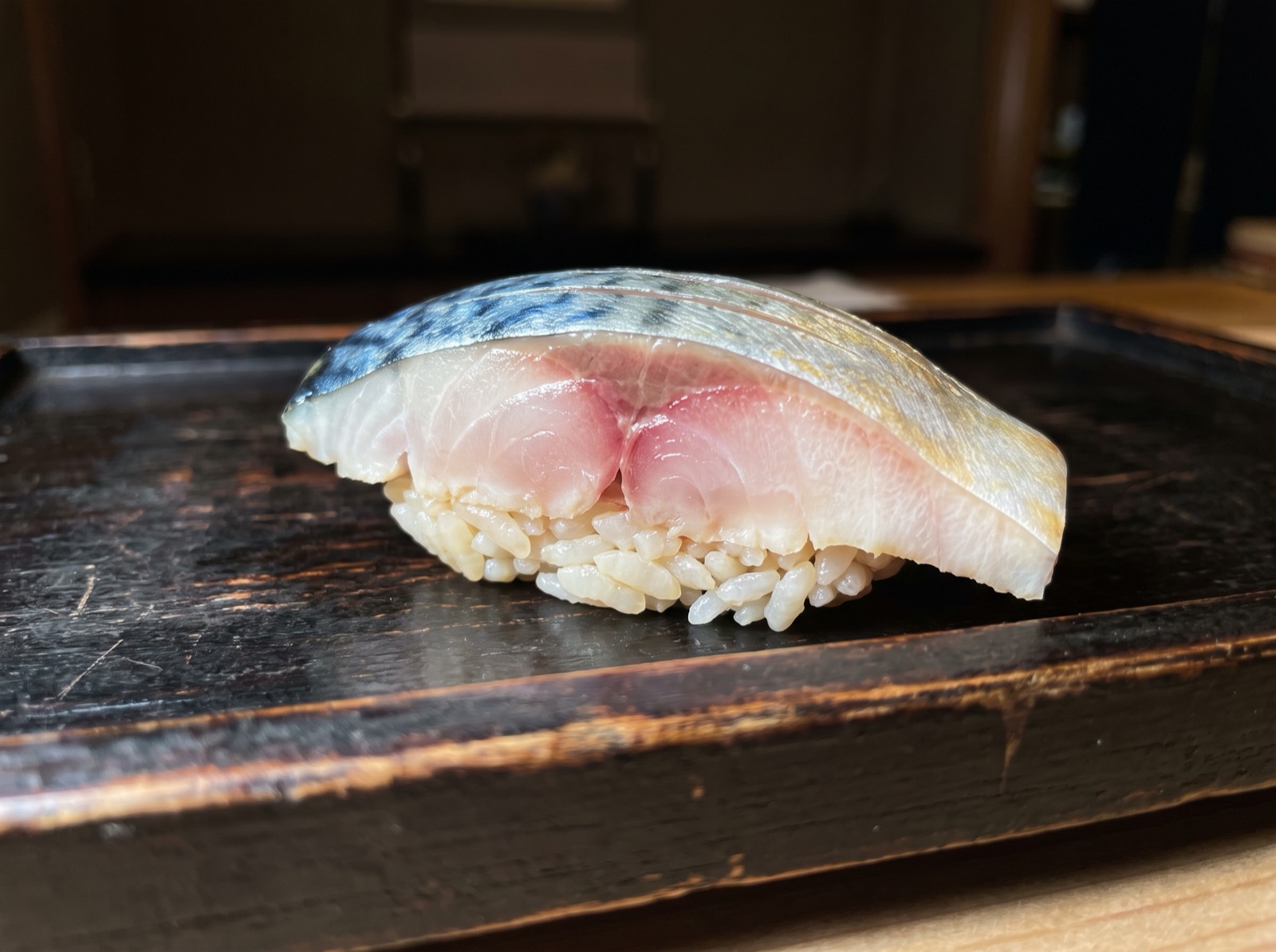
Saba (鯖, chub mackerel, Scomber japonicus) is almost never served raw in Japan. It arrives at the counter cured — salted first, then vinegared — as shime-saba, or pressed into a box as Osaka’s battera. The cure is not what makes the fish safe from parasites — vinegar does not kill anisakis, and Japan’s health ministry says so in as many words. It is there because this fish spoils faster than almost anything else in the sea.
What it is
An oily, strong-flavoured, blue-backed fish, common, cheap and enormously important in Japanese cooking. It belongs to the same broad family as tuna and bonito — fast swimmers with a lot of dark muscle — and it carries the most assertive flavour of the three.
It is also the origin of one of the bluntest phrases in Japanese food language: saba no ikigusare (鯖の生き腐れ), “mackerel rots while it is still alive”. The fish does not literally do that. What it does is degrade unusually fast after death, because it is oily, warm-blooded enough to hold heat, and carries strong digestive enzymes that go to work on its own flesh. Everything else in this piece follows from that sentence.
What the chef does to it
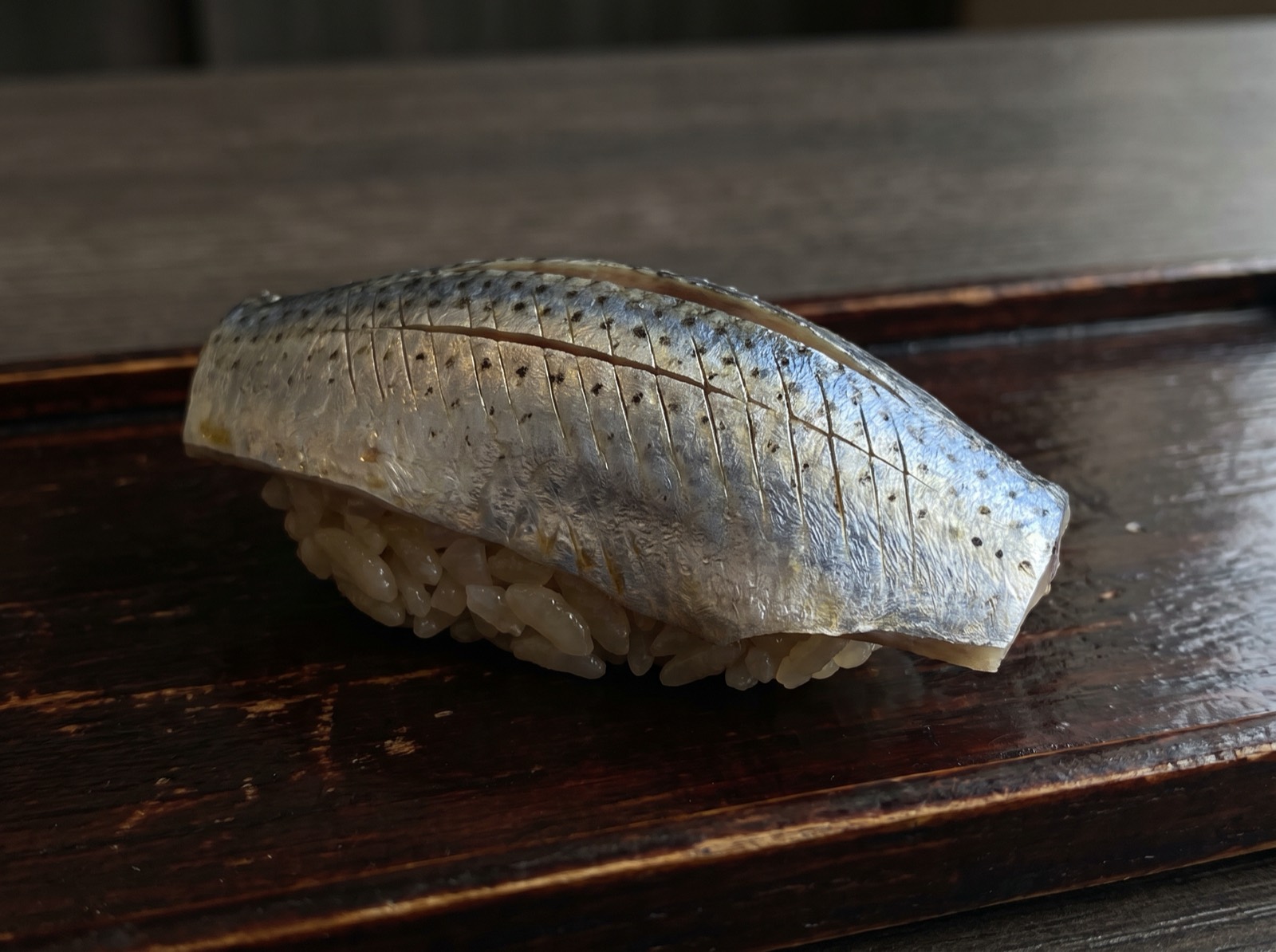
Shime-saba (締め鯖): salt, then vinegar. The same two-step cure applied to kohada, but on a fish several times the size, which changes every timing.
- Salt. The filleted fish is buried in salt and left. Water comes out, the flesh firms, the surface protein begins to change. On a large mackerel this stage is measured in hours, not minutes.
- Rinse. Usually with vinegar or with water, to take the surface salt back off before the second stage.
- Vinegar. The fillet goes into rice vinegar, often with kombu, sugar or sake. The acid sets the surface, turns it opaque white, and takes the sharpest edge off the fish.
- Rest. The cure keeps moving after the fillet comes out. A shop’s house style lives in this stage more than in the previous three.
How far the vinegar is allowed to travel is the single decision that defines a shop’s shime-saba. A hard cure drives white all the way through and produces a firm, sharply acidic piece that keeps. A light one — nama-jime (生〆) — leaves the centre pink and glossy and tastes far more of mackerel; it also has to be eaten sooner. Neither is the correct answer. A counter will usually be doing one of them on purpose.
The bones are pulled and the fine membrane over the skin is peeled by hand before slicing, which is fiddly, unglamorous and immediately obvious when it has been skipped.
What the cure does not do
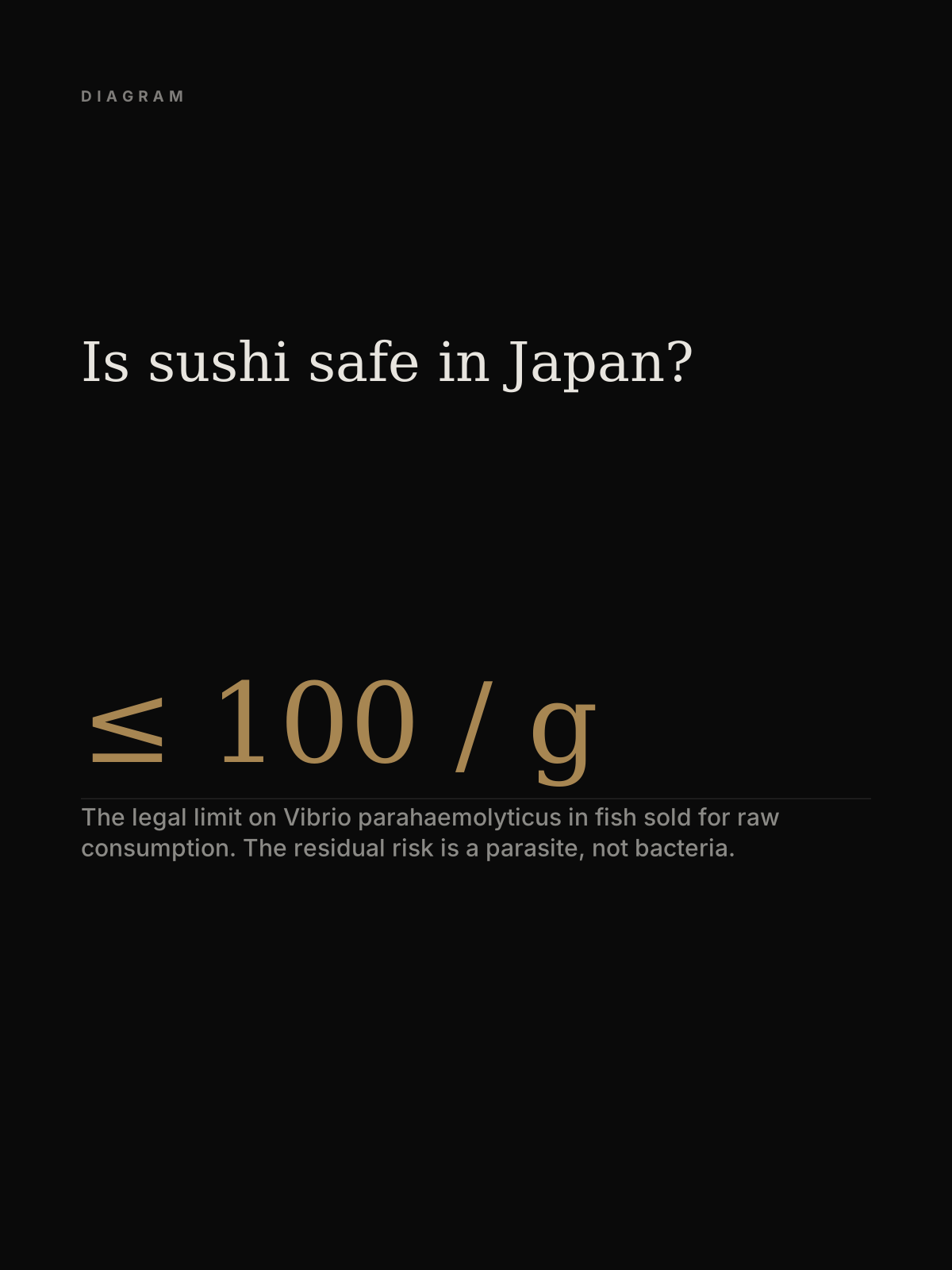
It does not kill parasites. Japan’s Ministry of Health, Labour and Welfare states explicitly that vinegar used in ordinary cooking, salting, soy sauce and wasabi do not kill Anisakis larvae, and it names mackerel first on the list of fish in which those larvae are found.
What does work, according to the same ministry: freezing at −20°C for 24 hours or more, or heating to 70°C (60°C for one minute), together with removing larvae by eye during preparation. Two temperatures and a trained pair of eyes.
This matters because the English-language internet repeats the opposite constantly, usually in the form “the vinegar in sushi makes it safe”. It does not. What makes commercially served shime-saba reliable in Japan is that the fish has been frozen at some point in its journey, or has been inspected and cleaned by someone who knows exactly what they are looking for, or both. Our safety guide sets out the regulatory framework around that.
The vinegar was never a disinfectant. It was a clock.
There is a second reason for the speed, unrelated to parasites: mackerel is the fish most associated with histamine, which builds up when the fish is held warm after landing and which cooking does not remove. The trade’s obsession with getting this fish cold immediately is about both problems at once.
When it is best
Autumn into winter, when the fat is highest — aki-saba and kan-saba, autumn and cold-season mackerel, are the words you will see. A fat winter mackerel and a thin summer one are barely the same eating experience, and a shop that only runs shime-saba in the cold months is telling you something honest.
A handful of line-caught branded fish are treated as a separate category, the best known being seki-saba from the strait between Kyushu and Shikoku. These are handled individually from the moment they are landed, and they are among the very few mackerel served genuinely raw in Japan — which is a statement about handling, not about the species.
Osaka’s version: battera and saba-zushi
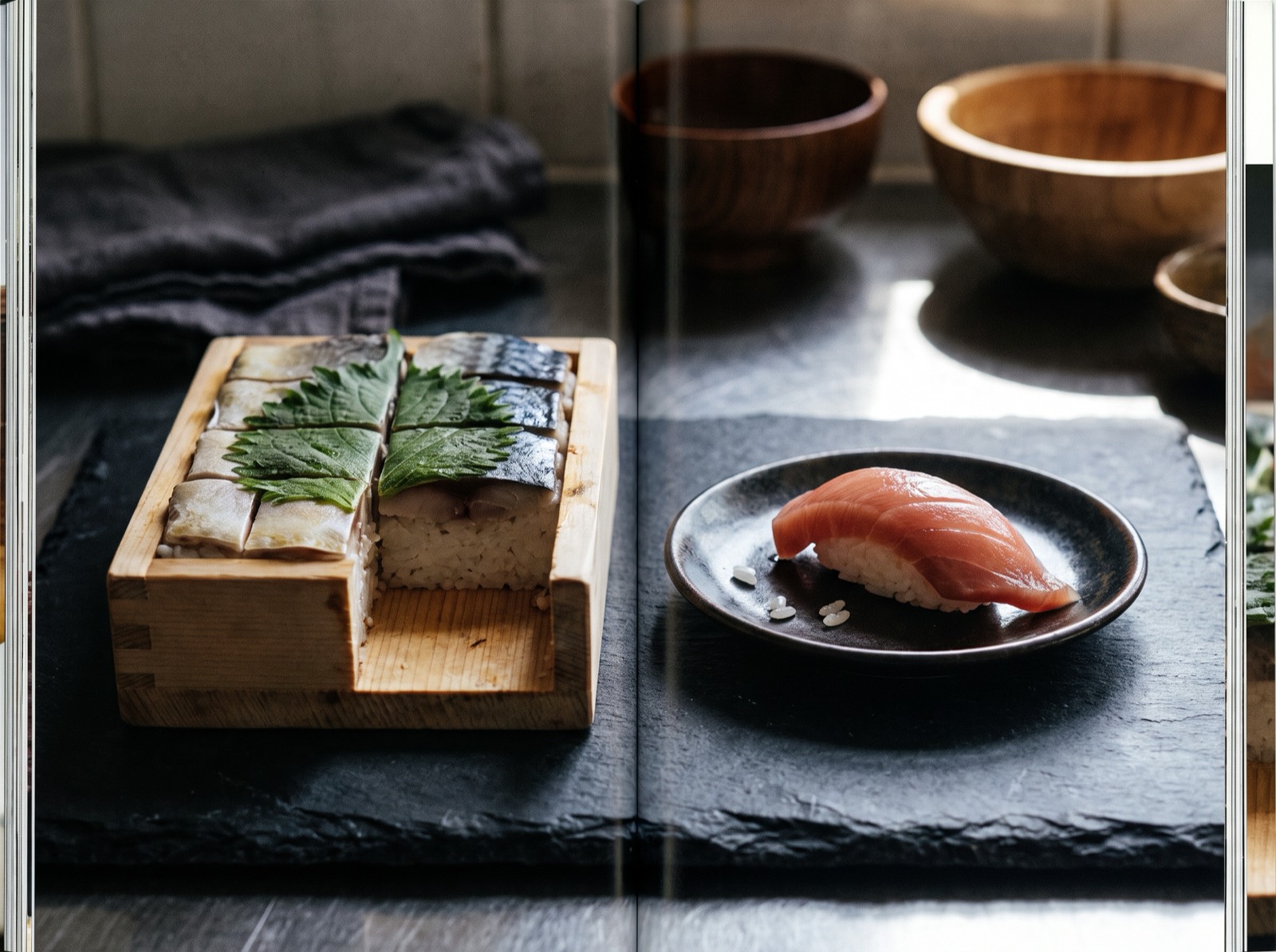
In Kansai the cured fillet does not go on a hand-formed piece of rice. It goes into a wooden box or is rolled in a cloth, pressed, and cut into rectangles — oshizushi, the older form of sushi, and the one Osaka kept. See our piece on pressed sushi for the form itself.
Two names get used and they are not identical. Battera (バッテラ) is the boxed, pressed version, usually topped with a translucent sheet of pickled kombu; the name is generally traced to Portuguese bateira, a small boat, after the shape of the piece. Saba-zushi or bō-zushi (棒寿司, “stick sushi”) is the rolled cylinder, thicker, with a whole half-fillet arched over the rice, and it is closely associated with Kyoto.
The Kyoto connection is geographical. Kyoto is inland, and salted mackerel was carried there overland from the Sea of Japan along a route still called the Saba-kaidō, the mackerel road. A fish that had been salted for the journey and then pressed with vinegared rice is what a landlocked capital could actually have, and the dish outlived the reason for it.
How it differs from what it is confused with
- Saba and aji. Both blue-backed and oily, but horse mackerel is smaller, milder and usually served raw with ginger and spring onion. Aji is the one that escapes the cure; saba is the one that cannot.
- Shime-saba and raw mackerel. Almost all mackerel on a Japanese counter is cured. Genuinely raw mackerel exists, and it is a specific claim about a specific fish and its handling rather than a default.
- Battera and saba-zushi. Boxed and pressed with a kombu sheet, as against rolled in a cloth with a thicker fillet. Both Kansai, both pressed, different objects.
- Saba and Norwegian mackerel. A large share of the mackerel eaten in Japan is imported Atlantic mackerel, a different and generally fattier species. It is not a lesser fish, but a menu that says saba is not promising a Japanese one.
How to say it
sa-ba, two even beats, short a in both. Shime-saba is shi-me-sa-ba, four beats, with no stressed syllable. Battera is ba-t-te-ra — the double t is a held pause, which is what makes it sound like the Portuguese word it came from.
Edomae and Kansai
This is one of the clearest east–west splits on the whole menu. Tokyo cures mackerel and serves it as nigiri, one piece at a time, in the Edomae idiom. Osaka and Kyoto cure it and press it, in boxes and rolls, and sell it by the piece from shops that do nothing else.
Neither is a variation on the other. Pressed sushi is the older form and Kansai never stopped making it; the hand-formed piece is Edo’s eighteenth-century invention. Mackerel is the fish where you can taste both traditions on the same day, which is a decent argument for eating it in Osaka.
Where you will see it, and roughly what it costs
Everywhere, cheaply. Shime-saba is a standard item at counters of every tier and a fixture of izakaya menus. Battera and saba-zushi are sold in Osaka and Kyoto by specialist shops, in department-store food halls, and as station bentō — which is a genuinely good way to eat it, because pressed sushi was designed to be carried.
No per-piece figure from us. Mackerel is inexpensive as a fish and the price is mostly labour; a shop curing its own is charging for hours you cannot see. Our cost guide sets out the ranges by format.
Frequently asked questions
Why is mackerel not served raw in Japan?
Because it degrades faster than almost any other fish — a Japanese proverb says it rots while still alive. It is oily, holds heat, and carries strong enzymes that break down its own flesh. Curing it in salt and vinegar was the practical answer, and it stayed because it tastes better.
Does the vinegar in shime-saba kill parasites?
No. Japan’s Ministry of Health, Labour and Welfare states explicitly that ordinary cooking vinegar, salting, soy sauce and wasabi do not kill Anisakis larvae, and it names mackerel among the fish that carry them. What works is freezing at minus 20C for 24 hours or more, or heating, plus removal by eye during preparation.
What is shime-saba?
Mackerel cured in salt and then in vinegar. The salt draws out water and firms the flesh; the vinegar sets the surface and softens the flavour. How far the vinegar is allowed to penetrate is the decision that defines a shop’s version — a light cure leaves the centre pink and tastes far more of the fish.
What is battera?
Osaka’s pressed mackerel sushi: cured fillet and vinegared rice compressed in a wooden box, cut into rectangles and usually topped with a translucent sheet of pickled kombu. The name is generally traced to the Portuguese bateira, a small boat, after the shape.
What is the difference between battera and saba-zushi?
Battera is boxed and pressed flat with a kombu sheet on top. Saba-zushi, also called bo-zushi or stick sushi, is rolled in a cloth into a cylinder with a thicker half-fillet arched over the rice, and is closely associated with Kyoto.
When is mackerel in season?
Autumn into winter, when the fat is at its highest. The Japanese terms you will see on menus are aki-saba for autumn mackerel and kan-saba for cold-season mackerel. A summer fish is much leaner and a different proposition.
Is it safe to eat shime-saba?
It is a standard item across Japan and the risk is managed by freezing and by careful inspection rather than by the cure itself. The important correction is that the vinegar is not what makes it safe. See our guide to sushi safety for what the regulations actually require.