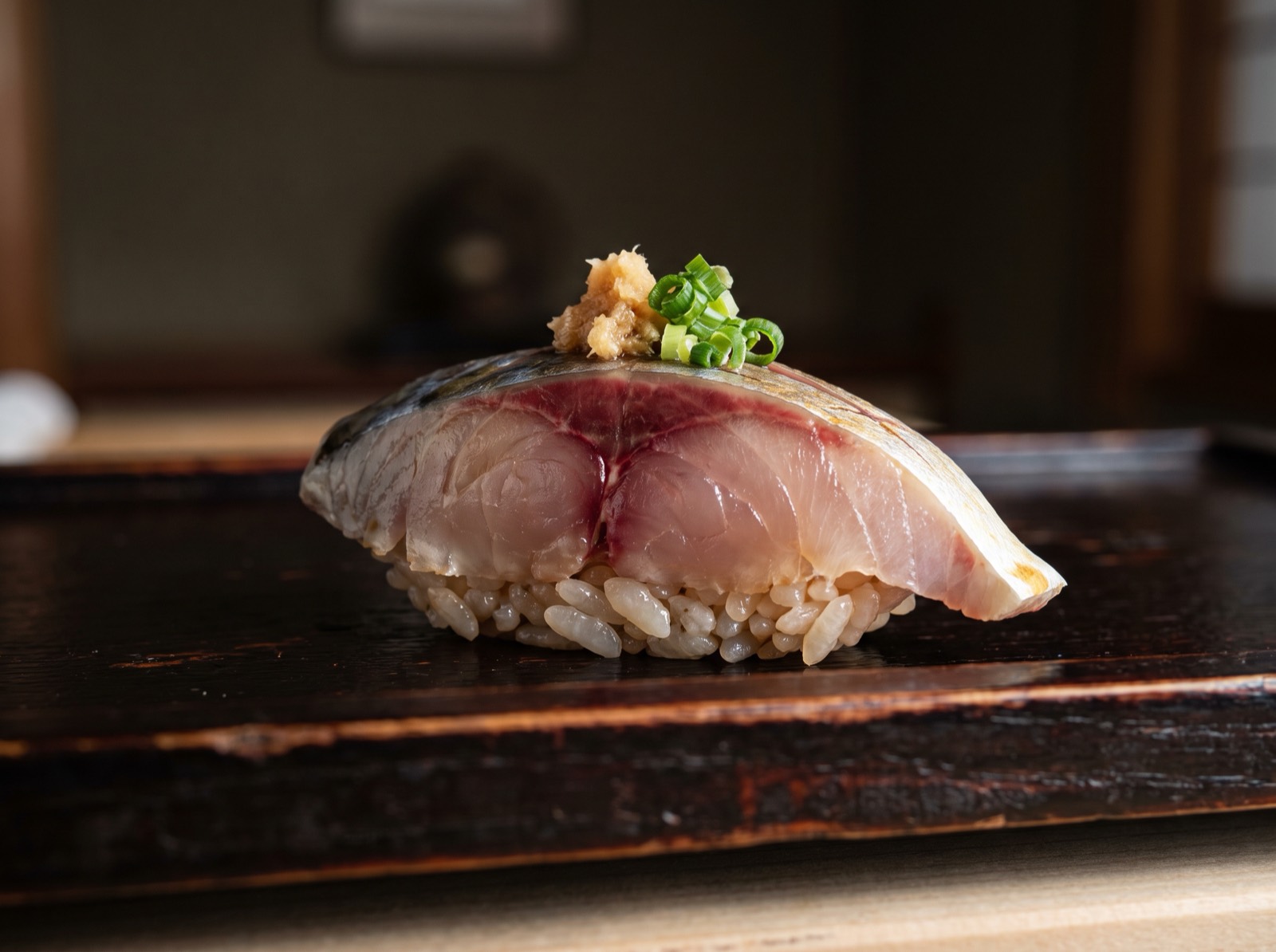
Aji (アジ) is Japanese horse mackerel, Trachurus japonicus. It belongs to the hikarimono category, the silver-skinned fish, but unlike kohada and mackerel it is generally served raw, topped with grated ginger and chopped spring onion rather than cured in vinegar. That exception is the interesting thing about it.
What it is
A mid-sized schooling fish, silver-blue above and pale below, with soft, oily flesh and a pronounced savoury flavour. The name is written 鯵 and is homophonous with aji meaning “flavour”, a coincidence Japanese writers on fish have never been able to leave alone, and one that may or may not be the actual derivation.
Its identifying feature is physical: a line of hard, sharp bony scutes running along each flank, called zeigo (ゼイゴ). They must be cut away before the fish can be used, and if you have ever met an unpleasant sharp edge in a piece of aji, that is what it was.
When it is best
Summer, broadly, when the fish fattens in warm coastal water, though aji is landed year-round across a long coastline and quality varies more by origin and handling than by month.
The trade distinguishes between coastal fish, which stay in one area, feed well and run yellower and fattier, and offshore migratory fish, which are leaner and darker. The coastal ones are what a counter wants. Certain areas have built serious reputations on this: fish from the fast tidal water of the Bungo Channel, between Kyushu and Shikoku, are handled and branded as a premium product, dispatched individually at sea and shipped with the care usually reserved for far more expensive animals.
What the chef does to it
Less than to the other silver fish, and that is a modern development.
- Zeigo removed, skin taken off or scored. The silver skin is usually peeled by hand rather than cut, which leaves the flesh intact and the shine on the surface.
- Yakumi on top (薬味). Grated ginger and finely chopped spring onion, sometimes with a little myoga or shiso. This is not decoration: oily raw fish carries a strong aroma that the ginger cuts directly, and it does the work vinegar would otherwise do.
- Nikiri, lightly, or salt.
- Sometimes a brief cure after all. Some shops give aji a short salt or vinegar contact, particularly on larger or older fish. It is a judgement rather than a standard.
- Tataki. Outside the sushi counter, aji is often chopped with the same seasonings into aji no tataki, which is a different dish and an excellent one.
Why it escapes the cure
Because it no longer needs it. Edomae vinegar curing exists because oily silver-skinned fish spoiled fast in a city with no refrigeration, and the technique was a preservation method that turned out to taste good. Aji is exactly the kind of fish that would have been cured on those grounds in the Edo period, and historically it was.
What changed is ice, refrigerated transport, and the practice of dispatching fish at the point of capture, ikejime (活け締め), which arrests the spoilage that made raw oily fish a gamble. Once a fish can arrive at a counter in that condition, the chef has a choice that an Edo-period chef did not, and with aji most choose raw. None of that touches the other question. Aji is on the health ministry’s list of fish that carry anisakis, and vinegar never dealt with that either — that is a matter of inspection, freezing and heat, and it is set out in is sushi safe in Japan.
The ginger is not garnish. It is doing the job the vinegar used to do.
This is a small but genuine illustration of a point we return to throughout this site: the Edomae repertoire is a set of solutions to technological constraints, and where the constraint has gone, the technique becomes a choice rather than a necessity. See what Edomae actually means.
How it differs from what it is confused with
- Aji is not mackerel, despite “horse mackerel”. Saba, the true mackerel, is in a different family, larger and considerably fattier, and is almost always vinegar-cured for sushi.
- Aji is not shima-aji, striped jack, though the names are related and both are in the jack family. Shima-aji is firmer, leaner, much more expensive, and eats nothing like it.
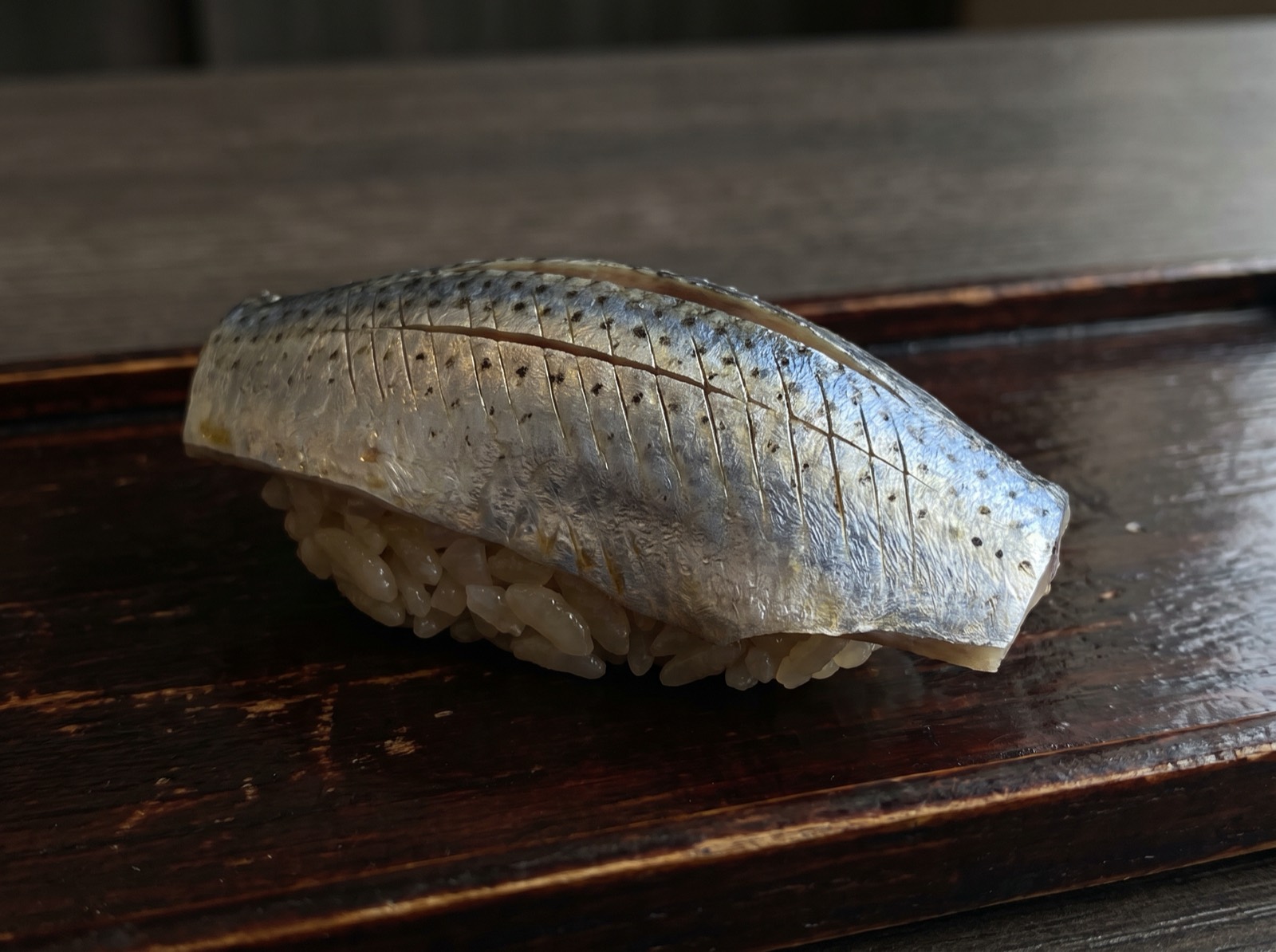
- Aji is not kohada. Both are hikarimono; kohada is smaller, cured in salt and vinegar, and is a test of technique in a way aji is not.
- “Spanish mackerel” on an English menu is usually sawara, a third fish again.
How to say it
AH-jee. Two beats, a-ji, both the same length, with the j as in English “jam”. It is one of the shortest and easiest fish names to use at a counter.
Edomae and Kansai
No strong regional split in treatment; the raw-with-ginger presentation is national. The regional dimension here is about origin rather than city: the premium branded fish come from western Japan and the Kyushu channels, and they command their prices in Tokyo as readily as in Osaka.
Where you will see it, and roughly what it costs
At every level. Aji is inexpensive, abundant and genuinely good, which makes it one of the best-value items on any menu; a conveyor-belt aji is often a more satisfying piece than a conveyor-belt tuna, because nothing about it depends on grade.
The branded coastal fish are a different price entirely and appear at serious counters in season. No per-piece figure from us; see omakase price tiers for the whole-meal picture.
Frequently asked questions
What is aji?
Japanese horse mackerel, Trachurus japonicus: a silver-skinned hikarimono with soft, oily flesh and a strong savoury flavour. Unlike most silver-skinned fish at a sushi counter it is usually served raw, topped with grated ginger and spring onion.
Why is aji served with ginger?
The ginger and spring onion cut the strong aroma of oily raw fish. They are doing the work that vinegar curing would otherwise do, which is why they appear on aji and not on lean white fish.
Why is aji not vinegar-cured like kohada?
Because refrigeration removed the need. Edomae vinegar curing was a preservation method for fast-spoiling oily fish. With ice, refrigerated transport and ikejime (dispatching the fish at the point of capture, usually with bleeding), aji can reach a counter in condition to be served raw, so most chefs do. Refrigeration does not address anisakis, which aji can carry; that is handled separately, by inspection, freezing or heat.
What is zeigo?
The line of hard, sharp bony scutes along each flank of a horse mackerel. They must be cut away before the fish is used, and an unpleasant sharp edge in a piece of aji is almost always a scute that was missed.
Is aji the same as mackerel?
No. Despite the English name 'horse mackerel', aji is in the jack family. True mackerel (saba) is in a different family, larger and much fattier, and is almost always vinegar-cured for sushi.
When is aji in season?
Broadly summer, when the fish fattens in warm coastal water. It is landed year-round, and quality depends more on origin and handling than on the month: coastal fish are fattier and better than offshore migratory ones.