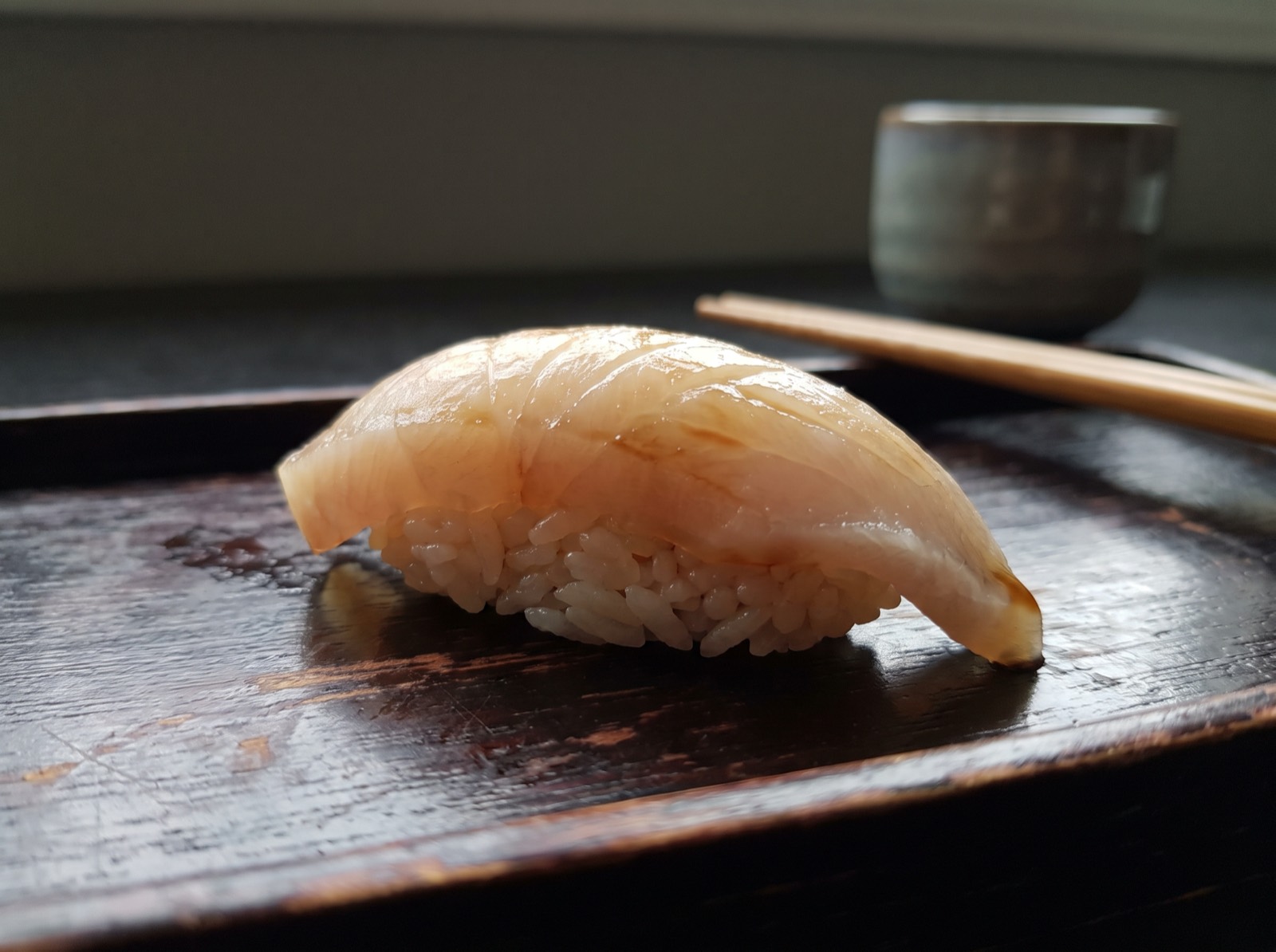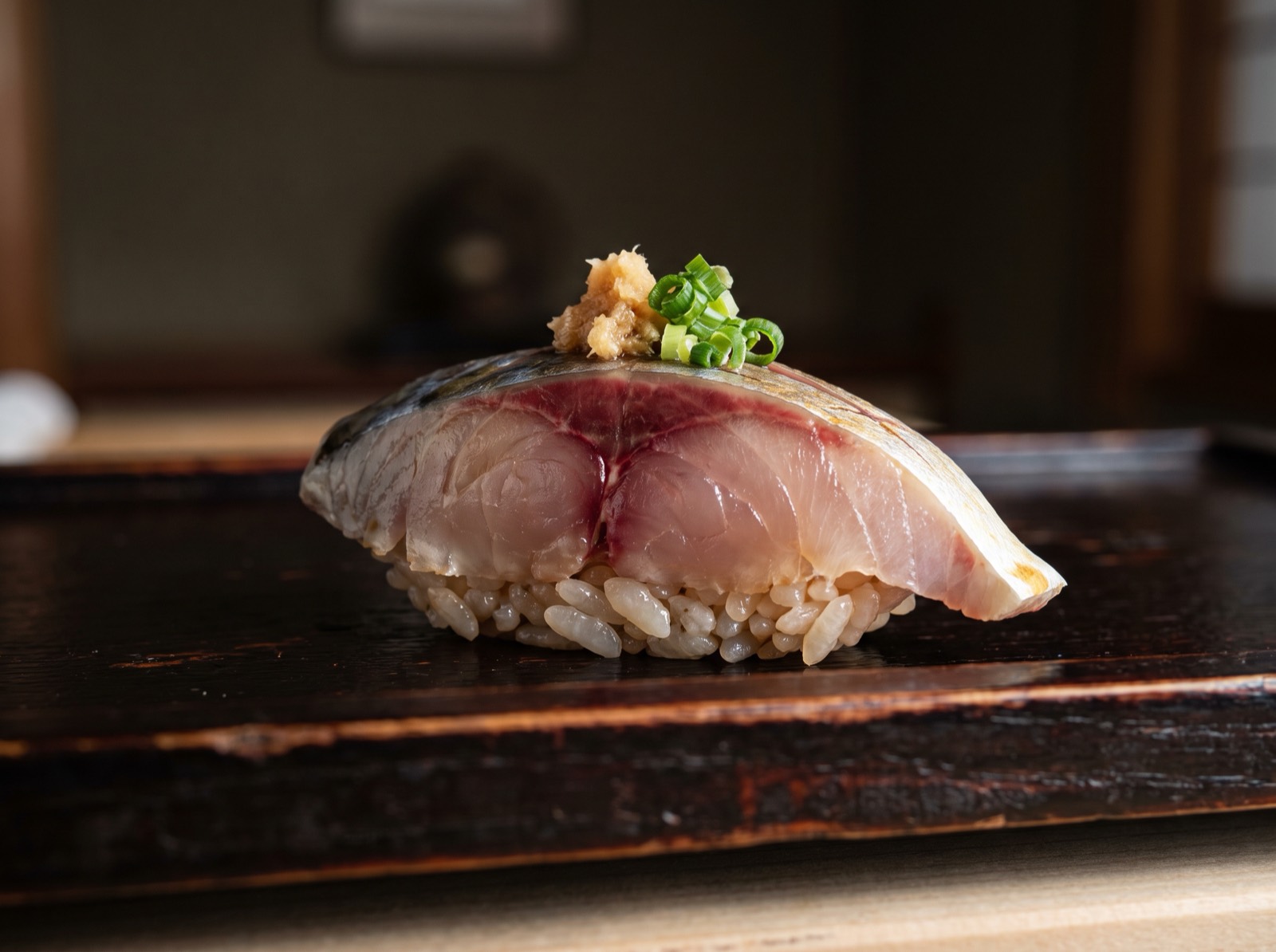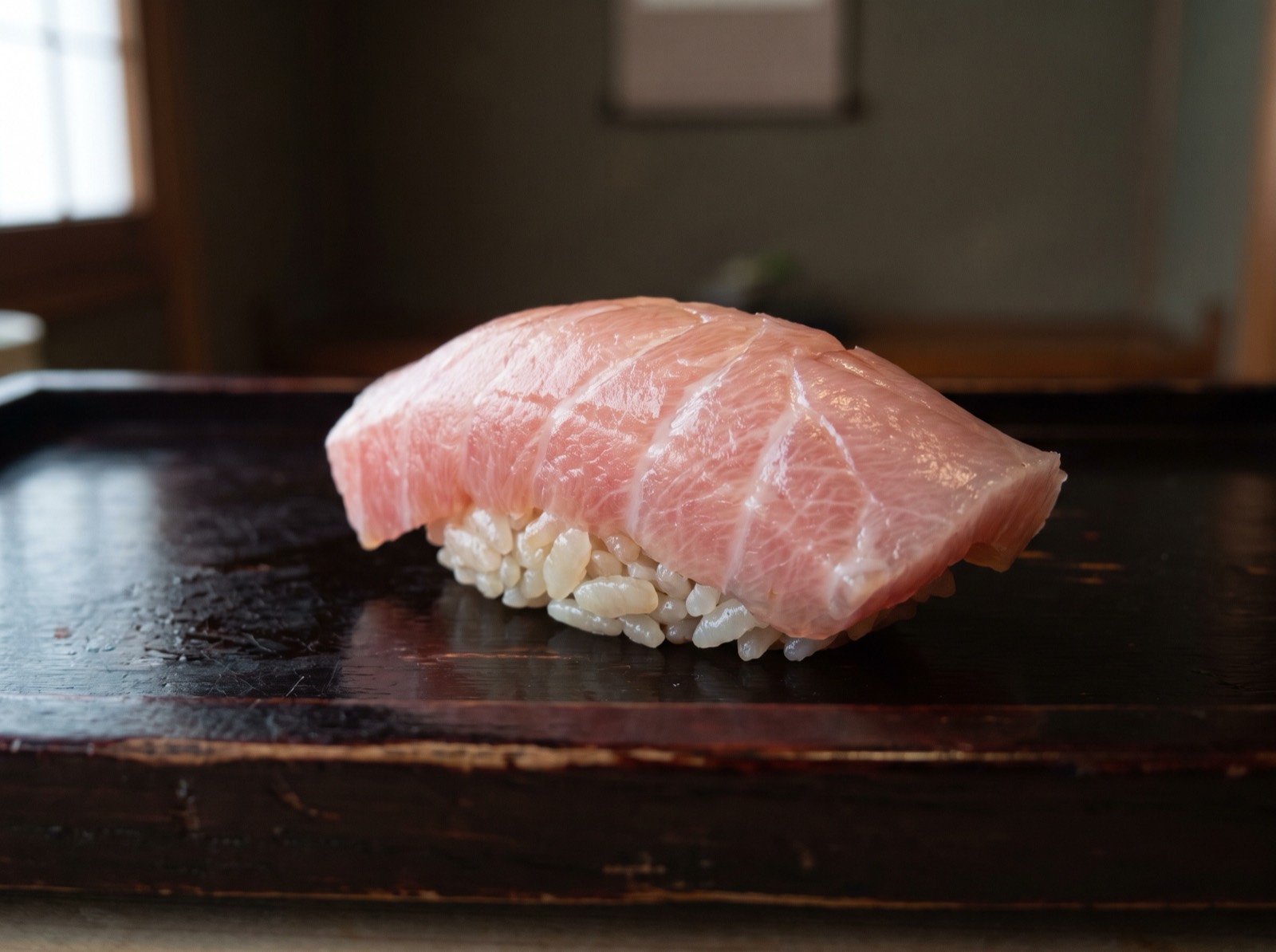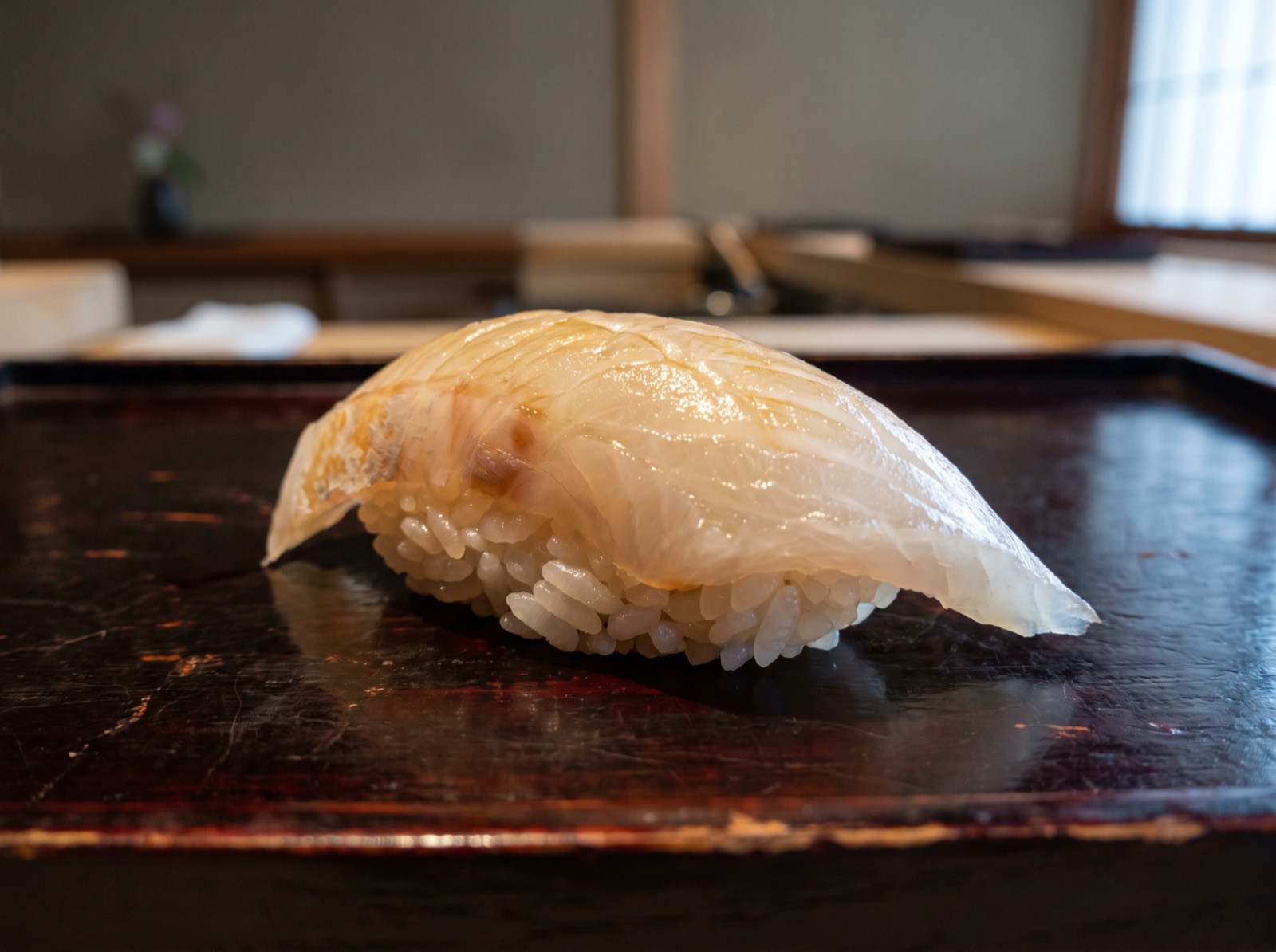
Shima-aji (シマアジ, striped jack) is the most expensive member of the jack family on a sushi counter and one of the most expensive white-fleshed fish in Japan generally. It is firm without being tough, sweet without being rich, and clean in a way that its relatives are not. It is also mostly farmed — and unusually, that is not a mark against it.
What it is
The name means “striped aji”, and it sits in the same broad family as aji, the everyday horse mackerel, and as the yellowtail group that gives us hamachi and buri. Family resemblance ends there. Where aji is soft and openly oily and asks for ginger and spring onion, shima-aji is firm, pale and restrained, and is served plain.
The stripe the name refers to is a yellow line running along the flank of the living fish. It is not visible in the finished piece, so the name will tell you nothing at the counter.
Wild fish are scarce: the species is not abundant in Japanese waters and large wild specimens are a genuine luxury item. Most of what reaches the market is farmed, principally in the warm waters of the south and west.
When it is best
Summer is the traditional shun for wild fish, which is unusual for a fish of this quality: most of the prestige white fish in Japan are winter items. Farmed fish are available year-round and hold their condition well, which is part of why they are taken seriously rather than tolerated.
Farmed generally means cheaper and softer. Shima-aji is the case that breaks the rule — and it is worth knowing why.
Why the farmed fish is respected
In most species, farming trades texture for reliability: a fish raised on feed in a calm pen carries more fat and less muscle tone than one that swam for a living, which is exactly the trade discussed in our hamachi entry. Shima-aji is the case where the trade lands differently.
- The species is naturally firm, and farming does not soften it to the point where it stops being firm. The defining quality survives.
- Farmed supply is consistent in size and condition, which matters to a shop planning a course, and consistency is worth a great deal at the top end.
- The wild fish is too scarce to build a menu around. A shop that wanted only wild shima-aji would serve it a few times a year.
- The price still sits well above most farmed fish, which tells you where the trade values it.
None of which makes farmed and wild interchangeable. A large wild fish in summer is a different and better thing, and a shop that has one will say so. But the farmed fish is a serious ingredient, not a substitute.
What the chef does to it
- Very little. A brief salt cure at most, sometimes nothing beyond cutting.
- Sliced thinner than an oily fish, because the texture is dense and a thick piece eats heavy.
- Salt and citrus as often as soy. The flavour is delicate and soy can cover it.
- Occasionally rested a day under kelp or simply held, which softens the flesh slightly and deepens the flavour, a technique that suits firm white fish generally.
- No ginger, no spring onion. Those are the aji treatment, and applying them here would be a category error.
How it differs from what it is confused with
- Shima-aji is not aji. Same family, different fish, several times the price, opposite handling. If you order aji and receive something firm, pale and plain, you have received shima-aji.
- Shima-aji is not hamachi. Also a jack, also mostly farmed, but hamachi is fatty and soft where shima-aji is lean and firm.
- “Striped jack” on an English menu is the standard translation and is accurate. “White trevally” also appears; it is used for this same fish in Australia and New Zealand, and elsewhere for others.
- Kanpachi, see our kanpachi entry, is the closest thing in feel: another firm, clean jack that is mostly farmed and taken seriously. The two are often offered as a pair.
How to say it
shee-mah-AH-jee. Four beats: shi-ma-a-ji. The two a sounds are pronounced separately rather than run together. The ji is soft, as in “jeep”.
Edomae and Kansai
No real regional split. This is an expensive fish handled the same way in both cities: cut plain, salted lightly, served early in a course while the palate is clean. Osaka's pressed and box traditions do not use it, for the same reason they do not use most premium white fish: those forms were built around fish that needed curing, and shima-aji does not.
Where you will see it, and roughly what it costs
At counters, and much less often below that. It appears on omakase courses as one of the early white-fish pieces, frequently alongside madai or kanpachi. It is uncommon on a conveyor belt and where it appears there it is worth treating with mild suspicion; the price does not usually work.
What is useful to know is the shape of the price: shima-aji sits near the top of the white-fish range at any given shop. For the bands a course itself falls into, see omakase price tiers.
Frequently asked questions
What is shima-aji?
Striped jack: the most expensive member of the jack family on a sushi counter. It is firm, pale, clean and faintly sweet, and served plain rather than with the ginger and spring onion used for ordinary aji. Most of the supply is farmed.
Is shima-aji the same as aji?
No. They belong to the same broad family, but shima-aji is firm, lean and served plain, while aji is soft, oily and served with ginger and spring onion. Shima-aji costs several times more.
Is farmed shima-aji worth eating?
Yes, and it is the standard product at good shops. The species is naturally firm and farming does not soften it enough to lose that quality, while the wild fish is too scarce to build a menu around. This is the rare case where farmed is a serious ingredient rather than a compromise.
When is shima-aji in season?
Summer is the traditional shun for wild fish, which is unusual: most prestige white fish in Japan are winter items. Farmed fish hold their condition year-round.
How is shima-aji served?
Plain, and usually early in a course. A brief salt cure at most, sliced thinner than an oily fish because the flesh is dense, and finished with salt and citrus as often as soy.
How do you pronounce shima-aji?
shee-mah-AH-jee, in four flat beats, with the two a sounds pronounced separately rather than run together.