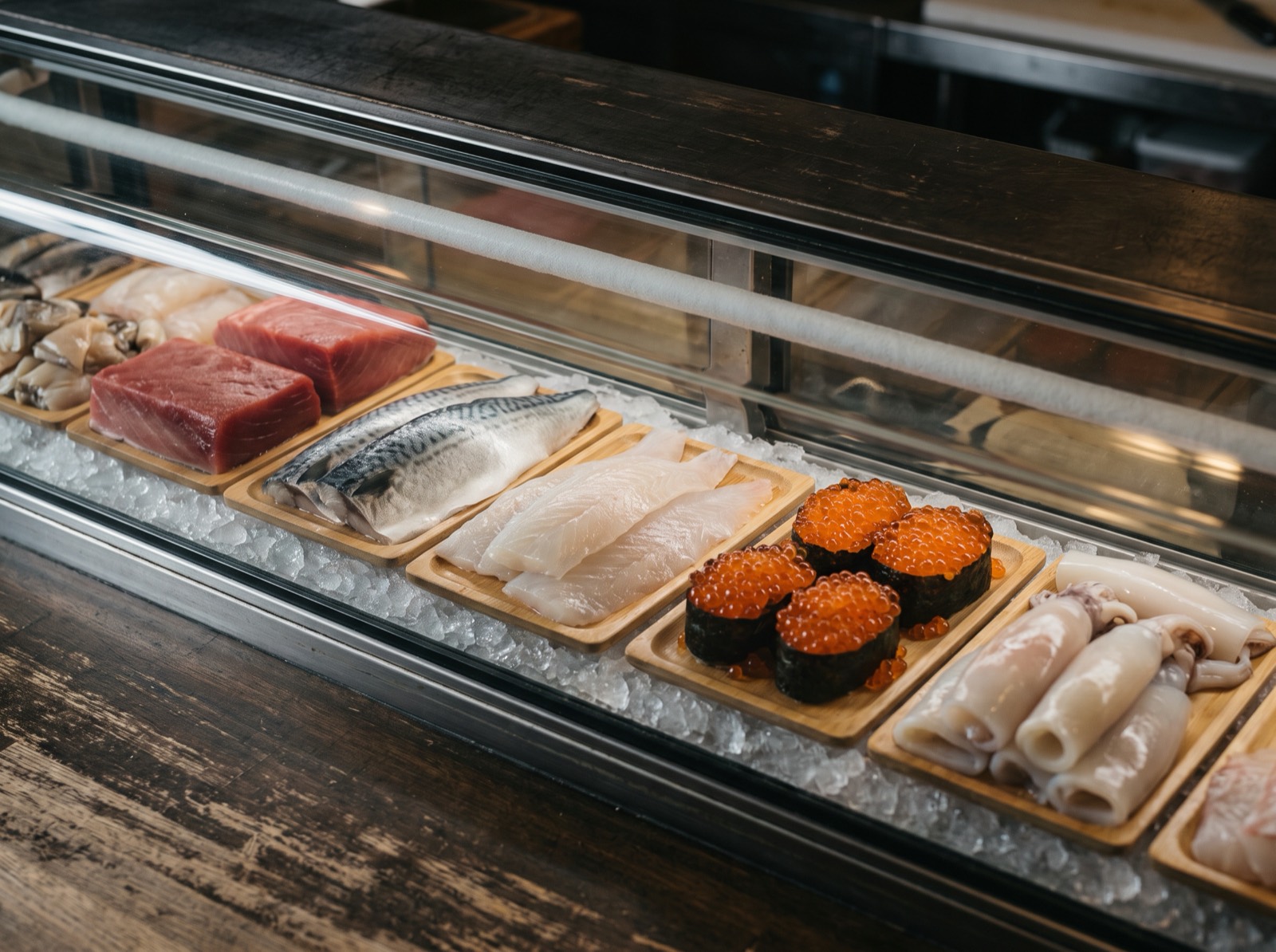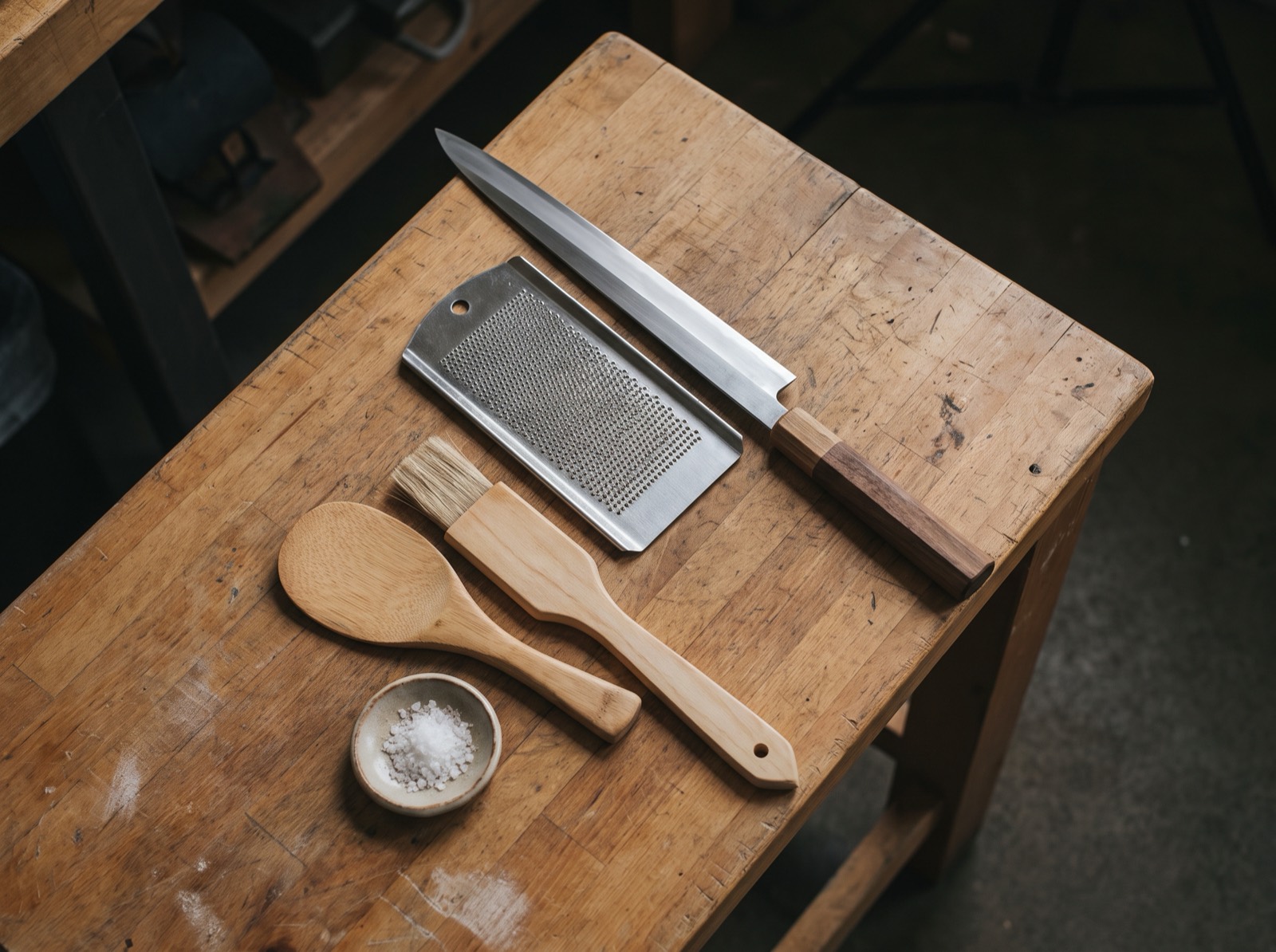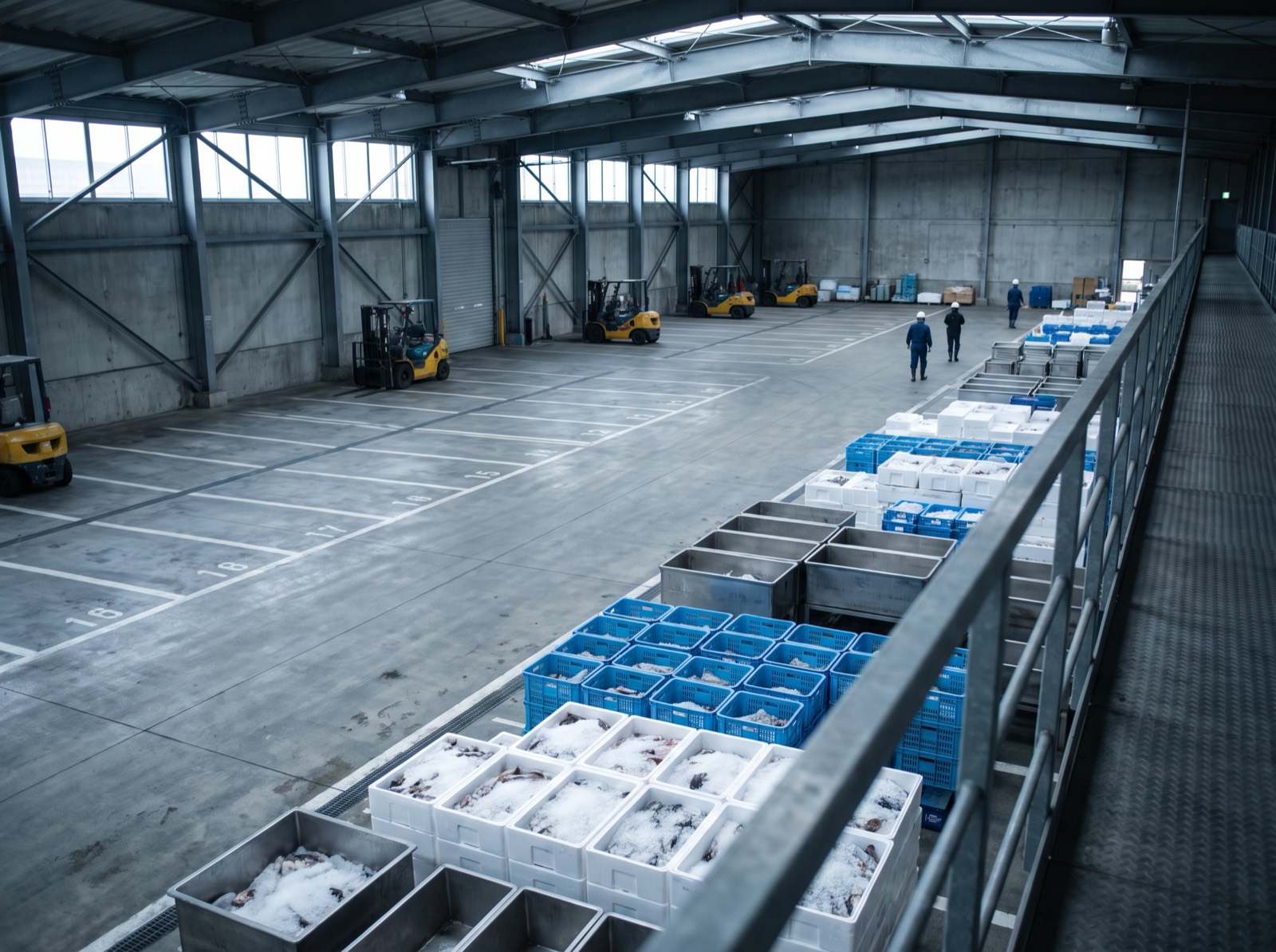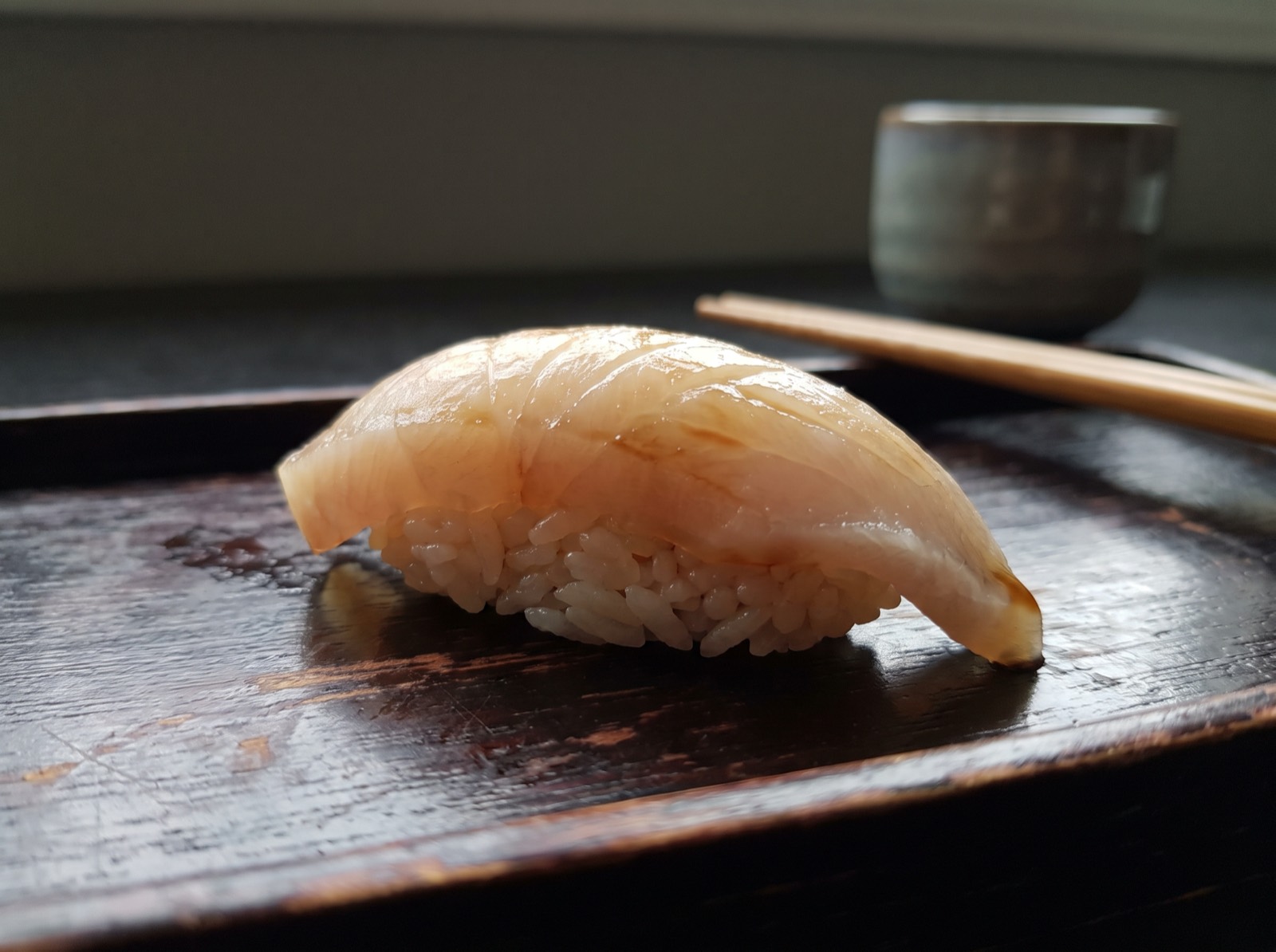
Kanpachi is greater amberjack (Seriola dumerili), a firm, clean-tasting member of the jack family, served as nigiri and as sashimi. It is at its best from summer into early autumn. English-language menus routinely present it alongside hamachi and buri as if the three were interchangeable. They are not: hamachi is not even a separate species, and kanpachi is leaner and firmer than either.
What it is
Kanpachi (カンパチ) belongs to the jack and scad family, Carangidae: アジ科, aji-ka in Japanese, the same family as horse mackerel and striped jack. It grows past a metre in the wild. The fish that reach a sushi counter are the mid-sized ones; the giants are not what a counter wants.
The name is written two ways, 間八 and 勘八, and the first of those explains itself the moment you look at the fish from the front. Two dark diagonal bands run from the snout back past the eyes. Seen head-on, they meet in a shape that reads as the kanji 八, the character for eight, sitting between the eyes. 間八 is literally “the eight in between”. It is the rare Japanese fish name that a diner can verify at the counter, provided the head is still on.
It picks up other names by size and by region. Small ones, around twenty centimetres, are called shiokko (シオッコ) in some markets. Larger fish are sometimes called aka or akahira (アカ, アカヒラ), “red”, because the lean flesh turns a deeper brownish red as the animal grows. These are trade nicknames, not menu words; you are unlikely to see them written down.
When it is best
Summer into early autumn is the answer you will get most often, and it is the one we would give. It is worth knowing that the Japanese trade literature is not unanimous on this. Several standard references put the peak in summer, when the flesh has tightened; at least one places it from autumn into winter. Both can be true of a fish this widely distributed, and the disagreement is a useful reminder that a printed shun calendar describes a tendency rather than a rule.
Wild kanpachi is associated with fast water. Fish taken from the strong tidal currents of the Bungo Channel, between Kyushu and Shikoku, have a reputation for firmness that comes from swimming hard against them. The main producing prefectures are Kagawa, Ehime, Ōita, Nagasaki and Kagoshima, with catches also landed around Shizuoka, Aichi and the Seto Inland Sea.
Farming complicates the calendar in a way worth stating plainly. Kyushu and Shikoku now raise kanpachi at scale, and farmed fish arrives all year at a consistent fat level. So availability is not seasonality. When a counter tells you the kanpachi is in season, what is being described is a wild fish; when a supermarket has it in midwinter, what is being described is a farmed fish.
What the chef does to it
Less than you might expect. Kanpachi has firm, low-moisture flesh and a mild, clean flavour, and the Edomae repertoire of curing techniques was developed for fish that need help: oily silver-skinned fish that spoil quickly, or lean fish that gain from a marinade. Kanpachi is generally served raw, with a brush of nikiri (煮切り), the pre-seasoned soy reduction that a counter applies so that you do not have to dip.
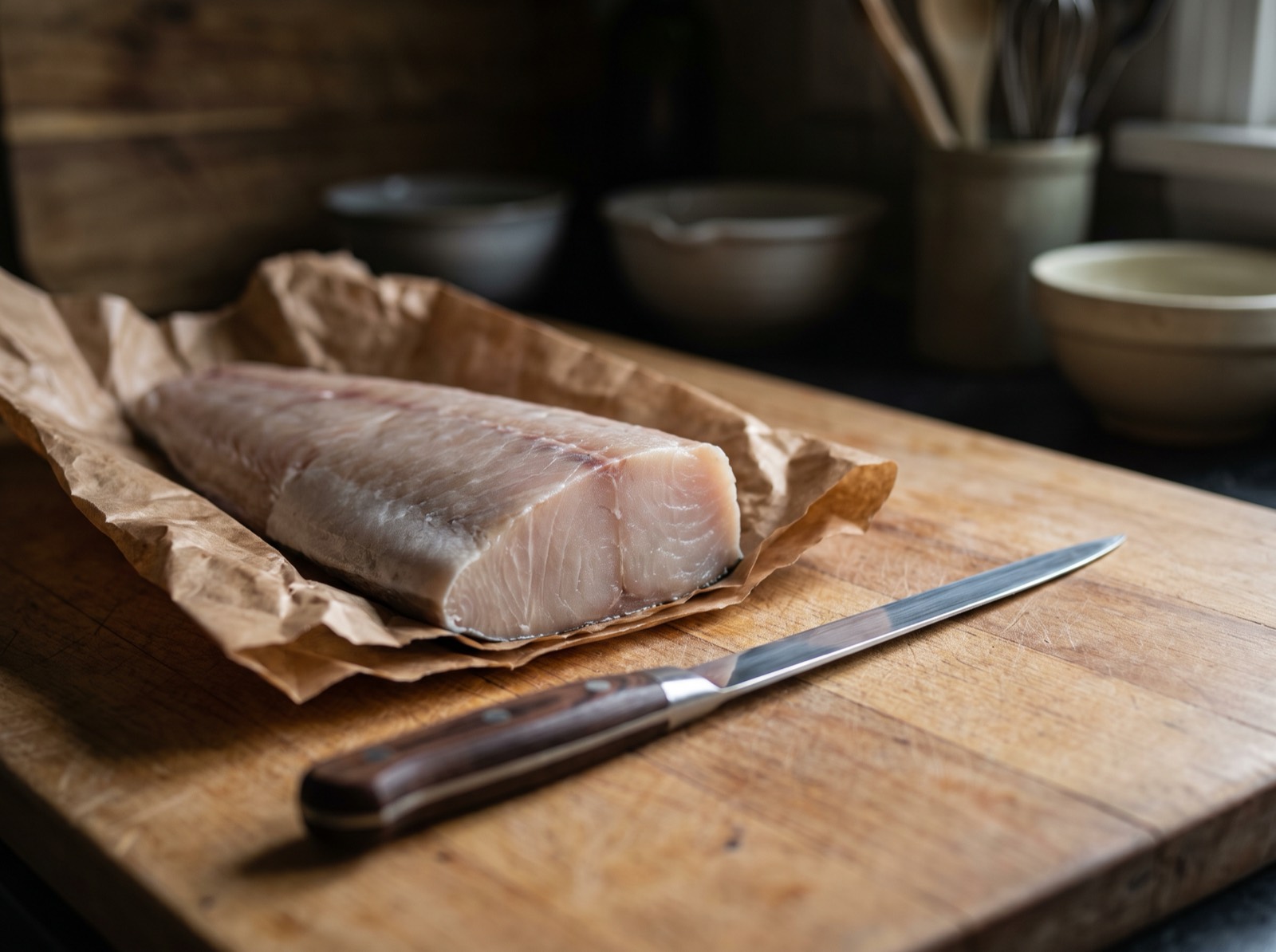
The work is therefore in the handling rather than the seasoning. A whole fish is filleted and then cut into saku (サク), the rectangular blocks a chef slices from, with the small bones along the spine deliberately left on the back side, so the belly portion comes away clean. The saku are then wrapped in absorbent paper and held under refrigeration, which draws off surface moisture and lets the flesh settle. Some shops give it a day or more; others cut it close to the day it arrives. Firm jacks do not demand ageing the way tuna does, and a chef who serves kanpachi fresh is making a defensible choice rather than a lazy one.
Three pieces of kitchen vocabulary come up around this family of fish, and they are worth separating:
- Su-jime (酢〆): curing in vinegar, usually after salting. It is the defining treatment for kohada and other silver-skinned fish. Among the amberjacks it turns up occasionally with hiramasa; it is not standard for kanpachi.
- Zuke (漬け): marinating in soy, historically a way of holding tuna before refrigeration. Applied to kanpachi it would flatten exactly the quality the fish is prized for.
- Jukusei (熟成): deliberate ageing under controlled temperature to develop savour. Widely applied to tuna and to white fish; applied to kanpachi selectively, and usually briefly.
The slice itself is sogigiri (そぎ切り), an angled cut drawn through the block in one unbroken motion. The angle sets how thick the piece eats without changing its footprint on the rice, and the single motion is the point: a sawing stroke tears the muscle fibre and dulls the surface.
How it differs from what it is confused with
This is the section this entry exists for. Three fish are involved, and the English-speaking world has flattened them into roughly one:
- Kanpachi (カンパチ), Seriola dumerili, greater amberjack. Firm, lean, mild.
- Buri (ブリ), Seriola quinqueradiata, Japanese amberjack. Fattier, softer, at its peak in winter.
- Hiramasa (ヒラマサ), Seriola lalandi, yellowtail amberjack. Between the two, and the one Kansai favours.
Together these three are known in Japan as the aomono gosanke (青物御三家), roughly “the big three of the blue-backed fish”. They are relatives, not variants of each other.
Which leaves hamachi, and hamachi is the reason the confusion persists, because hamachi is not a species at all. Buri is a shusseuo (出世魚), a fish that is given a new name at each stage of its growth. The word borrows from the old custom of taking a new name on coming of age or on promotion, which is why these fish are considered auspicious and appear at celebrations. The ladder differs by region:
- Kanto (Tokyo and eastern Japan): wakashi → inada → warasa → buri.
- Kansai (Osaka and western Japan): mojako → wakana → tsubasu → hamachi → mejiro → buri.
Hamachi is the fourth rung of the Kansai ladder. It is a young buri, and it became the international word for the fish largely because farmed young yellowtail was what got exported. Outside Japan, “hamachi” has drifted further still and is now often used for farmed yellowtail of any size.
Hamachi is not a species. It is a stage in one fish’s life — and that fish is not kanpachi.
Kanpachi, by contrast, is not a shusseuo. It carries one name from small to large, give or take the trade nicknames above. So if a menu offers you hamachi and kanpachi side by side, it is not offering you the same fish at two ages. It is offering you two species, and the difference on the tongue is real: buri and its younger selves are fatter and give way more softly, while kanpachi holds its shape and finishes cleaner.
How to say it
The usual English respelling is kahn-PAH-chee, and it will be understood. It is also slightly wrong, in a way worth thirty seconds. Japanese does not use stress the way English does; every mora takes roughly the same length. The word is four beats, ka-n-pa-chi, delivered flat. If you find yourself leaning on a syllable, lean less. That single adjustment does more for your pronunciation of Japanese fish names than learning any of them individually.
Edomae and Kansai
The clearest regional split is the one above: hamachi is a Kansai word that the rest of the world adopted, while a Tokyo counter naming the same fish young would more likely say inada or warasa. On the fish itself, Japanese trade handbooks note a preference that runs the other way: kanpachi is the more popular of the pair in Tokyo, while Kansai consumes proportionally more hiramasa. It is a tendency, not a border; both cities serve both.
Osaka’s own sushi tradition is pressed rather than hand-formed: hakozushi (箱寿司), built in a wooden box. The amberjacks are not part of that repertoire. Where you meet kanpachi in Osaka, you meet it as nigiri or as sashimi, the same as in Tokyo.
Where you will see it, and roughly what it costs
Everywhere, is the short answer, which is part of what makes it a useful fish to be able to recognise. Farmed kanpachi is a fixture on conveyor belts and in supermarket cases. Wild kanpachi in season, from fast water, is an omakase piece, and at that end the same species behaves like a different animal.
On price, we will give you a placement rather than a number. Among the farmed jack-family fish that reach sushi counters (striped jack, kanpachi and buri), it is striped jack (shima-aji) that trades highest, which is unusual for a farmed fish and tells you something about how it is regarded. Kanpachi sits below it and above buri. We are not publishing a per-piece yen figure here, because the honest range spans a conveyor belt and a Ginza counter and any single number would mislead you at both ends. For what the whole meal costs, see our guide to omakase price tiers.
Frequently asked questions
Is kanpachi the same as hamachi?
No. Kanpachi is greater amberjack (Seriola dumerili). Hamachi is not a species at all: it is the Kansai name for a young buri, Seriola quinqueradiata, at one stage of its growth. They are different fish: kanpachi is leaner and firmer, buri and hamachi are fatter and softer.
Is kanpachi the same as yellowtail?
Not exactly. "Yellowtail" in English is used loosely for the whole Seriola genus, which is why the confusion exists. Kanpachi is specifically greater amberjack. If a menu says yellowtail without qualifying it, it most often means buri or hamachi.
When is kanpachi in season?
Summer into early autumn for wild fish, with some Japanese references placing the peak later, in autumn or winter. Farmed kanpachi is available all year at a steady quality, so availability on a menu is not evidence of season.
How is kanpachi served at a sushi counter?
Almost always raw as nigiri, brushed with nikiri (a pre-seasoned soy reduction) and nothing else. It is not usually cured in vinegar or marinated in soy, because its flavour is clean enough that those techniques would work against it.
Does kanpachi have a strong flavour?
No. It is one of the milder fish at a sushi counter: firm texture, moderate fat, a clean finish. It is a reasonable choice if you are working out what you like, because there is little to hide behind.