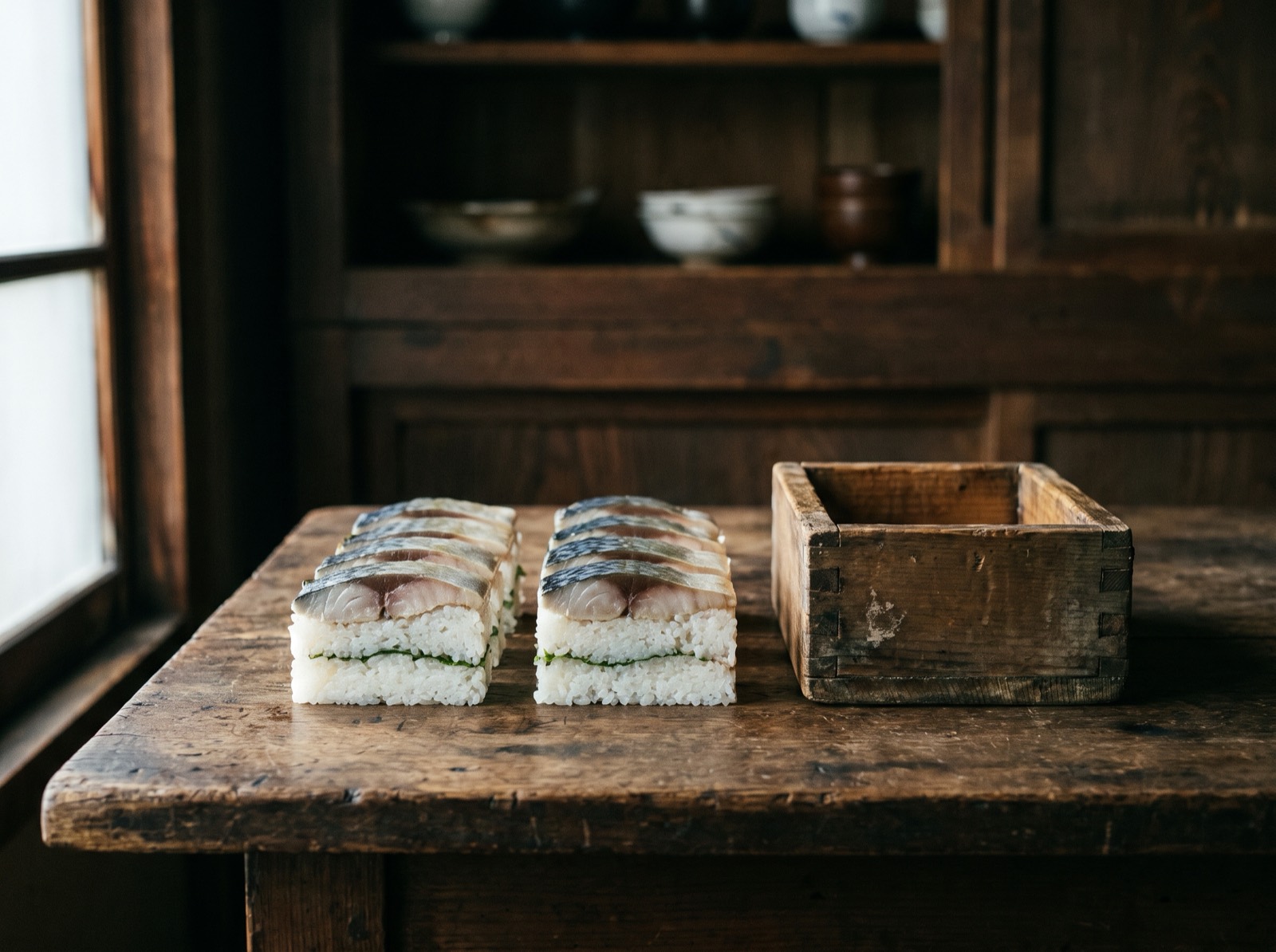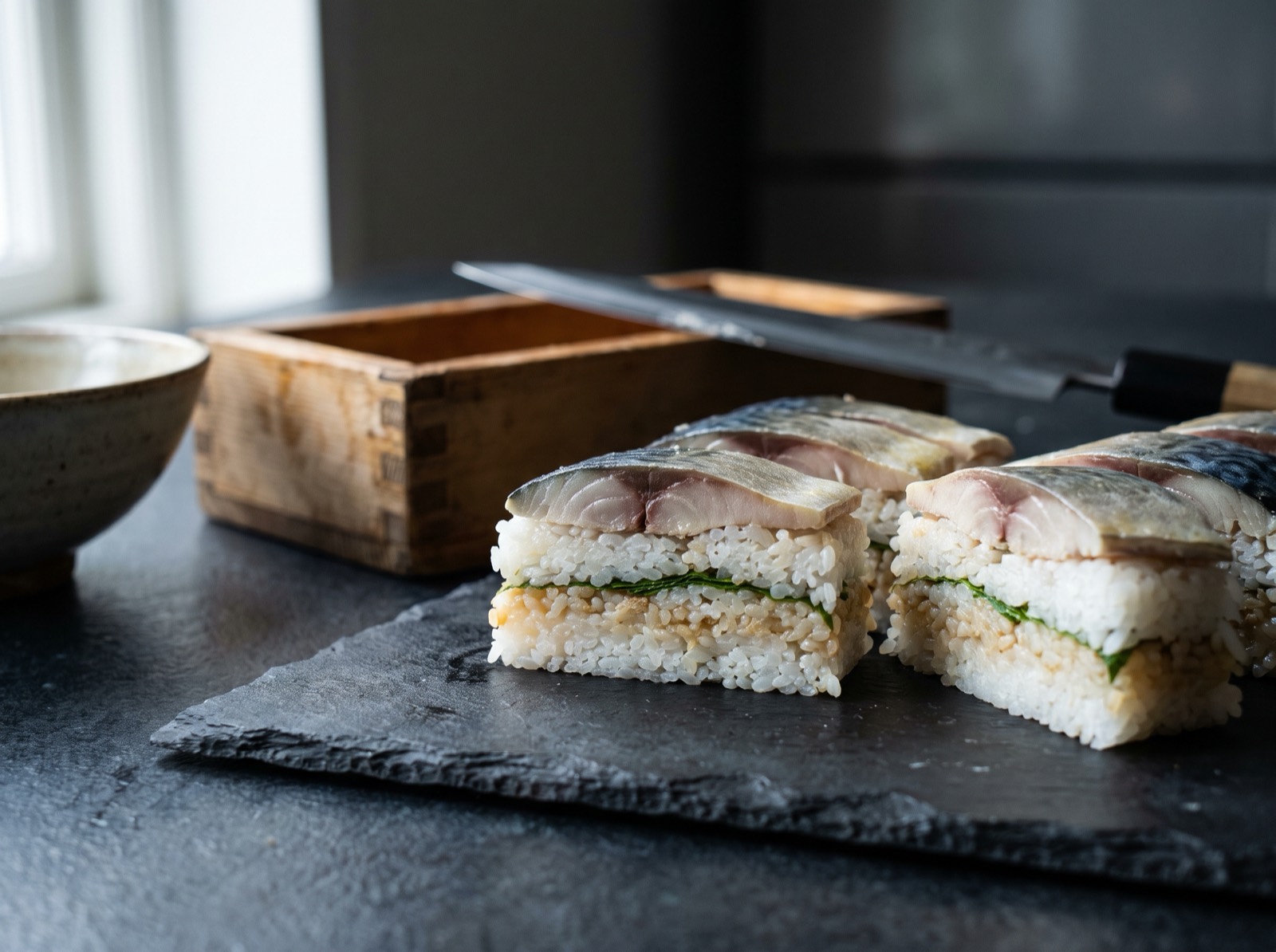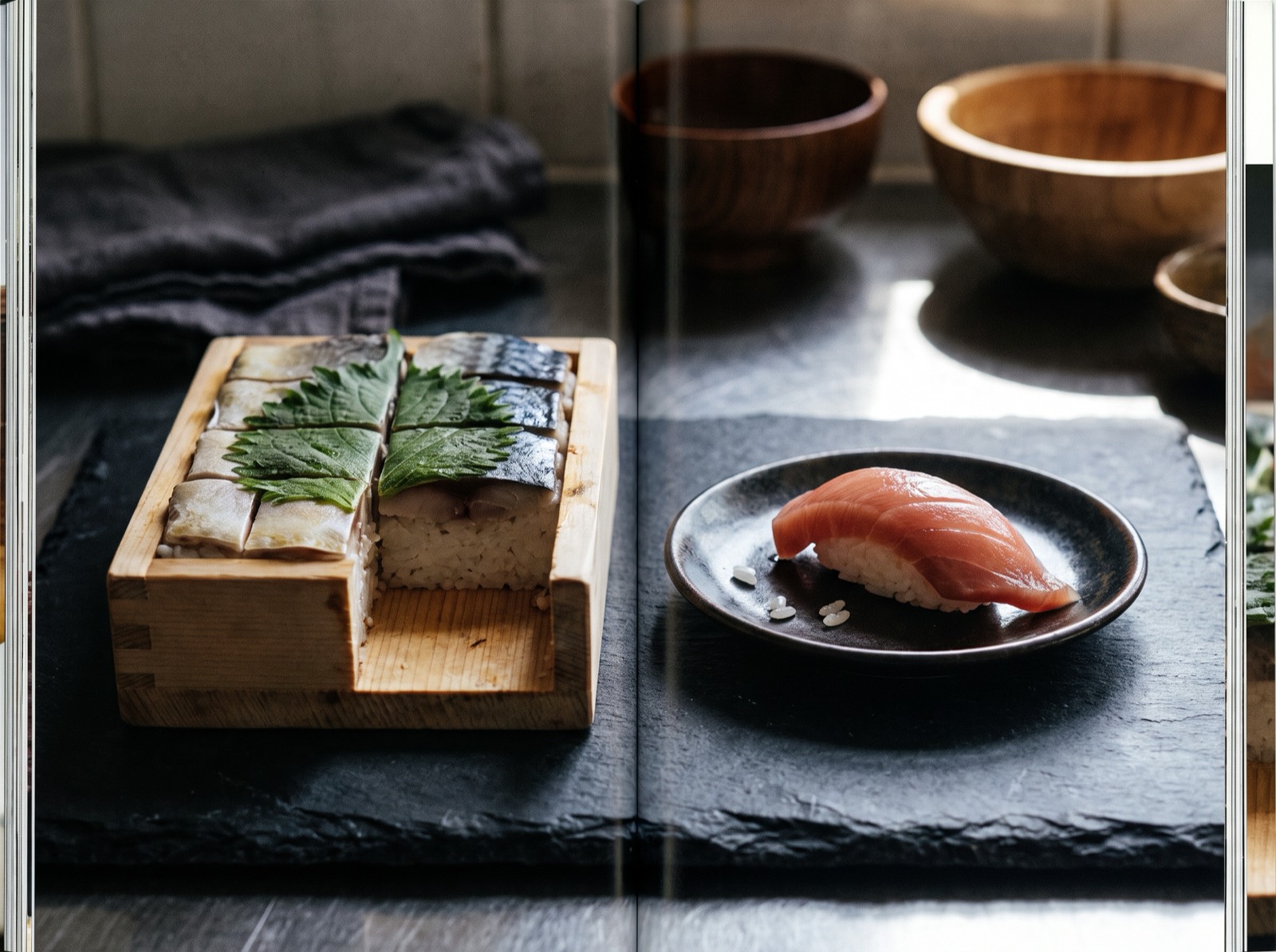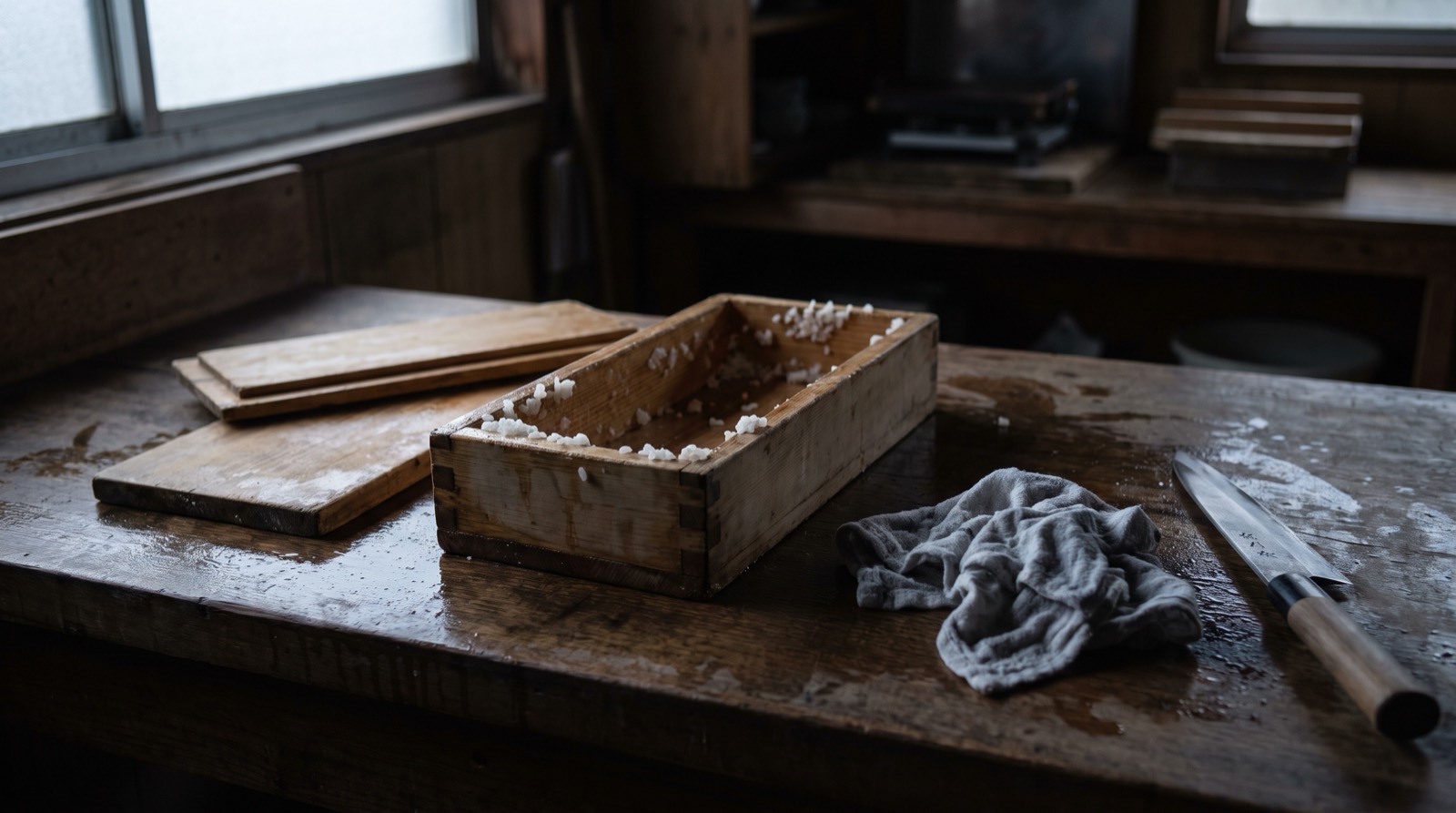
Two arms of the Japanese state have published, independently of each other, the same quiet warning about a kind of sushi. The Ministry of Agriculture, Forestry and Fisheries says that the dish takes so much time and handwork to prepare that the number of shops offering it is falling. The Osaka Convention and Tourism Bureau says the same thing in different words: the shops able to make it are decreasing. Neither of them is describing a foreign import or a modern invention. They are describing hakozushi, the pressed box sushi of Osaka, which for most of the nineteenth century was the sushi that people outside Osaka meant when they said the word.
That is an unusual thing for a government to write down. Ministries do not normally take a position on which restaurants are struggling. This one goes further and names names: two of the five shops below are identified in the national register, by shop name, as the inventors of the two dishes it describes. It also records, in the entry for one of them, that the shop closed and that the fourth generation brought it back in 2016. That is a national food register keeping track of the trading status of a single family business.
So we went to look. We picked five houses in Osaka that still press sushi in a wooden mould, and instead of reviewing them we read them — every page each one publishes about itself, plus the legally required commercial disclosure where there is one, plus, in one case, the response headers of the files sitting on the shop server.
What came back was stranger than the government warning. The five records have almost nothing in common. One house has been in business since 1653, employs a hundred and fifty people across eighteen shops, and will not take a single order through its website. One is named by the national ministry as the inventor of the dish, and its mail-order catalogue has not been touched since October 2011. One is named by the same ministry as the inventor of a second dish, and it took its sign down for twenty-eight years; it now has six seats. One publishes its entire menu, its telephone number and its address as pictures, so that none of it can be copied, searched or read aloud by a machine. And one has a hundred and twenty seats, a karaoke machine, a live availability calendar — and a takeaway list that carries the signature item of all four of the others, none of it over ¥2,400.
The hardest part of eating this dish in Osaka is not finding the shops. It is working out whether they are open.
The dish the state says is disappearing
Osaka-zushi is an umbrella. Under it sit three things: oshizushi, pressed in a mould; makizushi, rolled; and mushizushi, steamed and eaten warm in winter. The ministry treats them as one family because they share an origin. All three were built to be made in advance, carried somewhere and eaten later — at the theatre, on a boat, at home. None of them requires a chef standing in front of you.
The form that pulled ahead of the others was the box. Its nickname inside the trade is the kaiseki of two sun six bu — two sun six bu being the width of the mould, a little under eight centimetres in the old Japanese measure. The joke in the name is that a whole formal banquet has been compressed into a piece you can hold between two fingers: sea bream, prawn, conger eel and egg, each cut to the millimetre, laid in the box, pressed, and cut into squares.
The ministry goes further than describing the dish. It names the shop. Hakozushi in its present form, it records, was devised in the Meiji era by a sushi house in Semba called Yoshino Sushi, which used sea bream, prawn and conger eel where the earlier versions had used cheaper fish. It is rare for a national food register to name a private business as the author of a dish, and that shop is still trading, four hundred metres from where the ministry says it started.
It does it twice. The same register carries a separate entry for battera, the pressed mackerel that belongs to the family, and that entry names a second shop: Sushitsune, in Minami-semba, in 1891. The ministry gives the chain in the same order the shop gives it — gizzard shad from Osaka Bay, a half-fillet whose shape suggested a small boat, the Portuguese word bateira, the drift to cheaper mackerel, the move from a boat-shaped mould to a square one. Then it adds a sentence no register needs to carry: the shop that invented it closed once, and in 2016 a fourth generation in its line brought it back.
We flag that because it changes what the rest of this article is. Two of the five houses below are not merely old. They are written into a national record as the origin of the thing they sell, and in one case the state has gone to the trouble of tracking a single family business through a closure and a reopening. Whatever else these shops are short of, they are not short of provenance.
The tourism bureau adds the technical detail that explains why the dish is hard. Two points matter and both are counter-intuitive if you know Tokyo sushi:
- The rice is wrong on purpose. Edomae nigiri wants a soft rice that falls apart in the mouth. Pressed sushi wants a hard rice that holds its edge under compression, so the block can be cut into clean squares hours after it was made.
- The sugar is not a shortcut. Osaka pressed sushi uses more sugar than nigiri does, and the bureau gives the reason: sugar holds moisture. It is there because the sushi has to survive the trip home, not because Osaka has a sweet tooth.
- The fish is cooked, cured or pressed before it ever reaches the box — simmered conger eel, vinegar-cured sea bream, kelp-pressed mackerel — which is why the finished block keeps, and why almost none of the work happens in front of a customer.
- The mould does the last thing, and it is the only irreversible step. Under-press and the block will not cut; over-press and it is paste.
Put those together and you have a dish whose entire economics are hostile to a modern restaurant. The work is front-loaded into hours nobody sees. It cannot be produced to order at speed. It does not photograph as theatre. And its natural customer is somebody buying a box to take away, which is the part of the food business that has been squeezed hardest by convenience stores and department store basements for forty years.
The ministry sentence is usually quoted only as far as the bad news, and the second half is the part that matters here. What it says in full is that the shops offering the dish are decreasing because of the time and handwork involved, but that the technique and the taste are being carried forward by the efforts of the sushi shops still trading in the city. That is not a lament. It is a statement that the survival of the dish now rests on a specific and countable set of businesses.
Two government bodies say the same thing about hakozushi: the shops that can make it are disappearing. The five below are what is left in view.
The five houses that follow are not the five best. They are five records, chosen because each one has survived in a visibly different way, and because each one publishes enough about itself that we could check it. They run from a company founded in 1653 to a banquet hall opened around 1954, and the gap between how they present themselves is far wider than three centuries alone would explain.
Sushiman — 1653, eighteen shops, and an order line that never moved online
The full name is Sohonke Kodai Suzumezushi Sushiman, and it is not a restaurant so much as a company that happens to be older than most countries’ central banks. The corporate page gives two founding dates, which is itself a small lesson in how these houses count: 1653 for the fish business, 1781 for the sushi shop. The family sold fish in Semba first and made suzumezushi as a sideline; the sideline took over when it was sent to the imperial court.
The name comes from the shape. Suzume means sparrow. The old method was to pack the sushi rice into the belly of a small whole fish, and a seventeenth-century Osaka gazetteer records that the swollen result looked like a sparrow. Sushiman has used two-year-old sea bream from the sea off Nishinomiya since the eighteenth century, which is the version that got the imperial commission and the trademark.
The company history is published as a list, which we can compress without losing anything:
- 1653 — the first Kawachiya Chobei opens a fish shop and begins selling suzumezushi in Fukushima village.
- 1781 — the first Ishimoto Mansuke founds Sushiman as a dedicated kodai suzumezushi shop, sends it to the Sento Imperial Palace in Kyoto, and the family inherits the title of imperial sushi purveyor.
- 1868 and 1872 — imperial commissions in Osaka; the house is granted the signboard of kitchen purveyor to the imperial table.
- 1920 — kodai suzumezushi is registered as a trademark, which is why the product name still carries a registered mark today.
- 1942 to 1950 — the shop closes during the war and reincorporates as a company in April 1950.
- 1984 — the fourteenth Mansuke dies; Ogura Hiroyuki succeeds as the fifteenth.
- 1 June 2014 — Ogura Yasuhiro takes the name as the sixteenth generation, which is the arrangement today.
The most revealing sentence on the whole site belongs to the fourteenth generation, and it is the only place where any of these five houses admits how close the thing came to ending. He was demobilised in September 1946 after four years away. He did not go straight to Osaka; he got off the train at Kyoto and went to a poetry gathering in a garden, because he did not want to see what was left of home. When he finally turned the corner at the Sumitomo building in Tosabori he found a single strip of buildings along the east side of the canal still standing, and the shop was in it. He has written that if it had burned he would have given up being a sushi maker.
That is a company with 150 employees and eighteen shops as of June 2025, selling through the food halls of Hankyu, Daimaru, Takashimaya, Kintetsu, Matsuzakaya, Seibu and Sogo across five cities. Its pressed sushi list is short and has barely changed in a century. All prices are per roll of eight pieces:
- Kodai suzumezushi, the sea bream original — ¥4,536.
- Yokohori, prawn and sea bream with sansho leaf, made to order only — ¥4,968.
- Yanagizushi, the house’s own version of battera, named because the skin of the mackerel looks like a willow — ¥3,456.
- Anagozushi, simmered conger eel over shiitake and gourd — ¥2,484.
- Unomaru, eel and cucumber wrapped in nori — ¥3,240.
- Isomaki, mackerel in nori, revived by the fourteenth generation from an older recipe — ¥2,484.
Gift boxes run from ¥7,992 for a two-roll paper box to ¥23,976 for a six-roll wooden one, and there is a lacquered tub, order-only, at ¥21,600 and ¥32,400. The counter at the Utsubo-honmachi head office is open 10:00 to 17:00 and closed on Sundays, and the how-to-buy page adds three words to it that the shop list does not: by reservation only.
And then the modern part stops. On both the how-to-buy page and the pressed sushi page, in the same position, the same sentence: takeaway sushi must be ordered by telephone, and orders cannot be placed through the web. A company with eighteen shops, a registered trademark from 1920 and a page of SDG commitments does not sell a single box online.
Directly underneath that sentence sits the detail we did not expect to find in August 2026. Both pages carry a notice that, in response to the state of emergency declared for the spread of the novel coronavirus, opening hours at some shops have been changed. The restaurant and retail listings carry a second version of the same notice. Japan lifted its last state of emergency nationwide at the end of September 2021. The notice has outlived the thing it describes by nearly five years, and it sits on the page a customer is meant to read before deciding when to turn up.
There are two more small drifts, and we mention them because they are the kind of thing that tells you how a website ages. The greeting page says the house will shortly mark 370 years, which was true in 2023. The company history dates the second imperial commission to the fifth year of Meiji and puts 1871 in brackets; the fifth year of Meiji was 1872. Neither error costs a customer anything. Both are evidence that nobody has read these pages end to end in some years — which is exactly the assumption a visitor should not make when they are trying to work out whether the shop is open on a Tuesday.
Yoshino Sushi — the house the state names, and a catalogue from 2011
This is the shop the Ministry of Agriculture credits with the modern box. It was founded in 1841 and it is still on Awajimachi in Chuo-ku, a few minutes from the Semba streets where the ministry says the dish was assembled. Being named in a national food register is the strongest third-party credential any shop in this article holds, and it costs nothing and cannot be bought.
Because the shop sells by mail order, Japanese law obliges it to publish a commercial disclosure page, and that page is the most reliable document it has. It gives the corporate name, the person responsible for sales — the seventh generation of the family — the address on Awajimachi, a telephone and fax number, and the product range: hakozushi, bozushi, mushizushi and conger eel mushizushi. In the box marked licences and qualifications required, it says: none.
The rest of the site is a record of how the house works, and it is genuinely good writing. Four things from it are worth carrying away:
- The mould is made of hinoki cypress, cut deliberately thick, and the shop says that if it is looked after it will last twenty years. In the same breath it notes that the number of craftsmen who make these moulds has fallen. The tool has a longer supply problem than the fish does.
- The original press used no weight. A stone was the later shortcut; the older method, which the shop calls the origin of Osaka box sushi, was to lean into the lid with both hands and feel when the block had taken.
- The conger eel is wild, about thirty centimetres, and goes into a sauce the shop says has been carried forward since it opened. The shiitake are simmered for five hours. The small sea bream is salted, cured in vinegar and left overnight.
- The rice is a hard-grain variety from western Japan — the shop names Nihonbare. This is worth noting because the tourism bureau, describing the same dish, says the rice for hakozushi should come from Omi, in Shiga. Two authoritative sources, two different answers, and we are not in a position to settle it.
The shop also gives the width of the mould as 8.5 centimetres while calling the dish by its trade name of two sun six bu. Converted at the standard length of the old shaku system, two sun six bu is a little under 7.9 centimetres. We report both numbers because both are printed, and because the gap is the sort of thing that happens when a phrase is three generations older than the ruler being used to explain it.
Then there is the state of the site itself, and this is where the article earns its subject. The mail-order page offers a PDF catalogue and labels it 22.8M. We did not download it; we asked the server for its headers, which is the polite way to ask how old a file is. The file is 23,949,811 bytes, which is 22.8 mebibytes to one decimal place. The label is exactly right. It is, as far as we can tell, the most accurate number on the page — and the server also reports that the file it describes was last modified on 26 October 2011. The fax order form beside it, 148,300 bytes, was last modified on 27 December 2010. The page footer reads 2011.
The shop knows the catalogue has drifted, and the way it says so is the detail we cannot stop thinking about. A note beside the download explains that the prices in the catalogue are shown at five per cent consumption tax and have been changed to eight per cent, and asks customers to telephone for the current price. Japan left five per cent behind on 1 April 2014. It left eight per cent behind on 1 October 2019. The correction notice is itself two tax rates out of date. Somebody cared enough to write it, and then nothing happened for eleven years.
The live pages have the same quality. The web shop lists four sizes of hakozushi — ¥3,802, ¥5,724, ¥7,647 and ¥9,569, running from one and a half to three portions — with two conditions that matter more than the prices. The sushi must be eaten on the day it arrives, and the shop will not ship to Hokkaido, Aomori, Akita, Okinawa or the islands, because it cannot get a same-day box that far. A dish invented to be carried has a delivery radius.
Two more contradictions sit in plain sight. The general information gives the shop’s hours as 9:30 to 18:00, closed Saturdays, Sundays and public holidays; the page about the main shop says takeaway runs 9:30 to 14:00. And the listing for the branch inside Ekimarche Shin-Osaka — a station concourse in Osaka — prints a Tokyo 03 telephone number. None of this makes the sushi worse. All of it makes the shop harder to reach than a shop with a sign and a shorter history.
Sushitsune — 1891, twenty-eight years dark, six seats
The third house has the boldest claim on the site and the smallest room behind it. Sushitsune says battera was invented on its counter. Origin stories told by the party who benefits from them are usually worth exactly what they cost to print, which is why we went looking for somebody else who says it. The Ministry of Agriculture says it, in the national register of regional dishes, naming the shop and the year without qualification. That makes this the only claim in the article that we can report as corroborated rather than merely published.
The account runs in stages, and each stage explains the next:
- In 1891 the first-generation owner faced a glut of konoshiro — gizzard shad, then abundant and cheap in Osaka Bay. He filleted it, pressed it under a cloth and sold it.
- Demand outran the cloth, so he had a wooden mould made in the shape of a small boat, and pressed the fish in that.
- Customers who knew the Portuguese word bateira, meaning a small boat, started calling the thing bateira. The pronunciation flattened into battera.
- Gizzard shad stopped being cheap. The shop moved to mackerel, which is what battera means to everyone today.
- A rectangular mould presses more evenly than a boat-shaped one, so the boat shape was abandoned and the dish became the block sold across Osaka now.
- The fourth generation has gone back to the boat-shaped mould and back to the older pronunciation, which is why the menu says bateira and not battera.
The ministry account runs through the same five stages in the same order, in about sixty words, and adds one detail the shop leaves out: in Osaka the sheet of cured kelp laid over the mackerel is itself called battera kelp, which is how far the shop’s word travelled from the shop. It places the original counter in Minami-semba; the shop names the street, Junkeimachi, which is in Minami-semba. On the substance we could find nothing between the two accounts to reconcile. The state and the shop are telling one story.
Whether or not one accepts the whole chain, the last step is the reason to pay attention. A shop that inherited a famous name went back and undid the industry-standard simplification, at obvious cost in labour, and then changed the spelling on its own menu to say so.
The company chronology is the hardest fact in this article and the shop states it plainly. Founded 1891 in Junkeimachi. Moved to Tenjinbashi under the second generation in 1903. Moved again in 1954 under the third. In 1988 the third generation died and the family took the sign down. And then: 11 July 2016, the fourth generation reopened. Twenty-eight years with no shop at all. Almost every house in this article talks about unbroken continuity. This one published the gap.
The register carries that too, in its own words: the shop where battera began closed once, and in 2016 a fourth generation in its line revived it. Think about what that sentence is doing in a national food archive. The entry is supposed to describe a dish. Instead somebody decided that the trading history of one small room in Kita-ku — shut for twenty-eight years, reopened on a Monday in July — belonged in the permanent record of what battera is. On the evidence of the other four houses in this article, that was the right call.
What reopened is a room with six seats at the counter. That number governs everything else on the page. Lunch runs 11:00 to 14:00 on Fridays, Saturdays and Sundays only — three days a week — at ¥3,400 for the bateira set, ¥4,170 for the cured horse mackerel bo, and ¥4,500 for the temari set. Dinner runs 17:00 to 21:30: omakase from ¥22,000, or a bateira course at ¥6,900. The shop is closed Mondays, Tuesdays and Wednesdays, cards are not accepted at lunch, and the whole room is non-smoking. It is three minutes from exit 3 at Minami-morimachi.
Read those two paragraphs together and the shape of the business is obvious. Six seats, four days of service, an omakase that starts at twenty-two thousand yen and includes two slices of the pressed mackerel that made the name. The pressed sushi is no longer the product. It is the reason the product can be sold.
The aggregator we used to find the shop describes a different restaurant. It gives the closing day as Wednesday and the second Tuesday, the bateira lunch at ¥1,600 and the dinner omakase from ¥8,500. Those figures are from an article published in October 2020. We are not calling them wrong for their date; we are pointing out that they are what a search engine will hand a visitor in 2026, and that the shop’s own page says something else on every one of the three counts. If you take the aggregator’s word, you arrive on a Monday to a closed door with a budget less than half of what dinner costs.
Sushinao — a menu no machine can read
The fourth house is the one that changed how we think about this whole subject. Sushinao is on Tenjinbashi in Kita-ku, a few streets from Sushitsune. It has no dining room at all: delivery and takeaway only, run by the fourth generation of a family whose first generation worked in the Edo period. The rice is cooked over a wood fire in a traditional clay range, which the shop calls by its household nickname, hettsui-san.
Its website is five pages and they load in well under three kilobytes each, which in 2026 is remarkable on its own. Then you try to use one. We ran a plain text search across all five pages for a telephone number and for a yen price. The count for both, across the entire site, is zero.
Nothing is missing. The telephone number is there, the price list is there, the address is there, the opening hours are there. They are pictures. The menu is a single PNG. The header with the phone number is a PNG. The address block in the footer is a PNG. A human reading the page sees a complete shop; a search engine, a screen reader, a translation tool or a phone that offers to dial a number sees an image file and moves on. This is not a shop hiding from the internet. It is a shop that built its site the way a printer builds a leaflet, and never revisited the decision.
What the picture says, once you read it with your eyes, is a full Osaka pressed sushi list at prices well under the department store houses: mackerel matsumae-zushi and conger eel bozushi at ¥3,200, small sea bream suzumezushi and hakozushi at ¥3,000, a two-portion Osaka-zushi assortment at ¥4,350, chirashi from ¥1,400, and thin rolls from ¥800. Tax and box are charged separately, in the old way. The header picture gives the hours — ten in the morning to six in the evening, closing when the day’s sushi is gone, closed Tuesdays — and adds that mornings are for taking reservations only, and that there is no car park.
The written text on the pages, which is searchable, is where the shop puts the things it actually cares about, and they are not prices. On the mackerel: the shop buys only fish it is satisfied with, and states that even if a customer has booked a specific date, the order will be refused if the day’s fish is not good enough or the count is short, and asks customers to ring before coming to collect. That is a shop publishing, in advance, that it will break a confirmed booking rather than press a mackerel it does not like.
Then there is the storage instruction, a sentence worth quoting on its own: mackerel sushi likes the same temperatures a person does. Keep it at room temperature in spring and autumn, somewhere slightly cool in summer, and in a warm room in winter. Do not, at any time of year, put it in the refrigerator on the day — the rice goes hard and the fish goes dull. It is a whole food-safety philosophy expressed as a courtesy to a guest.
Two further limits are published without apology. Only two items ship at all, the mackerel and the small sea bream. And in July, August and September the shop declines all shipping, without exception. A business that could take orders from the entire country nine months a year switches that off for the quarter when it does not trust the weather. In an industry that treats nationwide next-day delivery as table stakes, it is a deliberate subtraction.
Fukusushi — 120 seats, a karaoke machine, and everybody else’s speciality
The fifth house is here as a control, and it turned out to be the most useful entry in the article. Fukusushi Omiya Sohonten is in Asahi-ku, five minutes from Senbayashi-Omiya station, and it is not an old Semba merchant house. It is a neighbourhood sushi restaurant with a banquet annexe, opened around the middle of the twentieth century, and everything about its record is the opposite of the four above.
It has 120 seats. It has private rooms for four to a hundred and twenty people, six free parking spaces, a karaoke machine, and a full drinking-and-banquet menu with courses from ¥2,800. It takes four credit card brands, two transit cards and PayPay. It is listed on Hot Pepper, Tabelog, Hitosara, Gurunavi, two delivery platforms, Facebook, X, Instagram and YouTube. There is no English menu and no wifi.
And on its takeaway page, in one unremarkable column, is this list:
- Prawn oshizushi — ¥1,560.
- Salmon oshizushi — ¥1,980.
- Conger eel oshizushi — ¥1,920.
- Eel oshizushi — ¥1,800.
- Kodai suzume oshizushi, the small sea bream sparrow press — ¥2,000.
- Mackerel matsumae-zushi, listed as a house speciality — ¥2,050.
- Hakozushi, also listed as a house speciality — ¥2,400.
Read that against the four houses above. The sparrow press is the item Sushiman has protected with a trademark since 1920 and sells for ¥4,536. The mackerel matsumae is what Sushinao will cancel a booking over. The box is the dish a national ministry credits to Yoshino Sushi. And further down the same page, inside a mixed assortment called sanjo, are three slices of battera — the thing Sushitsune says its first generation invented. There is also a one-portion Osaka-zushi at ¥1,680. One suburban restaurant, one column, all four specialities, nothing above ¥2,400.
Four houses have each built a century around one item. The fifth sells all four of them off a takeaway list, and the most expensive costs ¥2,400.
We are not saying they are the same sushi. Sushiman uses only wild sea bream from Japanese waters, kelp from Hokkaido and brewed vinegar from Kyoto, and has priced accordingly for two hundred years. What we are saying is that the dish did not vanish from Osaka. It moved. It is alive in the takeaway column of ordinary restaurants in ordinary wards, and it is nearly invisible to a visitor, because a restaurant like this markets banquets and beer, not the four hundred years of technique sitting in the fifth line of its takeaway list.
The other thing Fukusushi has, which none of the four older houses does, is a calendar that knows what day it is. Its front page prints a live availability grid, one cell per date, marking each as bookable, telephone-only, or closed. On the day we looked it showed the current date and the next four weeks, with every Tuesday marked closed. Below it, the news column has not been updated since November 2025.
Even here the record fights itself. The summary box on the front page says maximum banquet capacity 150 and lists four card brands plus PayPay; the shop information page says 120 and lists two card brands and no PayPay. The front page gives lunch and dinner as two separate blocks; the information page gives one block from 11:00 to 22:00 with a break in the middle and last entry at nine. A visitor comparing two pages of the same site gets two different restaurants, and neither page is dated.
One last thing we noticed only because we were counting: the group runs a takeaway-only branch in the Senbayashi shopping arcade, and it publishes the same telephone number as the main restaurant. If you ring to order pressed sushi for collection at the arcade, the phone that rings is in the banquet hall five minutes away. Nothing about that is wrong. It is simply the kind of thing you cannot know until you have read the page, and the kind of thing that no aggregator will ever tell you.
What the five records have in common
Almost nothing, and that is the finding. Between them these five houses cover 373 years, a national trademark, two separate citations in the state register of regional dishes, a twenty-eight-year closure, a website with no readable text, and a karaoke machine. There is no shared house style, no trade association voice, no common way of describing the same dish. Each one solved the problem of staying open by itself and the solutions did not converge.
What they do share is a gap between the quality of the food record and the quality of the operating record. Every one of these shops can tell you, precisely, what variety of rice it uses and how long the shiitake are simmered. Not one of them makes it easy to answer the question a visitor actually has, which is: can I get some, this week, and how. The oldest house will not take a web order at all. The house the state credits has a catalogue from 2011 and a tax correction that is two rates stale. The house with six seats serves lunch three days a week and the search engines will tell you otherwise. The house with the fullest written history on its site has published none of it in a form a machine can read. The house that is easiest to book is the one nobody is writing about.
And the government warning turns out to be true in a more specific way than it reads. The ministry says the shops are decreasing because the dish takes time and handwork. That is correct, and it is not the whole mechanism. Two of the eleven names on the list we started from had already closed — one in 2022, one demolished. What is thinning is not only the number of shops. It is the number of shops that are visible, reachable and legible from outside. A house can be perfectly alive, pressing sushi every morning at a wood-fired range, and be functionally unfindable because its price list is a picture.
None of which is an argument for nostalgia. It is an argument for reading the shop rather than the write-up.
How to actually eat this in Osaka
A short practical section, assembled from what these five records say rather than from general advice:
- Assume telephone, not web. Of the five, one takes no web orders at all, one takes orders by phone and fax with a PDF, one takes reservations only in the morning, and one requires a call before collection. Online booking is the exception here, not the default.
- Check the shop’s own page for the closing day, and believe it over anything else. Three of the five have a closing day that a widely-read aggregator article gets wrong or omits, and two of the five close on days most visitors would not guess — three consecutive weekdays in one case, Tuesday in another.
- Ask about the day, not the week. Pressed sushi is made in advance in a fixed quantity and several of these shops close when the day’s work is sold. Ten in the morning is a different shop from four in the afternoon.
- Buy it to carry, and eat it the same day. Every shop that ships says the same thing in different words: eat it on the day it arrives. One will not ship at all in July, August or September. One will not ship to five prefectures. This is not fragility, it is the recipe.
- Do not refrigerate it before you eat it. The instruction from the fourth-generation shop is the clearest we found: keep it at the temperature a person would be comfortable at. The refrigerator hardens the rice, which is the one thing the whole method exists to control.
- If the famous houses are closed, read the takeaway column of an ordinary sushi restaurant. That is where we found the sparrow press, the mackerel matsumae, the battera and the box, all in one list, all under ¥2,500.
The department store counters are the easy answer and a good one: Hankyu, Daimaru, Takashimaya and Kintetsu all carry a proper pressed sushi maker in the basement food hall, open the same hours as the store, seven days a week, with no telephone call required. That route costs more per box and skips the shop entirely, and for a visitor with two days in Osaka it is often the only version of this dish that is genuinely obtainable.
But the reason to go to the shops is that the record is still there to be read. A demobilised soldier getting off the train at Kyoto because he could not bear to see his city. A family taking the sign down for twenty-eight years and putting it back up on a Monday in July. A note asking you to keep the mackerel at the temperature you would want to sit in. None of that is on an aggregator, and none of it survives being summarised. It is on five small websites in Osaka, in varying states of repair, waiting for somebody to read to the bottom of the page.
Frequently asked questions
What is the difference between hakozushi, oshizushi and battera?
Oshizushi is the general term for sushi pressed in a mould, and it covers everything in this article. Hakozushi is the Osaka speciality within it: a wooden box packed with several toppings at once — typically sea bream, prawn, conger eel and egg — pressed and cut into squares, and known in the trade as the kaiseki of two sun six bu. Battera is one particular pressed sushi, mackerel with a sheet of cured kelp on top, and it is a single-topping dish rather than a composed one. All three are made in advance and meant to be carried away, which is the opposite of the Edomae nigiri that Tokyo is known for.
Is pressed sushi in Osaka really disappearing?
Two official sources say the number of shops making it is falling: the national agriculture ministry, in its register of regional dishes, and the Osaka tourism bureau. Both give the same reason, that the preparation takes a great deal of time and handwork. Our own small check supports it in a specific way — of eleven shops named in a widely-read 2020 article, two had closed by the time we looked, one of them a house founded in 1829 whose building has been demolished. But the dish itself is not gone. We found the full range of it on the takeaway list of an ordinary suburban sushi restaurant, at under ¥2,500 an item.
Can I order Osaka pressed sushi online?
Sometimes, and less often than you would expect. Of the five shops in this article, one states plainly on two separate pages that takeaway orders must be placed by telephone and cannot be placed through the web, despite the company having eighteen shops. One has a working web shop but will not deliver to Hokkaido, Aomori, Akita, Okinawa or the islands, because the sushi has to be eaten the day it arrives. One ships only two of its items and refuses all shipping in July, August and September. If you are in Japan, the reliable route is a telephone call, or a department store food hall.
Where can a visitor buy it without booking anything?
The basement food halls of the big department stores. The oldest house in this article alone sells through Hankyu, Daimaru, Takashimaya, Kintetsu, Matsuzakaya, Seibu, Sogo and others, at the same hours as the store and with no reservation. It costs more per box than the shop counter and you miss the shop itself, but for a visitor with two days in the city it is the version of this dish that is actually obtainable. The other route, if the famous names are closed, is the takeaway column of a normal neighbourhood sushi restaurant, which is where we found the whole repertoire at the lowest prices in this article.
Why do the shop websites and the search results disagree so often?
Because most of what is written in English and in Japanese about these shops descends from a small number of articles, and those articles age while the shops change. In one case the widely-circulated figures give the wrong closing day, a lunch price less than half the current one and a dinner price under forty per cent of it, all from a piece published in 2020. In another the shop publishes no machine-readable text at all, so aggregators have nothing to copy and simply invent a shape. The only document that is reliably current is the shop’s own page, and where the shop sells by mail order, its legally required commercial disclosure page.