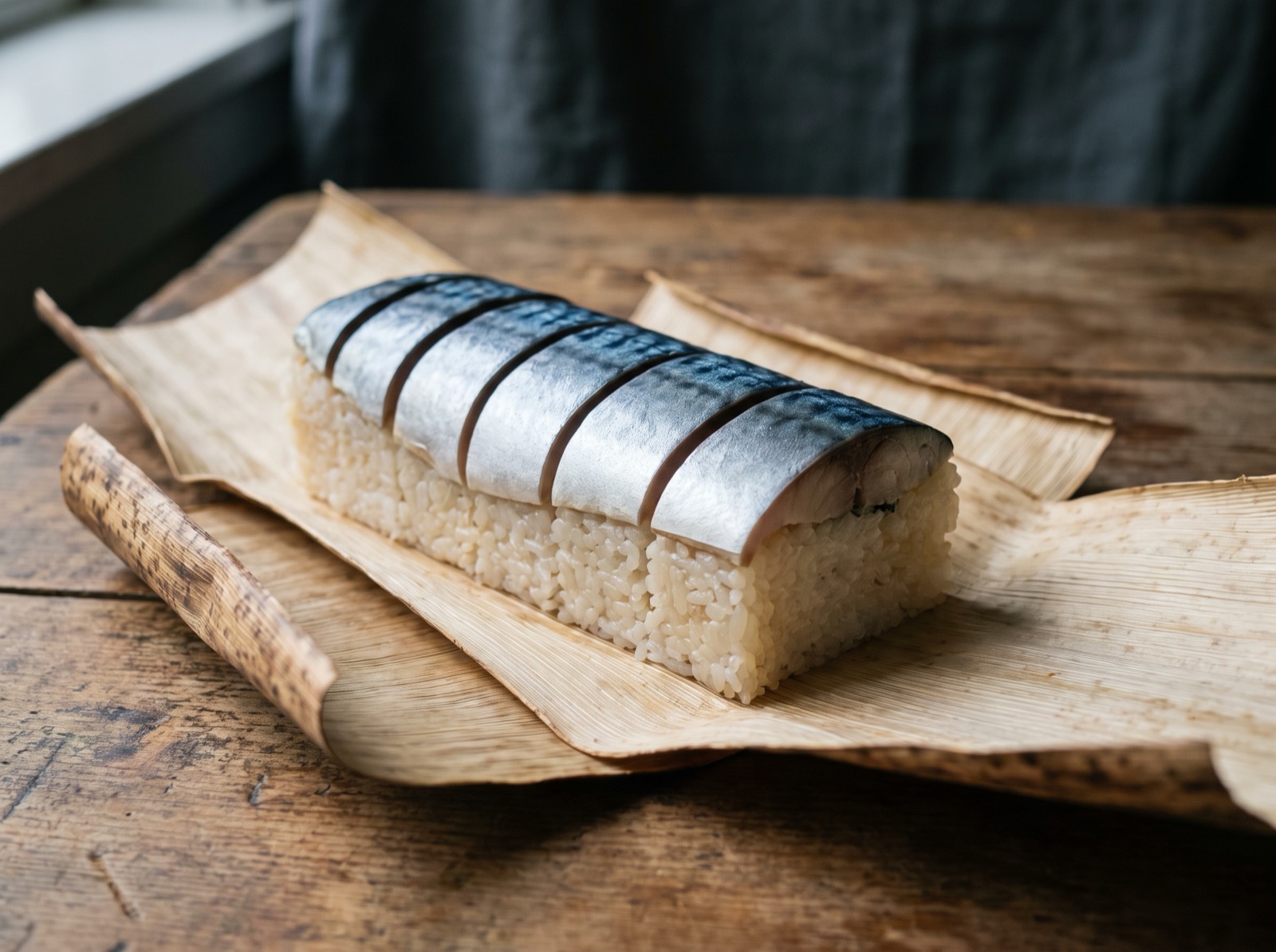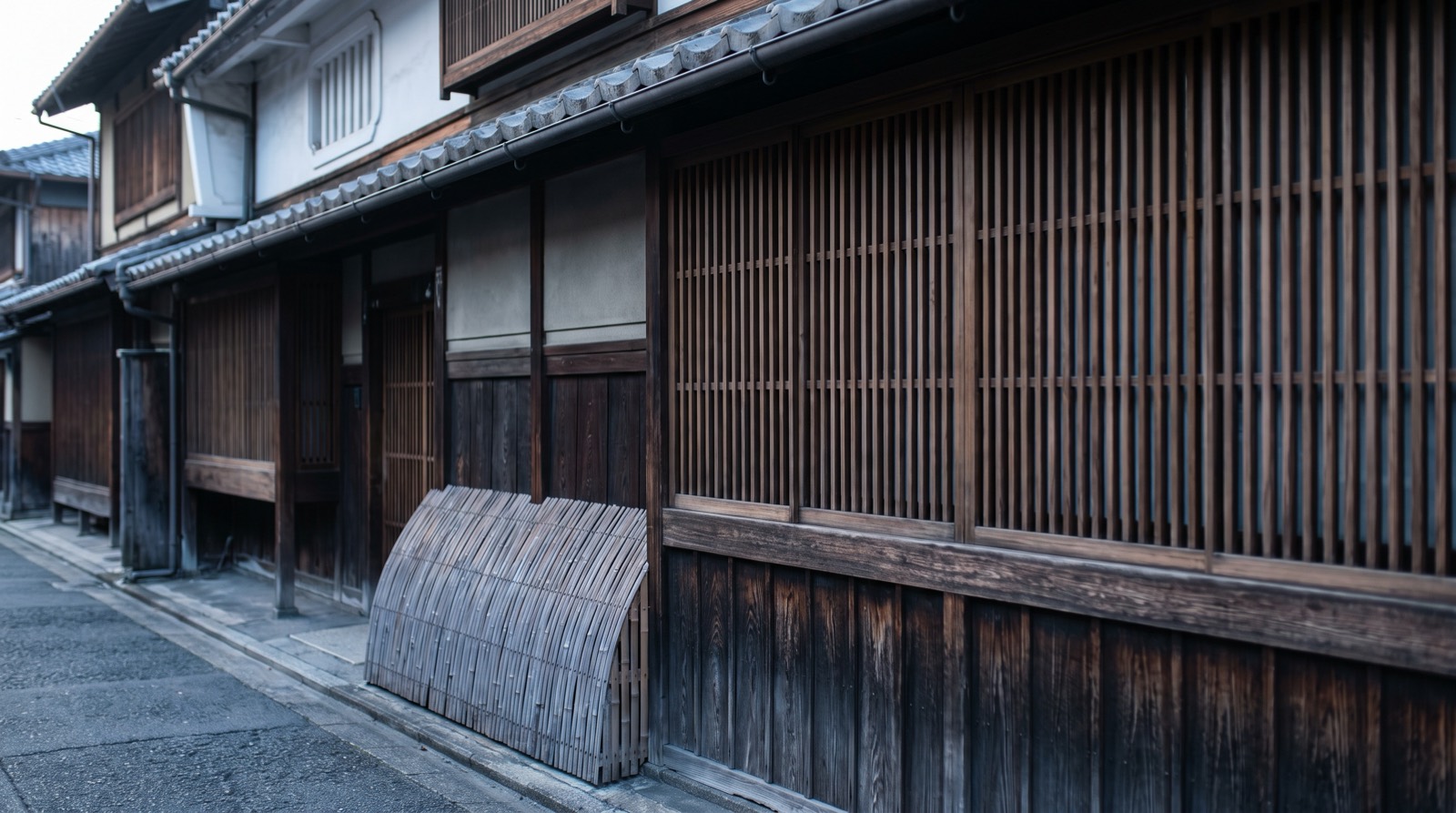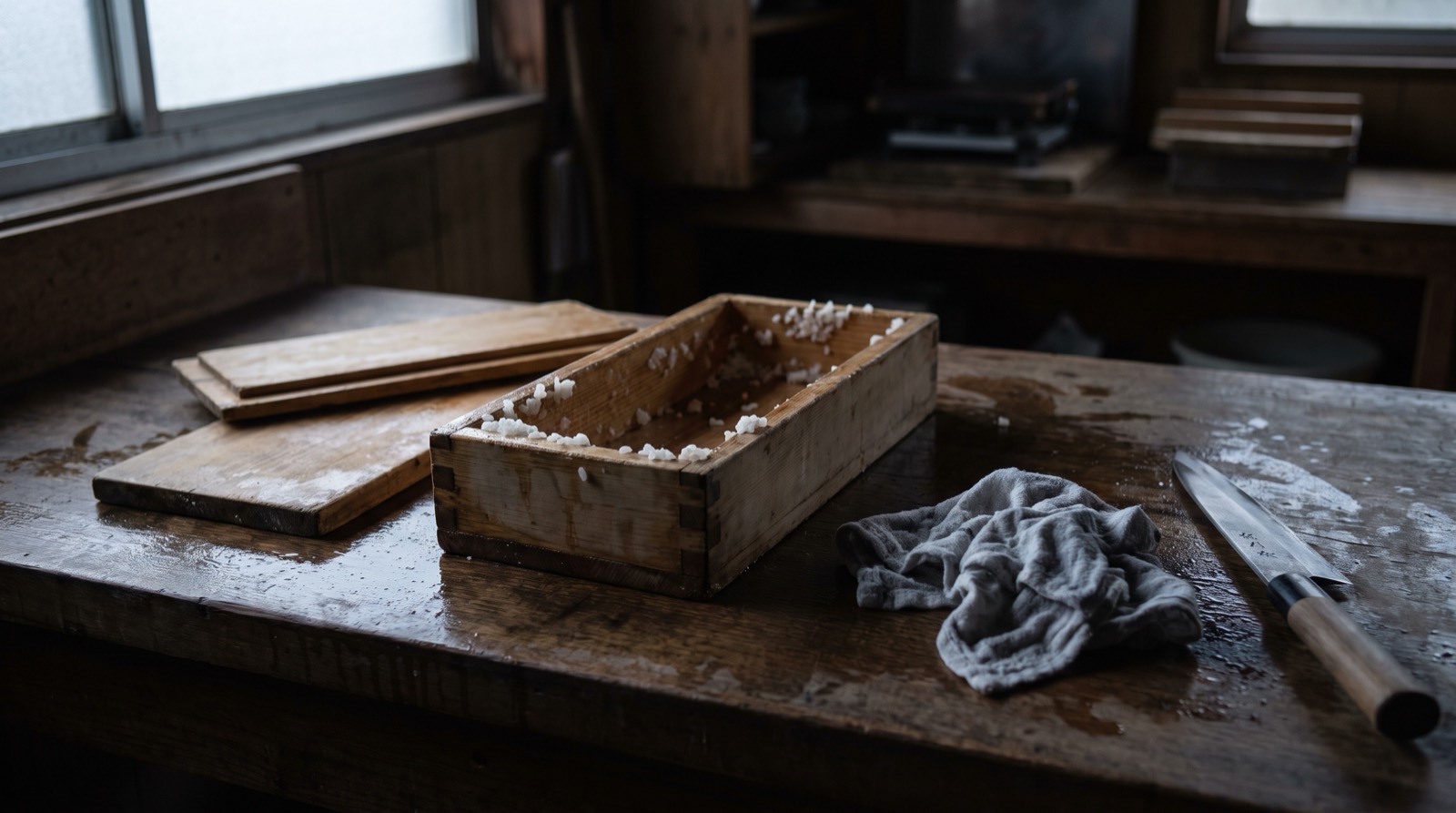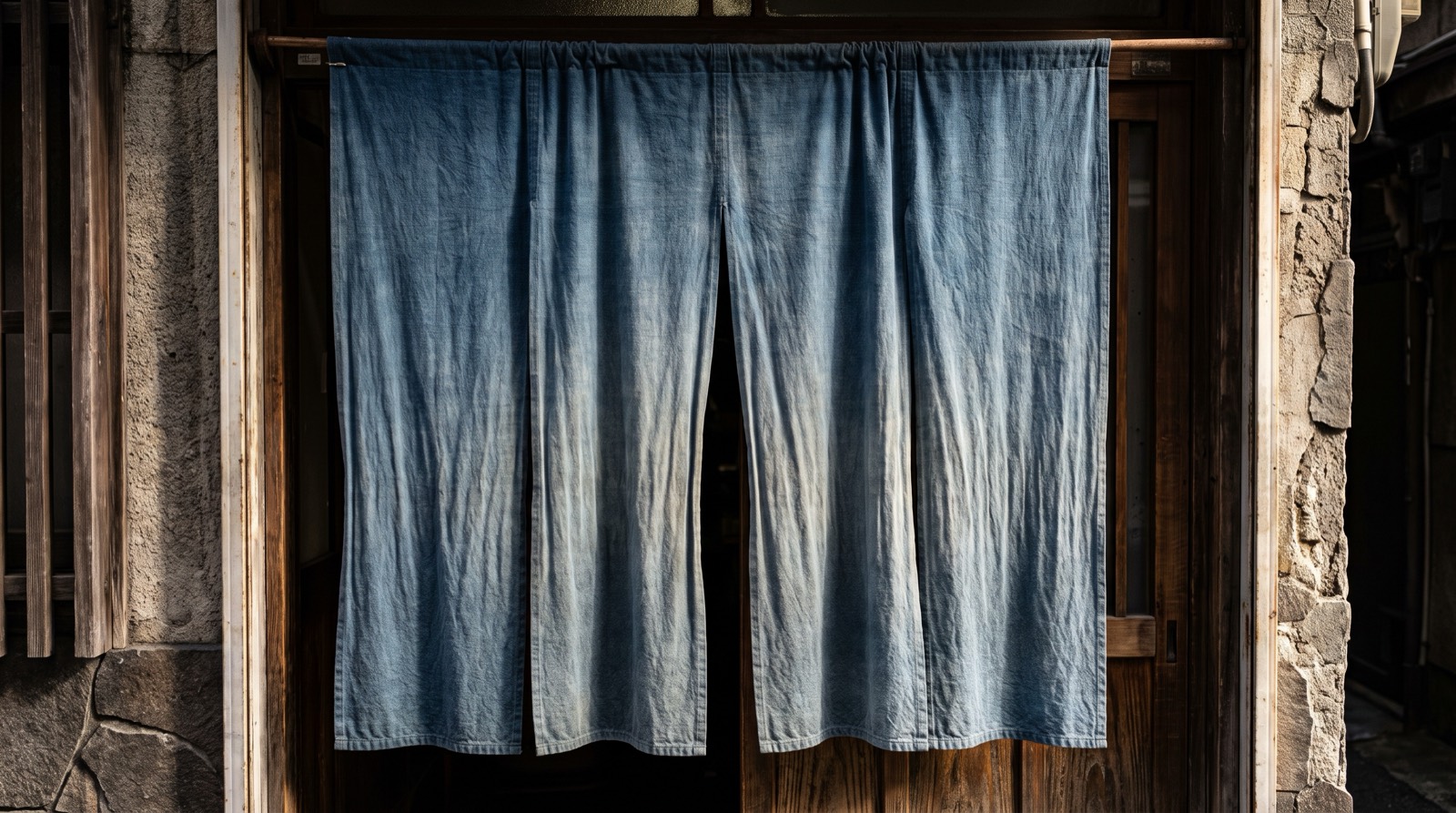
There is no legal definition of Kyoto sushi. No ministry certifies it, no register lists the shops entitled to use the phrase, and no court has ever been asked to decide whether a given box of pressed rice qualifies. What exists instead is a small association, founded in the spring of 1950, that put the words on its own front door and has been answering to them ever since. It is called the Kyoto Sushi Noren-kai — the Kyoto Sushi Curtain Association, a noren being the split cloth curtain a shop hangs at its entrance while it is open for business. It has eight members. That is the whole list. Every shop in this article is one of them.
Two of the eight, Izuu and Izuju, were the subject of an earlier piece on Kyoto mackerel sushi, so they are not the main subjects here. What follows is five of the remaining six, plus enough of the sixth to make the shape of the thing visible. The five are a shop trading since the Tenpo era that began life selling simmered food, a shop founded in Gion in 1936 by a man who wrote a textbook, a shop that opened in 1950 with a weighing scale on the counter because it was not legally allowed to sell rice, a shop in the old licensed quarter that can still send for a courtesan of the highest rank, and a shop in Fushimi that defines Kyoto sushi with five verbs and has no website at all.
The interesting thing about the eight is not that they agree. It is that they do not. Put their published material side by side and the same box of sushi is counted in three different units, the same dish appears under three different names, the same shop closes at two different times depending on which page you read, and one of them is filed by its own shopping street under a category its own association explicitly denies. None of this is carelessness. It is what happens when a word is maintained by eight independent businesses for seventy-six years without anyone in charge of reconciling the paperwork. This article is a guide to the five shops and, unavoidably, to the paperwork.
The word has an owner, and it has eight members
The association publishes its own founding account, and it is unusually specific about the room it happened in. In the spring of 1950, at the general meeting of the Kyoto Sushi Traders Union — the body that is today the Kyoto Prefecture Sushi Sanitation Trade Association — the union chairman, Nakajima Seijiro, proposed forming a separate body. Officers of the union at the time joined, and the Noren-kai was constituted as a shinboku dantai, a fellowship association. That is a specific legal-adjacent category in Japan and it matters: a fellowship association is not a regulator and not a cartel. It has no power to expel a shop from the trade, set prices, or stop anyone outside it from selling pressed sushi and calling it Kyoto sushi.
The stated purpose has survived verbatim on the association’s own page, and it is worth reading closely because it is the only sentence anyone has written down about what these eight shops owe each other.
To guard the noren, to raise the standing of the trade, to bring about the substance of prospering together, and to cultivate the fellowship of the members among themselves.
Four objectives, and the striking thing is that none of them is about the food. Guarding the noren means keeping the shop signs alive — not letting a house close. Raising the standing of the trade is a reputational aim. Prospering together and cultivating fellowship are, in plain terms, about not destroying each other. The association was formed five years after the end of the war, in a city where the food trade had been under rationing control and where several of these shops had only just resumed selling their own product. What the founders wrote down as their common purpose was survival, in a group.
The current chairman is named on the same page: Sasaki Kuniyasu. The formal statement of purpose in the association’s outline section adds one more phrase, that the members act in the spirit of mutual aid and, in a spirit of contribution to the district, spare no effort for the customer. Its area of operation is listed as Kyoto Prefecture. Its establishment is given as spring, Showa 25, which is 1950.
Then there is the business activity list, and it is three items long. The first is joint advertising: a placement in the Kyoto Shimbun, the prefectural daily, once a month. The second is a sushi class, held every March, run jointly with the same newspaper, at which the proprietors of the member shops teach members of the public to make mackerel sushi and rolled sushi. The third item is listed as Internet Utilisation Research. There is then a fourth line, Other Related Activities, with nothing after it.
Hold on to the third item. We will come back to it at the end, because the page it is printed on carries a copyright notice reading 2009, and because of the eight member shops, three have no website address in their entry — and at least one of those three has had a website for years.
The eight, in the order the association lists them: Suehiro, Honke Jubei, Izuu, Hisago-zushi, Izuju, Izugen, Otobun, Azuma. Five are in the central grid of the old city, one is in the former licensed quarter on the western edge, one is south of the river in Fushimi, and one — Izuu — is in Gion. It is a short list, and once you have read all eight entries you have read essentially everything the trade has published about itself in one voice. Everything else comes from the shops individually, and that is where the disagreements start.
Slices, cans, and cups of rice
Start with the simplest possible question. You want to buy a stick of pressed mackerel sushi, the long bar of rice and cured mackerel that is the single most recognisable thing these shops make. How much of it is there, and how do you ask for it?
At Suehiro, on Teramachi, the answer is in slices. The list reads: signature saba-zushi, one stick, twelve slices, ¥5,800, with a half size of six slices also available. Everything else on that list is counted the same way. The conger eel box sushi is one portion of eight slices. The rolled sushi is one stick of ten slices. The small-bream sushi is one portion of eight slices. The inari, the sweet fried tofu pouches, break the pattern and are counted in pieces — one portion, seven pieces — because a pouch is not something you can slice.
At Honke Jubei, in the hoko district, the same object is counted two ways at once. The mackerel stick appears as meidai saba-sugata-zushi, two portions, twelve slices, ¥5,500 in the room and ¥5,400 to take away, and immediately below it as meidai saba-zushi, one portion, six slices, ¥2,750 and ¥2,700. So far so consistent with Suehiro. But the shop also sells its assorted Kyoto sushi in a unit written as a go — the traditional measure of uncooked rice, about 180 millilitres, the amount that becomes a generous bowl. A one-go box is ¥2,214. A one-and-a-half-go box is ¥3,294. A two-go box is ¥4,374. A three-go box is ¥6,480. You are not being sold a number of pieces. You are being sold a quantity of rice, and the shop decides what shapes it takes.
At Hisago-zushi, on Kawaramachi, the unit is a kan, written with the character for a metal can. The August eel sushi is listed at three kan ¥2,592, six kan ¥5,184, and one full stick — nine kan — ¥7,776. The one-day-only sushi made for the Daimonji bonfire is a five-kan box. The monthly set includes eel sushi, two kan. The word does not mean a tin; in this trade it is the counter for a segment of a pressed or rolled bar, and Hisago-zushi uses it consistently across everything it presses. Its neighbours, three hundred metres away, use kire, slices.
None of these three shops is wrong. All three units are current Japanese, all three appear on printed price lists in 2026, and all three are describing the same physical thing: a bar of pressed sushi, cut. But a visitor who has learned that a stick is twelve slices at one shop will find that at the next shop a stick is nine kan and at the shop after that the relevant number is how many cups of rice went in. There is no conversion table. There is not even an acknowledgement anywhere on the association’s site that the members count differently.
This is the first and smallest example of the thing that runs through the rest of this article. The eight shops share a word, a curtain, a newspaper slot and a March classroom. They do not share a vocabulary. What each one publishes is internally coherent and externally incompatible with the others, and the association that exists to guard the noren has never taken the view that this is its problem.
The shop that opened with a weighing scale
Hisago-zushi has been on Kawaramachi-dori since 1950, which makes it exactly as old as the association it belongs to. Its own history page is the most detailed document any of the eight has published, and it contains one paragraph that explains more about postwar Japanese food than most books manage in a chapter.
The shop opened when sufficient ingredients were not available. So it put a weighing scale on the counter.
Taking in the precious rice entrusted to us by the customer, about thirty-nine momme of it, and processing it into eighty-five momme of sushi — that was the Kyoto Prefecture ordinance under which we started.
A momme is 3.75 grams. Thirty-nine momme is about 146 grams of raw rice; eighty-five momme is about 319 grams of finished sushi. The arithmetic works: rice roughly doubles in weight when cooked, and the seasoned vinegar and the topping account for the rest. What the sentence describes is a shop that was not permitted to sell sushi. Under the emergency restaurant control measures of the late 1940s, rice was rationed and the business of exchanging money for cooked rice was substantially closed down. The workaround, formalised by prefectures including Kyoto, was itaku kako — commissioned processing. The customer brought the rice. The shop supplied the skill, the fish, the vinegar and the box, weighed the input, returned an agreed weight of output, and charged for the labour rather than the food.
That is why there was a scale on the counter, and it is why the number is so exact. The ratio was the licence. A shop that returned too little was cheating a customer of rationed food; a shop that returned too much was, in effect, selling rice. Hisago-zushi has kept the figure on its website eight decades later, which suggests the family regards it as the founding fact of the business rather than an embarrassing detail of a hungry period.
The rest of the history is a family story that explains why a shop with roots in Wakayama and Osaka is a member of a Kyoto association. The founder, Ujita Shoichi, born 1915 and died 1982, was descended from gunners of the Wakayama castle gate and was the youngest of five children. He began his apprenticeship at a restaurant called Hisago on the bank of the Rankan bridge in Kishiwada, south of Osaka, which was the household his eldest sister had married into. The chef there — his brother-in-law — had himself trained at Futaba-zushi in Osaka, and in March 1940 Shoichi married Fumi, born 1917, the daughter of that Osaka shop. Six months later, in October, the call-up papers arrived and he was sent to south China.
While he was away, with the war going badly, his eldest brother brought the whole extended family out of Osaka to Kyoto, where he already lived. Shoichi came back to a family that had relocated without him. In 1949, with help from his siblings and his brother-in-law, and with Fumi and his eldest sister Shizue — born 1899, died 1998, so she lived to ninety-nine — he rented a small shop at Takoyakushi and opened under the name Hisago, the name of the Kishiwada restaurant where he had learned the trade. Some months later, in 1950, he moved it to the present site on Kawaramachi.
The shop calls what it makes Kansai sushi, not Kyoto sushi. So does the association’s entry for it. It is the only one of the eight with a name inherited from an Osaka-area restaurant, a founder who trained in Kishiwada, and a founding matriarch from an Osaka sushi house, and it is entirely open about all three. The Kyoto Sushi Noren-kai contains, as a founding member, a shop that arrived from somewhere else in 1949 and has never claimed otherwise.
The corporate history is equally plain: limited company in 1969, joint-stock company in 1982, renamed to the present entity in 1998. The second-generation proprietor, Ujita Shuu, born 1944, took over in 1982 and was the husband of the founder’s eldest daughter. The third, Ujita Keishitsu, born 1972, took over in 2009 and is the founder’s grandson. He is also, according to the footer of every page, the person who answers the shop’s email.
Two hundred years, or a hundred and seventy-odd
Suehiro is the one of the eight whose age is hardest to state, because the two pages that publish it do not agree.
The association’s entry says the shop was founded in the Tenpo era — it gives the years as 1830 to 1843 — at Teramachi Nijo, south of the imperial palace, as a nizakaya, a shop selling simmered food rather than sushi. By the Meiji period, it says, the house had begun putting effort into Kyoto sushi as well as simmered dishes, and laid the foundations of a sushi business. It served the Kuni and the Kaya princely houses and held an Imperial Household appointment. And then it says: for a hundred and seventy-odd years since founding, we have made box sushi, rolled sushi, mackerel sushi and, in winter, steamed sushi by the same distinctive method as ever.
The shop’s own site tells the same story and closes it differently. Founded in the Tenpo era at Teramachi Nijo as a nizakaya, it says, and then: guarding the taste of Kyoto sushi, nurtured by the townspeople of Kyoto, for about two hundred years.
Both cannot be a current statement. A hundred and seventy years from 1835 lands around 2005; two hundred years from 1835 lands around 2035. The likeliest explanation is the dullest one and it is visible in the page furniture: the association’s site carries a copyright line reading 2009, and a hundred and seventy-odd years was true when that text was written. The shop’s own site carries a copyright line reading 2016 onwards, and about two hundred years is a rounder claim written later. Nobody has lied. One number simply stopped being updated while the other was written to be vague enough to survive a decade.
This is worth naming plainly because a visitor doing research will hit it constantly with these eight shops. Age claims in this trade are not measurements. They are sentences written on a particular day and left there. The reliable figure is the era name — Tenpo, 1830 to 1843 — because that is the thing the family actually knows. Everything derived from it drifts.
What Suehiro publishes about the food is far more precise. The list runs to fifteen lines and every one carries a price and a count. The mackerel stick at ¥5,800 for twelve slices is described as the shop’s boast, made with thick, well-fattened fish by a method handed down through the generations, and recommended as a gift or a Kyoto souvenir. The conger eel box sushi at ¥1,840 for eight slices is flagged as the most popular item in the shop: one whole grilled conger, laid into the box, brushed with the house sweet glaze so that it needs nothing added. The inari at ¥1,190 for seven pieces has carrot, burdock and black sesame worked through the rice, and is recommended for a mushiyashinai — a Kyoto word for something eaten to quiet the stomach between meals.
Then the boxes proper. Kyoto-style hako-zushi, ¥1,920 for eight slices, described as the byword for Kyoto sushi: rice packed into a wooden mould, also called oshi-zushi, pressed sushi, in three combinations — prawn with thick omelette, white fish, and grilled Spanish mackerel. The mixed platter at ¥2,310 gathers box, roll, inari and hand-formed sushi. Box-and-roll together is ¥1,660. The thick roll at ¥1,750 for ten slices is filled with gourd shavings, shiitake, thick omelette, freeze-dried tofu and mitsuba. The iso-maki at ¥1,440 for nine slices is a square nori roll around cured mackerel and shibazuke pickle. There is an eel-and-cucumber square roll at ¥2,000, a lightly cured small-bream sushi at ¥2,800 for eight slices, thin rolls in nine varieties from ¥480, and clear or red miso soup at ¥600.
And there is a line reading Edomae assortment, ¥2,700: five pieces of hand-formed sushi with a tuna roll and a cucumber roll. A shop that has sold Kyoto sushi since the Tenpo era has a product on its list named after Tokyo. It is not hidden and it is not apologised for. The description is one line long: for those who want to eat Edomae hand-formed sushi, this is it.
One shop closes twice, another never quite closes
Suehiro publishes two closing times, and the distinction is the single most useful piece of practical information in this article.
Eat in the room: 11:00 to 15:00. Take it away: 11:00 to 18:00, closing as soon as it sells out. Closed Mondays and Tuesdays.
Those are two different businesses running out of one address. Between eleven and three, the shop is a restaurant and a takeaway counter at once. After three it is only a counter, and after three the clock stops governing it — the sellout does. A visitor who arrives at 16:30 has not missed the shop; they have missed the room, and whether they have missed the sushi depends on what the morning was like. There is no way to know this in advance and the shop makes no attempt to pretend otherwise.
Honke Jubei goes further in the other direction. Its published hours are lunch 11:30 to 14:00 and dinner 17:30 to 22:00, Tuesdays closed with occasional irregular closures. But on both its access page and its menu page it prints the same sentence twice: takeaway is accepted outside opening hours as well, so please telephone in advance to discuss. It repeats the point about lead time — some items take a while — and asks for orders by phone ahead of the visit. So the counter is, in effect, open whenever someone is in the building and the order was placed early enough. The association’s entry for the shop compresses this to a single phrase: takeaway is accepted at all hours.
Hisago-zushi does neither. It opens at 9:30 in the morning and closes at 19:00 with last orders at 18:30, every day except Wednesday, with the note that when a public holiday falls on the closing day the shop trades and takes the day off before or after instead. Nine-thirty is remarkably early for a sushi house and it is a consequence of what the shop is: a counter on a shopping street with a dining room hidden behind it, doing takeaway, delivery, and department-store trade. Its two branch counters, in the basement of JR Kyoto Isetan and the basement of Takashimaya Kyoto, keep department-store hours instead — 10:00 to 20:00 and 10:30 to 20:00, closing when the store closes.
Three shops, three completely different theories of what an opening time is. One publishes a room time and a counter time. One publishes a room time and then says the counter is negotiable. One publishes a single time and opens before almost anything else in the city. If there is a Kyoto sushi standard here, it is only this: the sushi outlives the room it was made in, all three shops know it, and each has arranged its day around that fact in its own way.
Fifteen minutes the same website disagrees about
Honke Jubei is worth one section on its own, for an error that is small enough to be honest and consequential enough to ruin an afternoon.
On the shop’s front page, the store information block reads: lunch 11:30 to 14:00, last order 13:30. On the shop’s access page, the same block reads: lunch 11:30 to 14:00, last order 13:15. On the shop’s menu page, above the lunch listings, it reads: opening hours 11:30 to 14:00, last order 13:15. And the association’s entry for the shop reads 13:15.
Three of four say 13:15. The one that says 13:30 is the page a visitor is most likely to see, because it is the home page, and because it is the block that a search engine or a map card is most likely to lift. A traveller who arrives at 13:20 having read the front page will be turned away by a shop that is not doing anything wrong.
The same pattern shows up in the walking directions. The shop’s own pages say two minutes from exit 22 at Karasuma or Shijo station; the association’s entry says three minutes from Shijo or Karasuma. And in the address: the association gives it as Nishiki-koji-dori Muromachi Higashi-iru, Ushiroyama-cho, while the shop gives the full form with the block number, 310-6, and the postcode 604-8155. Nobody is misdirecting anyone. But of the four numbers a visitor actually needs — when it opens, when the kitchen stops, how far the walk is, and which door — two are published in more than one version.
It is worth saying what the shop gets right, because the same site is the single most informative document any of the eight has produced. Seating: counter, ten seats, non-smoking. That is the whole room. Ten seats is not a restaurant that can absorb a mistake in either direction, which is presumably why the last order time matters enough to be printed four times, and why it is unfortunate that one of the four differs.
The history is on the site too, written by the third-generation proprietor. The first, Araki Shinji, hung the curtain in Gion — at Nawate Shinbashi-agaru — in 1936. He was a leading figure in saiku-zushi, decorative sushi, and the site notes that he spread the technique nationally and compiled a work called the Sushi Technique Textbook, Kansai Sushi Volume. The second, Teruo, held office in the sushi trade union. The third, Kazuo, built what the shop is now, described as sushi plus cooking. In March 2011 the shop left Gion and moved to Ushiroyama-cho in the hoko district, the neighbourhood that keeps and operates one of the great floats of the Gion Festival, so that in July the festival happens at the door. The name is glossed by the family itself: the characters in Jubei can be read as guarding one’s people heavily, and the proprietor lists gratitude to co-workers alongside gratitude to customers, ingredients and suppliers.
Which returns us, unavoidably, to the association’s entry, which opens: after seventy-odd years of patronage in the Gion quarter, the shop is now in the hoko district. The move was in 2011. Fifteen years on, the sentence is still written as though it had just happened. From 1936 to 2011 is seventy-five years, so seventy-odd was accurate at the time of the move — and the association’s page has been describing a fifteen-year-old relocation as current ever since.
What the rice is for
If there is a technical definition of Kyoto sushi anywhere in the material these eight shops publish, it is on Honke Jubei’s page about its own approach, and it is four sentences long.
Edomae sushi, it says, places its weight on the topping, and so the rice is properly seasoned with vinegar and salt only, without much flavour added. Kyoto sushi, by contrast, expresses a single taste out of the flavour of the rice and the flavour of the topping together. And therefore:
We hold old rice, Kyoto rice or Goshu rice, to be best, cook it in kombu stock, and after that let the grains take in the seasoning slowly.
Three claims worth separating. The first is the one a visitor will find counter-intuitive: old rice, komai, last season’s crop, is preferred. New rice is wetter and softer, and a grain that is going to be pressed in a mould, hold a shape for hours and absorb a seasoning without collapsing is better off drier. The second is the origin: Kyoto rice or Goshu rice, Goshu being the old name for Omi, the country around Lake Biwa in what is now Shiga. Azuma in Fushimi names the same rice in its own entry — the balance of fresh toppings and sharply prepared ingredients with Goshu rice sushi rice, it says, has been enjoyed by customers across four generations since founding. Two of the eight, independently, name the same growing region.
The third is the stock. Rice cooked in kombu dashi rather than in water is the practical centre of the whole style, and the other members say it too. Izugen, on Takakura-dori, states that its sushi rice, of which it is proud, is cooked in kombu and katsuo stock and has a firm, definite flavour. Honke Jubei says kombu. The association’s entry for Honke Jubei quotes the proprietor saying the same thing in one line: the sushi rice is cooked in kombu stock, for a deep savour.
That is the definition, as far as one exists. Kyoto sushi is sushi in which the rice is seasoned to be eaten as a flavour in its own right rather than as a neutral bed, which follows from the fact that most of it is designed to be pressed, wrapped and eaten some hours later, often somewhere else, by someone who was not in the shop. Everything else — the boxes, the mould, the bar shapes, the cured mackerel, the absence of raw fish in some dishes — follows from that one decision about the rice.
Honke Jubei adds one policy that follows from it and that no other member publishes. Because the shop wants people to taste a range, it serves hand-formed sushi from one piece, and it serves its Kyoto sushi — the iso-maki, the oboro-maki — from one slice. It keeps, it says, forty or more toppings for the purpose. Selling a pressed bar by the slice is a small thing that undoes a large constraint: the reason most visitors never eat Kyoto sushi is that the minimum purchase is a whole stick or a whole box. One shop out of eight has decided the minimum is one cut, and states outright that it considers making the style known to be its duty.
The dish with nothing raw in it
Two of the eight shops, independently, on their own sites, define the local scattered sushi by what it does not contain. Suehiro, describing its Kyoto-style chirashi at ¥2,200:
The characteristic of the Kyoto scattered sushi is that there is nothing raw in it.
The rest of that entry describes what is there instead: shiitake and gourd shavings worked through the rice, a generous layer of shredded omelette over the top, and prawn, grilled conger and seasonal ingredients arranged for colour. Honke Jubei sells the same idea as a separate product line and puts the definition in the product name — kyo-chirashi, glossed in brackets on the price list as chirashi that does not use anything raw, ¥1,980. It sits on the same list as the shop’s other four chirashi, which do use raw fish and run from ¥2,090 to ¥4,950. The Kyoto version is the cheapest of the five.
This is the second half of the definition that started with the rice, and it is the half that explains the geography. Sushi built to be pressed, wrapped, carried and eaten later cannot depend on raw fish, so the tradition developed around cured mackerel, cooked conger, grilled Spanish mackerel, simmered shiitake, gourd, omelette and vinegar-cured small bream. Kyoto is not on the sea. What arrived arrived cured, and what the city built was a cuisine of preparations that improve or at least hold for hours.
The consequence for a visitor is worth stating bluntly, because it inverts the usual advice. At these shops, the dish with no raw fish in it is not the compromise option or the children’s option. It is the house style, it is what the shop is for, and at Honke Jubei it is also the cheapest thing in its category. If you order the raw assortment at a Kyoto sushi house you are ordering the thing the shop added later.
Both shops also keep the seasonal system that follows from the same logic. Izugen sets it out most completely: the fortune roll at the February setsubun, chirashi at the March doll festival, whole hamo pike conger sushi for the July Gion Festival, well-fattened mackerel sushi in autumn, and warm steamed sushi in winter. Suehiro sells its mushi-zushi — steamed sushi, the winter dish, sushi served hot — from November to March, according to the association’s entry. It is not on the shop’s own year-round price list at all, and that absence is itself accurate: for seven months of the year there is nothing to price.
Sitting down costs three yen more
Two of the five shops publish every price twice, and the reason is a tax rule that visitors almost never see stated so plainly.
Japan applies a reduced consumption tax rate of eight per cent to food bought to take away and the standard ten per cent to food eaten on the premises. Most restaurants absorb the difference or quote one figure. Honke Jubei and Hisago-zushi do not. They print both.
At Honke Jubei the pattern runs through the entire list. Plum-grade hand-formed sushi ¥2,420 in the room, ¥2,376 to take away. Bamboo grade ¥3,300 and ¥3,240. Pine grade ¥4,730 and ¥4,644. Top grade ¥6,600 and ¥6,480. The signature mackerel stick ¥5,500 and ¥5,400. Box sushi ¥2,420 and ¥2,376. The famous iso-maki ¥1,430 and ¥1,404. Sparrow-style small bream ¥2,530 and ¥2,484. Prawn bar ¥2,530 and ¥2,484. Conger bar ¥1,760 and ¥1,728. And at the bottom of the list, one piece of inari sushi: ¥165 in the room, ¥162 to take away. Three yen.
Hisago-zushi does the same on its monthly specials — eel sushi six kan ¥5,184 to take away and ¥5,280 in the room, the August eel roll ¥1,944 and ¥1,980, the Ishin roll ¥1,880 and ¥1,914 — and then does what none of the others do, which is explain it. At the foot of the page, in one line: takeaway and delivery include eight per cent consumption tax, dining in the shop includes ten per cent.
For a visitor this is small money and useful information. It tells you, first, that the takeaway price is the real price of the food and the difference is tax, not a service charge or a downgrade. Second, it means the published price of a stick of mackerel sushi in a shop window is comparable across shops only if you check which of the two numbers you are reading. Third, and most practically, at these shops the decision to eat at the counter rather than carry the box out is a decision that costs about two per cent, which is almost certainly less than the visitor assumed.
There is one shop among the eight that charges a genuine service charge, and it is transparent about it too. Otobun, in Shimabara, notes on the association’s page that its upstairs tatami room seats up to thirty for celebrations, memorial gatherings, meetings and parties, and that when the room is used a service charge of thirteen per cent is applied. It is the only such figure published by any member.
The shop that can send for a tayu
Otobun is the westernmost of the eight, out past the Umekoji rail yards in Shimabara, and it is the one whose address does most of the work.
Shimabara was the licensed quarter — one of the three great shogunate-sanctioned pleasure districts of Japan, in the shop’s own words. Its name, the shop explains, is thought to come from the disorder around its forced relocation to the present site in 1641, which is said to have resembled the Shimabara rebellion of the year before. Its courtesans of the highest rank, the tayu, were accomplished in dance and poetry and educated to a standard that made them company for court nobles and warriors; Yosa Buson passed through, and so did the Shinsengumi. Of the buildings from that world, three survive: the Great Gate, the Sumiya, and the Wachigaiya.
The Wachigaiya is still trading, still an okiya and ochaya — the house that engages the performers and the house that hosts the parties. And Otobun states, on its own site, that it is one of the shops that supplies the Wachigaiya’s catering. From which follows the sentence that no other sushi shop in Japan is likely to be able to write: through that connection, it is possible to call a tayu to a banquet at our shop, so please enquire.
That single line explains where Kyoto sushi comes from more efficiently than any history. These are not restaurants that grew outward from a counter. They are shokudashi houses — caterers — that made food to be carried into somebody else’s room: a teahouse, a theatre, a temple, a merchant’s parlour. The box, the mould, the bar, the seasoned rice, the absence of raw fish and the wrapping are all engineering for a meal that is assembled in one building and eaten in another. The counter came later, in most of these shops much later. Otobun did not have a tatami room at all until it rebuilt in 1987, sixty years after it opened.
Its founding is 1927, and its name is an inheritance. The first proprietor, Bunjiro, trained as a sushi chef at a house called Otowa in Shinkyogoku, on Shijo. When he went out on his own he was given noren-wake — the division of the curtain, which the shop describes as the most honourable parting gift an apprentice can receive — and made his shop name from the first character of Otowa and the first character of Bunjiro. Otobun. The parent house is not a member of the association. The shop formed out of its curtain is.
That makes two of the eight whose names record a separation. The association’s own entry for Izuju, in Gion, opens: having received from Izuu the honour of a division of the curtain, one hundred years. Izuu is also a member. So within an eight-shop association there is one parent-and-child pair on the list together, and one shop whose parent is outside it.
Otobun’s practical details come with the same disagreement as the others. The association gives its hours as 11:30 to 18:30 last order, with the room until seven. The shop’s own site gives 11:30 to 22:00 with entry by 19:00. Those are the same fact told from opposite ends — the last moment you can come in, versus the last moment you can order and the hour the room empties — and a visitor reading only one of them will form a completely wrong picture of the evening. Reservations are required for both the upstairs room and the catering, taken from 9:30 to 18:00 including Sundays and public holidays. Closed Wednesdays and the third Thursday, with other irregular closures. Two parking spaces. Seven minutes on foot from Tanbaguchi or Umekoji-Kyotonishi, five from three different bus stops.
One more thing sits on that page, and it dates it precisely. The store information block notes that the shop is a Kyoto Prefecture certified establishment for coronavirus infection control measures and that Go To Eat vouchers may be used. The Go To Eat campaign finished several years ago. The site is not abandoned — it links a currently bookable walking tour of Shimabara led by the young proprietor — but that one block has been sitting there since about 2021.
A sushi that exists on one day of the year
On 16 August, the mountains around Kyoto are lit. Five giant characters and shapes burn on five hillsides, the largest of them the character for great, dai, on Nyoigatake above the city. It is the Gozan no Okuribi, the send-off fire that closes the Obon period and returns the ancestral spirits.
Hisago-zushi sells a sushi for it. Kyo no Okuribi-zushi, ¥3,240 to take away and ¥3,300 in the room, five kan in a box — tilefish, eel, conger, mackerel and sparrow-style small bream — with the character for dai set into it. The listing carries one qualifier: available on 16 August only. Reservations accepted.
It is the most concentrated version of something all these shops do. The same August page carries the monthly set, called the Hazuki no Sushi after the old name for the eighth month, at ¥6,380 to eat in: top-grade tuna, steamed abalone, sea bream, chilled hamo, tiger prawn or sweet shrimp, striped jack, two kan of eel sushi, a five-bu cucumber roll, a decorative sushi in the form of a pink, uzaku, chilled savoury custard and a sweet. Next month that list will be a different list. Alongside it sits the eel sushi of the month — the shop splits its eel from the belly, in the Kansai manner, but steams it, in the Tokyo manner, and finishes it with whole green peppercorns — and an August-only eel roll made by pressing the mixture in the iso-maki mould and wrapping it in shredded omelette instead of nori, and a mini eel chirashi sold only at the Takashimaya Kyoto counter.
And there is the Ishin-maki, the Restoration roll, at ¥1,880 to take away. The shop tells the story on the page. A customer told the house, in Kyoto dialect, that there are heaps of historic sites along Kawaramachi-dori so they had better think of something to match the television drama. What came of it was a variant of the shop’s shredded-omelette roll — shiitake, gourd, grilled conger, prawn, cucumber and pickle inside — branded with a hot iron designed by the papercut artist Tsuchida Shoko. The brand shows Sakamoto Ryoma looking out over Kyoto, inside the outline of a gourd. Hisago means gourd. It is the shop’s own name, wrapped around a figure who was assassinated a few hundred metres from its door.
The delivery note on the same page is equally local: deliveries are made across the city and its outskirts, with a charge depending on district, a paid carrier bag, and one exception — delivery to the Minamiza, the kabuki theatre at Shijo Ohashi, is free. That is a direct survival of the theatre-teahouse trade, food carried to a customer sitting through a long programme, and it is the reason a shop like this opens at half past nine in the morning.
Five verbs, and the list that lost them
Azuma is the outlier of the eight in every measurable way. It is the only member south of the city in Fushimi, near the Momoyama stations, on the Otesuji shopping arcade. It was founded in 1931. It has no website, no email address and no social account in its association entry — only a telephone number and a fax number. And it produces its definition of Kyoto sushi in one sentence, by refusing to define it as a set of products at all.
The mackerel sushi that is cured, the rolled sushi that is rolled, the hand-formed sushi that is gripped, the box sushi that is pressed, and then the scattered sushi that is scattered — we offer many kinds of sushi, by techniques whose handwork differs.
Five dishes, five verbs, each verb attached to its own dish. It is a taxonomy of technique presented as a menu, and it is exactly right: what unites these shops is not an ingredient or a region but a set of hand skills that a single apprentice was expected to acquire. The other members reach for the same construction. Hisago-zushi’s statement from the proprietor is three verbs long: in an age when so much is being mechanised, everything at this shop is made by the old methods, one at a time — gripped, rolled, and drawn out.
Drawn out is nuku, and it is the fourth verb, the one specific to pressed sushi. The rice and topping are packed into the wooden mould and the finished block is then drawn out of it. The shop uses the same word for a piece of equipment a visitor can see from the pavement. Behind the glass on Kawaramachi-dori is the cutting board, where sushi being made can be watched from the street, and stacked in front of it are the nuki-ita — the drawing-out boards, in clear acrylic — holding rolled sushi and box sushi waiting their turn. The August eel roll is described as being pressed in the iso-maki mould and drawn out. The verb runs from the equipment to the product to the sentence about the house philosophy, and it is a verb that has no equivalent in Tokyo sushi, where nothing is moulded.
Now look at what happens to Azuma’s sentence when somebody else republishes it. The Fushimi Otesuji shopping arcade keeps a directory of its tenants, and Azuma is in it, in block three. The entry carries what is recognisably the same text: Kyoto sushi, Edo sushi, scattered sushi, all sorts of sushi, the sushi of Azuma. The sushi of Azuma inherits the tradition of Kyoto sushi to this day, founded in 1931. And then the crucial line comes out as: mackerel sushi, rolled sushi, box sushi, scattered sushi and hand-formed sushi — we offer various kinds of sushi by techniques whose handwork differs.
The verbs are gone. Every one of them. What was a statement about five distinct physical actions has become a list of five nouns with a vague clause about differing handwork left dangling at the end, referring to nothing. The order has been shuffled as well. And the shop is filed in the arcade directory under a category heading that reads sushi izakaya — sushi drinking house — while the shop’s own text in its association entry opens by insisting: we are a specialist sushi shop. The arcade directory also renames it. On the association’s list it is Azuma. In the arcade it is Azuma-zushi.
This is the whole problem in one shop. A house with no site of its own is described by two directories that disagree about its name, its category and the sentence it wrote about itself, and the version that loses the verbs is the one attached to the street it actually stands on. Azuma’s remaining published facts are thin and consistent across both: open 10:00 to 19:00, closed Tuesdays, telephone 075-611-1379. Its recommendations are a hishi-bako, a diamond-shaped box sushi it describes as its own invention, a mackerel sushi made with high-grade salted mackerel, and a tub of scattered sushi. Its other listed items include a Kyoto sushi, a five-colour roll, plain hand-formed sushi, an Edo sushi, and something called tamayura, which it does not explain.
The association that researches the internet
Return now to the third item on the association’s list of activities: Internet Utilisation Research. The page it appears on carries a copyright notice reading 2009.
Of the eight member entries, five carry a website address and three do not. The three without are Izugen, Otobun and Azuma. Izugen’s entry has no URL field at all; where the others have one, it has a line headed SNS containing only the shop’s own name. Otobun’s has an email address and no site. Azuma’s has a fax number and no site.
Two of those three are accurate. Izugen and Azuma genuinely have no site of their own, to the point that search engines return the association’s own member page as the shop’s official website. That is a real outcome and not a small one: for two of the eight houses that define this style, the single authoritative published document about them is a page maintained by a fellowship association whose site design dates from 2009.
The third is not accurate. Otobun has a website. It is a current, responsive, well-photographed site at its own domain — the same domain as the email address printed in the association’s entry — with a history section, a menu, a mail-order page, an enquiry form and links to two social accounts. The association is publishing the email address at that domain and not the site sitting on it.
The newspaper column is the other half of the picture, and it is the part that works. The association’s joint advertising is a monthly slot in the Kyoto Shimbun under the running title Kyo no Sushiya, Tsumami-banashi — roughly, Kyoto sushi shops: bar-snack talk. The archive holds fourteen instalments across two seasons, and reading the dates in order tells you exactly how the association operates.
Season three runs: Otobun in August 2025, Izuju in September, Jubei in October, Izugen in November, Suehiro in December — and then nothing in January or February, resuming with Hisago-zushi in March 2026, Azuma in April, Izuu in May. Eight shops, one per month, one turn each. Now season two, as far as the archive holds it: Otobun in November 2024, Izuju in December — and then nothing in January or February, resuming with Jubei in March 2025, Izugen in April, Suehiro in May, Hisago-zushi in June, Azuma in July.
The order is identical. Otobun, Izuju, Jubei, Izugen, Suehiro, Hisago-zushi, Azuma, Izuu, twice through, without variation. And both seasons skip January and February. A rotation that never changes its running order and always takes the same two months off is not an editorial schedule; it is a rota, agreed once and kept. The two months it skips are the two months when a Kyoto sushi shop has the least spare capacity of the year, since New Year and the February setsubun rolls are the trade’s peak.
What the archive does not hold is any text. Every instalment is a scanned photograph of the printed newspaper page, a JPEG, offered with a link reading enlarge. The words the eight shops have published about themselves in the prefectural daily, monthly, for at least two years, exist online only as pictures of paper. And all fourteen carry the same update date: 9 June 2026. The front page announces it — we have uploaded season three of Kyo no Sushiya, Tsumami-banashi all at once — which means a year of monthly newspaper appearances reached the internet on a single day, roughly nine months after the first of them ran.
It would be easy to make this sound like a failure, and it is not one. The association does the two things it said it would do in 1950: it buys the newspaper space and it teaches the March class. Its members are eight small family businesses, six of which are on their third or fourth generation, most with fewer than twenty seats. The page is not maintained because maintaining pages is not one of the four objectives, and guarding the noren — keeping eight shops open — demonstrably is. But it does mean that a visitor researching Kyoto sushi in English or Japanese is reading, in several cases, a document written when the shops’ own claims about themselves were fifteen years younger.
How to use the eight
The five shops in this piece are not ranked and are not interchangeable. What follows is what each is actually for.
Suehiro, Teramachi Nijo, closed Mondays and Tuesdays, telephone 075-231-1363, five minutes north of Kyoto Shiyakusho-mae exit 11. Go for the widest single price list of the five and for the one item all its neighbours point at: conger box sushi, ¥1,840, eight slices, the shop’s own most popular. Eat in before 15:00 or buy before 18:00 and accept that it may sell out first. In winter, ask about steamed sushi, which the association says runs November to March and which appears on no price list.
Honke Jubei, Nishiki-koji Muromachi, closed Tuesdays, telephone 075-255-7190, two minutes from exit 22 at Shijo or Karasuma. Ten counter seats. Go here if you want to taste Kyoto sushi without buying a whole box, because it is the only member that sells hand-formed sushi from one piece and pressed Kyoto sushi from one slice, off a list of forty-plus toppings. Book. Treat the lunch last order as 13:15 regardless of what the front page says. For an evening, the omakase runs from ¥9,900 for sushi, ¥9,900 for cooked dishes, or ¥14,300 for both, and the shop asks for preferences, dislikes, allergies and a budget at the time of booking.
Hisago-zushi, Kawaramachi above Shijo, closed Wednesdays, telephone 075-221-5409, open 9:30 to 19:00 with last orders at 18:30. Fifty-three seats across two floors, all non-smoking since April 2020, and the only member you can eat in before eleven in the morning. Go for the monthly set, look at the acrylic boards through the window before you go in, and if you are in the city on 16 August, order the send-off fire box in advance. Two department-store counters if the main shop is closed, and a Takashimaya Osaka appearance on Tuesdays and Saturdays from noon.
Otobun, Shimabara, closed Wednesdays and the third Thursday, telephone 075-351-2792, reservations taken 9:30 to 18:00 daily. Go for the setting rather than the convenience: the shop is a fifteen-minute walk from anything, it is a caterer as much as a restaurant, its upstairs room seats thirty with a thirteen per cent service charge, and it is the one place in Japan where the sushi and the tayu can be arranged through the same telephone call. Book everything.
Azuma, Fushimi, closed Tuesdays, telephone 075-611-1379, open 10:00 to 19:00, three minutes from Fushimi-Momoyama. Go if you are already in Fushimi for the sake breweries or the shrine, and go knowing that this is the member with the least published information and the clearest idea of what it is doing. Ask for the hishi-bako, which exists nowhere else.
The sixth, Izugen, on Takakura below Ayanokoji, closed Thursdays with irregular closures, telephone 075-351-2516, has been trading since the Taisho era and breaks its day in two: 11:00 to 14:00, then 15:30 to 18:30. Its proprietor received the Kyoto Prefecture Contemporary Master Craftsman award in 2007 and writes that he wants the shop to be thought of as our own local sushi shop. It has no website. The two remaining members, Izuu and Izuju, are the subject of a separate piece.
And the general rules, which apply to all eight. Read the shop’s own page for prices and the association’s page for everything the shop is too modest to say about itself, then trust the shop’s page where they conflict, except on last order times, where the more restrictive of the two figures is the safe one. Assume the pressed and rolled items are made ahead and the counter items are not. Check whether the price you are looking at is the eat-in figure or the takeaway figure before comparing two shops. Do not expect any of them to seat a large group; the biggest room among the five is thirty, in a shop that requires a reservation to open it. And if a shop tells you an item is available in one month only, or on one day only, it is not a marketing device. It is the same instinct that made these houses put the words for cured, rolled, gripped, pressed and scattered on their price lists in the first place: a habit of saying exactly what was done, to what, and when.
Frequently asked questions
What actually is Kyo-zushi, and who decides what counts?
There is no legal or official definition. The nearest thing to an authority is the Kyoto Sushi Noren-kai, a fellowship association formed in the spring of 1950 at a general meeting of the Kyoto sushi trade guild, on the proposal of its then chairman, with eight member shops. Its four stated objectives are to guard the noren, to raise the standing of the trade, to bring about the substance of prospering together, and to cultivate fellowship among the members. Membership is not a quality grade and not an inspection; it is a fellowship list. Where the members themselves define the style, they do it two ways: by the rice, which is cooked in kombu stock and then allowed to absorb seasoning slowly rather than being merely vinegared, and by the absence of raw fish in the everyday dishes.
Why do these shops price sushi in units I do not recognise?
Because the three formats are counted the way they are cut. A stick of mackerel sushi is sold by the slice, so Suehiro lists one whole stick as twelve slices at ¥5,800 and a half at six. Hand-formed and one-slice items are sold by the piece, so Honke Jubei sells inari sushi at ¥165 for one. Box sushi is sold by the kan, the pressed unit that comes out of the mould, so Hisago-zushi sells its eel sushi as three, six, or nine. And a takeaway assortment is sold by the go, the cup of uncooked rice it took to make, so the same shop’s boxes run from one go at ¥2,214 to three go at ¥6,480. Four systems, one street. Ask how many pieces come out of the box before you compare two prices.
Is it true that Kyoto sushi contains no raw fish?
Of the everyday dishes, largely yes, and two of the eight shops say so in print. Suehiro writes that the characteristic of the Kyoto scattered sushi is that there is nothing raw in it. Honke Jubei sells a product literally named kyo-chirashi and glosses it on the price list as chirashi that does not use anything raw. The reason is geography and function: Kyoto is inland, and this is a catering cuisine built to be carried and eaten an hour or more later, so it developed around cured mackerel, simmered conger, grilled Spanish mackerel, shiitake, gourd, omelette and vinegar-cured small bream. All these shops also sell raw hand-formed sushi now. That is the part they added; the pressed and rolled work is the part they are for.
Why do the same shop’s hours and founding dates differ depending on where I read them?
Because two documents are being maintained on different schedules by different people. The association’s member pages sit on a site whose copyright notice reads 2009; the shops’ own sites are updated when prices change. So Suehiro is over 170 years old on one and about 200 years old on the other. Honke Jubei’s lunch last order is 13:15 on its own access page, its own menu page and the association page, and 13:30 on its own front page. Otobun closes at 18:30 on one and 22:00 with entry by 19:00 on the other. The safe rule: take prices from the shop’s own page, take background from the association page, and where a closing or last order time conflicts, believe the earlier of the two.
Do I need to book, and which of these can I simply walk into?
Hisago-zushi is the most walk-in of the five: fifty-three seats over two floors, open 9:30 to 19:00 with last orders at 18:30, closed Wednesdays. Suehiro and Azuma are counter-and-takeaway shops where arriving works, subject to selling out. Honke Jubei has ten counter seats and should be booked, particularly for the evening omakase, which the shop asks you to discuss in advance. Otobun requires a reservation for its upstairs room and for catering, taken from 9:30 to 18:00 daily including Sundays and holidays. None of the five can absorb a large group without notice; the biggest room among them holds thirty and carries a thirteen per cent service charge when it is used.