In Ginza the hard part is not choosing. Within about a square kilometre there are more expensive sushi counters than in any comparable patch of ground on earth, and a visitor with a week in Tokyo and a budget could eat well at a hundred of them. The hard part is the door. Most of these rooms hold eight to twelve seats and run one or two sittings a night, which means the entire capacity of a famous counter is smaller than a single mid-sized dining room — and the method by which those seats are handed out varies so much from shop to shop that the same visitor can be turned away from one and seated at another on the same afternoon.
What follows is five counters in Ginza, described by how each one takes a booking. They are not ranked. We have put them in order from the most restricted door to the most open one, which is a statement about access and nothing else: the shop that is hardest to get into is not thereby the best, and the shop you can book tonight on a website is not thereby a compromise. We do not award stars, and we do not tell you which of these five to prefer.
Sukiyabashi Jiro — the concierge door
Jiro is the counter most English-speaking readers can name, and it is also the one they are least likely to sit at. The shop’s own English page is unusually direct about why. Reservations are taken by telephone; and for guests visiting from abroad, it states that bookings “can only be made through the concierge of the hotel where they are staying.” There is no online form to fill in and no queue to join. If your hotel does not have a concierge who will make the call, the shop is closed to you, and no amount of advance planning changes that.
The same page adds that photo identification — a passport or residence card — may be requested when the booking is made, and must be presented on arrival. This is not theatre. A ten-seat room that is booked out months ahead has a resale problem, and asking the person who reserved to be the person who eats is the cheapest way to solve it.
A ten-seat room booked out for months has a resale problem. Asking the person who reserved to be the person who eats is the cheapest way to solve it.
The restriction is also the reason Jiro no longer appears in the MICHELIN Guide. It held three stars every year from 2007 and was dropped from the 2020 Tokyo selection; Michelin told reporters at the time that the shop does not accept reservations from the general public, which put it outside the guide’s scope. The stars were not taken away for cooking. They were taken away for the door — which is, in its way, the clearest possible statement of what this article is about.
- Where. Tsukamoto Sogyo Building B1F, 4-2-15 Ginza, Chuo-ku — one minute from Ginza station, exit C6.
- Booking. Telephone, +81 3-3535-3600. Guests visiting from overseas: through the concierge of the hotel where you are staying, per the shop’s own English page.
- Hours. 11:30–14:00 and 17:30–20:30.
- Closed. Sundays, national holidays, Saturday evenings, mid-August, and the New Year period.
- Price. Not published on the shop’s own site.
- Bring. Photo ID may be required at booking and must be shown on arrival.
Sushi Kanesaka — the telephone door, with conditions
Kanesaka’s Ginza main shop is a basement room in Ginza 8-chome with a counter and eight seats: no tables, no private rooms, nothing else. Reservations are by telephone. The shop’s own site also states a condition that surprises most visitors and that we have not seen published so plainly anywhere else in the district — the main shop is limited to guests aged thirty and over.
The menu is listed as omakase at jika, market price: the shop publishes no course figure at all, and the number is set by what was bought that morning. This is not evasion. It is the honest position for a room that buys eight seats’ worth of fish each day rather than working from a fixed cost sheet, and it means the useful question to ask on the phone is not “how much is the course” but “roughly what should I expect tonight.”
Kanesaka is also the counter on this list with the largest footprint outside Japan — the group’s own site lists rooms in Singapore, London, Hong Kong and Korea, alongside several in Tokyo and one in Kobe. A reader who cannot get into Ginza 8-chome may find the same name considerably closer to home.
- Where. Misuzu Building B1F, 8-10-3 Ginza, Chuo-ku.
- Booking. Telephone, +81 3-5568-4411. The main shop is limited to guests aged 30 and over, per the shop’s own site.
- Hours. Lunch 12:00–14:00, dinner 17:30–22:00.
- Closed. Sundays and Mondays. A summer closure was published for 9–17 August 2026.
- Seats. Counter only, eight seats.
- Price. Omakase at market price; no figure is published.
Ginza Kyubey — the door with an English-speaking phone line
Kyubey opened in Ginza 8-chome on 1 December 1935, and by its own account the first proprietor devised the gunkanmaki — the band of nori wrapped around the rice to hold something that will not sit still on it, sea urchin first among them. If you have eaten uni or salmon roe anywhere in the world, you have eaten the solution to a problem that this shop says it solved.
For a visitor, Kyubey is the most navigable of the five names on this list, because it publishes three separate ways in. There is the telephone, from ten in the morning. There is Ikyu, a Japanese restaurant-booking platform. And there is a concierge service the shop links to itself which takes reservations in English, Chinese and Korean — a genuinely unusual provision at this level, and the reason Kyubey turns up in so many first-trip itineraries.
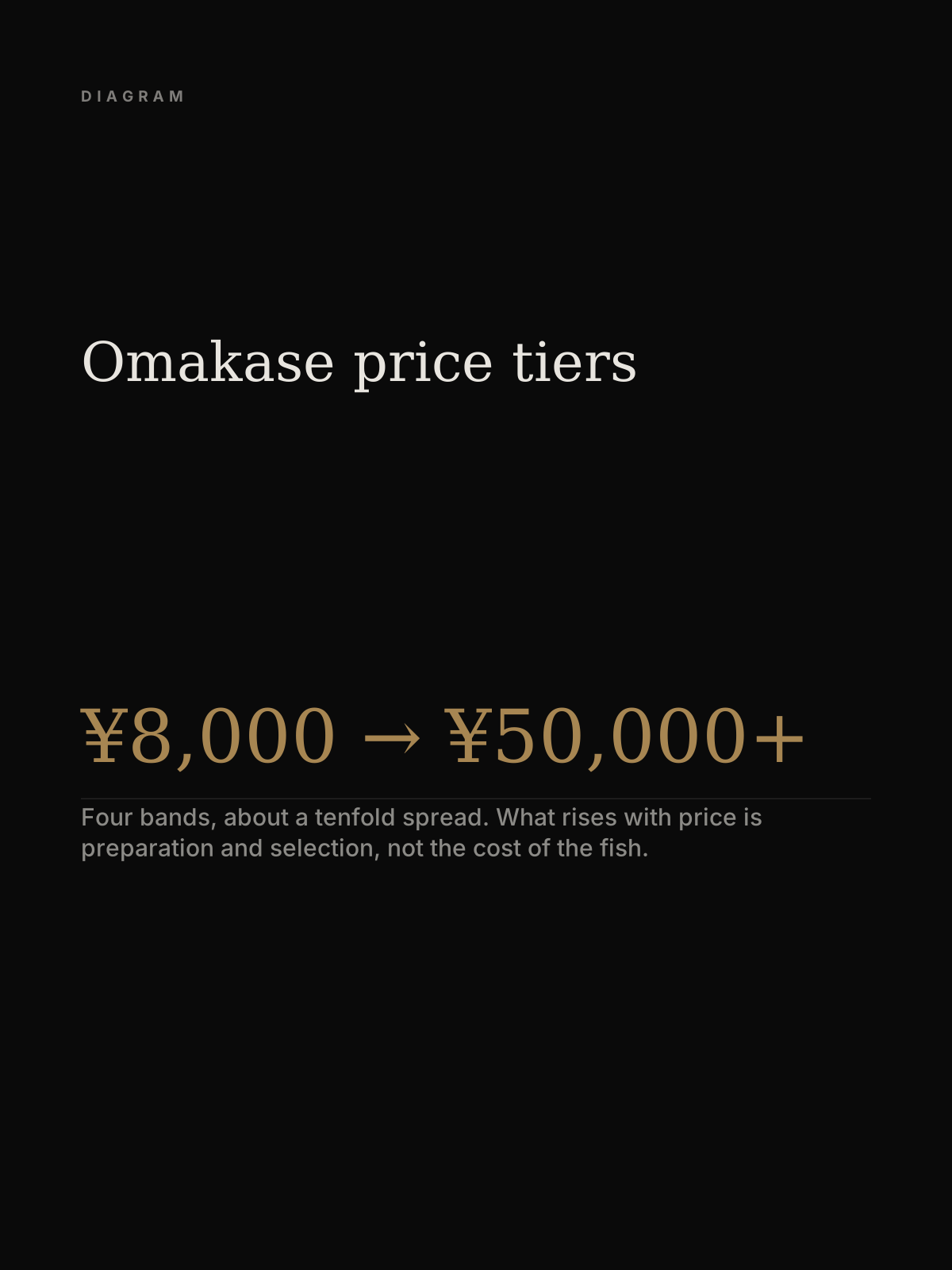
It is also the only counter here that publishes its prices in full, and the range is wider than its reputation suggests: lunch courses begin at ¥8,250 and dinner at ¥16,500, both running up to ¥44,000, with individual pieces available as well as courses. The cancellation terms are published with the same clarity — ¥5,000 a head for a same-day lunch cancellation, ¥10,000 for dinner, and charges from a week ahead for parties of ten or more and for private rooms. Read those before you book a group.
- Where. 8-7-6 Ginza, Chuo-ku.
- Booking. Telephone from 10:00, +81 3-3571-6523; or the Ikyu platform; or the shop’s linked concierge service, which handles English, Chinese and Korean.
- Hours. 11:30–14:00 and 17:00–22:00.
- Closed. Sundays and Mondays, including Mondays that fall on public holidays, plus the Obon and New Year periods.
- Price. Lunch courses ¥8,250–¥44,000; dinner courses ¥16,500–¥44,000; pieces also available individually.
- Cancellation. Same day: ¥5,000 per person at lunch, ¥10,000 at dinner. Parties of ten or more, and private rooms, are charged from one week before.
Sushi Ginza Onodera — the door you can open from a laptop
Onodera is the youngest name here by a wide margin: the company was established in July 2016. It is also the one most likely to be familiar to a reader who has never been to Tokyo, because the group put its rooms abroad early — its own corporate site lists Shanghai, Hawaii and Houston, in formats ranging from a counter to a conveyor belt.
For the purposes of this list, what matters is that the Ginza main shop takes reservations online and answers a published telephone number, and that it is open through the week rather than dark on Sundays and Mondays like the two counters above. It seats thirty-two rather than eight, across a basement and a first floor. Those two facts together — more seats, more days, an online form — make it the counter on this list a visitor is most likely to actually eat at on a given trip, which is a statement about arithmetic and not about quality.
It also runs an unusual middle service between lunch and dinner, from three in the afternoon to five, which is worth knowing if you are trying to fit a counter around a flight or a meeting. Course prices are not published on the shop’s own booking page; ask when you reserve.
- Where. Sunlit Ginza Building III, B1F and 2F, 5-14-14 Ginza, Chuo-ku.
- Booking. Online, or by telephone on +81 3-6853-8878.
- Hours. Lunch 11:00–15:00; an afternoon service 15:00–17:00; dinner 17:00–22:00, last entry 20:00.
- Closed. No regular closing day is published; the New Year period is marked as needing confirmation.
- Seats. Thirty-two in total, across two floors.
- Price. Not published on the shop’s booking page.
Ginza Sushiko Honten — the door with no website at all
Sushiko was founded in 1885, which makes it the oldest room on this list by half a century, an early founding date even by Ginza standards. It stands on Sukiyabashi-dori in Ginza 6-chome, and it has twenty-two counter seats and three tatami rooms — a plan that belongs to an older idea of what a sushi restaurant is for, when the counter and the private room served different kinds of evening.
It publishes no website of its own. This is worth stating plainly, because it changes what a visitor can rely on. The listings that do carry Sushiko do not agree with each other: one gives lunch from noon to two and dinner from five to ten, another gives a single unbroken service from 11:30 until quarter to eleven at night and says the shop never closes. We are not going to pick between them, and neither should you. Telephone the shop.
We have included Sushiko precisely because it is the awkward case. A hundred-and-forty-one-year-old restaurant that has never seen a reason to build a website is not doing anything wrong, and it is not rare in Ginza — a good number of the district’s counters are reachable only by a phone call in Japanese. If you cannot make that call, this is the point at which a hotel concierge stops being a luxury and becomes the tool for the job.
- Where. 6-3-8 Ginza, Chuo-ku, on Sukiyabashi-dori.
- Booking. Telephone, +81 3-3571-1968. The shop maintains no site of its own; a booking platform also lists it.
- Hours. Published listings disagree. Confirm by telephone.
- Founded. 1885.
- Seats. Forty in total — twenty-two at the counter, plus three tatami rooms.
- Price. One platform listing indicates roughly ¥20,000–¥30,000 at lunch and ¥30,000–¥40,000 at dinner. The shop publishes nothing itself.
The pattern behind the five doors
Put the five side by side and a shape appears that has nothing to do with cooking. The two counters that are hardest to enter — Jiro and Kanesaka — are also the two smallest, at ten and eight seats. The two that are easiest — Onodera and Kyubey — are the two largest, and both are attached to organisations with several rooms rather than one. Sushiko sits outside the pattern entirely, being large, old and unreachable except by telephone.
This is not a coincidence, and it is not gatekeeping for its own sake. A counter with eight seats and one chef cannot absorb a no-show; losing one guest is losing an eighth of the evening’s revenue and an eighth of fish that was bought that morning and will not keep. Every restriction described above — the concierge requirement, the identity check, the telephone-only rule, the age limit, the cancellation fee — is a device for making sure the seat is filled by the person who booked it. Read them that way and they stop feeling like snobbery.
The corollary is the practical advice in this whole article: the more of that risk you can absorb for the restaurant, the more doors open. Book through a channel the shop trusts. Confirm. Turn up on time with the number of people you said. Cancel early enough for the seat to be resold, and expect to pay if you do not.
If all five are full
They frequently will be, and the answer is not to keep refreshing. Ginza holds dozens of counters of real quality with no international reputation at all, and the mechanism that makes the five above hard to book — smallness, reputation, a foreign following — simply does not apply to most of them. A hotel concierge, given a budget, a date and a preference, will find one. So will lunch: several of the rooms above are materially cheaper at noon than at night, and Kyubey’s own published range spans a factor of five between its least and most expensive courses.
The other answer is to go somewhere other than Ginza. The district charges for its address, and the wholesale markets that supply it supply the rest of Tokyo too.
If you want to book one of these
Several of the counters described above answer the telephone only in Japanese, and a few of them take bookings by no other route. AutoReserve is a Japanese reservation service with an English interface, and it states that it will place the call on a diner’s behalf where a restaurant takes reservations by telephone alone. We have not tested it against every restaurant on this page, and a listing there is not a guarantee of a seat — the doors described above are the doors either way.
Frequently asked questions
Which of these five is the best?
We do not rank restaurants and this list is not ordered by quality. It is ordered by how restricted the booking is, from the most restricted to the least. A shop that is hard to enter is not thereby better than one you can book online tonight.
Can I book Sukiyabashi Jiro if I am not staying at a hotel with a concierge?
The shop’s own English page states that guests visiting from abroad can only book through the concierge of the hotel where they are staying. If your accommodation has no concierge who will place the call, there is no published alternative route.
Is there really an age limit at a Ginza sushi counter?
At one of the five, yes. Sushi Kanesaka’s Ginza main shop states on its own site that use is limited to guests aged thirty and over. This is unusual rather than typical; none of the other four publishes an age condition.
Do any of these take walk-ins?
None of the five publishes a walk-in policy, and at eight to forty seats with fixed sittings you should assume the answer is no. Ginza has stand-up and conveyor-belt sushi that does take walk-ins, but it is a different kind of meal.
Why do the opening hours here differ from what I found elsewhere?
Because we took them from each shop’s own published information on 2 August 2026 and from nothing else. Aggregator listings for these restaurants contradicted the shops’ own pages on closing days and service times, and in the case of Ginza Sushiko — which publishes no site — two listings contradicted each other. Confirm by telephone before you travel.