In Ginza the question was where to look, and the answer was the shop’s own page. In Shinjuku it was which of the shop’s pages to look at, because two of them disagreed. In Shibuya it was who had written the page at all. In Roppongi it was when it had been written. In Nihonbashi it was who else was publishing about the same shop. In Asakusa it was what language the answer was in, and what shape it took. In Ueno it was what the name on the page actually pointed to. Between Ebisu and Nakameguro it was where a reservation landed and what it committed you to. In Akasaka the question is narrower than any of those and more likely to matter on the night. All five of these shops print a price. What the printed number covers is not the same at any two of them.
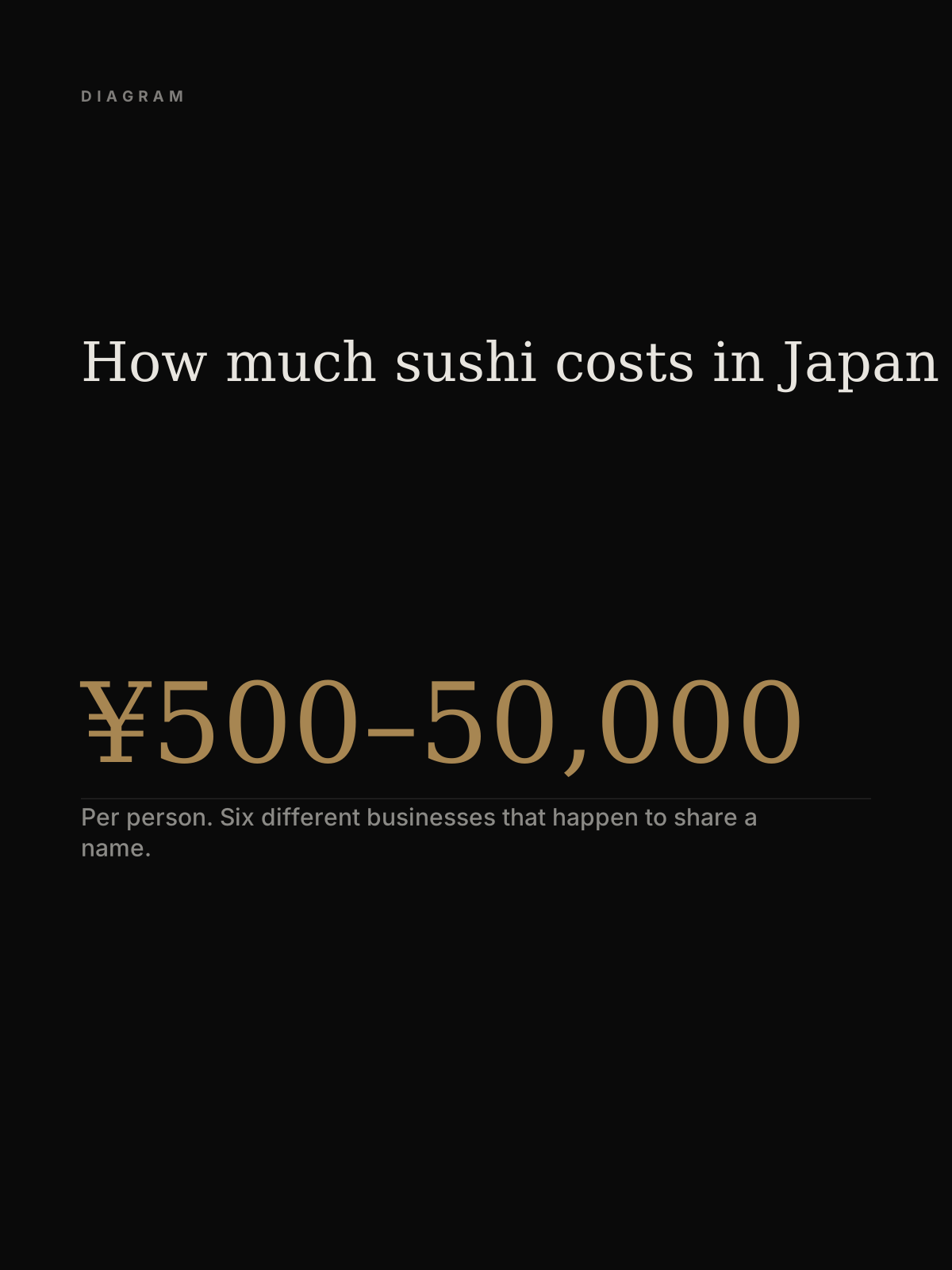
Every one of the five states its figures in yen on a page of its own, and four of the five say plainly whether the tax is inside. That is where the agreement stops. At the first, the number is a floor: a tilde after it, and no upper figure anywhere on the site. At the second, the page headed Course carries no prices at all, and the room you sit in costs a thousand yen a head on top of whatever you eat in it. At the third there is one figure, tax and service both stated to be included, with a line three rows below it asking you to check the price of each course somewhere else. At the fourth, the same website carries four different rules about what a number means, depending on whether you are eating, drinking, sending out for delivery or sending for a chef. At the fifth, the cancellation percentages and the shop’s invoice registration number are printed in the same table as the opening hours. They are set out below in that order: by how much the printed number is already carrying.
How this was put together
Everything below was read on 5 August 2026, from pages the shops publish themselves. No listing site, no review service and no booking platform is quoted for a fact, even where one of them carries a figure a shop leaves out; a price borrowed from a booking service is a fact about the booking service. One of these five sites is assembled by the browser after it arrives rather than sent complete, so for that one we rendered the pages and read what a visitor sees. Where a note about tax or service appeared on one page of a site, we searched the rest of that site before describing it — at one shop here, the food page and the drink page say opposite things.
Where a shop publishes no price, no service charge or no cancellation term, the line is left empty rather than filled in from somewhere else, and four of the five publish no cancellation terms at all. Where a shop’s own pages disagree with each other, both versions are printed as we found them. There is no ranking here, and none of it is about whether a price is high or low.
Akasaka Sushi Shino — the number is a floor
Third floor of a building near Tameike-sanno: three minutes on foot, says the front page; five, says the map page on the same site. Nine seats at the counter on the front page, and about eight in the booking note further down it. Dinner every day but Sunday, and on Sunday a lunch of exactly one hour, 12:00 to 13:00, which the shop says began in July 2025.
The price is on the course page and the tax is stated to be inside it: 23,000 yen a head for the evening, 9,900 yen a head at the Sunday lunch, both marked tax included. Both figures also carry a tilde. In Japanese menu writing that mark means from, and what it does not say is where the figure stops. There is no upper number anywhere on the site, no second and dearer course to bracket it, and no mention of a service charge in either language.
What is added to the meal is mostly published, and carefully: draught beer 900, bottled 800, alcohol-free 600; six sake by the go from 1,200 to 3,000; four shochu from 900 to 1,500; three whiskies at 1,000, 1,200 and 1,500; plum wine 700, lemon sour 1,000, soft drinks from 400. One heading on that page has no figures under it at all — six wines from a single estate, listed by name and vintage, half bottle and full, with no price beside any of them. The navigation offers a page headed Wine, and it opens on a heading, two links back to the other menus, and nothing else. The English page is the other absence: the chef’s training at two named Tokyo shops, an account of the sushi, and not one number on it.
- Where. FUN·ART AKASAKA 3F, 2-18-5 Akasaka, Minato-ku. The front page says three minutes on foot from Tameike-sanno and the map page says five; both are the shop’s own text.
- Booking. A booking system in Japanese, a different reservation service in English, or the telephone on 03-6230-8902. Parties of six or more are asked to ring. No cancellation terms are published.
- Hours. Dinner 18:00–22:30, Monday to Saturday. On Sundays there is also lunch, 12:00–13:00, which the shop says began in July 2025.
- Closed. No fixed day.
- Price. Dinner from ¥23,000 a head, tax included; Sunday lunch from ¥9,900, tax included. Both are written with a tilde and no upper figure is published. No service charge is mentioned anywhere.
- Seats. Nine at the counter on the front page; about eight in the booking note lower down the same page.
Sushi Akasaka Kazu — the prices are not on the page marked Course
One minute from exits 6 and 7 at Akasaka: seventeen seats, an L-shaped counter and one private room, and a small charcoal grill set on the counter and lit for each order. The menu section of the site has three tabs across the top — Course, Food, Drinks. Open the first and there is a heading and then nothing under it. Open the third and there is a heading and then nothing under it. Everything is on the second.
On that page the figures are plain enough, beneath a line saying the prices are tax included: two omakase courses at 16,500 and 19,800, two sushi courses named after the district and the ward at 8,800 and 11,000, two small-plate sets at 5,500, and ordering piece by piece at the day’s rate. A reader who went looking under the word Course would have found none of it.
There is one more figure and it is not on the menu at all. In the shop information table on the access page, directly below the row saying there is a private room for two, four, six or eight, a note reads: a private-room charge of 1,000 yen per person applies. The tax-included course price does not include the room. Two other rows in that table are worth noting once and no further. The average-spend row gives a lunchtime band of 2,000 to 2,999 yen, while the opening hours in the same table begin at 17:30 and no lunch service is published anywhere on the site. And those hours end at midnight, while a separate page on the same site says the shop stays open until two in the morning.
- Where. Minoya Building 2F, 6-4-21 Akasaka, Minato-ku. One minute from exits 6 and 7 at Akasaka station.
- Booking. One route: a booking form on a listing service, reached from every reserve button on the site, or the telephone on 03-6459-1869. No cancellation terms are published.
- Hours. 17:30–00:00 in the shop information table. A separate page on the same site says the shop is open until two in the morning.
- Closed. Sundays, Mondays that fall on public holidays, and some Saturdays.
- Price. Omakase ¥16,500 and ¥19,800; sushi courses ¥8,800 and ¥11,000; small plates ¥5,500; piece by piece at the day’s rate. Tax included. A private room is ¥1,000 per person on top. The page headed Course carries no prices at all.
- Seats. 17, and up to 25 when the room is used standing.
Edomaesushi Hanabusa — one figure, and the line beneath it
Eight seats on the ground floor of a hotel building, seven minutes on foot from Akasaka station and eight from Roppongi. The chef trained for twenty-three years at a shop founded in the Bunka years of the late Edo period, under its fourth and fifth masters, and opened this one in March 2015. The site says all of that in five languages — Japanese, English, simplified and traditional Chinese, Korean — each of them the shop’s own text rather than a translation widget. Closed Saturdays; 17:00 to 22:00, last orders 20:30; smart casual.
The menu page carries the clearest single number in this article: omakase nigiri course, 36,300 yen, tax and service charge included. It is the only figure among these five shops that names a service charge in order to say that it is already inside. The English page prints the same line and the same figure, in the same place on the page.
Three rows below it, on both pages, comes a second line: please check the price of each course on the booking site. Nothing on the page reconciles the two. It may be that other courses exist and are not listed; it may be that the figure moves. What a reader can take from the shop’s own page is that one course has a price, that the price is stated to include both the tax and the service, and that the same page asks them to confirm prices elsewhere. The two sentences sit three rows apart and both of them are the shop’s.
- Where. Akasaka Residential Hotel 1F, 9-1-7 Akasaka, Minato-ku. Seven minutes on foot from Akasaka station, eight from Roppongi.
- Booking. Online. The Japanese page offers one reservation service; the English page offers that one and a second. The shop’s number is 03-3478-1010. No cancellation terms are published.
- Hours. 17:00–22:00, last orders 20:30.
- Closed. Saturdays, with a note that the shop may open or close at short notice.
- Price. ¥36,300 for the omakase, stated as including both the tax and the service charge. Three rows below the figure, the same page asks you to check each course price on the booking site.
- Seats. 8. The shop can be taken privately.
Akasaka Sushi Ito — four rules on one website
Three minutes from Akasaka station on the Chiyoda line: nine seats at the counter, two pairs of seats behind it, private rooms for four, six and ten, and an annex with a twelve-seat tatami room. Lunch on weekdays, dinner every day but Sunday, and a business that reaches well past the counter — catering, a chef sent to your house, delivery. The menu page carries its own revision date, 7 May 2025, which almost no page in this series does.
On that page, under the food, the note reads: the prices shown are the total, including the service charge and the consumption tax. It is the plainest sentence of its kind in this article. Then open the drink list, which is the one part of this site written out in both Japanese and English, and the first line of it reads: ten per cent service charge and ten per cent consumption tax will be added to the prices shown. The English line says the same as the Japanese one. Neither page mentions the other.
Two more rules follow from the same site. Catering starts at 100,000 yen and a chef sent to your house at 108,000, and both are quoted before tax and service, with staff and travel charged separately from 15,000 and 16,200. Delivery starts at 3,300 yen with eight per cent tax added — eight, where the chef sent to your house is quoted at ten. In the other direction, the lunch figures carry more than any other price here: every lunch dish, the shop says, comes with a glass of white wine, a small dish, something grilled, chawanmushi, dessert and coffee, and that holds for the 4,500 yen platter as much as for the 8,500 one. At the counter you may order piece by piece, arranged, the page says, in steps of 1,200 yen. A private room with a chef assigned to your table alone is 26,000. The tatami room in the annex is priced partly by the number of guests, and by how much is not said. Two smaller things belong here and go no further: the minimum age is given as twelve on the menu page and ten in the footer of every page, and last orders are 21:00 on the menu and 21:30 on the access page.
- Where. Sun Valley Akasaka 1F, 6-6-29 Akasaka, Minato-ku. Three minutes on foot from Akasaka station on the Chiyoda line.
- Booking. A booking system, or the telephone on 03-3224-1464, which is also the fax number. Groups may book outside the published hours. No cancellation terms are published.
- Hours. 11:30–14:00 and 17:00–22:00 Monday to Friday; 17:00–22:00 on Saturdays and public holidays. Last orders are 21:00 on the menu page and 21:30 on the access page.
- Closed. Sundays, and Mondays that fall on public holidays.
- Price. Lunch ¥4,500 to ¥8,500, with lunch kaiseki at ¥11,500 and ¥16,500 and a counter selection at ¥10,000. Dinner ¥16,500, ¥19,500 and ¥23,000, or ¥26,000 in a private room with a chef to your table alone. Food prices are stated to include service and tax; the drink list states that ten per cent service and ten per cent tax are added.
- Seats. Nine at the counter, two pairs of seats behind it, private rooms for four, six and ten, and an annex with a twelve-seat tatami room and a room for four.
One page on this website says the figure includes the service charge and the tax. Another says ten per cent service and ten per cent tax are added to it. Both pages belong to the same shop.
Akasaka Sushi Furuyama — the whole bill, before you sit down
Five minutes from Tameike-sanno, five from Roppongi-itchome, seven from Akasaka: a small counter-only room opened in March 2020 by a chef born in a fishing town in Fukushima, who spent twenty-six years in Tokyo shops before it. The seat count is not published. What the shop publishes instead is why some of its rules exist — the master works alone, which is why it asks you to telephone if you are going to be late, and the room is small enough that a strong scent is a problem for the person beside you.
The prices are on the menu page under a line saying that every price shown includes tax, and no service charge is mentioned anywhere on the site. Lunch, by reservation made the day before: 5,500 yen for ten pieces and a bowl, or 8,800 for three small plates and seven pieces — and that second figure has two drinks inside it, which the shop states in the same line. Dinner is 19,800, with a second omakase at 16,500. In the other direction, the evening drinks are the least specified of the five: about six sake at any one time, the page says, without names or prices, and the wine and the two whiskies it names by name carry no figures either.
The rest is in the shop information table at the foot of the front page, in among the rows for credit cards and electronic money. The shop asks for cancellations three days before the visit; the day before is 80 per cent of the course price and the day itself is 100. And the last row of that table is the shop’s invoice registration number, T-1810067960373 — the number a Japanese company needs from a supplier in order to reclaim the consumption tax on a bill, which in a district where a good many dinners are settled by somebody who was not at the table is a practical thing to put on a website. It is the only one of the five to print either that or a cancellation term. The same table appears on the shop information page as well, and there it stops after the payment rows: no cancellation policy, no registration number. The front page is the complete one.
- Where. Bill Goute Akasaka 1F, 2-18-12 Akasaka, Minato-ku. Five minutes from Tameike-sanno exit 12, five from Roppongi-itchome exit 3, seven from Akasaka exit 5a.
- Booking. A booking form on a listing service, or the telephone on 03-6887-0181. Lunch is taken only by reservation made the day before. Cancellation: three days’ notice asked, 80 per cent the day before, 100 per cent on the day.
- Hours. Lunch 12:00–14:00, booked by the day before. Dinner 18:00–22:00, last orders 21:30.
- Closed. No fixed day.
- Price. Lunch ¥5,500, or ¥8,800 for a course that includes two drinks. Dinner ¥19,800, with a second omakase at ¥16,500. All prices are stated to include tax, and no service charge is mentioned anywhere on the site.
- Seats. Not published. The shop calls itself a small counter-only room and says parties of seven or eight can take it privately.
What the five have in common
All five print a figure, and none of them is being evasive. The tilde on the first shop’s price is ordinary menu writing. The empty tab on the second is a container the site never filled. The fourth shop’s four rules are four accurate sentences about four different kinds of business, each written where that business is described. What differs is how much of the evening the number has already absorbed. At one end is a figure with the tax inside it and nothing written above it. At the other is a lunch price with a glass of wine and a cup of coffee inside it, sitting on a site where the drink list adds a fifth of itself to whatever you order beside it. In between is a course price that does not include the room you are sitting in.
Three of the five mention no service charge at all, and a reader cannot tell from that whether there is none or whether it has simply not been written down. Four publish no cancellation terms. The practical consequence is small and it is the same everywhere. A price on a shop’s page answers one question — what this course costs — and the bill answers a wider one. The distance between them is the tax, the service, the room, the drinks, and, if you do not come, the percentage. Every one of those five is published by at least one shop here. None of the five publishes all of them. The one that comes closest prints them in the same table as its opening hours.
Reading a price in about a minute
- Read the word next to the figure, not just the figure. Tax included and tax not included are two different prices, and a tilde — or the word from — means the number is a floor with nothing written above it. All three appear on these five sites.
- Open the drink list separately. Two of these shops treat food and drink differently, and one of them states opposite rules about service and tax on two pages of its own site. The line at the top of a drink list is usually where that difference is written.
- Ask what the seat costs. A private-room charge, a cover charge, a corkage and a minimum all sit outside the course price. One shop here charges 1,000 yen per person for the room and prints it in a table of station exits and payment methods rather than on the menu.
- Look for a percentage and a date. Cancellation terms are the part of a booking that costs money, and one of these five publishes them. Where nothing has been written, that is not a promise that nothing will be charged; it means the terms were not published, and it is worth asking.
- Note the date on which you read it. Every figure in this article is what the shops published on 5 August 2026, and one of these menu pages carries its own revision date of 7 May 2025. Most pages never say when they last moved.
That is the last of these Tokyo districts for now. Read together, the questions they raised are one question asked nine ways — not what a shop is like, but what its own page is actually saying. Where to look; which of its pages; who wrote it; when; who else is publishing about it; in what language; what the name points to; where a booking lands; and, in Akasaka, what the number covers. Each of them takes about a minute, and every answer in the series came from the shops themselves.
If you want to book one of these
Several of the counters described above answer the telephone only in Japanese, and a few of them take bookings by no other route. AutoReserve is a Japanese reservation service with an English interface, and it states that it will place the call on a diner’s behalf where a restaurant takes reservations by telephone alone. We have not tested it against every restaurant on this page, and a listing there is not a guarantee of a seat — the doors described above are the doors either way.
Frequently asked questions
Are the prices on these five sites tax-included?
Four of the five say so in as many words. Shino prints tax included beside both its figures; Kazu heads its price list with a tax-included line; Hanabusa states that the tax and the service charge are both inside its figure; Furuyama says every price shown includes tax. Ito is the exception, and only in part — its food prices are stated to include both the service charge and the tax, while its drink list states that ten per cent service and ten per cent tax are added to the figures shown. Both of those statements are on its own site.
Which of them publishes a service charge?
Two. Hanabusa names one in order to say that it is already inside the ¥36,300. Ito names one twice over: as included on the food menu, and as ten per cent added on the drink list, with catering and out-of-house work quoted before service entirely. Shino, Kazu and Furuyama do not mention a service charge anywhere on their sites. That is not the same as saying there is none; it means it is not published, and it is a fair thing to ask when you book.
Can I book these without Japanese?
Hanabusa is the only one of the five with a full site of its own in English, and its English page carries the price, the house rules and two booking routes. Shino has a single English page written by hand, with the chef’s history and no prices at all, and it sends English readers to an English-language reservation service. Kazu, Ito and Furuyama publish in Japanese: two of them carry a translation widget, Furuyama’s language links lead to machine-translated copies of its own pages, and Ito’s drink list alone is fully bilingual. Beyond that, none of the three has English text of its own.
What do these shops charge if I cancel?
One of the five publishes terms. Furuyama asks for three days’ notice and states 80 per cent of the course price the day before and 100 per cent on the day, in the shop information table on its front page. Shino, Kazu, Hanabusa and Ito publish none on their own pages. Where a booking is made through a reservation service, that service will have terms of its own; those are the service’s terms rather than the shop’s, and they are not quoted here.
Is there a lunch at any of them?
Three, in three different shapes. Shino serves lunch on Sundays only, 12:00 to 13:00, from ¥9,900. Ito serves lunch on weekdays from 11:30, and every lunch dish comes with a glass of white wine, a small dish, something grilled, chawanmushi, dessert and coffee. Furuyama serves lunch 12:00 to 14:00 and takes bookings for it only up to the day before. Kazu’s shop information table gives an average lunchtime spend, but the hours in that same table begin at 17:30 and no lunch is published. Hanabusa opens at 17:00.