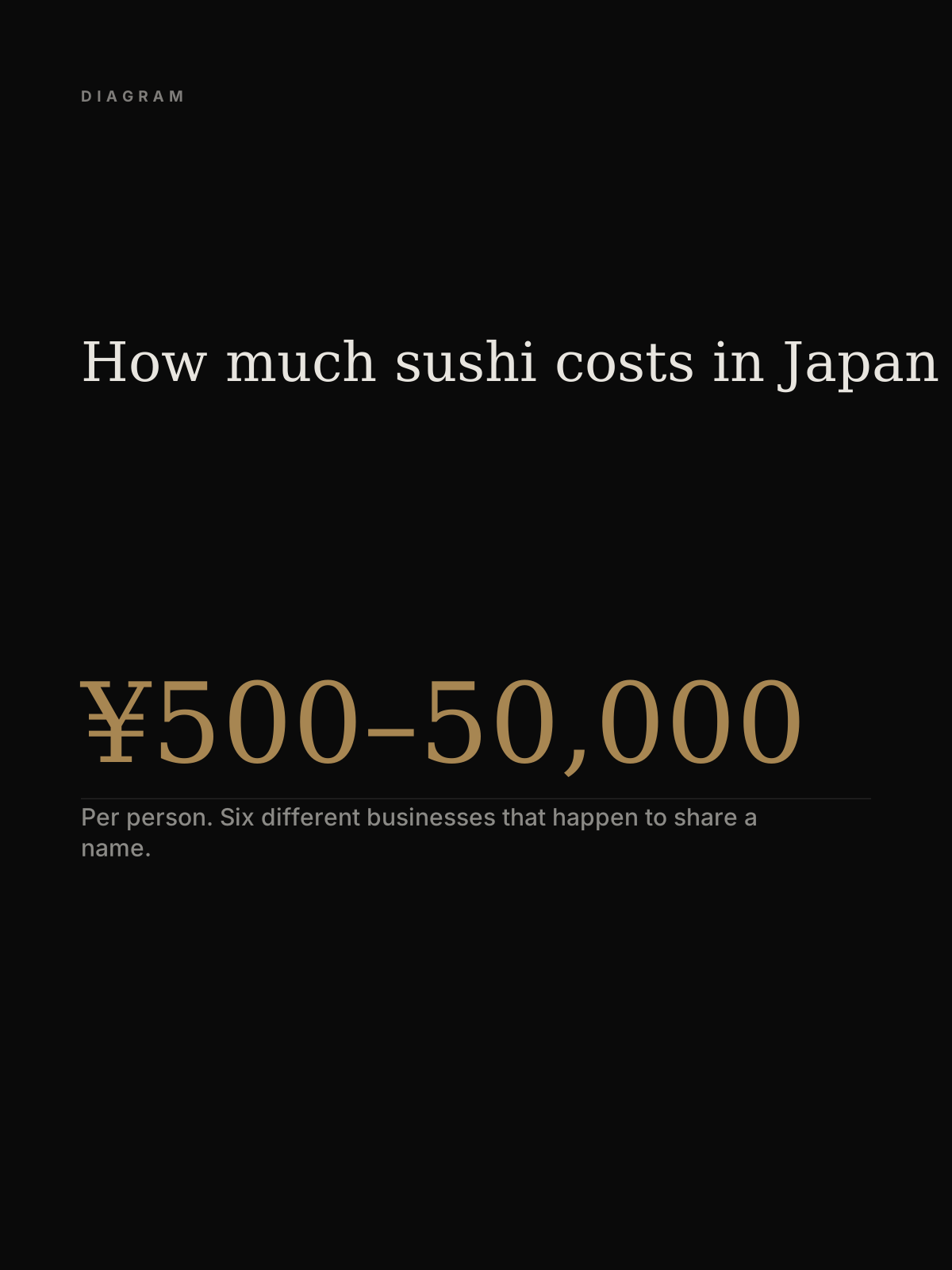
In Ginza, the difficulty is getting a seat. In Shinjuku, it is finding out what the seat costs. The counters here publish far more than Ginza’s do — prices, hours, full menus, photographs of the room — and the more a shop publishes, the more places there are for two of its own pages to disagree.
We took five sushi counters in Shinjuku and arranged them by how much of the price you can know before you sit down: from the shop that publishes none of it to the one that publishes every course with the tax included. It is not a ranking. Four of the five contradict themselves somewhere, and we have printed the contradiction rather than picked a side.
Uogashi Nihon-ichi, Shinjuku West Exit — the published price is not the counter price
This is a standing counter on the ground floor of a building in Nishi-Shinjuku 1-chome, run by Nippan, the company behind the Uogashi Nihon-ichi chain, which maintains a site in English as well as Japanese. It is the one shop of the five you cannot book: the operator’s page says so in a single line, because standing counters do not take reservations.
It is also the one shop of the five that publishes no price for what you would eat there. Search for it and figures appear — ¥1,400 at the bottom, ¥15,000 at the top — and they are real prices on a real site belonging to the same group. They are the prices of takeaway sushi platters on the chain’s ordering service. Nothing on any page tells you what a piece costs at the counter you would be standing at.
The hours carry a smaller version of the same problem. The operating company’s own page closes the shop at ten on Sundays and public holidays. The structured data behind the group’s branch listing closes it at half past nine. Both belong to the operator; neither is a stranger’s guess.
- Where. Kasai Building 1F, 1-12-12 Nishi-Shinjuku, Shinjuku-ku. Neither a walking time nor a nearest exit is published.
- Booking. None. The operator states plainly that the shop takes no reservations because it is a standing counter.
- Hours. 11:00 to 23:00 Monday to Friday; 11:00 to 22:00 Saturdays, Sundays and public holidays, per the operating company. The group’s branch listing gives 21:30 as the Sunday close.
- Closed. Not published.
- Price. Not published for the counter. The ¥1,400 to ¥15,000 range that appears online is for takeaway platters on the group’s ordering service, not for what is served standing up.
- Seats. Standing. No count published.
Sushi Iwase — one price, two tax treatments, on the same website
Iwase is a ten-seat counter in Nishi-Shinjuku, seven minutes on foot from the Keio New Line concourse, open for lunch and again from four in the afternoon. Ten seats is the whole shop; the site does not break the number into counter and tables because there is nothing to break.
Its evening omakase is ¥25,000. The header of the shop’s own site prints that figure with tax excluded. The menu section of the same site prints the same figure with tax included. On a ¥25,000 course the difference is ¥2,500, which is not a rounding error, and there is no third page to break the tie.
The same thing happens again one click further out. The shop asks ¥26,000 a head to hold a seat and calls it tax-inclusive; the Gurunavi page it links to for that booking calls the same ¥26,000 tax-exclusive. Both pages are reachable from the shop’s own navigation. Neither is wrong about the number. A third disagreement is about days rather than money: the shop-information panel opens for lunch on Wednesdays and Saturdays, while the line under the front-page headline offers lunch on Wednesdays only.
- Where. 3-4-1 Nishi-Shinjuku, Shinjuku-ku — seven minutes from Shinjuku station by the Keio New Line, or from exit 6 of the Toei Shinjuku Line.
- Booking. Telephone, +81 50-5486-9676. A seat reservation is quoted at ¥26,000 a head.
- Hours. Lunch 12:00 to 14:30 — on Wednesdays and Saturdays per the shop-information panel, on Wednesdays only per the front page. Dinner 16:00 to 23:00, last orders 22:30.
- Closed. Mondays, and the first, third, fourth and fifth Sundays of the month. The second Sunday is a trading day.
- Price. Lunch nigiri from ¥15,000; evening omakase from ¥25,000 — printed as tax-exclusive in the site header and tax-inclusive in the menu.
- Seats. Ten.
Shinjuku Sakaezushi — where the English page and the Japanese page disagree
Sakaezushi runs two large rooms in Shinjuku, one near exit B2 at Shinjuku-sanchome and one two minutes from the west exit, and maintains a site in Japanese and English on its own domain. Eighty-six seats at the main shop and a hundred and eighty-four at the west-exit branch make it the largest operation in this list by a wide margin, and the only one of the five to publish prices by the piece.
Read both language versions and three facts move. The Japanese page dates the founding to 1928; the English page says 1935. Both agree the company was incorporated in January 1950. The Japanese page closes the west-exit branch at ten in the evening with last orders at half past nine; the English page keeps it open until eleven with last orders at half past ten. And the Japanese page offers a private room at each branch — a partitioned room for four in the basement at the main shop, and one for parties from six at the west exit — while the English page prints, for both branches:
Private room: None
A fourth number sits on the front page in both languages: nigiri from ¥110 a piece. The current menu has no item at that price. The ¥110 line is still in the page source, commented out and no longer displayed, and the cheapest piece now listed is ¥165. The advertisement outlived the thing it advertised.
Beneath the main shop there is a third room, Hanare, open Thursday to Saturday evenings, with eight seats at the counter and two tables. It is the only part of the business that takes an online booking, and the only part with no English page at all.
- Where. Main shop, 3-6-2 Shinjuku, Shinjuku-ku, by exit B2 of Shinjuku-sanchome; west-exit branch, 1-18-16 Nishi-Shinjuku, two minutes from the station.
- Booking. Telephone, +81 3-3351-2525 for the main shop and +81 3-3340-2525 for the west exit. Hanare, the basement room, books online through TableCheck.
- Hours. Main shop 11:30 to 22:00, last orders 21:30; 11:30 to 21:30 on Sundays and holidays. The west-exit branch closes at 22:00 on the Japanese page and at 23:00 on the English one.
- Closed. 31 December to 3 January.
- Price. Weekday lunch sets from ¥980 at the main shop and ¥1,100 at the west exit. Evening assortments run ¥1,100 to ¥11,000, depending on how many people they are cut for. The front page still advertises ¥110 a piece; the cheapest piece on the menu is ¥165.
- Seats. Eighty-six at the main shop, a hundred and eighty-four at the west-exit branch, and eight at the counter downstairs plus two tables.
Hina-zushi, Shinjuku i-Land Tower — a price with a clock attached
Hina-zushi occupies a basement under an office tower in Nishi-Shinjuku and sells one thing above all others: an all-you-can-eat course of what it calls high-grade sushi, ¥5,489 for men and ¥5,159 for women, tax included. The price is published in full, and so is everything attached to it — two hours at the table, last orders after ninety minutes, a maximum of twenty pieces per order with unlimited re-ordering, a charge for anything left uneaten, a minimum of two people, and everyone at the table on the same course.
That is more disclosure than any other shop here manages. And yet the summary field at the top of the shop’s own page gives an average budget of ¥2,500 at lunch and ¥4,300 in the evening — figures that belong to a different way of eating there, and the ones a reader skimming for a price will carry away.
Since 24 July 2026 the shop has published a Muslim-friendly policy: seasonings certified halal by a third party, no pork or pork derivatives, no cooking alcohol, and the tatami room offered as a prayer space with a mat and a qibla compass, the policy posted in the room in Japanese and English. The same notice states that cookware and tableware are shared with the regular menu. Both halves are the shop’s own words, and a reader who needs the first half needs the second.
- Where. Shinjuku i-Land Tower B1F, 6-5-1 Nishi-Shinjuku, Shinjuku-ku. The Japanese page gives one station — Nishi-Shinjuku on the Marunouchi line, one minute — and the English page gives three.
- Booking. Telephone, +81 3-5323-2380, or online through ebica, linked from the shop’s own navigation. The all-you-can-eat course takes a minimum of two people.
- Hours. Weekdays 11:30 to 15:00 and 17:00 to 23:00; Saturdays 11:00 to 15:00 and 17:00 to 22:30; Sundays 11:00 to 15:00 and 17:00 to 21:30. Last orders half an hour before each close.
- Closed. The new year period, dates not specified. Third-party listings add a February closing day that the shop’s own page does not.
- Price. All-you-can-eat ¥5,489 for men and ¥5,159 for women, tax included, two hours. Children ¥3,069 from six to the end of primary school, ¥1,639 from four, free below four.
- Seats. A hundred and twenty-two, including a tatami room for up to forty-eight.
Shinjuku Sushi Yokota — every course priced, and no way to book on the shop’s own site
Yokota is a basement counter off Shinjuku-dori that serves sushi and tempura together as a set course, and it publishes the price of every one of them, tax included: three at lunch from ¥5,800 to ¥11,000, four in the evening from ¥9,800 to ¥25,000. Nothing is qualified with a ‘from’. Of the five, this is the shop whose bill you can predict most closely before you go.
What it does not have is a way to take your booking. The reservation button on the shop’s own site opens a Tabelog course page; there is no form of its own. And the JP|EN switch in the footer is a Google translation widget rather than an English page the shop wrote — worth knowing before you rely on it for a dietary request.
Its evening close is the one number here where an outside site disagrees with the shop rather than the shop with itself. The shop and Tabelog both say eleven; Ikyu says midnight. There is also a restaurant in the same group called Shinjuku Bettei, which is a different shop at a different address.
- Where. FS Building B1F, 3-20-6 Shinjuku, Shinjuku-ku — five minutes from Shinjuku station. The shop does not name an exit.
- Booking. Telephone, +81 3-6384-2538. The shop’s own booking link opens a Tabelog course page; there is no reservation form on its site. Cancellation is charged at the full course price on the day and at half the day before.
- Hours. Lunch 11:30 to 15:00; dinner 17:00 to 23:00, Sundays included. No last-order time published.
- Closed. Irregular.
- Price. Lunch ¥5,800, ¥8,800 and ¥11,000. Dinner ¥9,800, ¥13,800, ¥17,800 and ¥25,000. All tax included.
- Seats. Not published. A counter, plus private rooms seating two and four.
The pattern behind the five
In Ginza we found that the shop’s own page was the one to trust, because the aggregators were copying each other and the shop was not. Shinjuku is where that rule needs a second clause. Every contradiction above is between two pages belonging to the same business.
They fall into four kinds, and the kinds matter more than the shops do. A price published for one thing and read as the price of another — the takeaway platter, the average-budget field. A price published twice with different tax treatment — Iwase’s ¥25,000, and then its ¥26,000. A page in one language that has drifted from the page in another — Sakaezushi’s founding year, closing time and private rooms. And an advertisement that outlived what it advertised — ¥110 a piece.
None of these five is hiding anything. Four of them are simply maintaining more pages than they are updating.
That is the ordinary condition of a restaurant with a website, a menu, an English version, listings on two platforms and an ordering service. It is not a moral failing and it does not make the food worse. It does mean that ‘check the shop’s own page’ is incomplete advice in a district like this one.
Which page to believe
When two pages of the same shop disagree, four rules got us through all five of the counters above.
- Prefer the page that has to be right today. A menu page is repriced when prices change; a header, a front-page banner and a summary field are not.
- Read the tax twice. If a figure appears in two places on one site, check whether both say the same thing about consumption tax before assuming they say the same thing about money.
- Treat a translated page as a copy, not a second source. Where English and Japanese differ, the Japanese page is the one the shop revises first — and a machine-translated toggle is not an English page at all.
- Ask what the price is for. The cheapest number a shop publishes is often for something other than sitting at its counter: a takeaway platter, a weekday-only set, an average, a child.
None of that needs Japanese beyond the numerals. It needs knowing that a restaurant’s website is not one document.
If all five are full
Shinjuku is not short of counters. It is short of counters that publish enough for us to write about them honestly. Of the twelve we looked at, five publish no numeric price on their own pages at all, and one has a certificate error on its own domain that makes it unreachable in a current browser. Those are not in the list above, and their absence is a fact about disclosure rather than about quality.
If you want the district’s simplest answer, the standing counter takes no booking and stays open until eleven on weekdays, so you can turn up on the way to a train. If you want the most predictable bill, Yokota publishes it in full. And if you want the smallest room, the basement at Sakaezushi is the only part of that business you can book online — in Japanese.
If you want to book one of these
Several of the counters described above answer the telephone only in Japanese, and a few of them take bookings by no other route. AutoReserve is a Japanese reservation service with an English interface, and it states that it will place the call on a diner’s behalf where a restaurant takes reservations by telephone alone. We have not tested it against every restaurant on this page, and a listing there is not a guarantee of a seat — the doors described above are the doors either way.
Frequently asked questions
Which of these five is the best?
We do not rank restaurants, and this list is not ordered by quality. It is ordered by how much of the price a shop publishes before you sit down, from none of it to all of it. A shop that publishes a full price list is not thereby better than one that publishes nothing.
Why does a shop's own website give two different prices for the same course?
Most often because one figure is quoted with consumption tax and the other without, and the two live on pages that are updated at different times — a header or a banner against a menu. Sushi Iwase prints ¥25,000 both ways on its own site. Where that happens we print both and say which page each came from.
Is the ¥110 a piece advertised by Shinjuku Sakaezushi still available?
Not on the menu we read on 4 August 2026. The line remains on the front page in Japanese and English, but the item is commented out of the current menu and the cheapest piece listed is ¥165.
Can I book any of these five in English?
Shinjuku Sakaezushi and Hina-zushi maintain English pages of their own; Hina-zushi also books online through ebica. Yokota's JP|EN switch is a Google translation widget, not an English page the shop wrote. Uogashi Nihon-ichi takes no bookings at all, in any language.
Is Hina-zushi halal?
The shop publishes a Muslim-friendly policy dated 24 July 2026: third-party certified halal seasonings, no pork or pork derivatives, no cooking alcohol, and a prayer space with a mat and a qibla compass. The same notice states that cookware and tableware are shared with the regular menu. The shop does not claim certification of the restaurant itself, and neither do we.