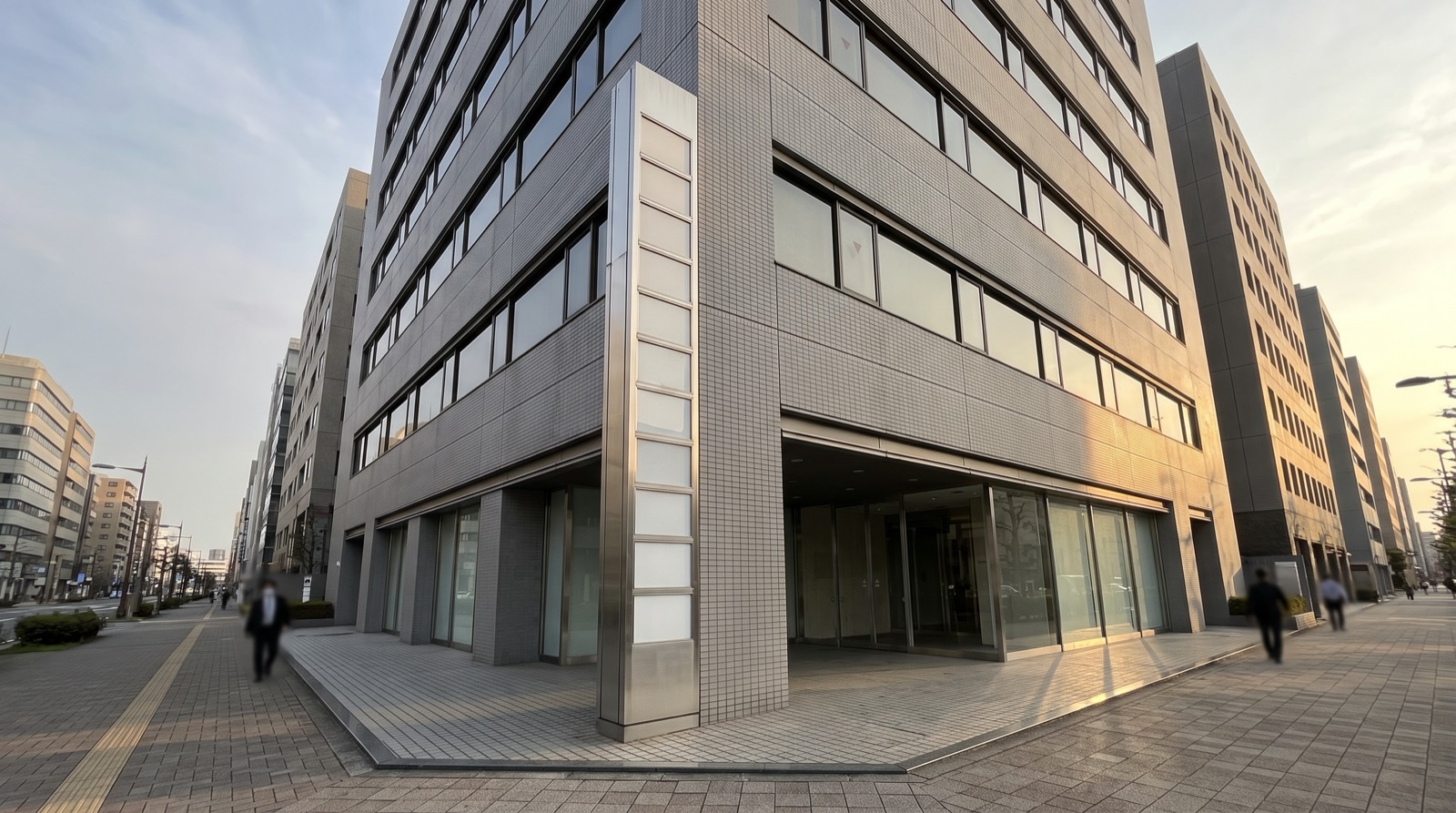
Tokyo carried this series through nine districts and Osaka through four more, each one testing a different question against a shop’s own page; none of those thirteen questions travels with it into Kyoto, which opens its own chain here. The first Kyoto round, in Kawaramachi, found that a shop’s own pages were themselves the unstable count — a street where some counters published none bearing their own name, one published two that disagreed with each other, and every number between nought and two sat within a few hundred metres of the next. Karasuma is the next stop north-west along the same subway line, and the count stops moving. Ask the same question of any of its five sushi counters — does this shop have a page on a domain built for itself alone — and the answer is no, five times running. That is not a story about disagreement. Disagreement needs at least two claims made about one fact, and on this stretch of Karasuma there is at least one counter that makes no claim of its own at all.
Every one of the five keeps some page that is unmistakably about it — an address, a phone number, a price, a photograph of a counter. What none of the five keeps is a domain built to be read as that shop and nothing else. Two addresses for Sushidokoro Susabiyu Kyoto Karasuma, matched down to the block number, sit on two different domains: one styled like a chain’s own site, its footer crediting only a company called initiate; the other a subdomain of a site-building service, Gurunavi’s GORP, carrying a different phone number and a different starting price. Uoya Sushishin has eight seats of its own inside a thirty-one-seat room, and the site those eight seats sit on is named for the room’s other half, Gyoza to Nikomi — dumplings and stew. Otachidokoro Sushiki. names its own lineage in its own body text, to a sister brand called Kyoto Saeki that the page never otherwise describes. Sushi Zacoya marks its own phone number undisclosed and asks a diner to register as a member at a sister restaurant before it will take a booking at all. And the site that speaks for Sushi to Tempura to Taruzake, Shijo-Karasuma opens, at its own top level, on a restaurant with a different name entirely. This is a different problem from the one Shibuya raised. In Shibuya the pages existed and the question was who had written them. Here the pages exist and are written carefully — the question is whose ground they are standing on.
What counts as a shop’s own page here
Everything below was read on 8 August 2026, from pages a shop, its listed operating group, or a site-building service the shop itself fills in publishes. Site-builder subdomains — Gurunavi’s GORP, and a similar service at jproject-shop.jp — are treated here as a shop’s own page when the shop supplies the text on them, a rule this series set in Shinjuku and has kept since. A restaurant-group portal is treated the same way for the one page naming a specific shop, and no further: Sushi Zacoya’s own listing counts; the group’s front page was checked only to see what it says about the shop, not quoted as a further source. Two other candidates that returned nothing but a page title under automated reading were treated as unreadable and dropped rather than guessed at.
No figure from a review site, a map listing or a booking platform is used for a fact a shop has not also published itself; where a shop’s own pages disagree with each other, both versions are printed as found. There is no ranking below, and the order is not one either — five counters arranged by how far the shop’s own name sits from the page that speaks for it, which says nothing about which is worth a visit.
Sushidokoro Susabiyu Kyoto Karasuma — two official pages, and neither names the other
Susabiyu is a chain, and its Kyoto Karasuma branch has a page built in the chain’s own style: susabiyu-initiate.jp/kyotokarasuma/, with a language switcher offering English, Simplified and Traditional Chinese, and Korean. The address is 329-34 Kamiyanagi-cho, on Butsukoji-dori east of Karasuma, and the page names two stations — Shijo on the subway’s Karasuma Line, Karasuma on the Hankyu Kyoto Line — without saying how many minutes either walk takes. The footer reads Copyright © initiate. All right Reserved. Susabiyu is not the name in that line.
A second page, on Gurunavi’s GORP site-building service at ke3t315.gorp.jp, gives the identical block number — 329-34 Kamiyanagi-cho — which is the reason to read it as the same shop rather than a different one nearby. It disagrees with the chain domain on two things a diner would actually use. The phone number is 050-5488-6139, not 075-353-2088. And the course price starts at ¥6,000 with tax stated as included, where the chain domain gives a range of ¥5,500 to ¥8,000 with no lunch or dinner distinction and no tax note either way. The seat count, 66, appears on this second page alone; the chain domain publishes none.
The one figure both pages agree on is that the shop has no closed days, year-round. That agreement is worth noting and then setting down: this article is not about the two pages disagreeing with each other, which is a Shinjuku question. It is about the fact that even the page dressed as the flagship — the one on a domain styled for the whole chain — turns out, at the bottom of its own footer, to name a company and not the shop. Neither of Susabiyu’s two pages is quite its own.
- Where. 329-34 Kamiyanagi-cho, Butsukoji-dori Karasuma Higashi-iru, Shimogyo-ku. Both official pages name Shijo station (subway Karasuma Line) and Karasuma station (Hankyu Kyoto Line), with no walking time given on either.
- Booking. Phone — 075-353-2088 on the chain’s own domain, 050-5488-6139 on the second official page for the same address — or the online booking system linked from the chain domain. No cancellation terms are published.
- Hours. Weekdays and days before public holidays 12:00–16:00 and 17:00–23:00 (last order 22:00); weekends and public holidays 12:00–23:00 (last order 22:00). Weekday lunch stops seating new tables at 14:00.
- Closed. No closed days, year-round — the one point both pages agree on.
- Price. A course from ¥5,500 to ¥8,000, with no lunch or dinner distinction, on the chain’s own domain; a course from ¥6,000, tax included, on the second official page. Neither page reconciles the two.
- Seats. 66 in total, stated only on the second official page. The chain’s own domain publishes no seat count.
Uoya Sushishin — a sushi counter without a page of its own
The building is SUINA Muromachi, at 78 Kankobokocho on Shijo-dori east of Muromachi — directly outside the north ticket gate of Shijo subway station and directly connected to exit 26 of Karasuma station on the Hankyu line, which makes it among the easiest addresses in this district to find without a map. The site that describes it, gyoza-nikomi.com, is named for the room’s other half.
Gyoza to Nikomi — dumplings and stew — is the brand on the domain, and the sushi counter inside it, Uoya Sushishin, is introduced as a section of that site rather than a business with a page of its own. The room seats thirty-one in total: seventeen at a counter, fourteen at tables. Eight of those thirty-one are the sushi counter specifically. There is no subdomain, no separate menu page and no separate booking line for the eight seats; everything about them sits inside the page built for the room’s other name.
Lunch runs 11:00 to 15:00, last order 14:00; dinner 17:00 to 22:00, last order 21:00. Set lunches run ¥900 to ¥1,400, and nigiri at dinner ¥1,650 to ¥5,500, both on the same menu page as the dumplings and the stew. The closing day is not a weekday at all: the page says it follows the closing days of the SUINA Muromachi building, which is a landlord’s calendar rather than the shop’s own. Booking is by telephone only, on the number printed at the top of the page — 075-341-2531 — with no online system mentioned anywhere on the site.
- Where. 78 Kankobokocho, Shijo-Muromachi Higashi-iru, SUINA Muromachi 1F, Shimogyo-ku. Directly outside the north ticket gate of Shijo station (subway Karasuma Line); directly connected to exit 26 of Karasuma station (Hankyu Kyoto Line).
- Booking. Phone only, 075-341-2531. No online booking is mentioned anywhere on the site.
- Hours. Lunch 11:00–15:00, last order 14:00. Dinner 17:00–22:00, last order 21:00.
- Closed. Follows the closing days of the SUINA Muromachi building it sits inside. No weekday is named.
- Price. Set lunch ¥900–1,400. Nigiri ¥1,650–5,500 at dinner.
- Seats. 31 across the whole room shared with Gyoza to Nikomi — 17 at the counter, 14 at tables. 8 of those 31 make up the Uoya Sushishin sushi counter specifically.
Otachidokoro Sushiki. — a lineage named once, and nowhere further
Two minutes on foot from Karasuma station, at 664-7 Bandoyacho on Higashinotoin-dori at Nishikikoji: Otachidokoro Sushiki. keeps one page, on Gurunavi’s GORP service at ken1800.gorp.jp, with a foreign-language menu offered in English and Chinese-speaking staff stated to be on hand. The shop’s name leans on tachi — standing — the word for a stand-and-eat counter, and yet the pricing on the page is not itemised the way a stand-and-eat counter’s usually is. Both lunch and dinner are a single course at ¥7,700 per person.
Further down the same page, in its own body text, the shop places itself: it describes itself as part of the lineage of Kyoto Saeki, which the page calls a leading Edomae sushi house representative of the Kansai region. That is the whole of what the page says about Kyoto Saeki. No link, no address, no further detail about what the relationship actually consists of — only the sentence claiming it. Whatever else Kyoto Saeki is, this page does not say.
Booking runs by phone, 050-5493-2094, or through an availability check and booking form on the same page. There is no closed day, and the total seat count is fourteen, with no breakdown between counter and table given. The relationship the page claims to a sister brand is the one fact here that points outward — toward information that, on the evidence of this one page, lives somewhere else.
- Where. 664-7 Bandoyacho, Higashinotoin-dori Nishikikoji Sagaru, Nakagyo-ku. Two minutes on foot from Karasuma station (Hankyu Kyoto Line).
- Booking. Phone, 050-5493-2094, or an online availability check and booking form on the same page.
- Hours. Lunch 12:00–14:30; dinner 18:00–22:00.
- Closed. No closed days.
- Price. Lunch course ¥7,700 per person; dinner course ¥7,700 per person.
- Seats. 14 in total. No breakdown between counter and table is published.
Sushi Zacoya — the phone number its own page calls undisclosed
Sushi Zacoya sits at 200 Sanmonjicho, on Higashinotoin-dori at Sanjo, four minutes on foot from Karasuma-Oike station. Its page is one listing — detail.html?id=200 — inside the site of a restaurant group called Zacoya. There is no domain of its own; the group’s front page links to the listing and states no operating company beyond the group name itself.
Four seats, with reservations accepted for up to six. Dinner runs in two seatings, 18:00 to 20:00 and 20:30 to 22:30; lunch is by reservation only, with no time published. The shop is closed on Sundays. And the phone number, the page states in as many words, is undisclosed.
What replaces it is a condition rather than a number. Booking is by reservation only, made by the day before, and the page states that using it requires first registering as a member at one of the sister restaurants in the Zacoya group — a step that happens at a different address, in person, before anything here can be booked at all. No price is published on either page; the listing says courses only, and no amount appears anywhere we could find on the group’s site.
- Where. 200 Sanmonjicho, Higashinotoin-dori Sanjo Sagaru, Nakagyo-ku. Four minutes on foot from Karasuma-Oike station.
- Booking. By reservation only, made by the day before, and conditional on first registering as a member at one of the sister Zacoya-group restaurants — a requirement the page states itself. The telephone number is marked undisclosed.
- Hours. Lunch by reservation only, no time published. Dinner in two seatings, 18:00–20:00 and 20:30–22:30.
- Closed. Sundays.
- Price. Not published. The page states courses only, with no amount given anywhere we could find.
- Seats. 4, with reservations accepted for up to 6.
The phone number is undisclosed, the page says. To use it at all, a diner is asked to first register as a member at one of the sister Zacoya-group restaurants — in person, at a different address.
Sushi to Tempura to Taruzake, Shijo-Karasuma — the parent page calls it something else
Five minutes on foot from Shijo and Karasuma stations, at 458 Kannondo-cho between Muromachi-dori and Shinmachi-dori on Nishikikoji-dori: the branch page, at watakushi.jproject-shop.jp/shijokarasuma/, names itself Sushi, Tempura, and Taruzake, Shijo-Karasuma, with a phone number, 075-211-2525, and a language switcher that includes English.
The domain it sits on belongs to somebody else’s name. Its own top page, watakushi.jproject-shop.jp, is branded for a different restaurant entirely — Sushi, Skewers, and Watakushi — and the word Taruzake, cask sake, does not appear on that top page at all. Only the one branch page, one level down, calls itself by the name over its own door. Nothing on either page explains the relationship or links the two names to each other.
Pricing here is also the odd one out among the five: not a course but an item list, tempura pieces from ¥200 and natural blowfish sashimi at ¥390, on a page that opens 17:00 to 23:00 on weekdays and from 16:00 at weekends and on public holidays. The other four counters in this piece price a course; this one prices a plate. That is noted here once, as the one place the group breaks its own pattern, and carried no further. Seats and closing day are not published on the page at all.
- Where. 458 Kannondo-cho, Nakagyo-ku, between Muromachi-dori and Shinmachi-dori on Nishikikoji-dori. Five minutes on foot from Shijo and Karasuma stations.
- Booking. Phone, 075-211-2525, or a 24-hour online booking system.
- Hours. 17:00–23:00, last order 22:30, on weekdays; from 16:00 on weekends and public holidays.
- Closed. Not published.
- Price. Priced per item, not by course — tempura pieces from ¥200, natural blowfish sashimi ¥390. The only one of the five priced this way.
- Seats. Not published.
What the five have in common
Line the five up and the shape of the absence changes at every stop without ever going away. Susabiyu has a domain built like a flagship, and its own footer credits a company rather than the shop. Uoya Sushishin has no page of its own at all, only a room inside somebody else’s. Otachidokoro Sushiki. names a lineage and stops, leaving the sister brand undescribed. Sushi Zacoya keeps its number undisclosed and its door held by a membership taken elsewhere. And the page for Sushi to Tempura to Taruzake sits one level below a parent page that has never once used the word Taruzake. None of this is two pages fighting over a fact, the way two pages disagreed over a phone number at Susabiyu itself. It is one page, in every case doing its job completely, for a name that turns out not to be the name of the sushi counter.
That is the finding for Karasuma, set against Kawaramachi’s scattered count of zero to two and against Shibuya’s question of who held the pen: here the pen is not the problem. The problem is whose desk the paper is sitting on. All five pages read clearly. None of the five domains is the shop’s own.
Reading a Karasuma page in about a minute
- Strip the address bar back to its root. A page three folders deep can look like a shop’s own site; the domain at the top of it is what actually tells you whose name is on the lease. Four of the five pages here sit on a domain branded for something other than the sushi counter.
- Read the footer before you read the menu. A line crediting a company name you have not seen anywhere else on the page — as at Susabiyu — is worth a second look; it usually means the domain belongs to whoever is named there, not to the shop.
- Watch for a sentence naming a second business — a group, a sister restaurant, a lineage. Otachidokoro Sushiki. and Sushi Zacoya both do this once, and both times the second name is where the rest of the information actually lives.
- Check whether using the page requires a step off the page. Sushi Zacoya’s membership requirement is the clearest example here: the phone number will not get you in on its own.
- Note the date you read it. Site-builder subdomains and restaurant-group listings get restructured without much notice, more often than a shop’s own domain does; every figure above is what these pages said on 8 August 2026.
Karasuma is the second stop in Kyoto’s own chain, following a first round in Kawaramachi that found the count of a shop’s own pages moving between nought and two along one street. Here the count does not move at all: it holds at zero, five times, in five different shapes. What moves instead is where the real page turns out to be — a chain’s footer, a room’s other name, a sister brand named once, a membership taken elsewhere, a parent site that answers to another name altogether. The name over the door and the name on the domain are, on this stretch of Karasuma, never quite the same document.
If you want to book one of these
Several of the counters described above answer the telephone only in Japanese, and a few of them take bookings by no other route. AutoReserve is a Japanese reservation service with an English interface, and it states that it will place the call on a diner’s behalf where a restaurant takes reservations by telephone alone. We have not tested it against every restaurant on this page, and a listing there is not a guarantee of a seat — the doors described above are the doors either way.
Frequently asked questions
Do any of the five Karasuma counters have a website on a domain of their own?
No. Susabiyu Kyoto Karasuma has a page built in its chain’s own style, but the domain’s footer credits a company called initiate rather than the shop, and a second official page for the same address sits on a site-building service’s subdomain. Uoya Sushishin has no page at all beyond a section of a site named for Gyoza to Nikomi. Otachidokoro Sushiki. sits on that same kind of site-building service’s subdomain, and Sushi Zacoya sits on a listing inside its own restaurant group’s site. Sushi to Tempura to Taruzake’s branch page sits beneath a parent page branded for a different restaurant, Sushi, Skewers, and Watakushi.
Why are there two different phone numbers for Susabiyu Kyoto Karasuma?
The chain’s own domain, susabiyu-initiate.jp, gives 075-353-2088. A second official page for the same address, on Gurunavi’s GORP site-building service at ke3t315.gorp.jp, gives 050-5488-6139. Both pages describe the same block number, 329-34 Kamiyanagi-cho, but disagree on the phone number and on the starting course price; neither page explains the other.
What is Kyoto Saeki, the name mentioned on Otachidokoro Sushiki.’s page?
The page describes Otachidokoro Sushiki. as part of the lineage of Kyoto Saeki, which it calls a leading Edomae sushi house representative of the Kansai region. That single sentence is the whole of what the page says about it — no address, no link and no further description of the relationship appear anywhere on the page.
Can I just call Sushi Zacoya and book a table?
Not directly. The shop’s own page states that its telephone number is undisclosed, and that booking requires first registering as a member at one of the sister restaurants in the Zacoya group — a step the page says happens in person, at a different address, before a reservation can be made at all.
Which of these five can I book in English?
Susabiyu Kyoto Karasuma and Sushi to Tempura to Taruzake both carry a language switcher that includes English on their own pages. Otachidokoro Sushiki. states that a foreign-language menu is offered and that Chinese-speaking staff are on hand, without naming English specifically. Uoya Sushishin and Sushi Zacoya publish nothing in English on the pages we read.