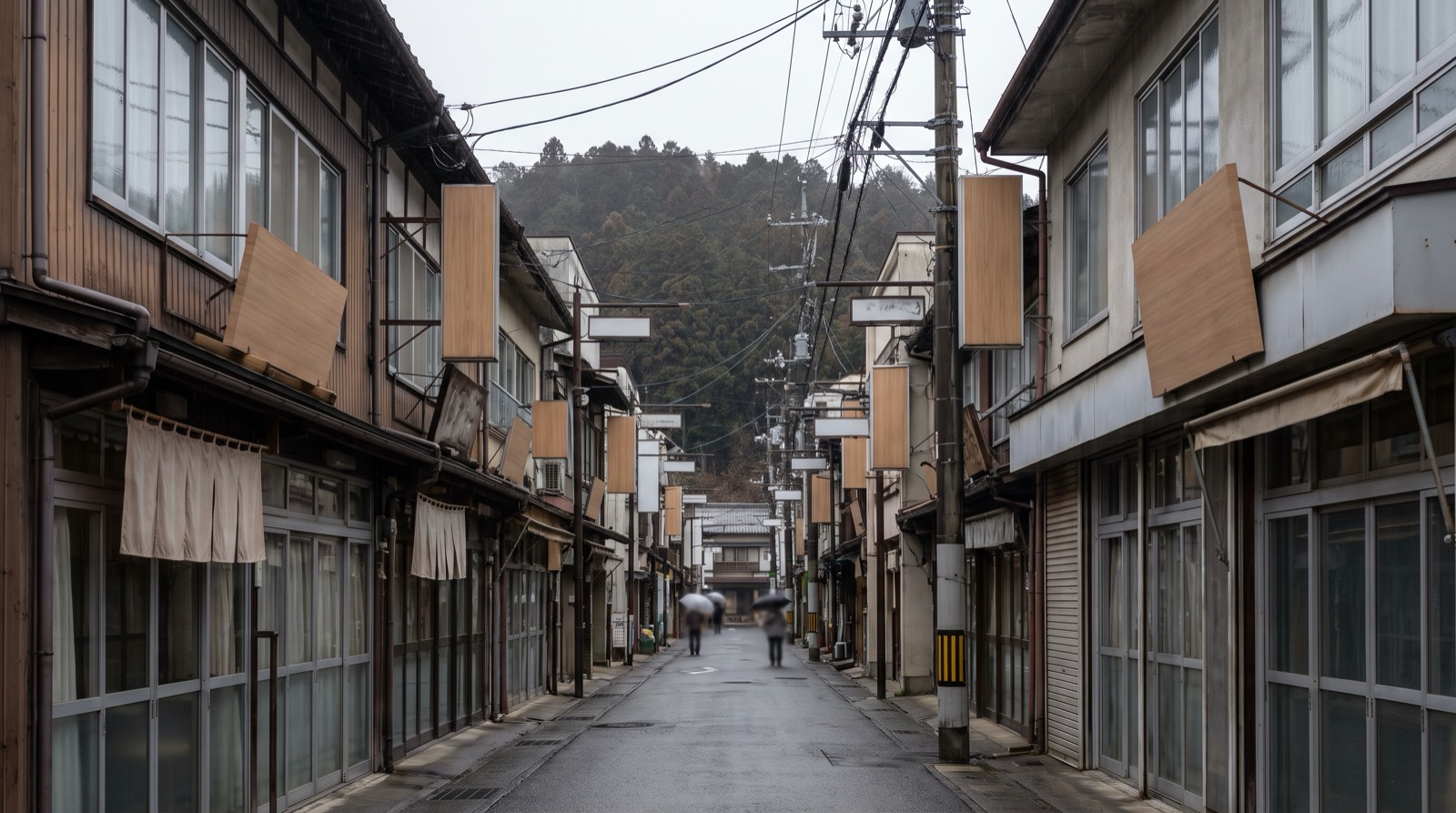
Every neighbourhood this series has read so far has had enough sushi counters of its own kind to line five of them up and compare how each one writes about itself. Arashiyama does not clear that bar. Six official sources were checked for it in full — a shopping street’s own member directory, a tourism association’s site, a citywide guild’s membership list, two chains’ own store searches, and the ordinary web search that opens every piece in this series — and between all six of them, two sushi counters meet the standard this journal has used in every other instalment: a page the shop runs itself, or an entry a public body keeps and stands behind. Not five, arranged a new way. Two, and this piece is about the six searches that arrived at that number rather than about choosing among five.
Kawaramachi found that the number of “official” pages itself differed shop to shop — zero, one or two sheets on the same street. Karasuma found the opposite kind of pattern: all five sitting alike on the side of owning no domain of their own, rather than scattering. Kyoto Station found an address and a set of hours for every one of its five, and a sushi price published for only one. Nine visits to Tokyo and four to Osaka carried the same base assumption forward without ever needing to test it, because there was always a fifth counter waiting to be read. In Arashiyama the assumption itself is what gets tested, and it does not survive.
Where Arashiyama ends, and what counts as a sushi counter
The ground checked here is Arashiyama and Saga, in Kyoto’s Ukyo ward: the area the Randen line’s Arashiyama stop, JR’s Saga-Arashiyama stop, the Hankyu Arashiyama terminus, the Togetsukyo bridge and Tenryuji temple sit on, extended out to wherever the Saga Shopping Street Association’s and the Arashiyama Hoshokai’s own directories reach. It was extended once further, toward Uzumasa, because a single candidate turned up there; it was not extended past the centre of that district, and it was not extended to Saiin, which is a separate part of the city with its own shops and its own trains. A boundary drawn any wider would have turned two shops into five without changing what was actually found.
Not everything with the word sushi attached to it was counted. A pickled-vegetable shop inside Arashiyama Shoryuen sells an eight-piece sushi-shaped product, but pickles are its stated trade, not sushi, so it is not on this list. The two national conveyor-belt chains were checked through their own store-locator pages rather than assumed absent: Sushiro’s own search, run against the word Arashiyama, returned no matching store, and Kura Sushi’s locator could not be reached at all, which counts as unresolved rather than as evidence either way. The dining rooms of the larger hotels lining the river near Togetsukyo were checked too, and none of them publishes a kitchen that states sushi as its trade rather than as one dish among many. What is being counted is narrower than sushi in Arashiyama. It is restaurants that state sushi as their business, sourced to a page they run themselves or a directory a public body keeps.
Six searches
The search ran in six passes rather than one. An ordinary web search for the neighbourhood’s name against the word sushi, in Japanese and in English, came first, the same starting point every piece in this series uses. Then the Saga Shopping Street Association’s own member list, which runs to roughly eighty shops across seven trade categories and was read in full rather than searched by keyword. Then the Arashiyama Hoshokai’s site, which is the neighbourhood’s tourism association rather than its shopkeepers, whose shop-introduction section runs to nine pages. Then the dining rooms of the riverside hotels. Then the two conveyor-belt chains’ own store searches. Then the membership list of the guild that has controlled the words Kyoto sushi since 1950, read shop by shop for a different Kyoto piece and checked again here for any member based in Arashiyama or Saga.
Of the roughly eighty entries in the shopping street’s own list, one gives sushi as its trade. The tourism association’s nine shop pages do not cover restaurants in any depth and name none. The guild has no member in Arashiyama or Saga. Of the two chains, one confirmed its own absence directly; the other’s store search could not be reached at all, which stands as unresolved rather than as a second confirmation. The hotels named none. What the ordinary web search added, once every result was checked against the standard above, was one further shop with a domain of its own. Two shops, from six searches, is not a partial result waiting on a seventh search to fill it in. It is what six searches, run in full, returned.
Arashiyama Daizen — the shop that calls itself the only one
Daizen publishes a complete site of its own, in Japanese, English and Korean, and the three versions agree with each other on hours, address and payment on every page checked. The address is 10-3 Isenokami-cho, Saga, Ukyo-ku; the access page names four different routes to it — the JR Sagano Line’s Saga-Arashiyama stop, the Randen Saga stop, the Hankyu Arashiyama terminus, and a Shimosaga bus stop — and gives no walking time for any of the four.
The hours split by day rather than by lunch and dinner. Monday to Wednesday the shop runs 10:00–17:00 and again 17:00–19:30, with the evening seating needing a booking by the day before; Friday to Sunday and on holidays it runs 10:00–19:30 straight through, closing early once the day’s stock is gone. Thursday is the fixed closing day, and the site adds that it also takes irregular days off and asks visitors to telephone and check. There is no separate lunch price list at all — nigiri, chirashi and rice bowls are priced individually and sold at the same figure whatever the hour: a nigiri set of seven kinds plus tamago at ¥2,500 before tax (¥2,750 with tax), a larger version of the same set at ¥4,000 before tax (¥4,400 with tax), a Kyoto-style chirashi at ¥2,300 before tax (¥2,530 with tax), and a seafood rice bowl at ¥3,800 before tax (¥4,180 with tax).
One price on the site is tied to a time of day, and aimed at a specific reader. The English page publishes a foreign-visitors-only evening course, served from 17:00 with a booking required the day before, at ¥11,000 tax included, menu and all. The same English page states, in its own words, “The only place in Arashiyama where you can enjoy traditional Kyoto style sushi.” That sentence is the shop’s own claim about itself, printed on its own site; it is not the same statement as this journal’s finding that no other Arashiyama sushi shop met this article’s citation standard, and the two should not be read as confirming each other.
A guess is not a search, and the site was checked once more to be sure it was not standing in for one: a Michelin Guide URL built from the same pattern this journal has used to check other Kyoto shops was tried against Daizen’s name, and it returned the guide’s own restaurant-not-found page. That is a record of one broken guess, not evidence of an absence from the guide, and it is printed here so a reader can see exactly how far the checking went and where it stopped.
- Where. 10-3 Isenokami-cho, Saga, Ukyo-ku. Four routes are given on the official site — JR Saga-Arashiyama, Randen Saga, Hankyu Arashiyama, and the Shimosaga bus stop — with no walking time attached to any of them.
- Booking. Telephone only, 075-882-0018, the one number printed anywhere on the site. Required by the day before for the evening seating and for the foreign-visitors dinner course; no stated requirement for the daytime hours.
- Hours. Monday–Wednesday 10:00–17:00 and 17:00–19:30; Friday–Sunday and holidays 10:00–19:30, closing early once the day’s stock sells out.
- Closed. Thursdays, plus irregular closures the site says to ask about directly.
- Price. Nigiri sets ¥2,500–¥4,000 before tax (¥2,750–¥4,400 with tax); chirashi ¥2,300 before tax (¥2,530 with tax); the foreign-visitors evening course ¥11,000 tax included. No figure is split into lunch and dinner bands.
- Seats. Not published. A counter is mentioned in passing — guests can watch the traditional kettle from it — but no count is given for it or for any tables.
Sushi Iso — one sentence in a shopping street’s ledger
Sushi Iso has no site of its own that this search could find. What it has is a single entry in the Saga Shopping Street Association’s member directory, alongside roughly eighty other businesses, and that entry is the entire published record of the shop: a name, a photograph, and one sentence of description. The sentence says there is sunken-table seating comfortable for families with small children, and that the shop draws a mix of locals and visitors from abroad in an easygoing atmosphere. Nothing else is written.
No address is given. No phone number, no hours, no closing day, no price, no seat count, and no way to book. The directory entry’s name links out to a third-party listing site, and that link was followed far enough to confirm the shop exists, but the page it leads to is not this journal’s kind of source, so nothing from it appears below. The directory page itself was also opened and checked as rendered HTML rather than skimmed as a summary, to confirm nothing else was sitting in the markup unread.
- Where. Not published. The directory places the shop in Saga, within the shopping street association’s membership, with no street address given.
- Booking. Not published.
- Hours. Not published.
- Closed. Not published.
- Price. Not published. No lunch or dinner figure appears anywhere the shop’s directory entry can be checked.
- Seats. Not published as a count. Sunken-table (horigotatsu) seating is mentioned in the one sentence the directory gives the shop.
Six official directories were checked for a third sushi counter in Arashiyama. None of the six produced one. Two is not this article’s shortfall — it is what six searches, run in full, returned.
What six searches also ruled out
Two shops came close enough to being counted that leaving them out needs explaining rather than a footnote. A long-standing local sushi shop near the Hankyu Arashiyama side of the Togetsukyo bridge turns up in third-party listings, real enough by that measure, but no site of its own could be found under its own domain, and the Instagram account most likely to be its does not confirm itself as such rather than as a related shop in Osaka. Neither the shopping street association’s directory, which does not reach that side of the river, nor the Hoshokai’s, whose linked shopping-street page returns a 404 when opened directly, covers it. A restaurant a few Randen stops further out, near Uzumasa, was found the same way and rejected for the same reason: an Instagram account with no confirmable own-domain site behind it, and a guessed domain that failed to resolve. Uzumasa was also treated as outside the range this piece drew for itself, nearer the Toei film-studio district than the river the other two shops sit beside.
Two further names surfaced and dropped out for a simpler reason: they were not in Kyoto at all. A shop trading under a name built from Sagano’s own place name turned out, on checking, to be trading in Sapporo, unconnected to Kyoto’s Sagano. A shop that early results placed inside a hotel in Arashiyama turned out, on checking, to be trading in Fukuoka, unconnected to that Kyoto property. Both were dropped once the mismatch was confirmed, not assumed. None of this changes the count of two. It is the record of what the count of two had to survive before it stood.
What this piece is not saying
This is not the same finding as the one made a few streets away in Gion and Pontocho, where three separate registers each publish a different total for the same short stretch of lanes, and none of them agrees with either of the others. That piece was about too many sources, disagreeing. This one is about six sources agreeing on scarcity. The two pieces sit close together on this site and describe the opposite mechanism.
Nor is this a claim that Arashiyama has little worth eating, or that the neighbourhood is somehow lacking. Its own tourism material is thick with kaiseki, yudofu and riverside dining rooms, and a shopping street with roughly eighty listed businesses is not a quiet one — sushi specifically is simply not what most of those businesses sell. The shortage recorded here is also bounded by this article’s own citation rule: a page a restaurant runs itself, or a directory a public body stands behind. A shop with no source that meets that rule is not the same thing as a shop that does not exist, and this piece has been careful to keep the two apart.
Checking this yourself
- Search the neighbourhood’s name against the word sushi, in Japanese and in English, and note every result before opening any of them.
- Find the shopping street’s own trade association and read its member list in full rather than by keyword — Saga’s runs to roughly eighty entries across seven categories, and only the trade each one states for itself counts.
- Check the tourism association’s site separately from the shopping street’s; the two cover different ground and neither substitutes for the other.
- Run each conveyor-belt chain’s own store search for the neighbourhood by name, rather than assuming a chain is present or absent.
- Before accepting a name, confirm the city it actually trades in. Two names that read as Arashiyama shops in a first search turned out to be trading in Sapporo and Fukuoka.
Sixteen earlier pieces in this series each answered a question about how five counters wrote about themselves. Arashiyama has answered a different one, and it is the question every one of those sixteen quietly assumed was already settled: whether five was ever there to begin with. Here, checked six ways, it was not, and those six searches are, for this neighbourhood, the whole of the story this journal has to publish.
If you want to book one of these
Several of the counters described above answer the telephone only in Japanese, and a few of them take bookings by no other route. AutoReserve is a Japanese reservation service with an English interface, and it states that it will place the call on a diner’s behalf where a restaurant takes reservations by telephone alone. We have not tested it against every restaurant on this page, and a listing there is not a guarantee of a seat — the doors described above are the doors either way.
Frequently asked questions
Why isn’t this a five-shop comparison like the rest of the series?
Because six official searches — the shopping street’s own directory, the tourism association’s site, the guild list, both chains’ own store searches and the open web — returned only two sushi counters that meet this series’ citation standard. A third, fourth or fifth shop was never found; padding the count would have meant using a source this series does not use anywhere else.
Does Arashiyama really have only two sushi restaurants?
This article does not claim that. It claims that, using a page a restaurant publishes itself or a directory a public body stands behind, and checking six such sources in full, exactly two shops could be sourced to that standard. Third-party listing sites carry other names; this series has never used them as fact sources, in Arashiyama or anywhere else.
Is Arashiyama Daizen really the only sushi restaurant in the area?
That is Daizen’s own description of itself, printed on its English page. This article’s independent finding — that no other Arashiyama sushi shop met its citation standard — is consistent with that claim but is not the same statement, and the two should be read separately.
What happened to the other shops that turned up in a search?
Two came close: a shop near Togetsukyo with real third-party listings but no citable own site, and one further out near Uzumasa with an Instagram account but no resolving domain. Two more names dropped out because they turned out to be trading in Sapporo and Fukuoka, not Kyoto, under similar names. None of the four met the standard this article applies to the two shops it does list.
What can I actually book at Sushi Iso?
Nothing is published to book against. The shop’s only public record is one sentence in the Saga shopping street association’s directory, describing sunken-table seating and a welcome to local and overseas customers alike. No phone number, hours, address or price appears anywhere this article’s sourcing standard allows it to look.