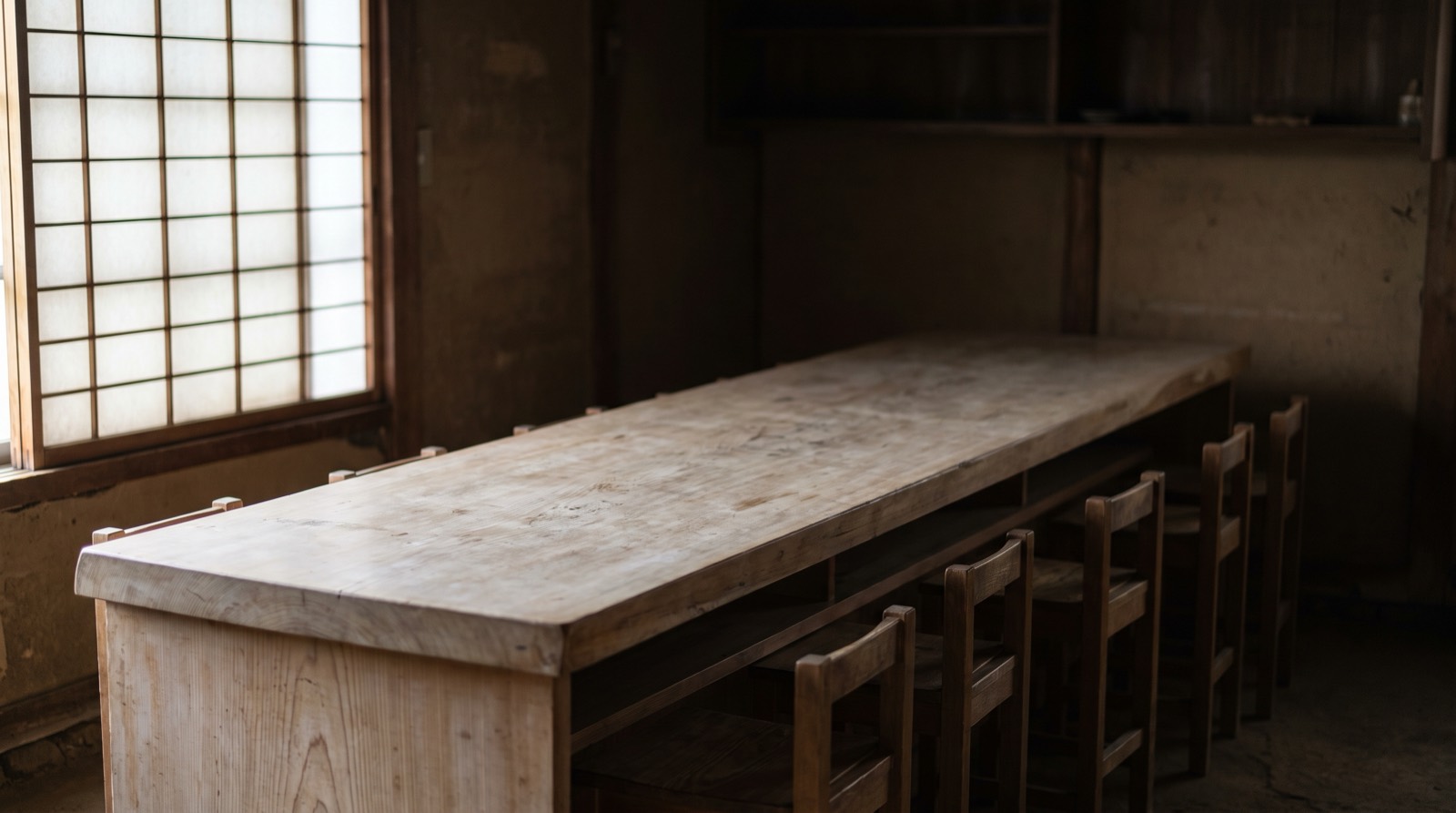
In Kyoto, lunch is when the counter is available. The seats that are impossible in the evening are open at noon, the course that takes three hours after dark takes ninety minutes before it, and the money involved falls by half or by three quarters. Every guide to the city says so, and every guide is right.
What no guide says is that lunch is also the meal these restaurants describe worst. Their own websites are built for dinner. Dinner is where the conditions are spelled out, where the number of courses is itemised, where the phrase “counter seats only” appears in bold and the deadline for booking is given in days. Lunch appears underneath, shorter, cheaper, and stripped of every one of those sentences — and a reader is left to guess whether the sentences were removed because they do not apply, or because nobody rewrote the page.
We spent a week reading nothing but the primary pages of five Kyoto sushi restaurants that serve lunch at a counter: their own domains, their booking platforms, and the legally required commercial-transaction disclosures that sit at the bottom of those platforms. We read no aggregator as a source of fact. What came back was stranger than expected. Three of the five have a second website that also calls itself official. Two of those second sites carry the seat count, the closing day and the prices that the first site does not have. One of them gives a lunch price roughly three times the lunch price on the restaurant’s own menu page. And the domain publishing all three of these second official websites has no homepage at all: its root address returns a 404.
This is an article about five counters you can sit at in the middle of the day. It is also an article about what a restaurant page is for, and what happens to the facts that nobody has a reason to maintain.
One word, ten times the money
Start with the arithmetic, because it settles the question of whether “sushi lunch in Kyoto” means anything as a category. Across these five restaurants, the cheapest thing described on a menu page as lunch is ¥1,200. The most expensive is ¥12,000. Both are sushi, both are served at a counter, both are the midday meal at an established Kyoto shop, and the ten-fold gap between them is invisible in any sentence that uses the word lunch without a number attached.
- Kyo-Sushi Ookini, Nakagyo ward: a weekday-only set of Sanuki udon with sushi and fruit, ¥1,200 including tax. Its standard lunch is ¥3,600.
- Nijou Kizuki, Nakagyo ward: a six-piece lunch course with an appetiser, a dish and soup, ¥1,980. A ten-piece version is ¥3,300.
- Kyoto Sushi Matsumoto, Shimogyo ward: four lunches, from ¥4,200 for seven pieces with a small ikura bowl to ¥12,800 for a ten-piece course listed as reduced from ¥16,500.
- Sushi Fukagawa, Nakagyo ward: one lunch, an omakase at ¥9,500. The restaurant’s own website does not mention it.
- Gion Sushi Nakamura, Higashiyama ward: one lunch, a nigiri course at ¥12,000, tax included. Dinner is ¥20,000.
That range is not a scale of quality. It is a range of different products that share a name. At ¥1,200 you are buying a bowl of noodles with sushi beside it, at a shop that has been in the same building since 2000 and that will let you sit at a counter made of horse chestnut to eat it. At ¥12,000 you are buying an eighteen-course nigiri sequence from a chef who trained in French kitchens, at a counter cut from a single cypress log. The word lunch does no work at all in telling the two apart.
The cheapest thing these five shops call lunch is ¥1,200. The most expensive is ¥12,000. Both are sushi at a counter in central Kyoto.
What follows is five restaurants, in no order, read through every page each of them publishes, for what those pages do and do not say about the middle of the day.
Nijou Kizuki: the rules for lunch are on somebody else’s website
Nijou Kizuki sits on Nijo-dori in Nakagyo ward, a short walk east of Yanaginobanba, on the ground floor of a small building. Eight seats at a cypress counter and two tables. The entrance has no step. The master, Morimoto Akira, was born in 1971 in Yamaguchi prefecture, where his family ran a sushi shop; he went to cooking school in Osaka, worked in Kyoto kaiseki and then in Tokyo, and opened this room at the end of July 2014. All of that is on his own site, told plainly, in the first person.
The hours are equally plain. Lunch runs 12:00 to 14:30 with last entry at 13:30. Dinner runs 17:00 to 22:00 with last entry at 21:00. Closing days are irregular, and a news post dated 30 July 2026 lists August’s: the 5th, the 13th, the 19th and the 26th closed entirely, and Monday the 10th closed for lunch only. A shop that publishes the one lunch service it will miss in a month is not a shop that is careless about lunch.
The menu page is where it becomes interesting. Lunch is a ¥1,980 course — an appetiser, a dish of the day, six pieces of nigiri chosen by the chef, and soup — with coffee at ¥300 and hojicha ice cream at ¥500 available on top. Beneath it, a single line: there is also a ¥3,300 lunch course with ten pieces. That is the entire published description of the midday meal.
Dinner, on the same page, is three courses at ¥8,800, ¥12,500 and ¥19,800, each with its contents itemised down to the number of small dishes and the number of pieces. And each of the three carries the same two annotations: reservations required by two days before, and counter seats only.
Neither annotation appears on either lunch course. This is the central problem of researching lunch anywhere in Kyoto, in its purest form. Does lunch need no advance booking, or did nobody write the sentence? Is lunch available at the tables as well as the counter, or is that also unstated rather than untrue? The page is silent, and silence in a menu is not information. It is the absence of information wearing information’s clothes.
Does lunch need no advance booking, or did nobody write the sentence? Silence in a menu is not information.
The booking page is a different document
Nijou Kizuki does not take bookings on its own domain. The reservation button hands you to a third-party platform, and the platform’s page for this restaurant is where the answers turn out to be. It offers lunch slots at 12:00, 12:30, 13:00 and 13:30, and dinner slots every half hour from 17:00 to 21:00. Party size is selectable from one to eight; nine and above are marked unavailable. And each course has a detail page with conditions the restaurant’s own site never mentions.
- The ¥1,980 lunch course is cash only. The restaurant’s own menu page does not say this anywhere.
- The ¥3,300 ten-piece lunch is counter seats only, cash only, and requires two people or more. Three conditions, none of them published on the restaurant’s site, on a course the site describes in one line.
- A lunch course that does not exist on the restaurant’s own site appears here: a monthly menu with an appetiser, clear soup, two kinds of sashimi, a steak of Ube beef from Yamaguchi, the shop’s sea urchin ice cream with sesame tofu, eight pieces of nigiri, red miso soup and dessert. Its contents change twice a month.
- That monthly course is listed at ¥6,500 on the index of courses and at ¥5,200 per person on its own detail page, and it is currently marked as not accepting reservations.
- The ¥8,800 dinner is described here as an appetiser, four small dishes, ten pieces, red miso soup and dessert. The restaurant’s own menu page describes the same ¥8,800 course as six small dishes.
One line on that platform does more work than everything else either site publishes about lunch. It reads, in translation: at the counter, even at lunch, the master forms each piece one at a time exactly as he does at dinner; at the tables, please use it for family groups with children or for lunch gatherings with friends. There it is. The counter at midday is the dinner experience compressed. The tables are a different proposition. A visitor deciding whether ¥1,980 buys them anything worth crossing the city for now has the answer, and it exists on a booking platform rather than on the restaurant’s own menu.
The soup, incidentally, is called miso soup on the restaurant’s site and red miso soup on the platform, on every course. It is the same bowl. Two people wrote these pages, at different times, and neither reconciled theirs with the other.
A legally required page that contradicts what it governs
Japanese law requires an operator selling online to publish a set of disclosures — the trader’s name, the person responsible, the address, the payment methods, the cancellation terms. On booking platforms this page sits in the footer and almost nobody opens it. It is frequently an unusually accurate document for a small restaurant to have published about itself, because it is the one page written by a lawyer’s checklist rather than by a marketer.
The disclosure for Nijou Kizuki names Morimoto Akira as the trader and as the responsible person — a sole proprietor, not a company — gives the shop name, the same phone number as the website, and a personal free-mail address for contact. The address given is the same lot number as the website, in the same ward, with one difference: the first character of the neighbourhood name is written differently. The website uses the character for fine weather; the disclosure uses the character for pure. Both are read the same way. One of the two is a typing error, and there is no way from either page to know which.
The payment field on that legally required page says: cash or credit card. The two lunch courses the same platform is selling, on pages one click away, both say cash only. The compliance document and the product pages disagree about how you may pay, on the same website, for the same restaurant, on the same day.
None of this makes Nijou Kizuki a badly run shop. The opposite: a shop that lists which single lunch service it will miss in August, that publishes a step-free entrance, that explains in English — and only in English, with no Japanese equivalent anywhere on the site — that guests wearing strong scent may be refused and charged the cancellation fee, is a shop paying unusual attention. What it shows is that a restaurant’s facts now live in three or four places maintained by three or four different parties, and that no one of them is complete.
The compliance page says cash or card. The product pages say cash only. Same platform, same restaurant, one click apart.
Gion Sushi Nakamura: a page that disagrees with itself
The official website of Gion Sushi Nakamura — the words “official” and the restaurant’s name are how the page titles itself — is not on a domain the restaurant owns. It is a subdomain of a service that hosts restaurant pages, and the restaurant appears to have no other website. The address is in Suekichi-cho in Higashiyama, on the fourth floor of a building a few minutes from Gion-Shijo station. Lunch is 12:00 to 15:00, dinner 18:00 to 23:00, and the shop closes on Sundays and public holidays.
The prose on that page is good. It describes a counter cut from a single cypress trunk, six metres end to end, twelve seats. It says the master trained in French kitchens before sushi. It names the tuna dealer at Toyosu, describes the rice cooked in a Nambu ironware pot from Iwate, and specifies that the vinegar is a blend of red vinegar and rice vinegar. Two courses: ¥12,000 for lunch nigiri, ¥20,000 for the dinner omakase, both tax included.
Further down the same page, in the box of restaurant data, the seat count is ten. In the frequently asked questions below that, also ten. The prose says twelve, the table says ten, the FAQ says ten, and all three are on one page under one heading that says official.
A two-seat discrepancy changes nothing about the meal. It changes a great deal about how you read the rest. If the number of seats — the single most stable fact a sushi counter possesses, the one that cannot drift without carpentry — is inconsistent within a single screen, then the phone number, the hours and the price are all being maintained by the same process.
And the phone number is worth looking at. It begins 050, which in Japan is an internet-telephony prefix, not a Kyoto number. Numbers like this are issued by listing platforms so that calls can be counted and attributed. It rings at the restaurant, but it is not the restaurant’s number; it is the platform’s meter, printed on the restaurant’s official page.
Then there are the customer voices. The page carries a section of them, and they are worth reading closely, because they are not about this restaurant. One praises a master trained at a famous kaiseki house. One refers to the shop in Roppongi, in Tokyo, that once held a star. One describes visiting a popular Tokyo sushi restaurant that opens here only one day a week. The restaurant this page is about is run by a young chef who came from French cooking. The reviews collected under its name describe a different shop, in a different city, with a different chef and a different lineage.
The prose says twelve seats. The table says ten. The reviews are about a restaurant in Tokyo. All of it is on one page that calls itself official.
None of this tells you the lunch is bad. A ¥12,000 midday nigiri course at a six-metre cypress counter in Gion is a serious proposition, and the descriptive writing about the fish and the rice is specific in ways that marketing copy usually is not. What it tells you is that you should ring before you go, on the Kyoto number rather than the 050 one if you can find it, and confirm the two things this page cannot confirm for itself: that lunch is running that day, and that there is a seat.
Sushi Fukagawa: two official websites, and a menu page with no menu
Sushi Fukagawa owns its domain. The site is elegant, mostly photography, and organised into five sections: top, philosophy, menu, space, reservations. The address is on Matsumoto-cho in Nakagyo ward, in a building near Teramachi and Ebisugawa. The phone number is a Kyoto number. Lunch opens at 12:00 and runs to 15:00; dinner opens at 16:00 and runs to 21:00. The page title says five minutes on foot from Kyoto Shiyakusho-mae station.
The menu page contains no menu. It contains one sentence, which reads in translation: for us, the people who eat sushi carefully matter more than anything; in order to meet a wide range of needs we have prepared a broad selection of courses; please do not hesitate to get in touch. There are no dishes. There are no prices. There is no indication of how many courses that broad selection contains or what any of them costs.
The philosophy page has a heading and images. The space page has a heading and images. Between them, the entire website yields three pieces of text a visitor could act on: an address, a phone number and a pair of opening times. There is no seat count. There is no closing day. There is no price for anything at any hour. The reservation link leaves the site entirely for a national booking platform.
And then there is a second website, on a different domain, whose page title also begins with the word official and gives the same restaurant name. That site has everything the first one lacks.
- Lunch: an omakase course at ¥9,500, tax included. Dinner: two omakase courses, at ¥34,000 and ¥39,500.
- Thirteen seats, counter only, with an explicit statement that the only seating is the counter where you can watch the work in front of you. No private rooms. Non-smoking throughout. Parking available.
- Closed every Wednesday, with a note that Sunday is lunch service only — a restriction that appears nowhere on the restaurant’s own site.
- Dinner runs until 21:00 or until the fish runs out, whichever comes first. The restaurant’s own site gives only the clock time.
- The address is written in Kyoto’s street-crossing notation, naming Gokomachi rather than Teramachi as the reference street, and the walk from Kyoto Shiyakusho-mae is given as seven minutes rather than five.
So the single most useful fact about eating lunch here — that it costs ¥9,500, and that on Sundays it is the only meal served — is absent from the website the restaurant built and present on the website it did not. A visitor who finds the beautiful site first and stops there will conclude that the prices are unpublished, which is usually a signal to stay away. A visitor who finds the second site will book.
The prose on that second site is also more informative about the food than anything on the first. It says the serving board was made by a Kyoto lacquer craftsman. It says the rice is from Tamba and is cooked with bonito stock. And it states an ambition worth quoting: to make, with the techniques of Meiji and Taisho-era Kyoto sushi, the sushi that pre-war Edomae craftsmen wanted to make. That is a specific and slightly unusual claim — Kyoto method aimed at a Tokyo goal — and it is the kind of thing a restaurant normally puts on its own philosophy page. This restaurant’s philosophy page has no words on it.
One further detail from the customer voices on that second site, dated 2020: a diner notes that the photographs are from when the shop still traded under a different name. The restaurant has been renamed at some point in its life, which is a useful thing to know if you are searching for it and finding two sets of results.
The website the restaurant built has no prices. The website it did not build has all of them.
The domain that publishes official websites and has none
Three of the five restaurants in this article — Gion Sushi Nakamura, Sushi Fukagawa and Kyo-Sushi Ookini — have a page on the same host, each titled with the word official in brackets followed by the restaurant’s name. They look like restaurant websites. They are indexed like restaurant websites. In two of the three cases they are the only place a price appears.
The root of that domain returns a 404. There is no homepage, no company page, no explanation of what the service is or who runs it. It publishes what it calls the official websites of restaurants and does not publish anything about itself.
The pattern is consistent across all three. Each carries a phone number beginning 050 rather than the restaurant’s own Kyoto number. Each fills its photography and its customer reviews from a large review platform, with every link marked “see more” leading there. Each has a structured data table — seats, private rooms, smoking, cards, parking — of exactly the kind that restaurant owners never write and platforms always require.
The uncomfortable part is that these pages are frequently better than the restaurants’ own. They have the seat counts. They have the closing days. They have the prices. The structure that forces a platform to fill in a seats field is the same structure that produces the twelve-versus-ten contradiction at Nakamura, and it is also the reason a diner can find out what lunch costs at Fukagawa at all.
What a reader should take from this is narrow and practical: when a Kyoto restaurant has two official websites, read both, and when they disagree, treat neither as authoritative and telephone. That is not a satisfying answer. It is the accurate one.
Kyo-Sushi Ookini: the shop that writes everything down
Kyo-Sushi Ookini is the opposite problem. It is in Mibu, in the west of Nakagyo ward, near Mibu-dera and close to Kyoto’s central wholesale market — which its own site notes, correctly, was the first central wholesale market in Japan. The shop opened on 7 July 2000; it marked twenty-five years on 7 July 2025 and announced its twenty-sixth anniversary event in May 2026. The proprietor is named on the site, as is his wife, who runs the front of house.
It is also the only restaurant of the five that explains its own location honestly. It is not near a major station. The site says the nearest stops are the Hankyu and the Keifuku stations that share a name written with the same two characters and read two different ways — Saiin on one railway, Sai on the other — and that both are thirteen or fourteen minutes on foot. From Kyoto Station it gives ten-odd minutes by car. That is a restaurant telling you it will take effort to reach.
The hours are stated in a form that acknowledges the difference between the last order and the last minute. Lunch takes orders from noon to 14:00 and closes at 14:30. Dinner takes orders from 18:00 to 20:00 and closes at 21:00. Both carry a note that these were revised during the pandemic and not revised back. Closing days are every Wednesday and, in principle, the first and third Tuesday of each month, with a parenthetical admitting this can change.
The counter is horse chestnut. There is a raised tatami area beside it, and a room upstairs laid with tatami but furnished with chairs and tables for up to twenty-five. Cards are accepted for eating in; takeaway and catering are settled in cash only. The whole building has been non-smoking since 1 June 2017, and the site gives its reasons: guidance from the Kyoto prefectural and city authorities, and the national tidying-up ahead of the Tokyo Olympics. Vegetarian, vegan and halal requests are handled, stated in Japanese and in English.
And the lunch menu is itemised to a degree none of the other four approach:
- The house lunch, ¥3,600 including tax: an assortment of sushi with tempura, chawanmushi, a soup and fruit.
- A made-to-order lunch, from ¥4,500 before tax.
- A sashimi set, ¥2,200 including tax.
- A sushi assortment set, ¥1,850 including tax.
- A chirashi set, ¥1,850 including tax.
- A Sanuki udon set with sushi and fruit, ¥1,200 including tax, weekdays only, with a green-tea soba alternative.
Five of those six prices are given inclusive of tax. The made-to-order lunch, alone on the same page, is given exclusive of it. This is a small thing and it is the sort of small thing that decides whether a visitor with limited Japanese trusts a page. A reader who does not notice will assume the difference between ¥3,600 and ¥4,500 is nine hundred yen. It is not.
Nine days in August
Ookini publishes a business-day calendar, which is rare, and it is worth doing the arithmetic on it, because the result is instructive about how much any stated rule is worth.
The rule the shop states is: closed every Wednesday, plus in principle the first and third Tuesday of the month. Apply that to August 2026 and you get six days: Tuesday the 4th and Wednesday the 5th, Wednesday the 12th, Tuesday the 18th and Wednesday the 19th, and Wednesday the 26th.
The calendar marks nine. It has the six the rule predicts, and it adds Monday the 17th, Thursday the 20th and Tuesday the 25th. A visitor who read the rule, did the arithmetic and walked to Mibu on the 17th, the 20th or the 25th would find the shop shut, having followed the shop’s own published instructions correctly.
The stated rule predicts six closed days in August. The calendar marks nine. Both are on the restaurant’s own website.
Now the part that reverses the expected order of things. The second official page for this restaurant — on the domain with no homepage — lists August’s closures in a line of running text: the 4th and 5th, the 12th, the 17th through the 20th, the 25th and 26th. That is the same nine days, exactly. It goes on to give September’s, which the restaurant’s own calendar has not yet reached. The two sites agree perfectly on the hardest fact to maintain: a hand-edited list of irregular closures that has to be rewritten every month.
They do not agree on the price of lunch. The restaurant’s own lunch menu tops out at ¥3,600, with a made-to-order option from ¥4,500. The second page advertises lunch kaiseki courses at ¥8,800 and ¥9,900. Nor do they agree on what kind of restaurant this is: the shop’s own site is entirely about Kyoto-style sushi, pickled vegetables and Kyoto produce, while the second page’s headline calls it authentic Edomae sushi and describes forty-five years in Japanese cuisine.
The second page also carries something the restaurant has never published in twenty-six years: a seat count. Forty-six seats, broken down — a counter for one to eleven, one table for three to six, one raised alcove for two to three, and the upstairs room for five to twenty-five. The restaurant that documents its own smoking policy back to a date in 2017 has never said how many seats it has.
And its address appears in two forms. The restaurant’s own site uses the street-crossing notation Kyoto residents actually use, naming Onmae-dori and Matsubara and the side of the street. The second site uses the registered town name and lot number, which is what the post office uses. Neither is wrong. Neither can be checked against the other by a visitor holding only one of them, which is a genuine and permanent difficulty of navigating this city and not anybody’s error.
Set the two sites side by side and the lesson is uncomfortable. The fact that should decay — a list of irregular closing days, rewritten monthly, in two places — is correct in both. The facts that should be stable — what the restaurant serves and what lunch costs — are three times apart. Effort has gone into the perishable and none into the permanent.
Kyoto Sushi Matsumoto: one lot number, two stations
The last of the five is near Kyoto Station, in Shimogyo ward, and it is the clearest example in this article of a restaurant whose two published identities cannot both be true.
Its own site gives the address as a lot number in Maoya-cho, and the access as four minutes on foot from Kyoto Station — listing five railway lines separately, all of which are Kyoto Station, all of which are four minutes — and adds a distance of 470 metres. Weekday hours are lunch 11:30 to 14:00 and dinner 17:00 to 23:00; on weekends and holidays dinner starts at 16:00. It opens on Sundays, and closing days are irregular. Cards yes; electronic money no; QR payment no.
A second page for the same restaurant, on a third-party host, gives the same ward, the same town, the same lot number, and adds a building name and floor that the restaurant’s own site omits. It gives lunch as 12:00 to 14:00 rather than 11:30. It has no closing-day field at all. And it gives the access as one minute on foot from Hankyu Kyoto-Kawaramachi.
Kyoto Station and Hankyu Kyoto-Kawaramachi are different stations on different railways in different parts of the city centre. The two pages give the same lot number and irreconcilable walks. One of the two is wrong, and there is nothing on either page that identifies which.
That second page also supplies what the restaurant’s own does not: twenty-five seats in total, a counter, couple seating, and five table-based private rooms for two to four people each, with doors and walls. It adds two card brands the restaurant does not list. It states that children are not admitted. And it closes with the standard disclaimer that information may differ from the restaurant’s current practice and that you should check directly — which, given everything above, is the single most accurate sentence on either site.
Whose star is it
The page title of this restaurant’s own website translates as: lunch and dinner at a Michelin-awarded shop. The top page says the master became independent from a celebrated Akasaka restaurant that held one star for two consecutive years. The page about the Kyoto branch says something different: that the celebrated Akasaka restaurant, listed in the Michelin guide to Tokyo for two consecutive years from 2019 to 2020 and awarded one star, has opened here in Kyoto. The third-party page repeats the second version.
Independence and branch expansion are not the same event. A chef who leaves a starred restaurant to open his own does not bring the star; a starred restaurant that opens a second location does not extend the star to it either, because Michelin awards stars to establishments and inspects each one. Either way, the star described is a Tokyo star, for a Tokyo restaurant, in the Tokyo guide, for 2019 and 2020. Kyoto has its own guide. Nothing on any of these pages claims a Kyoto star, and a reader skimming the page title could easily believe one is being claimed.
The sentence about the 2019 and 2020 Tokyo star is attached to all eight courses on the menu — four lunches and four dinners — identically, as a line of small print under each price. Repetition of that kind is a template being filled, not a fact being stated.
A star awarded to a restaurant in Tokyo in 2019 and 2020 appears under all eight courses on a menu in Kyoto.
Both the lunch and dinner sections carry another line: menu contents and prices may differ by branch, please contact the restaurant for details. On a page that exists to tell you what the branch charges, that sentence withdraws the page’s own numbers. And the reservation link in the site header returns a 404. The other reservation links go back to the top of the same page. There is no working way to book this restaurant from the website it operates.
The prices themselves are worth a closer look. Lunch runs ¥4,200 for seven pieces with a small ikura bowl, ¥5,800 for the same with sashimi added, ¥9,800 for a ten-course omakase, and ¥12,800 for a course shown as marked down from ¥16,500. Dinner starts at ¥13,500 for a weekday-only fifteen-piece omakase and rises through ¥13,800, ¥18,000 and ¥22,000.
The gap between the most expensive lunch and the cheapest dinner is ¥700. At this restaurant, the usual reason for eating sushi at midday — that the same room costs meaningfully less — has been arbitraged almost entirely away at the top of the lunch menu, and remains completely intact at the bottom of it, where ¥4,200 buys seven pieces in a room with a white-wood counter four minutes from the shinkansen.
What the cancellation policies tell you
Here is the strange thing we did not expect to find. Across all five restaurants, the one subject on which lunch is described precisely, in yen, without ambiguity, is what happens when you do not turn up.
Nijou Kizuki, on every course including both lunches: cancelling on the day costs one hundred per cent whether you telephone or not; from midnight the day before, fifty per cent. Kyoto Sushi Matsumoto, under all eight courses: on the day, with or without contact, one hundred per cent; the day before with contact, fifty per cent. Two restaurants that share nothing else have converged on the same structure, and both make explicit the point people most often get wrong — that on the day itself, telephoning changes nothing about the charge. You should still telephone. It simply does not reduce the bill.
Ookini goes further than either, and its policy is the only document in this entire article that prices lunch and dinner against each other directly. For a table booking without a set course, for parties of five or fewer, cancelling the day before costs ¥1,000 per person for lunch and ¥2,000 for dinner; on the day, ¥2,000 for lunch and ¥3,000 for dinner. For six or more, a sliding scale begins two weeks out. Where a course has been specified, it is thirty per cent from two weeks out, fifty the day before, one hundred on the day, one hundred for a no-show.
Read that first line again, because it is the only number anywhere in this research that states what a restaurant thinks a midday seat is worth relative to an evening one. Lunch is half of dinner, or two thirds of it, depending on the notice. That is the whole economics of Kyoto sushi at midday, expressed by accident, in a cancellation schedule.
The same policy contains the only sentence any of these five publishes about lateness: arrive more than twenty minutes after your booked time without calling and it is treated as a no-show at one hundred per cent, and the closing time of your table will not, in principle, be extended to compensate. It also specifies that a cancellation the day before must be made by telephone and cannot be made by email. For a lunch service of two and a half hours with one seating, this is not severity. It is arithmetic.
How to read a Kyoto lunch listing
The five restaurants above are worth eating at and the point of this article is not to warn you off them. It is to give you a method, because the pattern repeats across the city and across every price level in it.
- Search the restaurant’s name and look for a second page that also calls itself official. In three of our five it existed, and in two of those three it held the price, the seat count and the closing day.
- Check the telephone number’s prefix. A Kyoto landline begins 075. A number beginning 050 is a routing number issued by a platform; it works, but it tells you the page is a listing rather than the restaurant’s own.
- Read the dinner section before the lunch section. Conditions that appear on dinner and not on lunch — counter only, two days’ notice, minimum two people — are the ones to ask about, because their absence at lunch may mean they do not apply or may mean nobody wrote them down.
- Open the booking platform’s course pages individually rather than reading the index. Cash-only, counter-only and two-person conditions appeared only inside the individual course pages, never on the list.
- Scroll to the legally required commercial disclosure at the foot of any booking platform. It gives the trading name, the responsible person and the payment methods, and it is usually an unusually carefully checked page for a small restaurant to publish.
- If the restaurant has a business-day calendar, believe the calendar over the stated rule. At Ookini the rule predicted six closed days in August and the calendar marked nine.
And one habit that costs nothing: telephone. Every difficulty described in this article — the missing price, the two seat counts, the two stations, the nine closed days — dissolves in a ninety-second call. The restaurants are not hiding any of it. They simply have no mechanism for keeping four websites in agreement, and neither would you.
If you want to book one of these
Several of the counters described above answer the telephone only in Japanese, and a few of them take bookings by no other route. AutoReserve is a Japanese reservation service with an English interface, and it states that it will place the call on a diner’s behalf where a restaurant takes reservations by telephone alone. We have not tested it against every restaurant on this page, and a listing there is not a guarantee of a seat — the doors described above are the doors either way.
Frequently asked questions
Is it really easier to get a Kyoto sushi counter at lunch than at dinner?
Yes, and the restaurants’ own pages show why. At one of the five here, all three dinner courses carry the same two conditions — counter seats only, and reservations required by two days beforehand — while neither lunch course carries either. At another, dinner runs to 21:00 or until the fish runs out, whichever is first, and lunch has no such note. Lunch is a single seating in a fixed window, usually noon to around 14:30 with last entry earlier than that, which makes it far more predictable to staff and therefore far easier to release. The caveat is that easier does not mean walk-in: last entry at 13:30 is common, and a shop with eight seats can still be full.
Why does the same restaurant have two websites that both say official?
Because a hosted listing service publishes pages under the restaurant’s name with the word official in the title, and many small restaurants either commissioned one years ago or never objected. Three of the five restaurants in this article have one. They are recognisable by three signs: a telephone number beginning 050 rather than the Kyoto prefix 075, photography and customer reviews sourced from a large review platform, and a structured data table listing seats, private rooms, smoking and cards. They are not fake, and they are frequently more informative than the restaurant’s own site — in two of our three cases they were the only place the price appeared. Read both, and when they disagree, telephone.
How much should I expect to pay for sushi lunch in Kyoto?
The honest answer is that the question has no single answer, because the range within these five restaurants alone runs from ¥1,200 to ¥12,000. Three practical bands emerge. Below about ¥2,500 you are buying a set — sushi with noodles, or a chirashi bowl — at an established neighbourhood shop, often with a counter and often weekday-only. Between roughly ¥3,300 and ¥5,800 you get a short chef-chosen nigiri course of six to ten pieces with an appetiser and soup. From about ¥9,500 upward you are buying the same work the restaurant does at dinner, compressed into ninety minutes. At the very top the saving disappears: at one restaurant here the most expensive lunch and the cheapest dinner are ¥700 apart.
Do Kyoto sushi restaurants charge a cancellation fee for lunch?
Several state one explicitly, and it is the single subject on which lunch is documented precisely. Two of the five publish the same structure: cancelling on the day of the booking costs one hundred per cent whether or not you telephone, and cancelling from midnight the previous day costs fifty per cent. A third charges per head for a table booking without a course — the day before, ¥1,000 a person at lunch against ¥2,000 at dinner; on the day, ¥2,000 against ¥3,000 — and treats arrival more than twenty minutes late without a call as a no-show at full price. Telephoning on the day does not reduce the charge at any of them. It is still the right thing to do.
Can I book these lunches without speaking Japanese?
It varies more than it should. One of the five takes reservations only through a Japanese-language platform where the conditions that matter — cash only, counter only, minimum two people — appear inside the individual course pages rather than on the list. One routes booking to a national reservation service. One has a reservation button in its site header that returns a 404 and no other working booking path on its own domain. Where a restaurant has a second, hosted official page, that page usually carries a live availability calendar, which is often the most reliable route. If none of that works, telephone during service hours; the numbers are published, and a booking for two at a stated time is a short conversation.