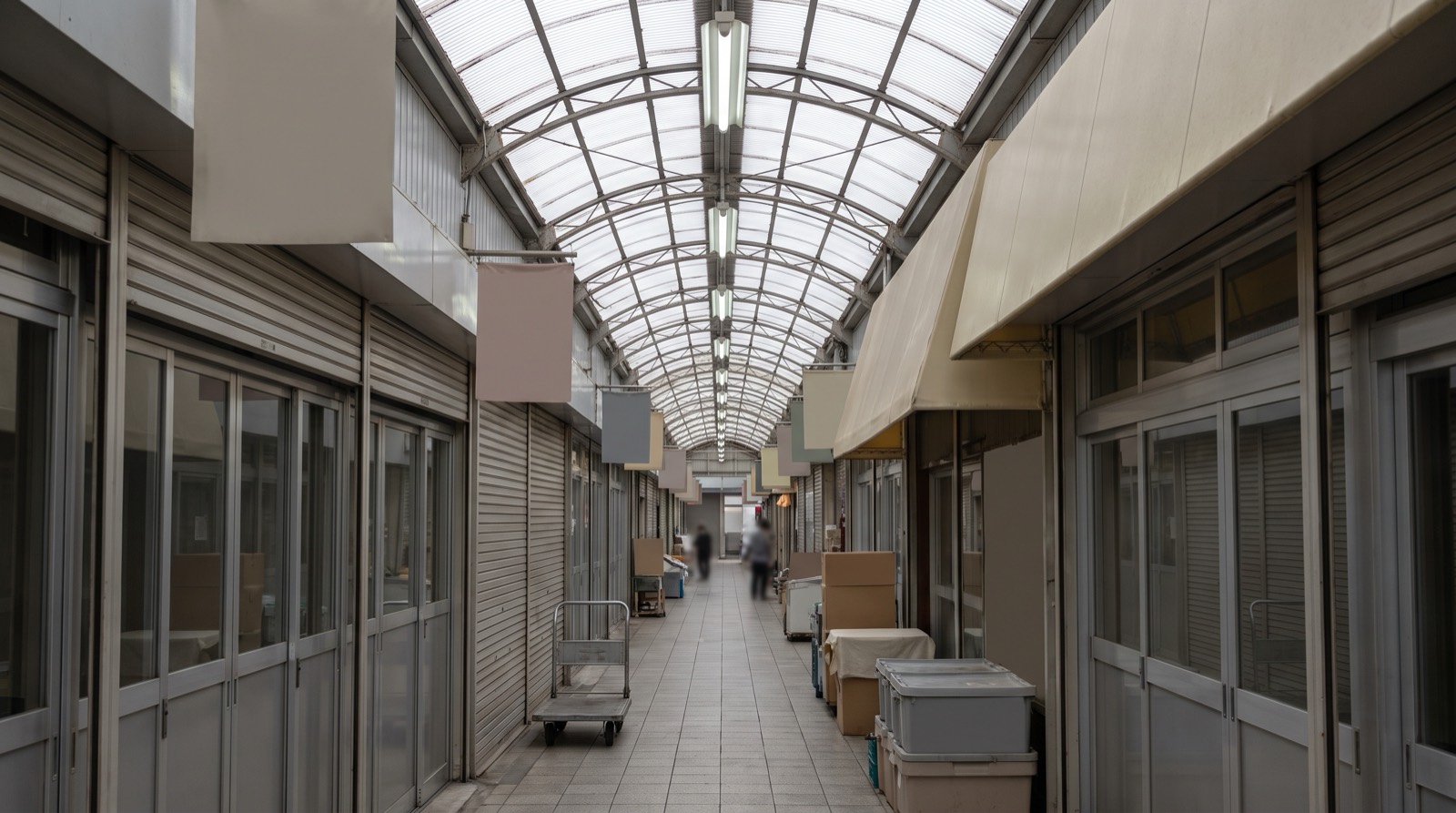
Every visitor to Kyoto is warned about the same thing. There are restaurants here, the warning goes, that will not seat you unless someone who already eats there brings you or vouches for you. The Japanese phrase is ichigensan okotowari, and it translates roughly as no first-time customers. It is repeated in guidebooks, in travel forums, in videos, and in conversation with people who have never been refused anywhere, and it produces a specific behaviour: visitors stop trying. They decide in advance that the small counter with the wooden facade and no menu in the window is closed to them, and they go somewhere with a photograph of a salmon roll on a light box outside.
The warning is not invented. But it points at the wrong industry, and it describes the wrong mechanism. What actually stops a first-time visitor from eating at a Kyoto sushi counter is not a social rule about introductions. It is a set of published, mechanical, entirely legible conditions: a minimum party of two, a single simultaneous seating time, a telephone number that only rings during service, a menu published as a photograph, or two different pages both calling themselves the official site and disagreeing about which day the shop is closed.
None of those are secrets. All of them are printed on pages the shops themselves control, or on pages published by the trade association that runs the arcade they sit in. They are simply printed in a form that a visitor reading in a second language, on a phone, three time zones from home, will not reliably parse. The barrier is not gatekeeping. It is information design.
This article walks five Kyoto sushi counters that will seat a stranger. Every fact in it comes from a page the restaurant or its operator or its shopping-street association publishes. Nothing here is drawn from a review platform, a ranking, or a photograph of a receipt. There is no order of merit and no order of preference. The five are arranged along a single axis: how much the shop tells you before you arrive, against how much it asks of you to get in. That axis turns out to point the opposite way from what anyone would expect.
What the warning is actually about
Ichigensan okotowari is a practice of the ochaya, the tea houses of the five hanamachi districts, and it exists for a reason that has nothing to do with exclusivity. An ochaya does not sell you a meal. It assembles one on your behalf: the geiko and maiko, the food from a caterer, the sake, the room, the musicians. It bills the customer afterwards, sometimes months afterwards, and it settles with every supplier itself. That is a credit relationship, not a dinner reservation, and a house extending unsecured credit to a stranger it cannot invoice is not being exclusive. It is being solvent.
A sushi counter does not operate that way. It takes payment at the end of the meal, from anybody. The economic reason for the introduction system is absent, and so, almost everywhere, is the system. In four days of reading the pages of Kyoto sushi restaurants for this article, across the shopping-street registers, the operators’ corporate sites and the shops’ own domains, we did not find a single sushi restaurant that published a requirement for an introduction. Not one.
What we did find, repeatedly, were conditions with the same practical effect and none of the mystique. A restaurant whose entire menu — seven courses, both meals, from ¥9,800 to ¥39,800 — carries the note two guests minimum, so that a person travelling alone cannot book anything at all. A restaurant whose dinner service begins at one fixed moment for everyone in the room, so that arriving at 19:00 is not late, it is impossible. A restaurant that publishes thirty-two ways to pay and puts its menu online only as a photograph of a piece of paper.
The introduction system is a credit arrangement, and sushi counters do not extend credit. What replaces it is duller and far more effective: a minimum party size, a fixed seating hour, a phone that rings only during service.
That is the substitution this article is about. The barrier moved from the social layer to the operational layer, and it stopped being discussed, because an operational barrier does not make a good story. Nobody writes a blog post about being turned away by a party-size minimum. But it is the same door, and it is closed the same number of times.
Sushi no Musashi, Sanjo Honten: the shop that publishes everything
Start at the extreme end. On Kawaramachi, a short walk north of the Sanjo intersection, in Ebisu-cho 440, there is a conveyor-belt sushi restaurant on two floors with thirty-six counter seats downstairs, eight counter seats and five booth seats upstairs, and a queue outside it most of the afternoon. It opens at 11:00 and takes its last customer at 21:20. It closes one day a year, the first of January. It takes no reservations because it has no mechanism for them and no need of one.
It is also, by a distance, the most thoroughly documented restaurant in this article. Its site publishes the price of every item at seven price levels, in three forms each: the pre-tax figure, the tax-inclusive figure for eating in, and the tax-inclusive figure for taking away. It publishes an English name for every single item on the menu, including the ones a visitor would otherwise have to guess at — engawa, tsubugai, shimesaba, negitoro. It publishes which items are stocked at which of its two shops. It publishes its rice blend, its vinegar formula, its soy sauce, and the port where it buys some of its fish direct.
And it publishes its own accounts. The company page gives the operating company as Karaku Co., Ltd., founded on 5 December 1945, capital ¥38,350,000, about 131 staff of whom 32 are permanent, and revenue for the 2024 financial year of ¥999,082,800. That is a restaurant group with two eat-in shops disclosing a figure to the yen, unprompted, on a page a customer has to click twice to reach.
The history on the same page is worth reading slowly, because it explains what the shop is. The company was incorporated in December 1945 and opened, at the address it still occupies, a musical instrument shop. In January 1958 it opened a grill. In September 1967 it opened an udon restaurant. Then:
- March 1977: opens Mawaru Sushi Genroku Zushi — that is, a franchise of the Osaka company that had built the first conveyor-belt sushi table twenty years earlier and patented it in 1962.
- October 1978: changes the shop name to Sushi no Musashi, and in the same month opens a second branch in Rakuhoku.
- December 1978 to August 1991: branches at Nagaoka, Shijo, Kamihorikawa and Shimeidori.
- September 1992: a takeaway counter inside a Kintetsu department store.
- March 1995 to November 1998: three branches on the Hankyu line, at Katsura Nishiguchi, Sonoda and Itami.
- October 2001: the Kyoto Station Hachijoguchi shop opens.
- October 2014 to October 2015: a fish restaurant at Kyoto Katsuragawa opens and closes within twelve months.
- June 2019: the Kamihorikawa shop closes; three months later the two kitchen centres are consolidated into the building it vacated.
- July 2021 to July 2024: a shop in the Porta underground mall opens and closes at the expiry of its lease.
Count them and the company has opened at least a dozen restaurants in forty-nine years and now runs two. That is not a decline; the two remaining shops and the kitchen turn just under a billion yen a year between them. It is a deliberate contraction into a format — high turnover, long hours, a central kitchen, a takeaway channel — that the company has been iterating on since it stopped selling pianos.
The relevance to a first-time visitor is that this shop is the answer to the ichigensan warning taken to its logical end. There is no introduction, no reservation, no minimum party, no course, no fixed seating time, no dress code and no ambiguity about the bill. You join the queue, you sit, you take what you want off the belt or you order it, and the plates are priced by their pattern. A solo traveller who speaks no Japanese can eat here at 21:15 on a Tuesday in February for ¥1,000 or ¥6,000, entirely at their own discretion, and will know the figure before the first plate is finished.
The second shop, at the Hachijoguchi side of Kyoto Station, inside the Asty Road arcade, has a thirty-four-seat counter, opens half an hour earlier at 10:30, and trades every day of the year. The third address on the shop page, in Kita ward, is not a restaurant at all: it is a takeaway-only unit where orders are accepted exclusively by phone or web, no counter orders and no payment at the door, collection between 12:00 and 18:00. It is the building the closed Kamihorikawa branch left behind. The company page, meanwhile, describes the business as the operation of conveyor-belt sushi restaurants, two directly managed. Read the shop page and you count three locations; read the company page and you count two. Both are true, and a visitor gets no help distinguishing them.
Seven plates with names, and prices carried to one decimal place
The pricing deserves its own section, because it is the clearest example in this article of a restaurant solving a visitor’s problem without being asked to. Conveyor-belt sushi is priced by plate, and the plate design encodes the price. That is fine if you grew up with the convention and useless if you did not. This shop names each level and then prints all three relevant numbers against it.
- Shukin no Tsuru, ¥888 before tax — ¥976.8 eating in, ¥960 taking away. Kobe beef, seared, eat-in only. Sea urchin.
- Goshoguruma, ¥764 — ¥840.4 and ¥826. Bluefin otoro, one piece. Large scallop with lemon. Fatty bluefin thin roll.
- Ichimatsu Kingin, ¥634 — ¥697.4 and ¥685. House kelp-cured flounder. Striped jack, at the station shop only. Large boiled prawn.
- Kinzara, ¥463 — ¥509.3 and ¥501. Scallop with the mantle attached. Wagyu roast beef. Seared eel. Salmon roe.
- Tokujo, ¥364 — ¥400.4 and ¥394. Bluefin chutoro, one piece. Straw-fired bonito. Toro salmon. Red prawn.
- Akazara, ¥263 — ¥289.3 and ¥285. Bluefin akami, one piece. Salmon. Aji, squid, octopus, simmered conger, whelk, cured mackerel, flounder fin. Twenty-odd items.
- Teiban, ¥146 — ¥160.6 and ¥158. Tuna, one piece. Albacore. Prawn. Ark shell. Egg, one piece. Cucumber roll. Inari. Battera.
The gap between the top and bottom plate is a factor of six. The gap between the two tax-inclusive columns is the eat-in and takeaway consumption tax differential, ten per cent against eight, which is why the eat-in figures carry a decimal: ¥976.8, ¥840.4, ¥697.4, ¥509.3, ¥400.4, ¥289.3, ¥160.6. Not one of those is a sum of money you can hand over. They are per-item figures that resolve to a payable total only when the plates are added up.
This is an unusually honest way to publish a price. The alternative — rounding each plate to the nearest yen on the menu — produces a printed total that does not match the till. This shop has chosen to be arithmetically correct on the page and let the register do the rounding, and the visible cost of that choice is seven prices with a decimal point in a country whose smallest coin is one yen.
Seven prices carried to one decimal place, in a currency with no subunit. It is the arithmetic of a shop that would rather look strange than print a number that does not add up.
Two more details on the same page matter to a first-timer more than any of the fish. The first is that some items are marked as stocked at one shop only, in both directions: the seared tuna with mayonnaise is Sanjo Honten alone, the striped jack, the raw salmon, the ishigaki clam, the yuba and the yuba matcha dessert are Hachijoguchi alone. The Kobe beef is marked eat-in only, not available to take away. A visitor who has read a menu photograph taken at the other branch will be looking for something that is not there.
The second is the drinks. A 180ml bottle of junmai daiginjo is ¥1,100 before tax. A medium draught beer is ¥630. Wine, in a 250ml bottle, is ¥580 and is sold at the Sanjo shop only. Non-alcoholic beer is ¥500. These are published in the same table as the sushi, at the same granularity, which means a visitor can construct the entire bill in advance. Very few restaurants in this article allow that, and none of the expensive ones do.
The wasabi notice, and what it tells you about who eats here
On 2 February 2025 the shop posted a notice. From Friday 14 February, it said, all sushi would be served without wasabi; wasabi would be on the table for customers to use as they wished. For takeaway, the change came earlier, from 3 February, with sachets attached instead.
That is a small operational note and it is a useful sentence on the site for a visitor who does not read Japanese. Wasabi between the fish and the rice is invisible, unmentioned, and a common unpleasant surprise for a first-time eater of Japanese sushi. A great many restaurants will remove it if asked in Japanese. This one removed it from everything, for everyone, permanently, and wrote down the date.
It is also a piece of evidence about the room. A conveyor-belt shop on Kawaramachi with a thirty-four-seat sister inside Kyoto Station, publishing an English name against every item including horse meat and smoked duck pastrami, does not make that change for its regulars. The notice is dated, specific, and describes an accommodation made at scale.
The news page it sits on is worth a glance for a different reason. It runs to eleven pages, and it is not in date order. A November 2025 item sits above a March 2026 item; a 1 March 2021 item sits above a 3 March 2021 item. The most recent post, from 1 July 2026, advertises whole-hamo pressed sushi at the station shop for ¥3,000 including tax, six pieces, sold between 14 and 31 July — a window that closed before this article was written and is still at the top of the page.
This matters because it is the failure mode of every restaurant page in this article, including the good ones. The permanent information — addresses, seat counts, hours, prices — is maintained. The dated information decays and stays up. A visitor cannot tell from the page which kind they are reading, and the shops give no signal.
Tachigui Sushidokoro Sushi Nishiki: the shop that publishes nothing
Now the other extreme. Nishiki Market is a covered arcade three hundred and ninety metres long, four hundred years old, with more than a hundred tenants, running one block north of Shijo between Teramachi and Takakura. Four of those tenants are sushi shops. The smallest is a standing counter at Higashi-Uoyacho 168, in the eastern third of the arcade, and it is the easiest room to enter in this entire article.
It is a standing bar. There are no seats to reserve and, at the size described, no realistic prospect of a queue longer than a few minutes. The shopping street association publishes its address, its telephone number, the fact that it has no fax, its opening hours of 10:00 to 19:00 with a last order at 18:30, and the note that it has no closing day, closing irregularly instead. It opens at ten in the morning, which is earlier than any restaurant in the previous article in this series and earlier than most cafes.
The association’s description of it is short and does something no other entry in this article does: it makes a price claim without a price. A very small shop, it says, where you can have proper sushi made with fresh fish, and have it at less than half the price of a high-end restaurant. Local sake and small dishes too. Very convenient for a short stop. The popular omakase board and the lunch set are limited in number. A slightly cramped shop, but extremely comfortable. Please feel free to order more.
Less than half the price of a high-end restaurant is the only quantity anybody publishes about this shop. It is a ratio, not a number, and it is written by the shopping street, not by the restaurant. The operator’s own page for the shop carries a full menu and not one price on it.
That menu is not short. It lists four sets:
- Omakase ichimai — the day’s choice, five pieces each, served on a board with the house red miso soup.
- Lunch set — six pieces of nigiri and a rolled omelette.
- Sushi Nishiki eight-piece nigiri set.
- Premium selection ten-piece nigiri set.
Then twenty-eight single items by the piece: sardine, whitebait, the house egg, horse mackerel, salmon, raw scallop, squid, lean bluefin, amberjack, prawn, raw octopus, raw oyster, sea bream, rich crab, cured mackerel, turban shell, raw shrimp, freshwater eel, flounder, medium fatty bluefin, simmered conger, ark shell, salmon roe, seared wagyu, abalone, splendid alfonsino, blackthroat seaperch, and Hokkaido sea urchin. Then eleven drinks, four of them named sake from named breweries. Then the day’s red miso soup and the day’s special.
Abalone, blackthroat seaperch and Hokkaido sea urchin are not the same order of magnitude as sardine and whitebait. In a shop with published prices they would be four or five times the cost. Here they sit in one undifferentiated column, and a visitor deciding whether to order the nodoguro has no basis on which to decide anything at all.
The easiest room in this article to walk into is also the only one that does not publish a single price. The two facts are not unrelated. Standing counters do not need a page that closes a sale.
Two sets of opening hours for one very small room
There is a second problem with this shop, and it is the kind that a visitor discovers by standing outside a shutter. The shopping street association gives its hours as 10:00 to 19:00, last order 18:30. The operator’s own brand page for the same shop gives 9:00 to 20:00. Both are current pages. Both are maintained by organisations with a direct interest in the shop trading. They disagree by an hour at opening and an hour at closing, which is to say the published trading day differs by two hours out of ten.
There is no way for a reader to arbitrate between them. The association page is the more conservative and carries a last order, which suggests it was written from operational reality. The operator page is rounder and looks like a standard set of hours applied across a group. If you are planning a 9:15 breakfast of sushi in Nishiki Market on the strength of the operator’s page, you are taking a risk that page does not disclose.
The same shop is also called two different things. The association calls it Tachigui Sushi Sushi Nishiki. The operator calls it Tachigui Sushidokoro Sushi Nishiki, with the extra character that means, roughly, establishment. A visitor searching for one name will not necessarily surface the other.
And the shop, which is a standing counter with no seats, offers both telephone booking and online booking. Whatever those book, it is not a seat.
The company behind the standing counter
The official site the association links to is not the shop’s site. It is the corporate site of Natura Foods Co., Ltd., and the shop is one brand entry on it.
The company is registered at 1-7-1 Tatsuminaka, Ikuno ward, Osaka, on the ground floor of an NTT building. It was established on 27 March 2013 with capital of ¥3,000,000. Its representative director is named. It belongs to the Osaka Chamber of Commerce and Industry and the Osaka Foodservice Association. Its own account of itself begins: it started with a single kitchen truck. It now runs about thirty-five directly managed restaurants.
The brand list runs to twenty-four names, and reading it is instructive. There is a Kyushu chicken brand, a Kobe beef brand, a retro Western-food brand, two udon brands, a tempura brand, a ramen brand, a fisherman’s-hut brand, a seafood wholesaler brand, a meat brand, a rice-bowl-and-fish brand, two Kamakura seafood-grill brands, an organic gastro brand, three standing-bar brands, and the two Nishiki sushi shops. One brand page, for a shop whose name means inner Nishiki, contains only the name. The page is otherwise empty.
This is not a criticism of the food. It is the explanation for the missing prices. A twenty-four-brand operator running thirty-five outlets from Osaka does not maintain twenty-four price lists on a corporate site; it maintains twenty-four brand pages that describe a concept, and the prices live on the wall in each shop. That is a perfectly rational allocation of effort, and its cost falls entirely on the person deciding from four thousand miles away whether to walk into a standing counter in a covered market.
The corporate site does publish one document in detail, and it is the cancellation policy, dated 8 December 2025. Course reservations cancelled the day before are charged at fifty per cent, on the day at a hundred per cent, and a no-show at a hundred per cent; cancellation is free up to two days ahead. Seat-only reservations require contact by the day of the booking, and a party more than thirty minutes past its time without contact is treated as a no-show. Bad weather and natural disasters are exempt. Cancellations and changes, it says, are accepted by telephone.
It then lists the telephone numbers, and there are five: a standing bar, a fisherman’s hut inside a Kyoto shopping centre, two branches of the same near Shinsekai in Osaka, and a drinking place. Neither Nishiki shop is on the list. Whatever the online booking form on the standing counter’s page produces, the policy governing its cancellation names a phone number that does not belong to it.
Nishiki Sushishin Honten: fourteen seats, three prices, one telephone
One block along the same arcade, at Higashi-Uoyacho 169-2, is a completely different proposition: a hinoki single-plank counter, fourteen seats, Edomae sushi, fish brought in from Miyazu and Maizuru on the Sea of Japan side of the prefecture, and red and white vinegar used for different fish. It is the closest thing in Nishiki Market to a conventional sushi counter, and it is also, on its own numbers, one of the cheaper serious counters in Kyoto.
Its site is 506 characters long, including the address. That is the whole site. It carries a copyright date of 2023, an address, a telephone number, two sets of hours, a closing policy, a seat count, two social media handles, one instruction and three prices.
The instruction is: reservations by telephone. There is no form, no platform, no email address. The prices are:
- Omakase nigiri, ten pieces, Nishiki — ¥3,000.
- Omakase nigiri, eleven pieces, Jo — ¥5,000.
- Omakase nigiri, ten, Tokujo — ¥7,000.
The naming follows the old three-grade convention: the house grade, the upper grade, and the special upper grade. The oddity is in the middle: the ¥3,000 course has ten pieces, the ¥5,000 course has eleven, and the ¥7,000 course has ten again — and the third line omits the counter word for pieces altogether, so it reads as a bare number. Whether the top course is ten pieces or ten of something else, the page does not say.
Against the rest of Kyoto that is a remarkable set of figures. A ten-piece omakase at a fourteen-seat hinoki counter in the middle of Nishiki Market for ¥3,000 is roughly one plate of the Kobe beef at the conveyor-belt shop, and it is less than a third of the cheapest lunch course at the fifth restaurant in this article. The association’s description adds that the lunch omakase is ten pieces of nigiri and rolls, and the dinner omakase is ten to twelve pieces plus about five other dishes.
The site has one visible defect, and it is a revealing one. Where the image captions should be, the page shows sequences of broken characters — the filenames of the photographs, encoded once in Japanese and decoded once as something else. Read backwards, they resolve to the shop’s own name plus a camera’s serial numbering. Somebody uploaded a folder of photographs straight off a camera in 2023 and nobody has looked at the rendered page closely enough since to notice.
The shop with the fourteen-seat hinoki counter and the ¥3,000 omakase has a website of 506 characters, three prices, and image captions that have been mangled since 2023.
And the shop is the clearest case in this article of the two-official-pages problem. On the shopping street association’s register, this restaurant serves lunch from 11:00 to 15:00 and dinner from a single simultaneous start at 18:00, and it closes on Wednesdays unless the Wednesday is a public holiday. On its own site, it serves lunch from 12:00 to 16:00 with a last order at 15:00, and dinner from 17:30 to 21:00 with everyone out by 21:00, and it closes irregularly.
Every one of those three fields conflicts. Lunch starts an hour apart and ends an hour apart. Dinner is either one fixed seating at 18:00 or a three-and-a-half-hour service beginning at 17:30. The closing day is either a specific weekday with a stated exception, or unpredictable. A visitor who arrives at 11:30 on a Wednesday has read one of the two pages and will discover which.
The market that lists four sushi shops and no seat counts
Both of the Nishiki restaurants above are documented in the same place: the register maintained by the Kyoto Nishiki Market Shopping Street Promotion Association, at 609 Nishi-Daimonji-cho, telephone published, in Japanese and English. The market it describes is 390 metres long, has more than a hundred tenants, and dates its history to four hundred years.
The sushi category has exactly four entries. Two are the shops above. The third is Sushisho, at Higashi-Uoyacho 197, open 10:00 to 20:00 with no closing day, whose entry mentions a dug well at the back of the ground floor that was once the market’s water source and tatami seating upstairs. Its record has no telephone line at all — not a blank field, but no field. As far as this register is concerned the shop has no published telephone number.
The fourth is a seafood wholesaler-restaurant at Kajiya-cho 209 with eighty seats, run by the same Osaka company as the standing counter. Its hours on the association page are 9:00 to 19:00, last order 18:30; on the operator’s own page, 9:00 to 20:00. The same one-hour discrepancy as the standing counter, in the same direction, from the same two sources. Even the street name is spelled with different characters on the two pages.
What the register publishes for every tenant is: address, telephone, fax, opening hours, closing day, official website. What it does not publish for any tenant is: seat count, price range, whether cards are accepted, whether the room is non-smoking, or what an average customer spends. Every category page carries the same disclaimer — hours and closing days may have changed, please understand.
That is worth setting beside the register kept by Shin-Umeda Shokudogai in Osaka, described earlier in this series, which publishes seat counts, last order times, card policy, smoking policy and an average spend for every one of its roughly hundred tenants. Two arcades of similar size, both maintained by their own trade bodies, and one gives a visitor five times as much to plan with. The difference is not resources. It is that the Osaka corridor is a hundred restaurants and the Kyoto market is a hundred shops, most of which sell pickles and knives and fish to take home, and a register designed around retail does not have a seats field.
The one thing the Kyoto register does insist on, on every single page, is a request rather than a fact: please refrain from eating while walking, as it can cause trouble and nuisance; please eat in front of the shop where you bought it, or inside. A market that has become a food street faster than it intended, asking in two languages.
Kanazawa Maimon Sushi, Kyoto Station Porta: the refusal published inside the phone number
The fourth restaurant is in the underground mall in front of Kyoto Station, at Higashi-Shiokoji-cho 902. It belongs to a Kanazawa company, M&K Co., Ltd., registered in Yokaichi in that city, and it is the Kyoto outpost of a conveyor-belt-derived brand built on fish from the Sea of Japan.
It opens at 11:00 and closes at 22:00 with a last order at 21:00, noted as subject to change. It is directly beneath the station, which makes it one of the few restaurants in this article a visitor can reach with luggage.
And its page contains a notably blunt sentence, printed in brackets immediately after the telephone number: we do not accept seat reservations.
Consider what that does. It publishes a telephone number, which is an invitation to call, and inside the same parenthesis it removes the main reason anyone would. It is not hidden and it is not rude; it is simply placed where a reader who does not read Japanese carefully will see a phone number and stop reading. The practical meaning is that this is a walk-in-only restaurant, which for a visitor arriving off a train with a suitcase is close to ideal — and the page communicates that fact in the least prominent position available.
The company’s sister restaurant is eleven floors up and one lot number away: a sushi restaurant on the eleventh floor of the Kyoto Station building at Higashi-Shiokoji-cho 901, same operator, same opening hours, same last order, an identical payment list — and no note about reservations. Whether that means it takes them, the page does not say. Two restaurants by one company, at adjacent addresses, one underground and one on the eleventh floor, and the only structural difference between their pages is the presence or absence of one bracketed sentence.
Thirty-two ways to pay, and a menu you cannot read
The payment section of that page is the most complete of any restaurant in this article, and unusually thorough for any small restaurant’s page. Alongside cash it lists:
- Nine credit and card-adjacent brands: Visa, Mastercard, JCB, American Express, Diners Club, j-west, Discover, UnionPay and a stored-value card.
- Fifteen electronic money systems: ICOCA, Kitaca, Suica, PASMO, TOICA, iD, QUICPay, nanaco, PiTaPa, Rakuten Edy, WAON, Hayakaken, nimoca, SUGOCA and manaca.
- Eight code-payment services: d-barai, PayPay, LINE Pay, au PAY, Rakuten Pay, Alipay, WeChat Pay and merpay.
That is thirty-two named non-cash methods, including two Chinese systems and every regional transport card in the country. The inclusion of Alipay and WeChat Pay is a deliberate accommodation of overseas visitors; so is UnionPay; so, arguably, is publishing the list at all.
The same page publishes its menu as five files. The main menu is a PDF. The lunch menu is a JPEG. The drinks menu is a JPEG. The takeaway menu is a JPEG. Only the allergen information is a PDF alongside the main menu.
A JPEG of a menu cannot be translated by a browser, cannot be searched, cannot be read aloud by a screen reader, and on a phone must be pinched open panel by panel. The restaurant has gone to the trouble of accepting Alipay and WeChat Pay for customers who cannot read Japanese, and has published the prices those customers are being asked to pay in the one format that cannot be machine-translated. It also publishes no seat count at all, which for a restaurant that takes no reservations is the single number a visitor would most like to have.
Thirty-two ways to pay, two of them Chinese, and a menu published as a photograph. The restaurant has solved the transaction and not the decision that precedes it.
Kyoto Sushiichi: two official sites that disagree about everything
The fifth restaurant is south-west of the station, at Sakai-machi 94, on the ground floor of the Onishi building. It is a modern counter-and-private-room sushi restaurant with an English menu, a wheelchair-accessible entrance, a page in five languages and a live availability calendar. On the evidence of its own material it is well prepared for a foreign visitor.
It also has two websites, both of which describe themselves as official, and they contradict each other on nearly every field a visitor would check.
One is built on a reservation platform and carries the restaurant name followed by the word official in brackets. The other is built on a different platform and carries the word official in brackets before the name. Neither links to the other. Here is what they disagree about:
- Telephone: a mobile number beginning 070 on one, a redirect number beginning 050 on the other.
- Seats: sixteen on one, eighteen on the other, the second stating it twice, once in a frequently-asked-questions block.
- Address: one gives the full traditional Kyoto form with the cross-street and direction, the other gives the lot number alone.
- Walk from Kyoto Station: fifteen minutes on one, ten minutes and 740 metres on the other.
- Lunch service: ends 13:30 with last order 13:00 on one; ends 14:00 with last entry 12:30 and last order 13:30 on the other.
- Dinner last order: 21:00 on one, 21:30 on the other, with a last entry of 19:30 stated only on the second.
- Closing day: Mondays, stated flatly, on one; please ask the restaurant, on the other.
- Cards: seven brands including Discover and UnionPay on one; five brands, without either, on the other.
- Courses: seven, including three lunch courses and a cookery class, on one; three dinner courses on the other.
Nine fields, nine disagreements. Neither page is obviously stale — both carry current copyright and both have live booking. A visitor cannot resolve this by choosing the more official-looking one, because the word official is on both, in brackets, in the title.
And the first page contradicts itself as well. It states an average spend of ¥7,001 to ¥8,000 for lunch. Its own course list has three lunch courses, the cheapest of which is ¥9,800 including tax, and every one of them requires two guests. The published average lunch spend is lower than the cheapest thing a customer is permitted to order. Somewhere below that, on the same page, is a notice that the restaurant is closed from 10 to 14 May 2026, which was three months before this was written.
The seat arithmetic does not close either. The summary field says sixteen seats in total. The seating page describes three private rooms, two of which can be combined for a maximum of ten, plus a counter of ten. Three rooms and a ten-seat counter do not obviously come to sixteen, and the second website says eighteen.
The two-guest rule
The line that matters here on that restaurant’s page is not any of the above. It is a two-character annotation on each course, and it appears on all seven of them.
Two guests minimum. On the ¥14,800 dinner. On the ¥24,800 dinner. On the ¥39,800 dinner. On the ¥9,800 lunch, the ¥14,800 lunch and the ¥24,800 lunch. The seventh item, a lunchtime cookery class at ¥25,000 a head, requires between five and ten people.
There is no a-la-carte listing on either site. Which means that a person travelling alone in Kyoto cannot book anything at this restaurant at all. Not the cheapest lunch, not the most expensive dinner, not the class. The counter is ten seats, the restaurant is set up for foreign visitors down to the Korean and traditional-Chinese versions of its own page, and a solo diner is excluded by a rule printed in grey type beside the price.
This is what the ichigensan warning should have been about. It is published, it is unambiguous once you find it, it has a plain commercial logic — a nine-course kaiseki-style progression is easier to run in pairs — and it excludes a specific and very common kind of visitor completely. Nobody writes about it, because it does not sound like Kyoto. It sounds like a booking form.
A restaurant with an English menu, a Korean page, a wheelchair-accessible entrance and a live availability calendar, at which a person travelling alone cannot book a single item.
What actually closes the door
Set the five side by side and the pattern is the reverse of the one visitors are taught to expect. In order of how much each restaurant tells you before you arrive, and what it asks of you in return:
- The conveyor-belt shop publishes seven price bands in three tax forms, an English name for every item, per-branch stock differences, its rice and vinegar and soy sauce, and its annual revenue to the yen — and asks nothing at all. No booking, no minimum party, no fixed time, one closing day a year.
- The standing counter publishes an address, two conflicting sets of hours and not one price — and also asks nothing, because there is nothing to book.
- The fourteen-seat counter publishes three prices and a seat count in 506 characters — and asks for a telephone call, in Japanese, and possibly for you to be seated at 18:00 with everyone else.
- The station restaurant publishes thirty-two payment methods and a menu you cannot read — and asks nothing, in a sentence placed inside a bracket after the phone number.
- The restaurant with the five-language site, the English menu and the live calendar publishes the most of any restaurant in this article — and asks for a second person, on every course, without exception.
The correlation between openness of information and openness of door is not merely weak. In this sample it is inverted at both ends. The restaurant that documents itself most thoroughly for foreign visitors is the only one a foreign visitor travelling alone cannot enter. The restaurant that documents itself least will serve anybody who is standing up at ten in the morning.
The exception, and the reason it is worth naming, is the conveyor-belt shop, which sits outside the correlation entirely: maximum information, minimum conditions. That is not an accident of format. A restaurant whose entire operating model is high turnover and no reservations has a direct financial interest in every prospective customer knowing the price of a plate before they join the queue, because a customer who hesitates on the pavement is a seat not turned. Publishing everything is not generosity there. It is throughput.
How to read one of these pages in five minutes
Nothing above requires Japanese. It requires knowing which five fields decide whether you can eat somewhere, and checking them in a fixed order before anything else on the page.
- Party size, first. Look at the course list, not the summary. If a note appears beside every course, assume it is a minimum. In this sample it was two on all seven courses at one restaurant and absent everywhere else. A solo traveller who checks this field first will save the most time.
- Whether reservations exist at all. Three of these five take none. The information may be inside a bracket after the telephone number, or absent because the concept does not apply. If a page has a phone number and no booking form, read the characters immediately around the number before dialling.
- Whether the shop has one set of hours or two. Search the restaurant name and see whether an arcade, market or station-building register also carries it. Where two registers exist they disagreed, in this sample, three times out of three. Trust the one with a last order time; it was written from operations.
- What format the menu is in. A price table is a restaurant that expects you to decide in advance. A JPEG is a restaurant that expects you to decide at the door. No prices at all is a restaurant that expects you to be local, or brave, or both.
- The date on the newest notice. If the top item on a news page advertises something that finished, the dated content on that site is not maintained and nothing dated should be relied on. The undated content — address, seats, prices — usually still is.
Five checks, in that order, on any restaurant page in Japan. They are more useful than the entire literature on ichigensan okotowari, because they describe conditions that are actually enforced.
And they lead to an ordinary conclusion, which is that Kyoto is not withholding its sushi. Four hundred years of market, thirty-six counter seats on Kawaramachi that turn over from eleven in the morning, a standing counter that opens at ten, a fourteen-seat hinoki counter with a ¥3,000 omakase, and a room under the station that has arranged to take your Alipay. The doors are open. What is closed is the information, and only in the places you would least expect it.
If you want to book one of these
Several of the counters described above answer the telephone only in Japanese, and a few of them take bookings by no other route. AutoReserve is a Japanese reservation service with an English interface, and it states that it will place the call on a diner’s behalf where a restaurant takes reservations by telephone alone. We have not tested it against every restaurant on this page, and a listing there is not a guarantee of a seat — the doors described above are the doors either way.
Frequently asked questions
Is ichigensan okotowari real, and will a Kyoto sushi restaurant turn me away for it?
It is real, and it belongs to the ochaya of the hanamachi districts rather than to restaurants. The reason is financial rather than social: an ochaya assembles an evening on the customer’s behalf — performers, food from a caterer, sake, the room — pays every supplier itself and bills the customer afterwards, sometimes months afterwards. That is unsecured credit, and it requires someone who can be invoiced. A sushi counter takes payment at the end of the meal from anybody, so the economic basis for the system is absent. Across the shopping-street registers, operator sites and restaurant domains read for this article, not one Kyoto sushi restaurant published a requirement for an introduction. The conditions that do turn people away are published, mechanical and dull: party-size minimums, fixed seating times and telephone-only booking.
I am travelling alone. Which of these five can I actually book or enter?
Four of the five, and three of those need no booking at all. The conveyor-belt shop on Kawaramachi takes no reservations and has forty-nine seats across two floors; its sister inside Kyoto Station has a thirty-four-seat counter and trades every day. The standing counter in Nishiki Market has no seats to reserve and opens in the morning. The restaurant under the station states plainly, in brackets after its telephone number, that it does not accept seat reservations, which makes it walk-in only. The fourteen-seat counter in Nishiki takes bookings by telephone, in Japanese, and one of its two published schedules has dinner starting for everyone at once. The fifth restaurant, the one with the English menu and the five-language site, marks every one of its seven courses as requiring two guests, and has no a-la-carte listing on either of its websites, so a solo diner cannot book anything there.
Why do so many of these restaurants have two different sets of opening hours?
Because two organisations publish them and neither is wrong. A shopping-street association or station-building operator keeps a tenant register for its own purposes; the restaurant or its parent company keeps a brand page for different purposes; both are updated on their own cycles and neither reconciles with the other. In this article it happened three times out of three where two registers existed. The standing counter is 10:00 to 19:00 on the market register and 9:00 to 20:00 on the operator’s page. The seafood restaurant next door shows the same one-hour gap at closing. The fourteen-seat counter differs on lunch, dinner and closing day — every field. As a rule of thumb, prefer the version that publishes a last order time, because a last order is written from operational reality rather than from a template.
What do these five actually cost?
The spread is wider than in any other article in this series, and only two of the five publish enough to answer the question. The conveyor-belt shop prices seven plate bands from ¥146 to ¥888 before tax, with tax-inclusive figures given separately for eating in and taking away, so a bill can be constructed in advance to the yen; drinks are published at the same granularity. The fourteen-seat counter in Nishiki publishes three omakase courses at ¥3,000, ¥5,000 and ¥7,000, which is unusually low for a counter of that kind in Kyoto. The restaurant south-west of the station publishes seven courses from ¥9,800 to ¥39,800 including tax. The station restaurant publishes its menu only as images and PDFs. The standing counter publishes twenty-eight items by the piece, from sardine to abalone and sea urchin, and not a single price for any of them.
Is Nishiki Market a sensible place to eat sushi, or only to walk through?
Both, with a caveat the market itself publishes. Its association register lists exactly four sushi shops among more than a hundred tenants: the standing counter, the fourteen-seat Edomae counter, an eighty-seat seafood wholesaler-restaurant, and a shop whose entry mentions a dug well at the back of the ground floor that was once the market’s water source and which carries no telephone number at all. The caveat appears on every page of that register in two languages: please refrain from eating while walking, and eat in front of the shop where you bought it or inside. The register also publishes address, telephone, fax, hours and closing day for each tenant — and no seat count, price range, card policy or smoking policy for any of them, which is markedly less than an equivalent Osaka arcade publishes for its own tenants.