A menu that lists this fish almost always writes one name: ノドグロ, nodoguro. If a second name appears at all, it is smaller, in parentheses beside the first — akamutsu — and it reads like a translation rather than an equal. That parenthetical is the standard Japanese name for the species. The name doing all the work in front of it is not.
What it is
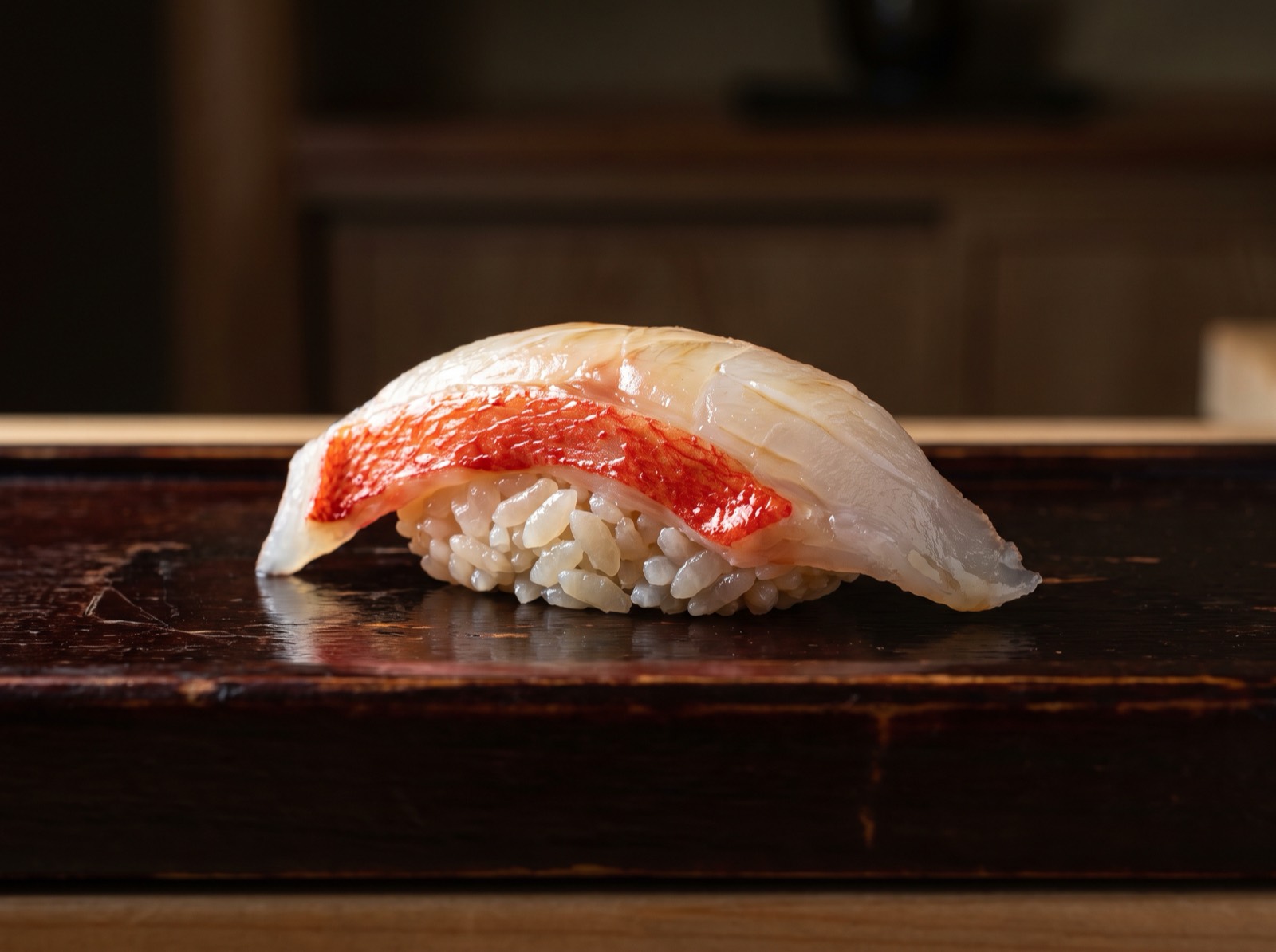
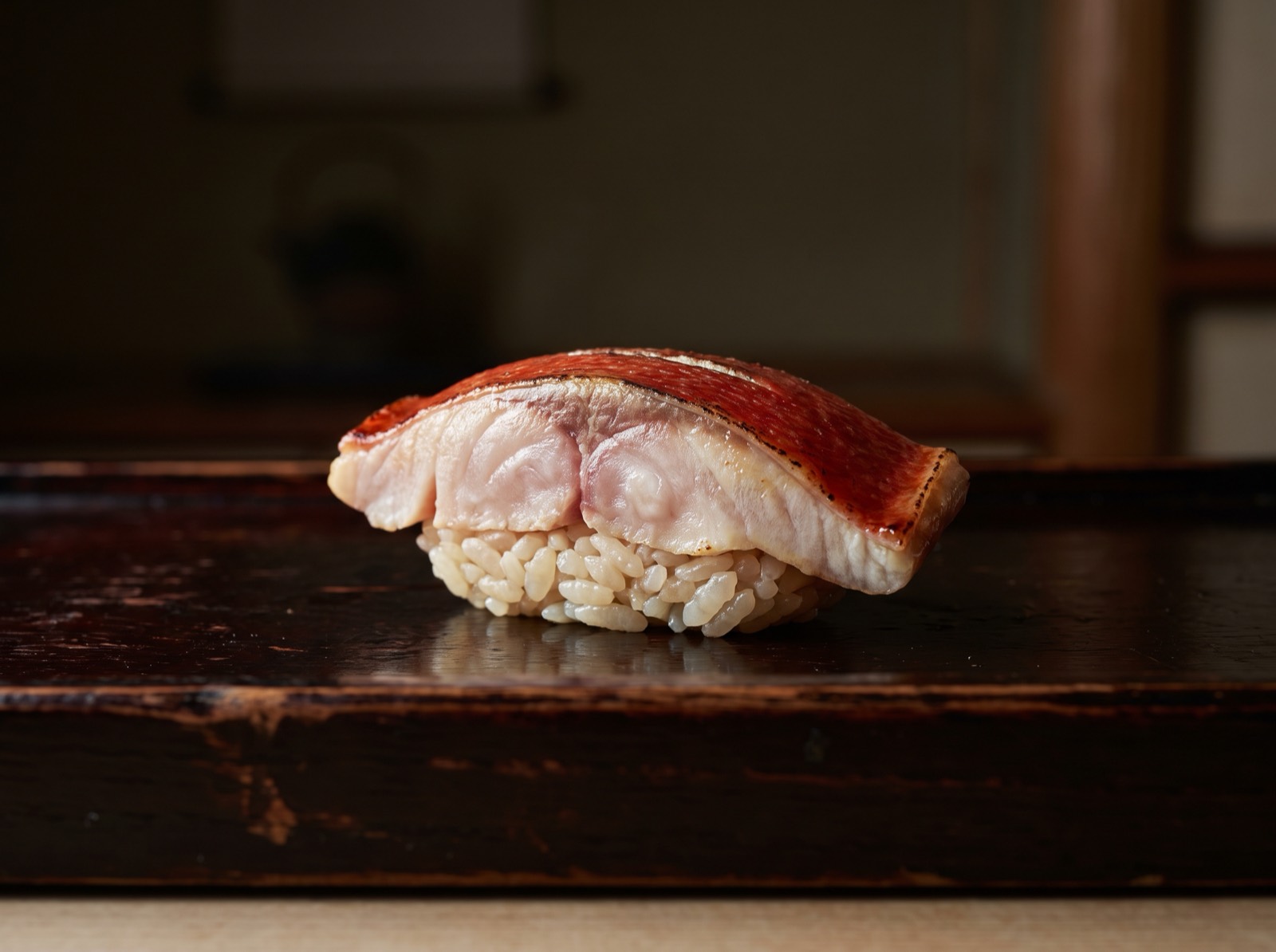
Nodoguro (ノドグロ) is blackthroat seaperch, Doederleinia berycoides: a deep-water fish with brilliant scarlet skin, white flesh, and a fat content that puts most other white fish in the shade. It sits on the seabed in cold water off the Sea of Japan coast, and it is landed heaviest from autumn into spring.
Two names, and only one of them spoken
The standard name, akamutsu (アカムツ), is built from two pieces: aka, red, and mutsu. The word mutsu is on record in the trade literature as a shortening of mutsukkoi, an old description for a markedly fatty fish. It was not coined for this species alone: an unrelated deep-water fish carries the same root, distinguished only by its own colour prefix. Two families, one shared word, because Japanese fish-naming reaches for mutsu whenever a fish is fatty enough to earn it.
The popular name, nodoguro (ノドグロ, written 喉黒), reads plainly as “black throat.” What we consulted gives the word itself but not an explanation for it, so we record any account of what exactly is black, and why that became the name, as a popular reading of the characters rather than a documented etymology.
In practice the split runs one way. Restaurant write-ups and fish profiles in the Japanese trade press write nodoguro first and largest, adding akamutsu afterwards in parentheses if at all, a pattern that repeats across independent sources. Akamutsu fares better in reference works organised by species rather than by counter, where it appears as the running head and nodoguro is folded into a caption — not disagreement, just different audiences. The audience that eats the fish reads it, almost always, as nodoguro.
- Ishikawa markets its own catch simply as nodoguro, letting the prefecture name carry the distinction.
- Shimane uses Donchicchi Nodoguro (どんちっちのどぐろ), a regional brand built on the popular name rather than the standard one.
- Nagasaki departs from both and calls its catch Beni-hitomi (紅瞳), “red pupil”, a name that shares nothing with either akamutsu or nodoguro.
Even nodoguro is not this fish's alone. The trade literature carries an explicit warning about it: in Sagami Bay, the same word is a local nickname for offshore horse mackerel, a different fish altogether, and readers are cautioned to check which one is meant. The name that has all but replaced the standard one is, in at least one place, doing someone else's job as well as this fish's.
The name that has all but replaced the standard one is, in at least one place, doing someone else's job as well as this fish's.
When it is best
Autumn into spring, when landings from the Sea of Japan are heaviest and the fat is at its fullest. It lives too deep and too far offshore to disappear the way an inshore fish does out of season, but the trade literature treats the colder months as the ones worth ordering it in, and San’in prefectures — Shimane above all — build regional pride around exactly that window.
What the chef does to it
The fat sits in a distinct layer directly under the skin, thick enough that removing the skin means removing much of what makes the fish worth ordering, and much of what follows is built around keeping that layer intact and making use of it.
- Salt. A light salting on both sides draws out surface moisture and begins to firm flesh that starts out very soft.
- Yubiki (湯引き). Boiling water is poured over the skin side alone, then the fish goes straight into ice water. The skin softens enough to eat without the flesh beneath ever cooking, and the gelatinous layer just under it stays exactly where it is.
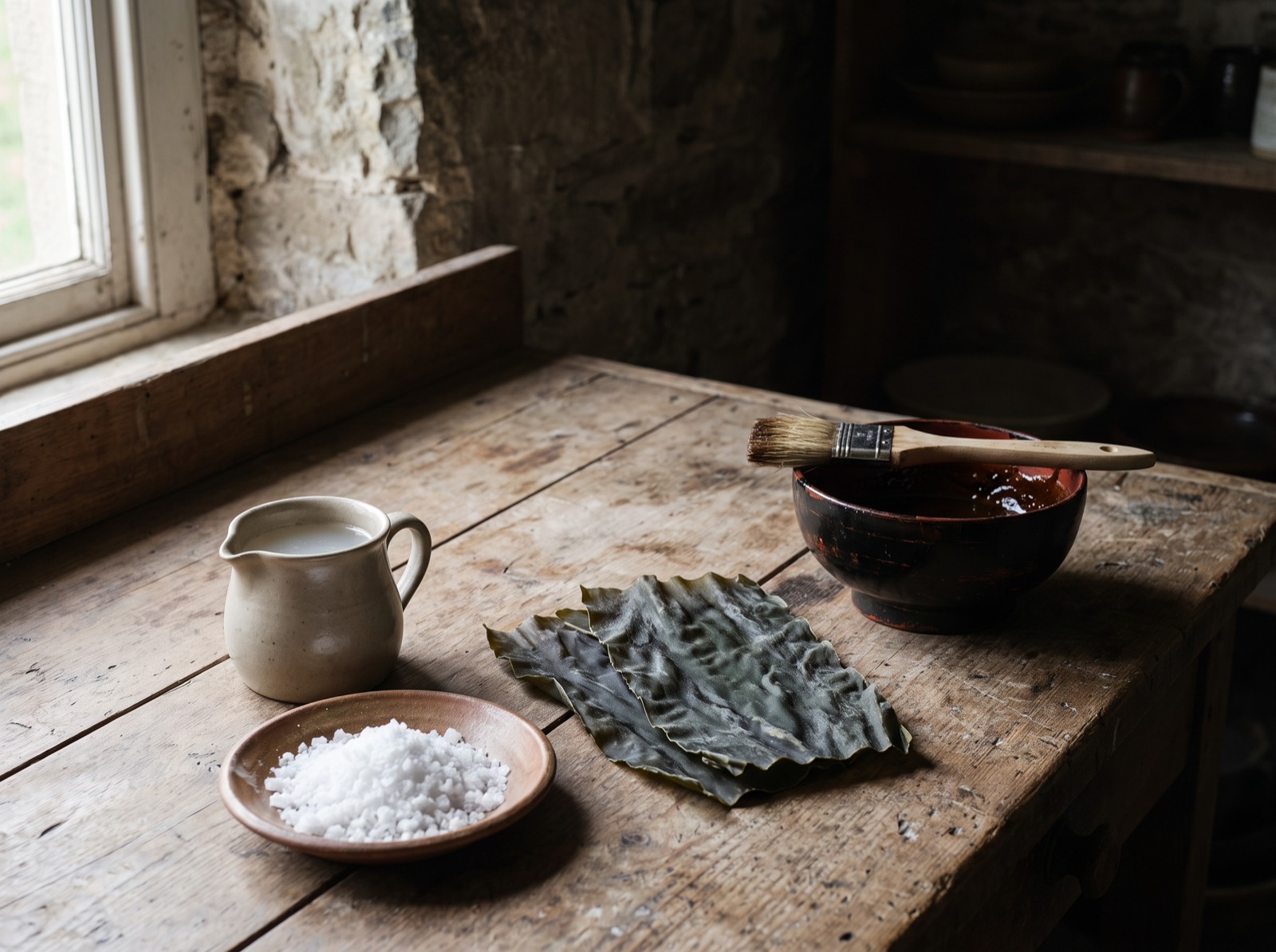
- Kobujime (昆布締め). The fillet is wrapped in kelp moistened with sake and left under a light, even weight in the refrigerator, for a period the chef judges by the size and fat of that day's fish rather than by the clock.
- Rest. Unwrapped and held chilled until service, the piece continues to firm and its flavour continues to settle.
Nigiri is not the only place it goes, and at this level of fat, direct heat is often the more natural choice. Salt-grilled skin-on fillets and lightly smoked ones both appear on izakaya menus built around this fish, treatments that let the fat render rather than merely soften, and the source material treats both as standard preparations in their own right, not as fallbacks from nigiri.
How it differs from what it is confused with
- Nodoguro and kinmedai are grouped together as the fatty red-skinned deep-water fish, and our kinmedai entry already places nodoguro as fattier still and priced higher again. Where kinmedai's fat is managed mostly with boiling water and a flame, nodoguro turns up on a grill or in a smoker just as readily.
- Nodoguro is not mutsu in the narrower sense. A separate, unrelated deep-water fish carries that word alone or as kuromutsu, “black mutsu”, and shares only the root, not the family.
- The word nodoguro is not always this fish, as the Sagami Bay usage for horse mackerel shows. A menu using the word is almost always naming this species, but it is not a certainty.
How to say it
ah-kah-MOO-tsu is close enough, four beats, a-ka-mu-tsu, with no strong stress on any of them. Nodoguro is noh-doh-GOO-roh, also four beats, no-do-gu-ro, and it is by far the more useful of the two to know: it is the word that will actually get you the fish.
Edomae and Kansai
This is not a historically Edomae fish. Its home ground is the Sea of Japan coast and the San’in region in particular, where it has been used in sushi for longer than anyone in Tokyo has been serving it. The trade literature is direct about the order of events: established there first, favoured in Kanto only recently. A Tokyo counter serving it well is not drawing on an old Edomae habit; it is doing what Edomae counters have always done with a good fish from somewhere else, which is take it in.
In the San’in region itself, small fish are often served with the skin lightly seared rather than raw, a treatment suited to a fish too fatty to need much else done to it. Kansai's white-fish idiom, built around lean fish and kelp, has less obvious use for something this rich; the fish's strongest regional identity sits north of both traditional centres.
Where you will see it, and roughly what it costs
On winter and early-spring omakase courses at counters that carry Sea of Japan fish, and on izakaya menus as a grilled or smoked dish as often as nigiri. No per-piece figure from us; see omakase price tiers.
What is worth knowing instead is that a piece billed simply as the popular name and a piece billed with both names in parentheses are, as far as the fish on the plate is concerned, the same order.
Frequently asked questions
What is nodoguro?
Blackthroat seaperch, Doederleinia berycoides: a deep-water, red-skinned white fish with an unusually heavy layer of fat just under the skin. It is landed off the Sea of Japan coast, heaviest from autumn into spring.
Is nodoguro the same fish as akamutsu?
Yes. Akamutsu is the standard Japanese name; nodoguro is the popular one. In the trade press that describes how the fish is actually talked about, nodoguro is written first and largest, with akamutsu added afterwards in parentheses if at all.
What does the name nodoguro mean?
Written 喉黒, it reads plainly as "black throat." The sources we consulted give the word but not an explanation for it, so any account of what exactly is black, and why that became the name, is recorded here as a popular reading rather than documented etymology.
Why does akamutsu have "mutsu" in its name?
Mutsu is documented in the trade literature as a shortening of mutsukkoi, an old description for a fish that is markedly fatty. An entirely different, unrelated deep-water fish carries the same root word, distinguished from akamutsu only by its own colour prefix rather than red.
Does nodoguro always mean this fish?
Almost always, but not quite. The trade literature notes a regional exception: in Sagami Bay, the same word is a local nickname for offshore horse mackerel, a completely different fish, and it explicitly cautions readers to check which one is meant.
How is nodoguro prepared at a sushi counter?
Often kelp-cured after a light salting and a brief scald of the skin (yubiki), which softens the skin without cooking the fat-rich flesh beneath it. Just as commonly, it is salt-grilled or lightly smoked and served off the rice entirely, rather than as nigiri.