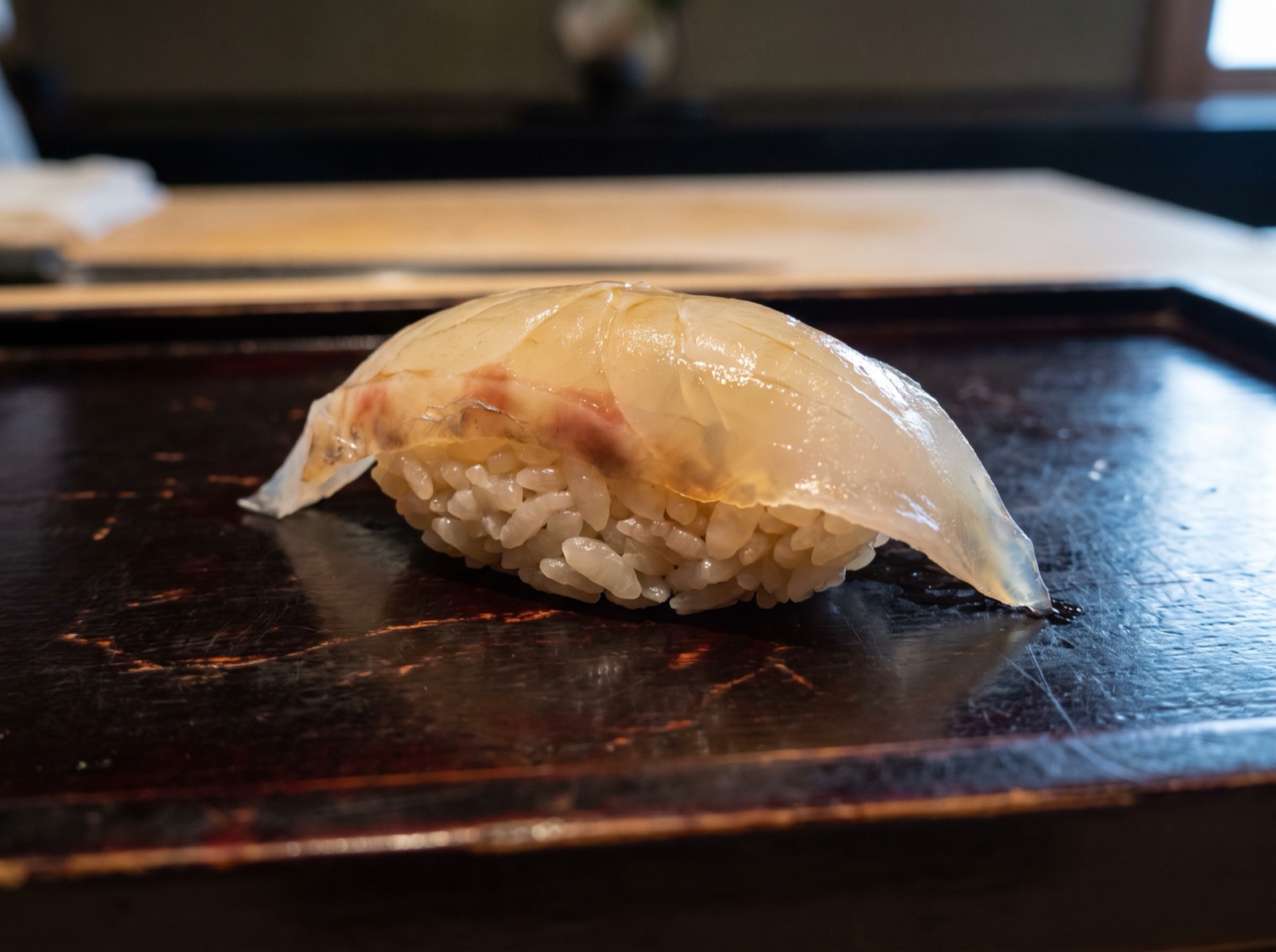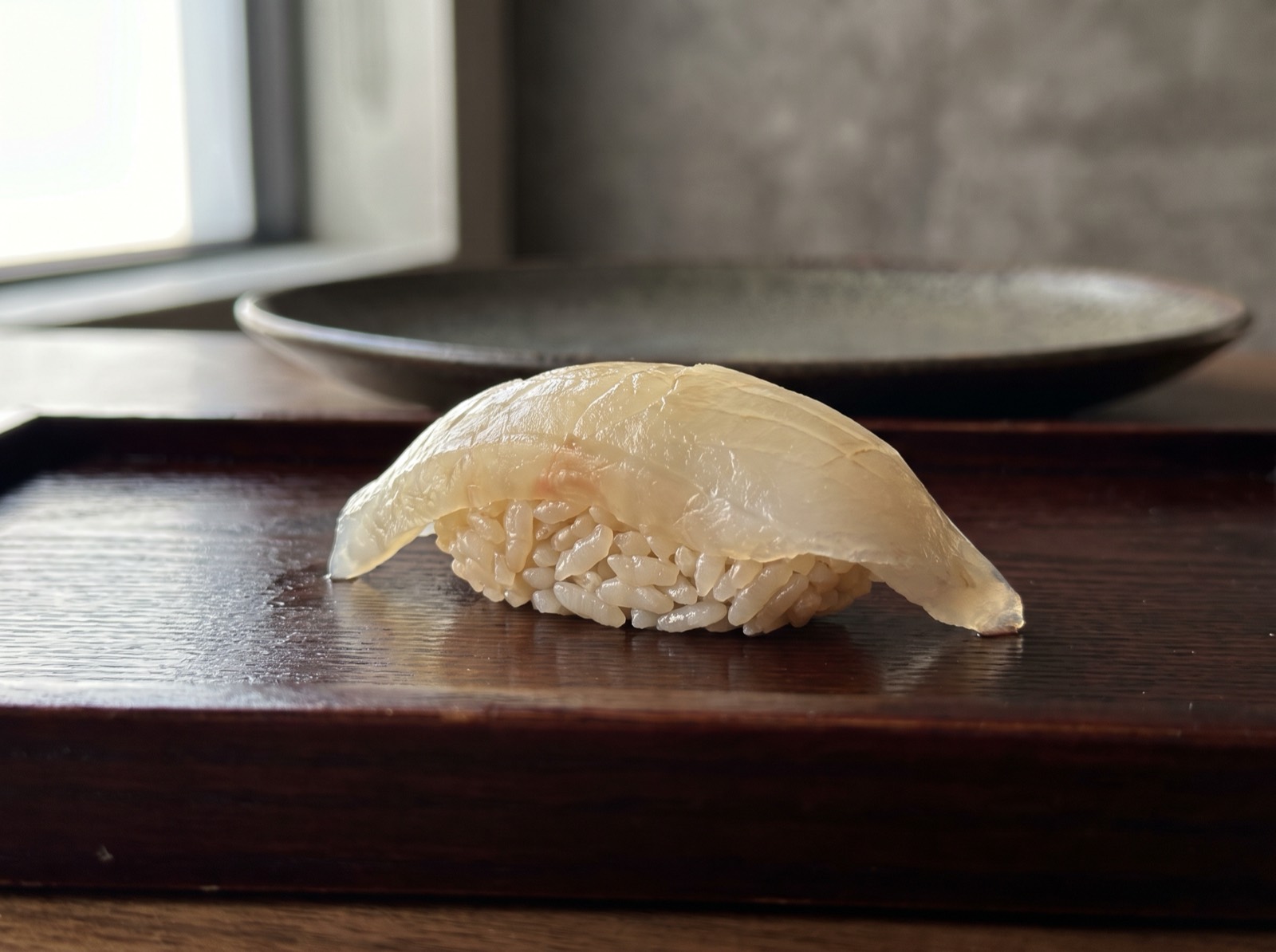
Kobujime leaves nothing to see. There is no crosshatch of a decorative knife, no seared skin, no visible glaze — set beside plain sashimi, a piece that has spent a day between sheets of kelp looks almost identical to one that has not. What changed happened earlier, out of sight, and the only evidence of it is on the tongue.
What it is
Kobujime (昆布締め) means pressing sashimi between sheets of kelp, kombu, and leaving it to rest. The word ends the same way su-jime does — -jime, “to firm” — and the shared ending is part of why the two get confused with each other. What differs is everything before it. There is no vinegar in kobujime, and no cure by acid. A fillet may be salted briefly first, but that step is preparation, not the treatment itself. The treatment is the kelp: a dried sheet with an appetite for the fish’s water, and a flavour of its own to trade in exchange.
The Japanese trade word for this whole family of treatments is shigoto, work done to a topping before it reaches the rice, and kobujime sits inside it as a kind of ageing by contact: not open-air ageing, but a fish held against a specific flavour source rather than left alone. Our guide to what Edomae actually means sets out the four families this belongs to, and where kobujime sits among them.
Which fish get it
Kobujime is a white-fish technique first, and a squid technique second. Sea bream, madai, is the fish most associated with it on this site and in the literature behind it; hirame, flounder, is the other regular subject, sometimes down to the engawa cut as well as the main fillet. Squid takes the same treatment for a related reason: it, too, is lean, without much fat to carry a flavour of its own.
That leanness is the whole mechanism. A fish with very little fat gives up its water quickly and takes on the kelp’s savour just as quickly, so the exchange is fast and the result is predictable. A fattier fish already carries plenty of flavour of its own and holds its water more stubbornly; it is not what kobujime is reached for, which is why it is not the treatment applied to something like fatty tuna.
What the chef actually does
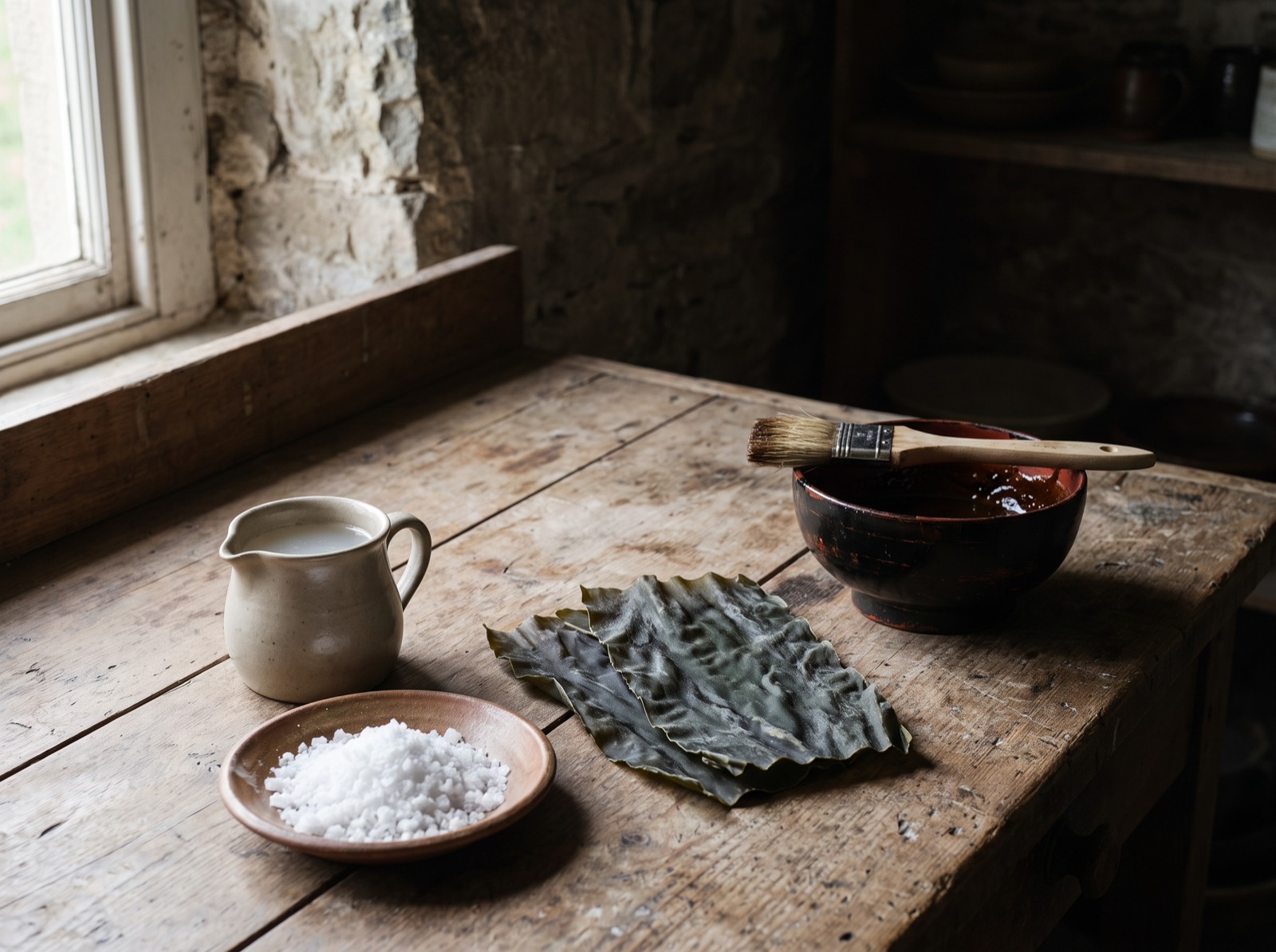
The fish arrives as a fillet or a block, saku, the same cut used for plain sashimi. Some chefs salt it lightly first — a brief scattering, left just long enough to draw the surface moisture out — then rinse it and pat it dry before the kelp ever touches it. Others skip the salt and go straight to the kelp. Either way, the salting, where it happens, is a preliminary, not the cure.
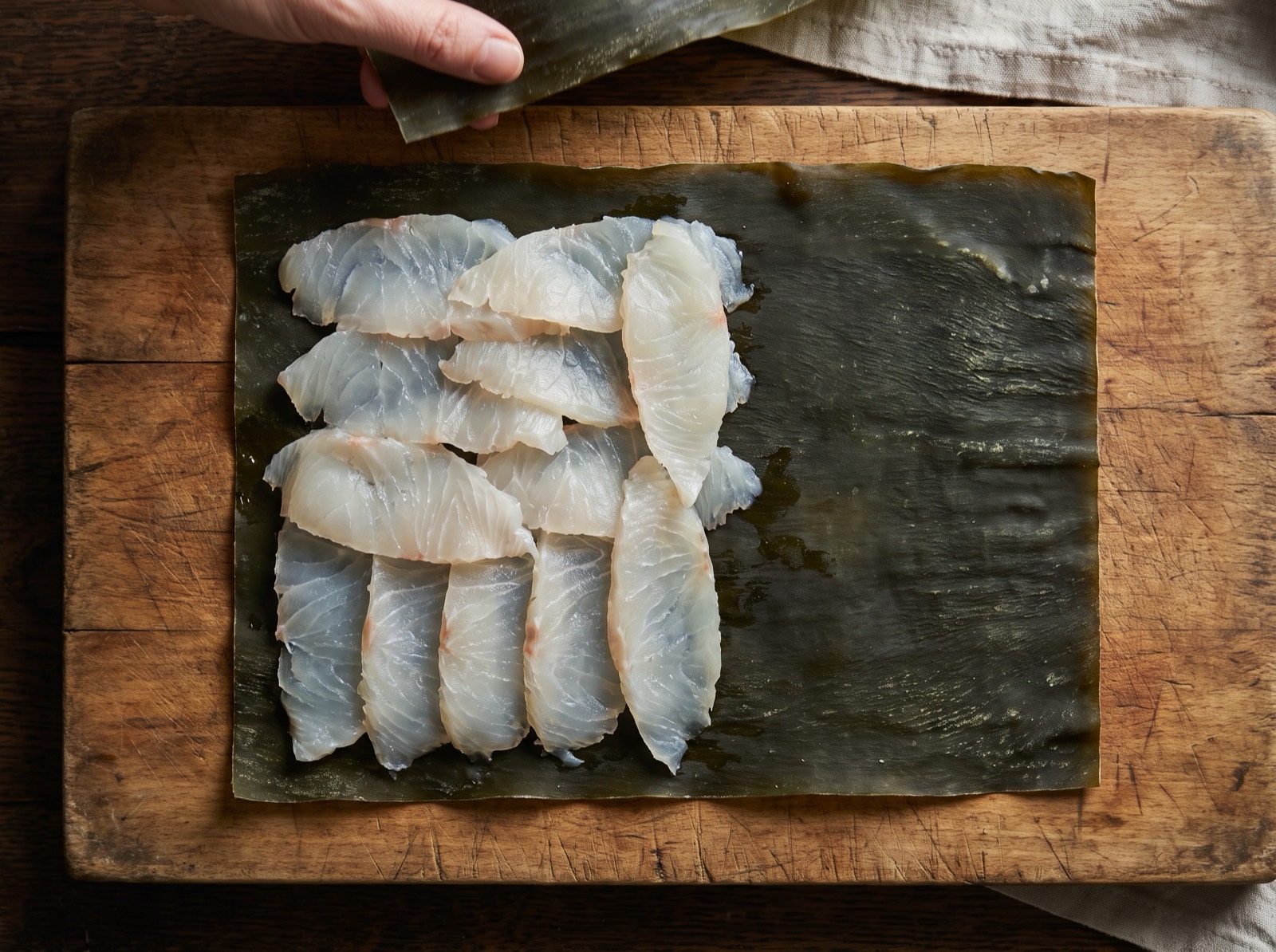
The kelp itself has to be dried, not fresh, because it is the dryness that does the work: a dried sheet pulls moisture out of whatever touches it. The fish is laid directly against it, sandwiched under a second sheet or wrapped, and left.
- Salt. Optional, and brief. Draws surface moisture out before the kelp is involved.
- Kelp. The fillet is laid between two dried sheets of kombu, in direct contact.
- Rest. Most sources describe this as an overnight process, though how long a given piece actually needs is a judgement about that fish, not a fixed number.
- Unwrap. The fillet is lifted out and sliced to order.
What comes out is firmer than what went in, slightly translucent rather than glassy, and often a shade darker — some of the kelp’s own colour moves into the flesh along with its flavour. None of this is a safety measure. Like the salt and vinegar used on kohada, neither the salt nor the kelp in kobujime kills parasites; the measures that do are covered in is sushi safe to eat in Japan.
Why it is done
Kobujime belongs to the same history as the rest of Edomae work: a set of techniques invented before refrigeration existed, to let fish be held and still be safe to eat. A fillet resting against kelp for a day was originally being kept, in the plainest sense — drawn free of the moisture that spoils fastest.
That job disappeared with the refrigerator, and the technique did not disappear with it, because it turned out to be doing something else worth keeping. Kelp is rich in one savoury compound, glutamate; fish carries a different one, inosinate. Put together, the two reinforce each other far more than either does alone — food science calls this umami synergy, and it is the reason a piece of kobujime-cured fish tastes stronger, not just firmer, than the same fish left untreated.
Su-jime cures with vinegar. Kobujime cures with kelp, and there is no acid in it anywhere.
How it differs from what it is confused with
- Kobujime and su-jime are both described, in English, as “curing,” and both end in the same Japanese verb. Su-jime, the salt-then-vinegar treatment behind kohada and shime-saba, changes the fish with an acid. Kobujime uses salt, sometimes, and then kelp — nothing acidic touches it at all. One is a chemical cure; the other is closer to a controlled dehydration with flavour added back.
- Kobujime and jukusei, open-air ageing, are cousins rather than the same thing. Both let a fish sit and change over time. Jukusei happens with the fish exposed; kobujime happens with the fish held against a specific ingredient that is doing chemical work of its own.
- Kobujime is not the same as plain sashimi, even though the two can look identical on the plate. Untreated sashimi is simply cut and served; a kobujime piece has already lost water and gained flavour before the knife ever reaches it a second time.
How to say it
ko-bu-ji-me, four even beats. Note that the kelp is kombu on its own but becomes kobu inside this compound — a regular sound change in Japanese, not a spelling inconsistency, and the same shift shows up wherever kombu is paired with another word.
Where you will see it
Printed on a menu, it is usually just the two characters, 昆布締め, next to the name of the fish. At the counter it is easy to miss entirely, since there is nothing on the plate to signal it — a chef working in this style will often say so out loud when the piece is served, because the technique has no other way to announce itself.
English menus and English write-ups of Japanese food have not settled on one translation. “Kelp-cured” and “kelp-pressed” both appear, sometimes for the same dish, depending on whether the writer is describing the effect or the action. Neither is wrong. Both describe the same two sheets of kombu.
Edo and the west
Kelp curing is more strongly associated with the Japan Sea coast and the west of Japan than with Tokyo specifically; it entered the Edomae repertoire as one technique among the four rather than as the one the style is best known for. That is a different balance from su-jime, which is about as Edo as a technique gets. A Tokyo counter that kobujime-cures its white fish is doing something it inherited rather than something it invented, which does not make the work any less exact.
Frequently asked questions
What is kobujime?
Pressing sashimi between sheets of kelp, kombu, and leaving it to rest, usually overnight. Unlike vinegar curing, kobujime uses no acid: the kelp firms the fish by drawing out its water and gives back savour in exchange.
Is kombu-cured fish raw?
Yes. Kobujime changes the fish's texture and flavour but nothing about the process cooks it, and the fish stays raw in the way sashimi is raw. It is also not a food-safety step; the measures that make raw fish safe in Japan are covered separately in our guide to sushi safety.
What is the difference between kobujime and su-jime?
Su-jime salts the fish and then cures it in vinegar, an acid that changes the flesh chemically. Kobujime may involve a brief salting too, but the actual treatment is kelp, not vinegar, and no acid touches the fish at all.
Which fish is kobujime used on?
Mainly lean white fish, madai and hirame among them, and squid. Fat content is the reason: a lean fish gives up its water and takes on the kelp's flavour quickly, which is what makes the technique work.
How long is fish cured in kelp?
Most sources describe an overnight rest, but the sources are also explicit that the correct length depends on the fish, its thickness and its fat content. There is no fixed number in the literature, and we do not print one.
How do you pronounce kobujime?
Ko-bu-ji-me, four even beats. The kelp is kombu on its own but becomes kobu inside this word, a regular sound change rather than a spelling inconsistency.