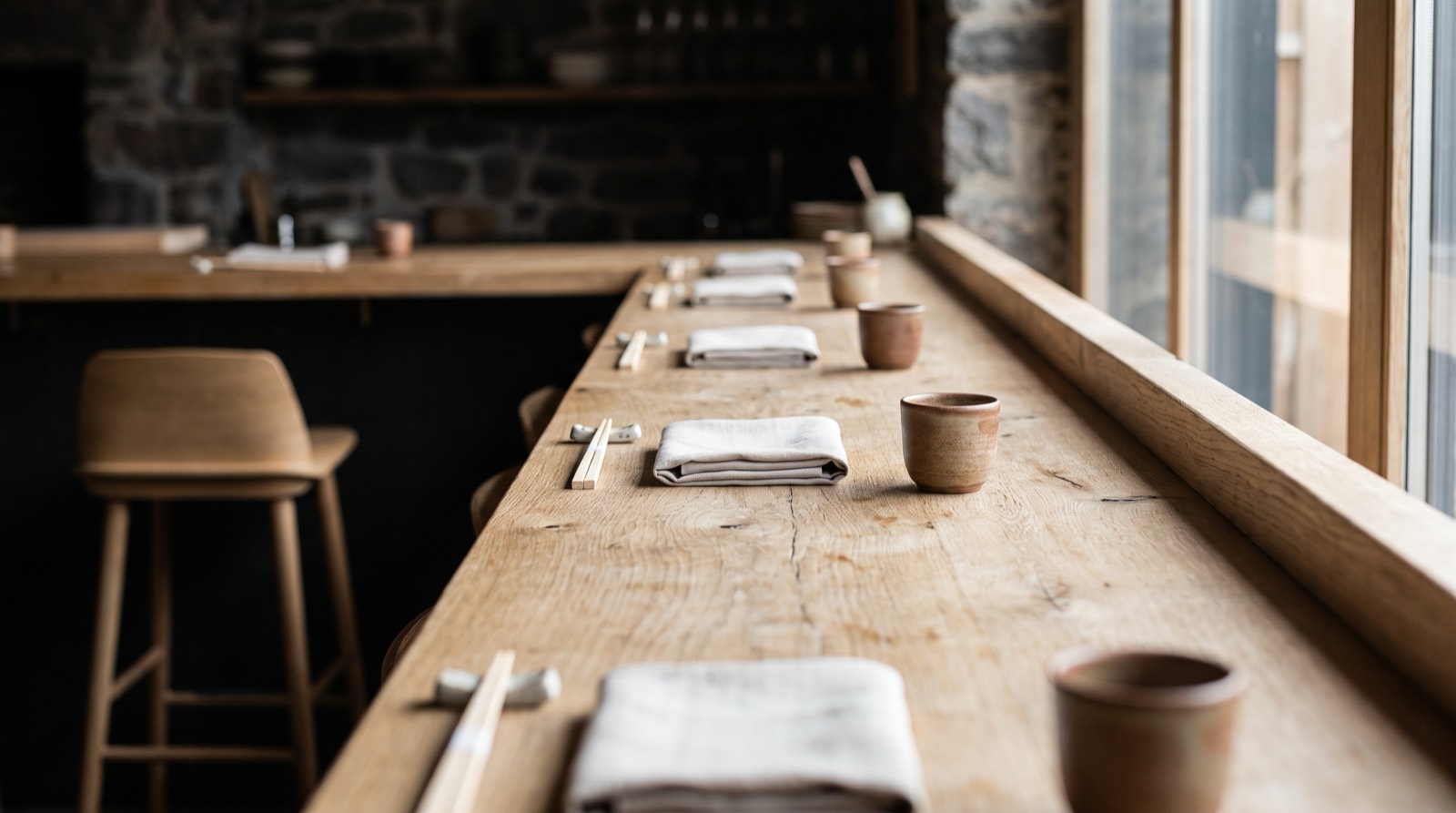
The worry is usually phrased as a question about welcome. Will they seat me — alone, at a counter built for the sort of evening that comes in pairs. It is the wrong worry. Almost nothing in Tokyo turns a single diner away. What turns a single diner away is a mechanism: a reservation book that opened ninety days ago, a queue that closed an hour before you arrived, a telephone line that answers in Japanese. And the mechanism, unlike the welcome, is published.
So this is not a list of counters that are kind to people eating alone. Kindness is not something anyone can verify from a website, and we are not going to pretend otherwise. It is a list of five Tokyo counters where the thing you have to produce in order to sit down is small and clearly stated: nothing at all, a phone in your pocket, a numbered ticket, a walk-in before five, and one sentence at the end of the meal.
They are arranged by the size of that ask, smallest first. That is an order, not a ranking. Nobody from this journal ate at these five for this article, and we do not award stars.
The counter was built for one
Two of the five shops below were founded in 1889. Neither of them started as a restaurant.
Tsukiji Sushisay says its first generation, Kondo Seisuke, began from a stall in the fish market that then stood at Nihonbashi, and only later hung a shop curtain over a door. Janoichi says it opened the same year at the north end of the Nihonbashi bridge, in the same market, as a stall called Janome-zushi. The novelist Shiga Naoya, a regular in the first generation’s day, called the owner Ichi-chan of the Janome, and the shop has carried the name Janoichi ever since.
The third shop in this list is not old at all and describes itself in the same terms. Uogashi Nihon-ichi calls its standing counters a return to the sushi stall of two hundred years ago, and its own line for them is: freshly made Edomae sushi, whenever you want it, whichever fish you want, as much as you want.
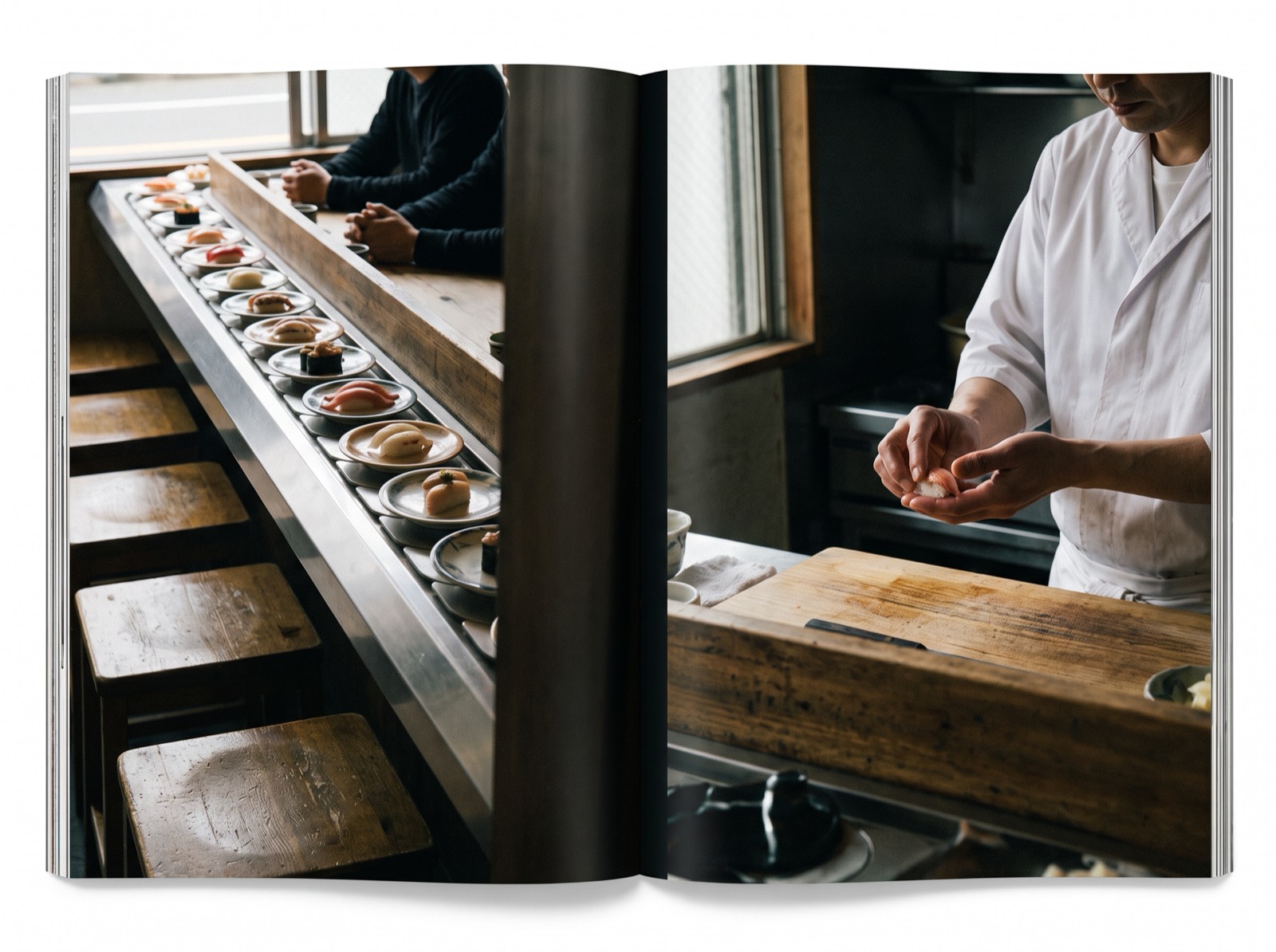
A stall has no reservation book, no table plan and no minimum party. You arrive, you stand, you eat what you point at, you leave. Every constraint that makes a person eating alone feel like an inconvenience — the pair of seats sold together, the fixed seating time, the deposit — arrived later, with the room. The counter, for one person, is not an awkward compromise. It is the older shape of the thing.
A party of four needs four seats together. You need one. On a full evening that is not a disadvantage. It is the only condition in the room working in your favour.
Uogashi Nihon-ichi Shinbashi, which cannot take your booking
The clearest sentence about reservations we found on any of these five sites is a refusal, and the refusal is the reason the shop is here: standing shop, therefore no reservations.
- 3-21-10 Shinbashi, Minato-ku, ground floor of the Orbus Building. Telephone 03-5472-0641.
- Hours as published for the week of 2 August 2026: 11:00 to 23:00 Tuesday to Friday; 11:00 to 14:30 and 17:00 to 23:00 on Monday; 11:00 to 22:00 Saturday; 11:00 to 21:30 Sunday.
- Reservations: not accepted, and the store page gives the reason — it is a standing shop.
- Sets, per person: ¥1,400 for ten pieces at the base grade, ¥1,800 at the next, ¥2,400 above that, and ¥3,000 for ten pieces plus a roll at the top. A seafood chirashi is ¥1,500.
- Payment: cash, Visa, Mastercard, transport IC cards and six e-money or QR services. Mobile ordering is offered.
The useful thing on that menu is not the price. It is the unit. One person’s worth is a listed item at ¥1,400, sitting in a column beside three people’s worth and five people’s worth. The shop decided some time ago that one person is a normal quantity of customer, and then printed it on the menu.
The sets were reprinted on 1 November 2025, and the page says so on every line. That is a small thing, and it is the reason we are willing to quote the figures at all: the page is maintained by someone who notices when it goes stale.
One caution. The chain moves. Its own news page carried a closing notice for the Kojimachi branch in May 2026. Check the branch, not the brand.
Touryumon, where the order goes through your own phone
Sushi Ginza Onodera runs a standing counter on the same Ginza street as its flagship, under a name that means the gate the carp swims through to become a dragon. The concept, in the group’s own words, is a sushi shop raised by its customers: young chefs work the counter for real, the fish is the fish the flagship buys, and the price is lower because the customer is, in effect, paying tuition.
- 5-14-17 Ginza, Chuo-ku, ground floor of the Ginza USB building. Telephone 050-3204-0718.
- Hours: 17:00 to 22:00 on weekdays, 16:00 to 22:00 at weekends and on holidays. Last entry 21:00, last order 21:30. Closed irregularly. Twenty seats. Dinner only, so there is no lunch to fall back on.
- A standing counter. The group’s own reservation index lists every other restaurant it runs in Tokyo, and does not list this one.
- Ordering: mobile order, from your own phone. The shop adds that spoken orders are also accepted.
- Prices are per piece. The examples printed on the shop’s own page in August 2026: kuruma prawn ¥700, simmered anago ¥520, toro-taku roll ¥880. The illustration of the ordering screen shows tuna at ¥380 for akami and ¥550 for chutoro, and is marked as an illustration.
We spent a while on that third line, because it is the kind of claim that is easy to assert and hard to prove. The group runs one reservation page covering all of its restaurants; the flagship is on it, the second shop is on it, the conveyor shop, the tempura shop, the wood-fire shop and the teppanyaki shop are all on it. Touryumon is not. A shop that has been left off its own company’s booking page is not a shop that has quietly filled up before you got there.
For a person alone, mobile ordering removes the two hardest sentences in the room: the first order and the last one. You are not competing for the chef’s attention with a party of six, and you are not performing your Japanese to a counter that can hear you. The screen in the shop’s own illustration carries a globe in the corner.
What you give up is the conversation. At a twenty-seat standing counter with a phone in your hand, nobody is going to ask what you would like next. If that exchange is the reason you came to Japan for sushi, this is the wrong counter, and the fifth shop on this list is the right one.
Nemuro Hanamaru at KITTE Marunouchi, where the queue is the reservation
The Tokyo branch of a Hokkaido conveyor-belt chain, on the fifth floor of the JP Tower beside Tokyo Station. It is the only shop of the five that publishes, on its own page, how long the wait is at this moment.
- JP Tower 5F, 2-7-2 Marunouchi, Chiyoda-ku. Telephone 03-6269-9026.
- Hours 11:00 to 22:00, last order 21:30. No closing days listed for either July or August 2026.
- Reservations: not accepted. Once the shop is full, a ticket machine issues numbers.
- The machine only wakes when the shop fills after the 11:00 opening, and you cannot queue at the door beforehand — the lifts and escalators to the fifth floor do not run until 11:00.
- Scan the code on your ticket and you can watch the queue from anywhere in the building, with a call notification by messaging app or email.
- Four plate prices, tax included: ¥176, ¥319, ¥418 and ¥550. Tuna akami is ¥319 a piece, chutoro ¥418, a double-decker raw scallop ¥550. The menu is dated May 2026.
- Counter seats and box tables seating up to four. Wheelchair access at both, and a pushchair can stay beside you at the counter.
When we read the page at around a quarter past six on the evening of Saturday 2 August 2026, it said eighty groups were waiting.
Two of the shop’s published rules matter more to a person alone than any of the prices. The first: a group is seated only once every member of it has arrived. If you are the group, you are always fully arrived. The second: if you miss the call, you have fifteen minutes to appear before the number is cancelled and you start again. Both rules are neutral on their face, and both are trivially easy to satisfy alone.
Then there is the arithmetic that no shop will state out loud. A single seat at a counter comes free every few minutes; four adjacent seats come free rarely, and the machine has to hold seats empty to assemble them. Eighty groups ahead of you is not eighty groups ahead of you.
Tsukiji Sushisay, where lunch has no door to open
The main shop of a company founded in 1889, five minutes from Tsukiji station, in the outer market it moved to after the earthquake of 1923. It has been called Tsukiji Sushisay only since 1976; before that it was simply Sushisay, and before that it was a cart.
- 4-13-9 Tsukiji, Chuo-ku. Telephone 03-3541-7720. Three minutes from Tsukijishijo station on the Oedo line.
- Hours: weekdays 10:00 to 14:30 with last orders at 14:00, then 17:00 to 20:30 with last orders at 20:00; weekends and holidays 10:00 to 20:30 straight through. Last entry 19:30 either way. Closed on Wednesdays.
- Seats: sixteen at the ground-floor counter, ten at the counter upstairs, eight at tables upstairs. Non-smoking throughout. No car park.
- Reservations: from 17:00 only, and the shop notes that the number of reservable seats is limited. Before 17:00 there is no booking to make.
- Counter-only nigiri: ¥3,500, ¥4,500, and ¥6,000 for the top omakase. Lunch: a ¥2,500 chirashi, and nine pieces for ¥2,500 on the first floor above. Prices include tax; cards, IC and phone payments accepted.
- The shop says orders are taken either piece by piece, as you choose them, or left to the chef.
Read that reservation line again, because it may be the most useful sentence in this article. A shop that takes no bookings before 17:00 is a shop where, at lunch, a person alone and a party of four stand in exactly the same position: whoever is at the door when a seat opens. Sixteen counter seats with no reservation book held against them is a better set of odds than any polite telephone call was ever going to buy you.
Note also that the counter here has its own menu. Three sets are marked counter-only, and they are the sets the shop is proudest of. Sitting alone is not the compromise seat. It is the seat with the extra page.
Janoichi, 1889, where the ask is that you say when to stop
Three minutes from Mitsukoshimae station, in Nihonbashi Muromachi. The stall that opened in 1889 at the north end of the bridge is now a room refitted in March 2020, with private rooms behind it, and the rice is still dressed with red vinegar and no sugar. The simmering liquid the anago is finished in has been topped up rather than replaced since the shop opened.
- 1-12-10 Nihonbashi Muromachi, Chuo-ku. Telephone 03-3241-3566. Three minutes from exit A1 at Mitsukoshimae.
- Hours 11:30 to 14:00 with last orders at 13:30, and 16:30 to 22:30 with last orders at 21:30. Closed Sundays, Mondays and public holidays.
- Reservations: by telephone, or through the booking link on the shop’s own front page. Both halves of the day take them.
- Lunch, with soup: six pieces and a roll ¥2,200; eight and a roll ¥3,850; ten and a roll ¥5,500; thirteen and a roll ¥8,800. A bara-chirashi is ¥3,850, and ten weekday lunches a day are sold as a ¥1,980 bowl. A lunch omakase runs ¥11,000.
- Dinner nigiri, with a small dish, soup and dessert: ten pieces and a roll ¥8,800; thirteen ¥11,000; fifteen ¥13,200.
- Seat count: not published.
At the bottom of the dinner list there is an omakase with no number of pieces against it and no price. The shop describes it in a single line: nigiri, one after another, until someone says something. The Japanese is plainer than the English can be — they will keep making sushi until you speak up.
That is the largest ask on this list, and it is not the money. It is that you have to end the meal yourself. There is no course length to hide behind, no companion to glance at, no waiter arriving with a bill on a schedule. You eat, and at some point you decide the meal is over and say so.
For a certain kind of person alone at a counter, that is the entire appeal, and it is why this shop is here instead of a sixth standing counter. It is also the cheapest 1889 counter in this article at lunch: ¥2,200 buys six pieces, a roll and a bowl of soup at a shop that opened in the Nihonbashi fish market.
What none of the five publish
Not one of these five says anything, anywhere on its site, about eating alone. No welcome, no restriction, no minimum party, no note about counter seats being held back for pairs. We looked for it on every page we read, in both languages where both existed.
That is worth stating plainly, because the internet is full of confident claims in both directions. The honest position is this: in Tokyo, a policy on single diners is not a thing sushi shops publish. What they publish is the mechanism, and the mechanism is what actually decides whether you get in.
- Three of the five cannot take a reservation at all, from anybody, for any party size. Nothing about you is being weighed.
- One takes reservations for half its day and not the other half, and the half without them is the half with sixteen counter seats.
- One takes them all day, and prints six lunch prices so that you can decide before you dial.
- None of them asks, on any published page, how many people you are, until the moment you book or take a ticket.
Reading a counter in about a minute
The method that produced this article is short enough to use on any shop you are looking at, and it does not require Japanese beyond a browser’s translate button.
- Find the shop’s own site, not a listing page. If the official site link redirects you to a booking portal, you have not found it yet.
- Read the reservation line before the menu. Not accepted and from 17:00 tell you more about your chances than any price does.
- If reservations are not accepted, find out how the queue works and when it starts. A ticket machine that only wakes when the shop fills is a different animal from a list that opens at 11:00.
- Check the last-entry time rather than the closing time. Three of the five here stop admitting people before they stop serving them.
- Check what payment is accepted before you go. Standing shops in Tokyo take almost everything now, which is a recent change and not yet universal.
- Check the news or notices page. One of these five closed a branch in May 2026 and said so there and nowhere else.
What sitting alone actually buys
The five shops here ask, in order: nothing, a phone in your pocket, a numbered ticket, a walk-in before five in the evening, and a sentence at the end of the meal. The most demanding of the five asks for the least equipment. That inversion is the finding, and it holds across price: the ¥1,400 counter and the ¥13,200 counter both want less from a person alone than a mid-priced dining room with a table plan does.
It is also, if you look at the dates, the oldest arrangement on this list. In 1889 the two shops on this list that are still trading were carts in a fish market where every customer was one person, standing, eating with their fingers, on the way to somewhere else. The room came afterwards. So did the reservation, and the party of four, and the idea that arriving alone is something a restaurant has to make an allowance for.
You are not asking a Tokyo sushi counter to make an exception for you. You are the original case.
If you want to book one of these
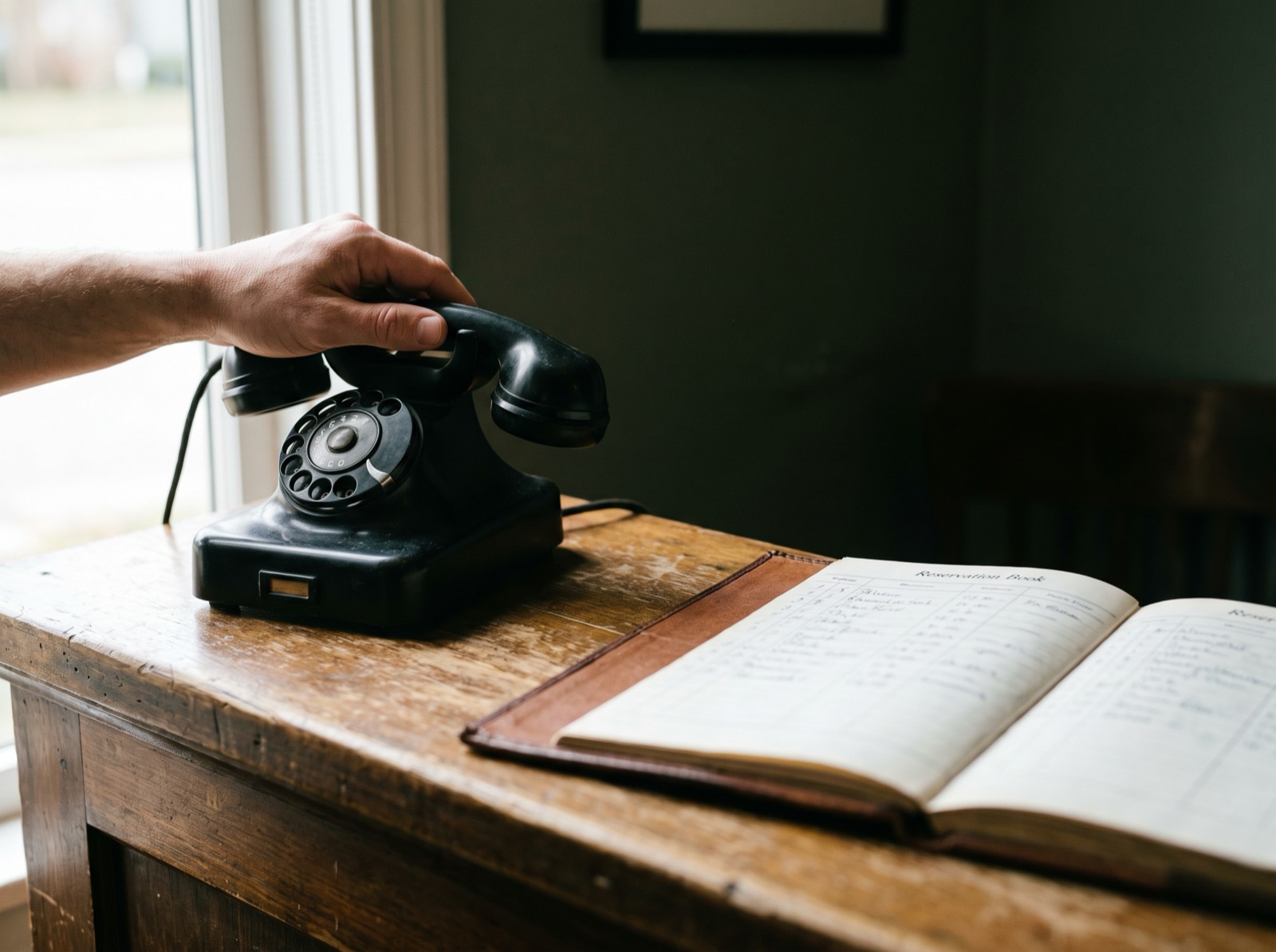
Several of the counters described above answer the telephone only in Japanese, and a few of them take bookings by no other route. AutoReserve is a Japanese reservation service with an English interface, and it states that it will place the call on a diner’s behalf where a restaurant takes reservations by telephone alone. We have not tested it against every restaurant on this page, and a listing there is not a guarantee of a seat — the doors described above are the doors either way.
Frequently asked questions
Do Tokyo sushi counters accept solo diners?
Almost all of them do, and almost none of them say so in writing. Of the five counters in this article, not one publishes any policy at all on single diners — no welcome and no restriction. What they publish is the mechanism: three of the five take no reservations from anybody, one takes them only from 17:00, and one takes them all day. A shop cannot refuse a reservation it does not accept, so for three of these five the question never arises.
Which of these five can I book for one person?
Janoichi in Nihonbashi takes reservations by telephone and through the booking link on its own front page, at both lunch and dinner. Tsukiji Sushisay takes them from 17:00 only, and says the number of reservable seats is limited — before 17:00 it is walk-in for everyone equally. Uogashi Nihon-ichi in Shinbashi and Touryumon in Ginza are standing shops and take no reservations at all; Nemuro Hanamaru at KITTE does not either, and issues numbered tickets once it fills up.
Is it rude to eat sushi alone in Japan?
No, and the history runs the other way. Two of the five shops here were founded in 1889 as stalls in the Nihonbashi fish market, and a third describes its standing counters as a return to the sushi stall of two hundred years ago. A stall has no table plan, no reservation book and no minimum party. Eating alone at a counter is the older form of the meal, not a departure from it.
How much does a solo meal at a Tokyo sushi counter cost?
As published by these five shops in August 2026: ¥1,400 for a ten-piece set at the standing counter in Shinbashi; four plate prices between ¥176 and ¥550 on the conveyor at KITTE Marunouchi; per-piece ordering in Ginza with printed examples between ¥380 and ¥880; ¥2,200 for six pieces, a roll and soup at lunch in Nihonbashi; and ¥3,500 to ¥6,000 for the counter-only sets at Tsukiji. Prices move, so check the shop’s own page before you plan around a figure.
Do I need to speak Japanese to sit at these counters?
At three of the five, no order has to be spoken: Touryumon takes orders through your own phone and says spoken orders are also accepted, Uogashi Nihon-ichi offers mobile ordering, and a conveyor belt asks nothing of you at all. At Tsukiji Sushisay and Janoichi you either choose piece by piece or leave it to the chef, and both are easier in Japanese. Only one of the five publishes any English pages at all, and none of them states what language is spoken at the counter, so we cannot tell you what you will meet when you sit down.