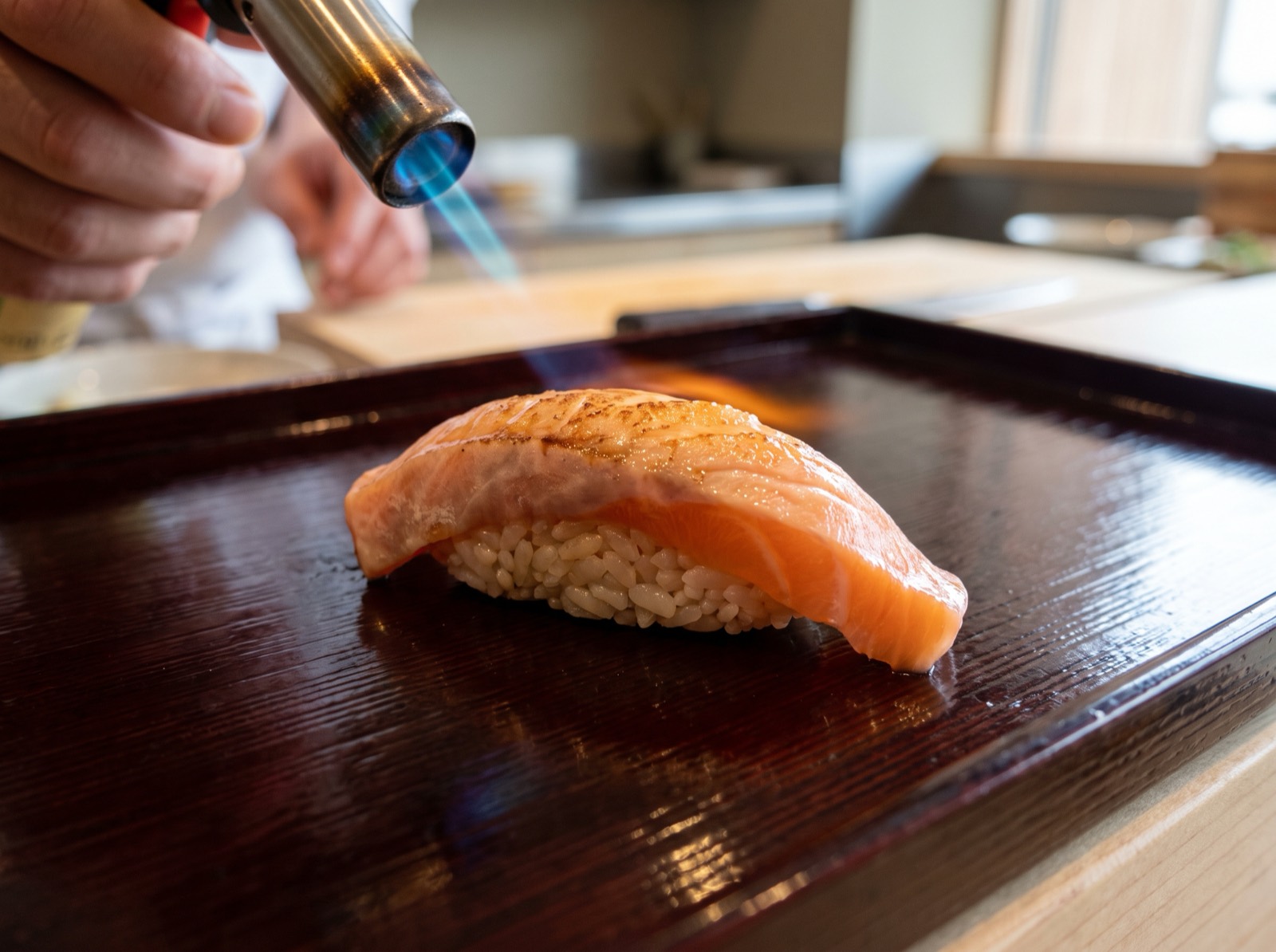
A flame passes over the fish, briefly, and the piece in front of you changes colour, smell and temperature before it reaches your mouth. Aburi (炙り) is the word for that pass. It is also one of the most familiar Japanese words on an English-language sushi menu anywhere in the world — and it turns up in passing across this site’s other entries, from a scallop’s sweetness to a tuna belly’s fat, without ever getting one of its own. This is that entry.
What it is
Our own fact index defines it plainly: searing the topping with a flame, whether an open flame or a handheld torch. The wider Japanese-language literature on sushi technique adds hot charcoal and a gas ring to that list, but the target stays the same — the surface only, for as long as it takes to change colour, no longer.
The flame can meet the fish at either of two points: on the raw fillet before it is cut and set on the rice, or on the finished nigiri, topping and all. Both are described in the trade literature as legitimate versions of the same word, and which one a shop uses is house method, not a rule this entry can settle.
When it is used
This is one of the few entries in our A–Z that breaks from the seasonal framing running through most of it, because aburi is not a property of a fish or a month. It is a decision made piece by piece, at the counter. Our own guide to the words worth learning for a counter visit lists it among the handful a customer can use in full sentences, and for a specific reason: at some shops, whether a given piece arrives seared or raw is a question the chef puts to you, not a house style fixed in advance.
What the chef actually does
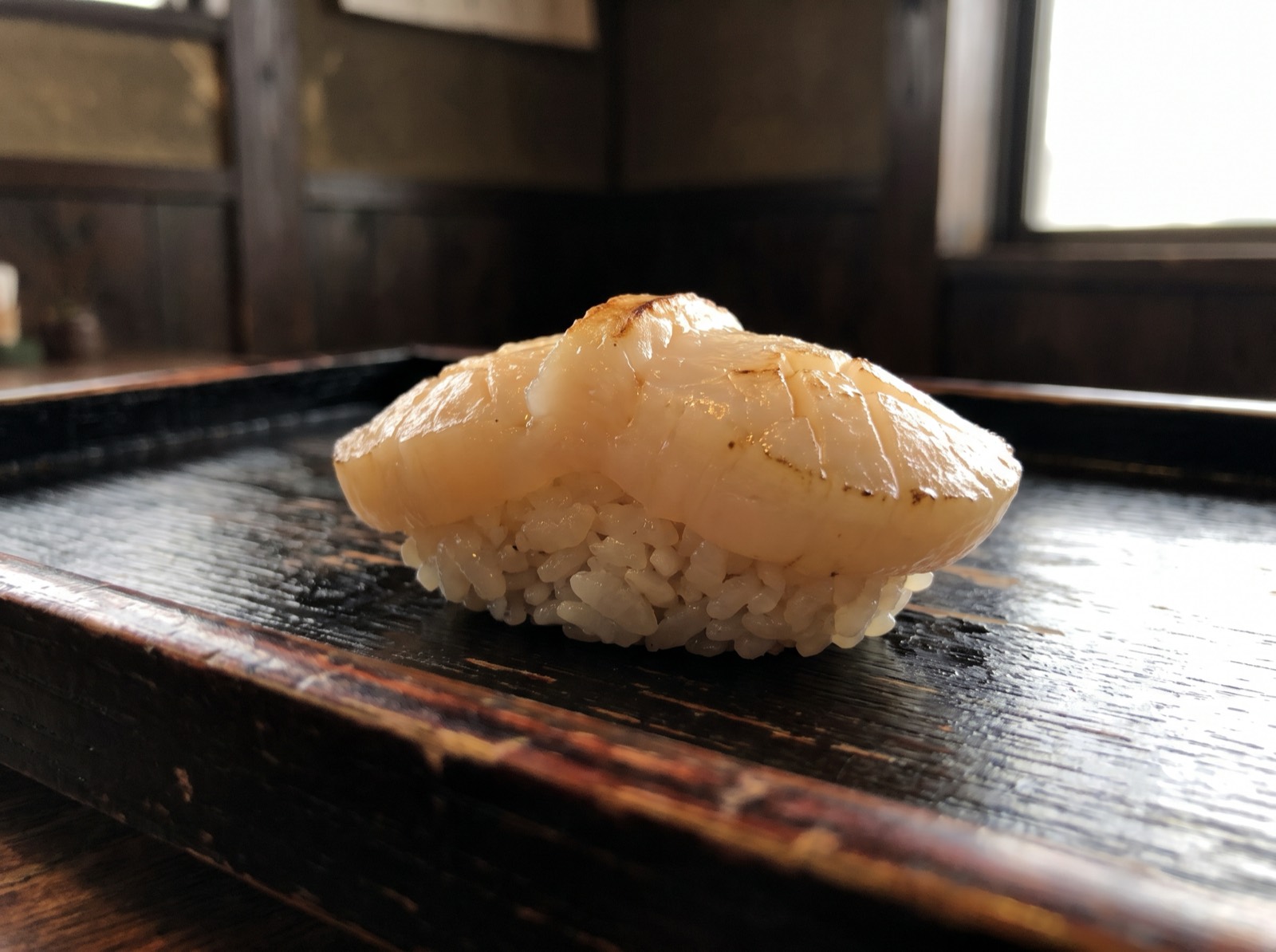
The pass itself is short and it stays on the surface. Our entry on scallop shows what that looks like on one particular piece: a quick flame across the surface caramelises the sugars and leaves the centre raw. That split — a warmed, browned top over a centre that never heats through — is the shape the technique is aiming for wherever it appears, not a side effect of doing it quickly.
Most of the work happens where the fish is fattiest, usually the skin side or the layer directly beneath it. Heat applied there does two things at once: it renders some of that fat so it runs rather than sits, and it browns the surface enough to add a note the raw fish does not otherwise carry. Which effect a kitchen is chasing changes from one fish to the next, which is the subject of the next section. There is no standard duration or temperature: the sources attach no number to the pass, only relative language — brief, quick, a light touch. That judgement belongs to the person holding the torch, not to a general description of the technique.
Why it is done
The reason splits by fish, and the two ends of the split are close to opposites. On a very fatty cut, searing can be a reduction rather than an addition: heat brings excess fat to the surface, where some of it renders away, leaving a piece that reads as cleaner rather than richer. It solves the same problem yubiki solves with water instead of fire — our entry on kinmedai describes that treatment as softening the skin enough to eat and melting some of the fat beneath it, while the flesh stays untouched. Aburi does the fire version of the same job.
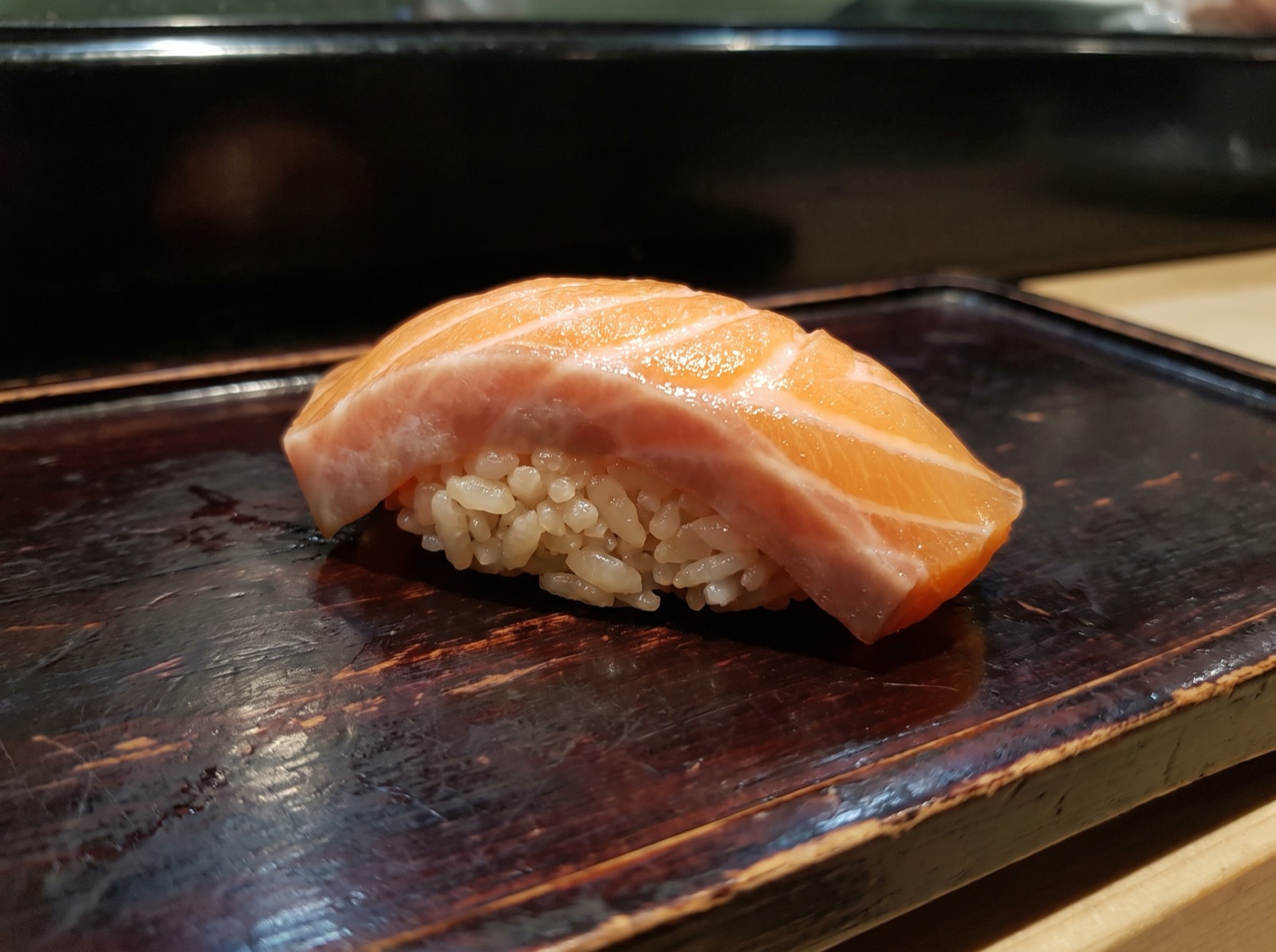
At the other end, on a fish with little to render and no history of this treatment at all, aburi is pure addition. Our entry on salmon is direct about it: one pass with a blowtorch melts surface fat and adds a browned note the raw fish does not have, and it is, in that entry’s own words, “the standard way to make an unremarkable fillet taste like something.” That is a technique answering a flavour problem, not a fat problem, on a fish that arrived in Japan too recently to have inherited an Edomae answer of its own.
Salmon is also the plainest illustration of a structural fact: it has no Edomae job. Our guide to Edomae sushi sets out four preparation families — curing, marinating, simmering and glazing, and ageing — and every one exists because it once solved a keeping problem, before refrigeration made the problem disappear. Aburi is not on that list, and it could not have solved that particular problem if it tried. A pass of flame across a surface preserves nothing. It changes a piece for the next few minutes, not the next few hours.
A pass of flame across a surface preserves nothing. It changes a piece for the next few minutes, not the next few hours.
Old technique, or new
None of the sources we consulted give aburi a date of origin, and we are not going to invent one. What they do support is narrower: aburi is not one of the four Edomae jobs, for the structural reason just given, and at least one fish on this site is described in our own reporting as having taken it up recently rather than by inheritance. Our entry on scallop calls the seared version “a modern move rather than a classical one” — a claim about scallop specifically, because that is what the source supports, not about the technique in general.
That same entry found where the modern version concentrates: an Edomae counter tends to serve scallop plain, letting the sweetness stand; Kansai and the modern national chains lean on searing more readily, alongside mayonnaise and sweet glazes. That is one fish, reported on once, and it is not a claim that Edo-style counters avoid searing altogether. Our entries on kinmedai and hamachi both describe Edomae practice reaching for the same flame on certain fish, and our entry on otoro notes that some counters use it while others consider it a distraction — disagreement, not absence. The technique sits outside the historic four jobs, it is put to more than one use depending on the fish, and its most famous carrier abroad is a topping with no Edomae tradition to sit inside in the first place.
How it differs from what it is confused with
- Aburi and yubiki. Same goal on some fish — soften the skin, melt a little fat, leave the flesh raw — reached with water instead of fire. Our entry on kinmedai treats the hot-water version as that fish’s standard, with the flame listed as the alternative.
- Aburi and tataki. Both put fire to a raw fillet, but tataki is a harder, more complete sear with its own name and its own reason. Our entry on katsuo (bonito) describes a fillet seared hard on the outside, traditionally over burning straw, to make tough skin edible and burn off a strong surface flavour — a heavier job than the light pass this entry is about.
- Aburi, raw, and cured — three live options, not one. Our entry on sanma lays out all three for a single fish: raw with ginger and scallion, seared, or cured in vinegar. Aburi is the middle one, changing a piece for the length of a meal rather than the length of a shift.
- Aburi is not the same claim as “cooked.” The centre of the piece is still raw. What changed is the surface, and only the surface.
How to say it
ah-boo-ree is the usual English attempt and it is fine. More precisely it is three even beats, a-bu-ri, with no stressed syllable — the same flat pattern that runs through almost every word in this glossary.
Where you will see it
Two different menus use the word for two different reasons. At a counter serious about Edomae work, aburi is one option among several for a handful of fish, sometimes offered as a question rather than printed as a fixed style — see our guide to the words worth learning for how that conversation usually goes. On a conveyor belt or at a modern chain, it is more often a named, fixed item on the printed menu, and salmon is the clearest case: a fish with no Edomae tradition behind it, sold seared as standard, in Japan as much as anywhere else.
That is the honest shape of the gap this entry opened with. The word was never missing from Japanese counters. It was missing from this site’s own glossary, mentioned in passing across other entries and explained once, here.
Frequently asked questions
What does aburi mean in sushi?
Searing the topping with a flame — an open flame or a torch — applied briefly and to the surface only. The centre of the piece stays raw; what changes is the top layer: colour, aroma and a little of the fat.
Is aburi a traditional Edomae technique?
Not in the way curing, marinating, simmering and ageing are. Those four jobs exist because they once solved a preservation problem, before refrigeration; a flame pass preserves nothing, so it sits outside that structural list even though many Edomae kitchens use it today.
Why is salmon sushi so often served seared?
Salmon has no Edomae tradition behind it at all, nothing to cure, marinate or age, so a pass of flame is one of the few things a kitchen can do to it. Our own entry on salmon calls searing the standard way to make an unremarkable fillet taste like something.
What is the difference between aburi and yubiki?
Both can soften skin and melt some of the fat beneath it while leaving the flesh raw. Yubiki reaches that result with boiling water followed by an ice bath; aburi reaches for a similar result with fire instead.
Does searing make raw fish safer to eat?
No, and our own reporting says so directly. Our entry on sanma, a fish sometimes served this way, states that a seared piece may well be safe, but if it is, the reason is freezing or inspection upstream of the counter, not the sear itself.
Can I ask for a piece to be seared at a sushi counter?
At many counters, yes, and you may not even need to ask. Our guide to counter vocabulary lists aburi among the small set of Japanese words a customer can use directly, because at some shops the chef offers the choice first.