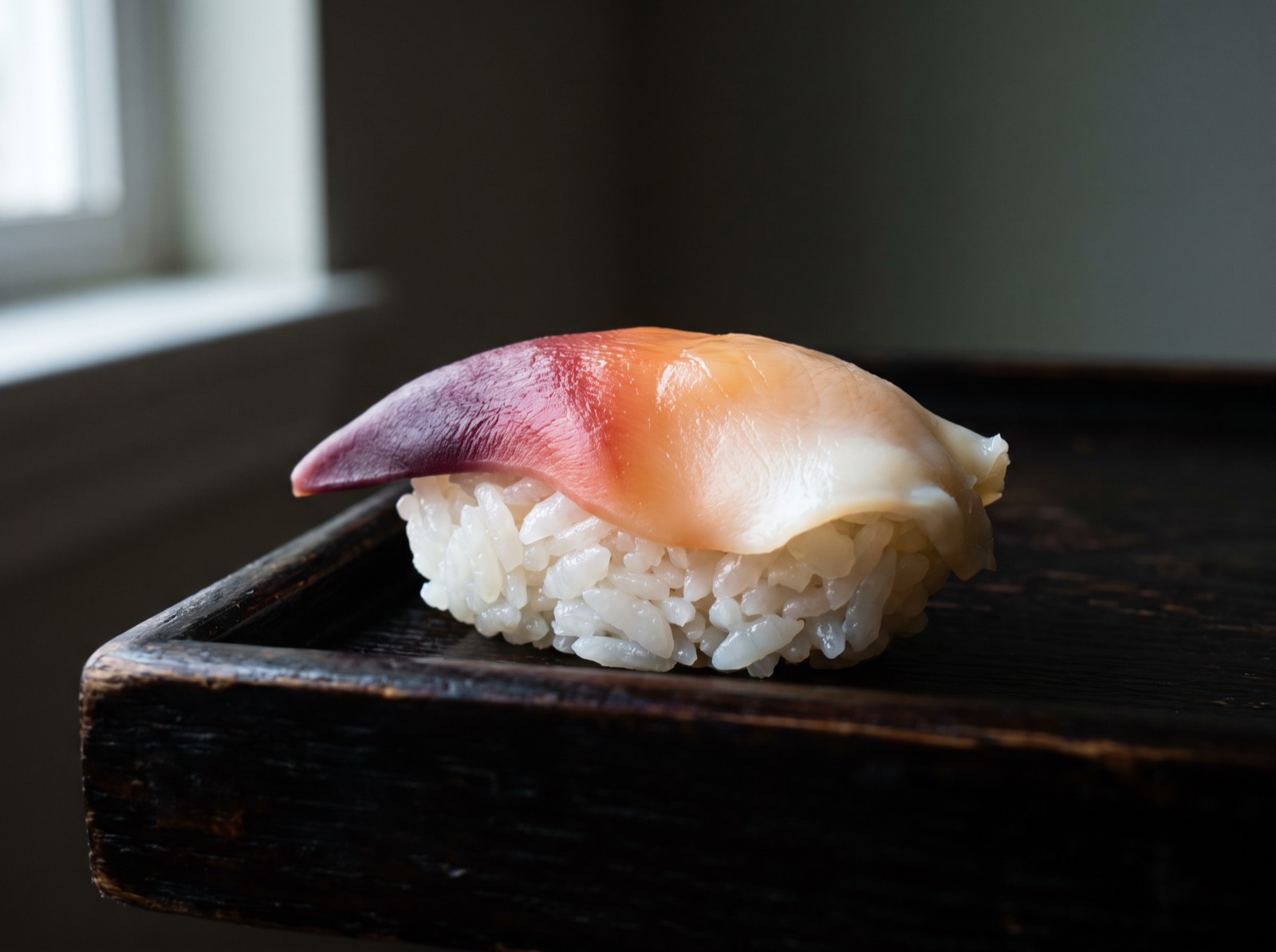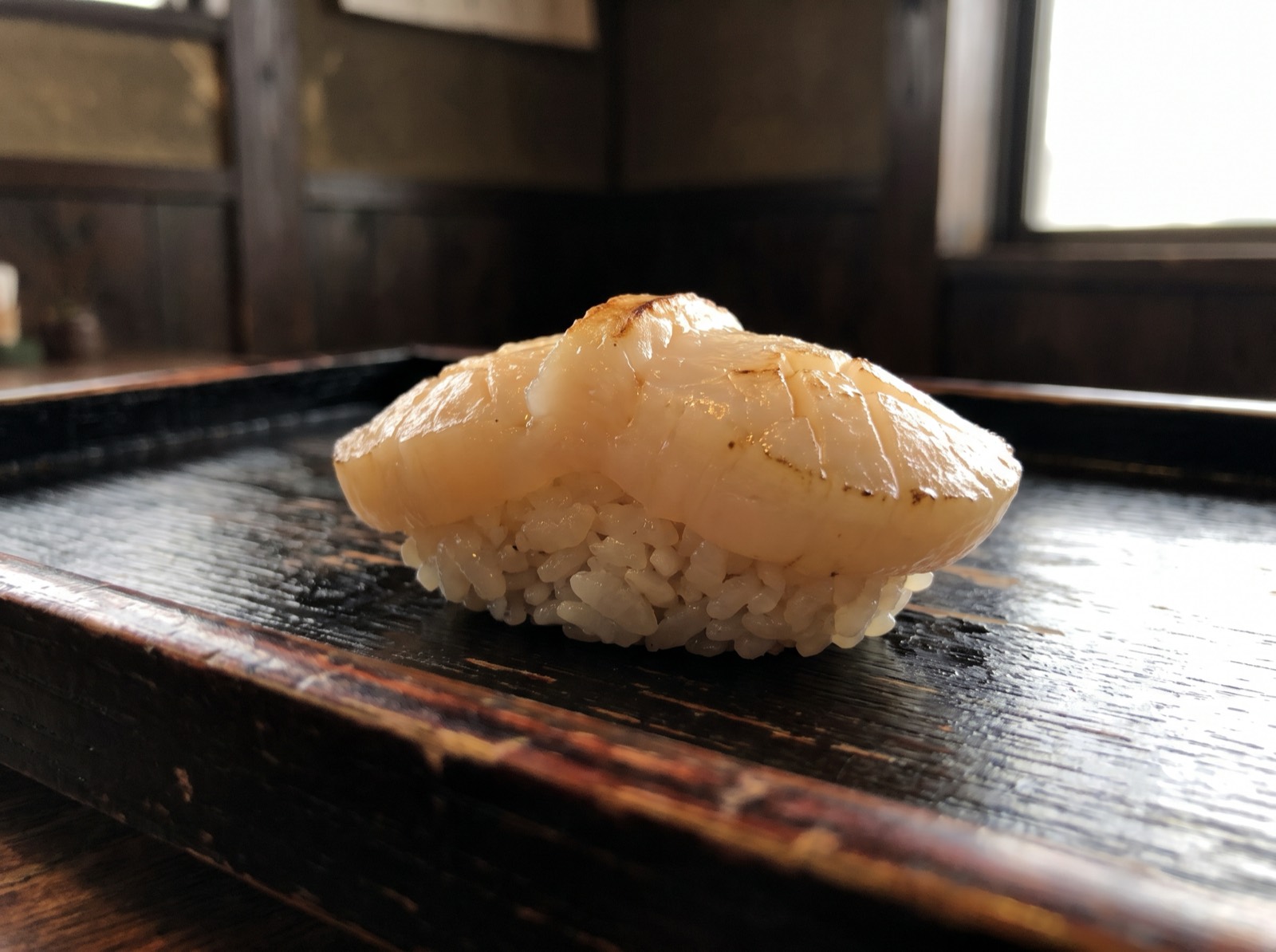
Hotate (帆立, Japanese scallop) is the large adductor muscle of a bivalve, served raw over rice. It is pale, faintly translucent, cool and yielding, and it is the one item on a sushi counter that tastes unambiguously sweet without anything having been added to it.
What it is
The scallop opens and closes its shell with a single powerful muscle, and that muscle — kaibashira (貝柱), literally the shell’s pillar — is the piece. It is built from vertical fibres, which is why a thick-cut scallop pulls apart in strands rather than slicing cleanly, and why the cut face has a visible grain.
The sweetness is real and chemical rather than impressionistic: the muscle stores sugars and free amino acids, and a scallop in good condition is distinctly sweet in a way almost no other raw seafood is. It fades quickly once the shellfish is out of condition, which is most of what separates a good piece from a dull one.
The name is written with characters meaning “sail-raising”, from an old belief that the animal travels by putting up its mantle like a sail. It does move, by clapping its shell, but not that way — the etymology is a story rather than an observation, and it is the kind of thing worth knowing precisely because it is repeated as fact.
The two production systems
Almost all Japanese scallop comes from the north, and it comes by one of two routes that produce noticeably different animals.
- Hanging culture (垂下式). Young scallops are suspended from ropes or in lantern nets and grow in the water column, never touching the bottom. They are harvested younger, the shells are clean and thin, and the muscle is tender.
- Seabed culture (地撒き式). Juveniles are released onto the seabed and left for several years before being dredged. The animals work harder, grow larger, and the muscle is denser and more strongly flavoured.
Neither is the superior product in the abstract; they suit different treatments, and a counter that serves scallop thick and raw is generally buying with that in mind. The two systems are geographically distinct within the northern fisheries, which is why regional names on a menu carry information.
What the label means
Japanese shellfish is sold under two designations that visitors read wrongly. Namashoku-yō (生食用) means the product has been handled to a standard that permits raw consumption; kanetsu-yō (加熱用) means it must be cooked.
The distinction is about handling, water quality and the chain of custody, not about freshness alone. Heating-grade shellfish is not older or worse; it has simply come through a route that was not certified for raw service. This trips people up in supermarkets constantly, and the rule is the simple one: the label decides, not the smell or the date.
Raw-grade is not simply a freshness label. It means somebody documented the water it came out of.
What the chef does to it
- Cuts it thick. A scallop sliced thin loses the texture that is the point of it. The standard nigiri is a single thick piece, sometimes butterflied open so it drapes over the rice without towering.
- Scores it, sometimes. A shallow cut across the face helps the piece sit and lets a brush of soy glaze or a grain of salt reach into it.
- Salt and citrus over soy. Because the flavour is sweet and delicate, many counters serve it with salt and a squeeze of citrus rather than the house soy glaze, which would flatten it.
- Sears it, sometimes. A quick flame across the surface — aburi — caramelises the sugars and leaves the centre raw. It is a modern move rather than a classical one, and it works well enough that almost everyone does it.
The other parts
A whole scallop yields more than the muscle. The frill of mantle around the edge, himo (ひも), is chewy and strongly flavoured and appears in gunkan or rolled with cucumber. The orange or cream lobe is the gonad; it is eaten in Japan, usually cooked, and is more often a home or izakaya item than a counter one. The rest is discarded.
When it is best
Broadly winter through spring, as the animal builds reserves before spawning. It is farmed and harvested at scale, so it is available all year and a great deal of it is frozen at sea — which, for a single dense muscle, is a much less damaging process than it is for a whole fish.
How it differs from what it is confused with
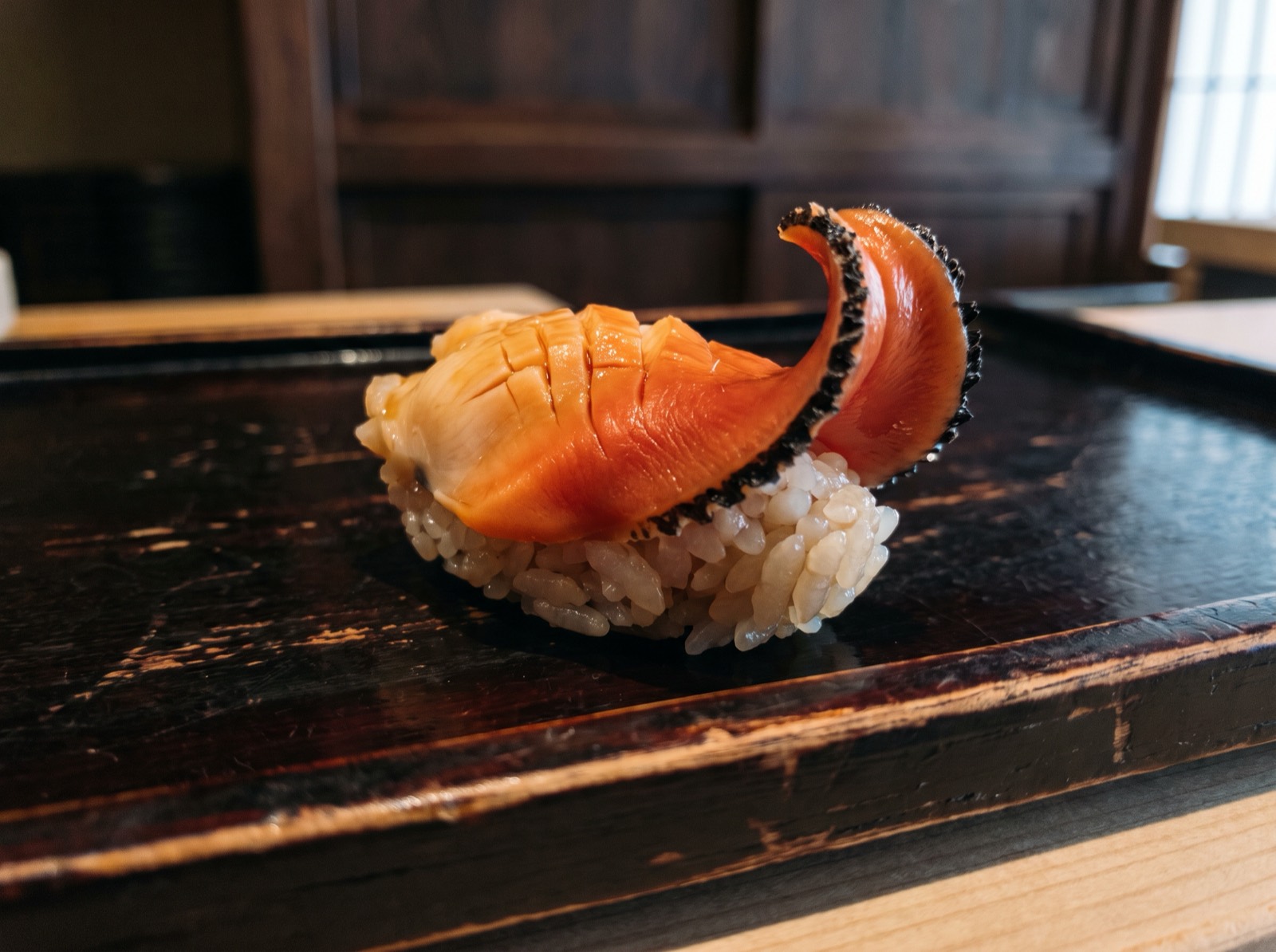
- Hotate and hokkigai. Both northern shellfish. Surf clam is served blanched, with the tip turned bright red by the heat, and is firm and briny. Scallop is raw, pale and sweet.
- Hotate and tairagai. The pen shell also gives up a large adductor muscle and looks similar on the rice. It is squarer in section, firmer and less sweet.
- Hotate and akagai. Opposite ends of the shellfish range. Ark shell is red, mineral and assertive; scallop is pale, sweet and mild.
- Japanese scallop and the scallop on a European menu. Different species, usually served cooked, and a great deal smaller. The Japanese one is unusually large, which is why it works as a single-piece topping.
How to say it
ho-ta-te, three even beats. On menus you will also see hotate-gai, with the word for shellfish attached, and kaibashira when the muscle is being named specifically — that one is ka-i-ba-shi-ra, five beats.
Edomae and Kansai
Scallop is northern and both cities bring it in, so this is not a tradition split. What differs is treatment: the Edomae counter tends to serve it plain with salt and citrus, letting the sweetness stand, in keeping with the restraint described in our guide to Edomae. Kansai and the modern national chains lean more readily on searing, mayonnaise and sweet glazes, and scallop is one of the pieces where that difference is most visible on the plate. See the two cities compared.
Where you will see it, and roughly what it costs
At every tier, from the cheapest belt to the top of the market, which makes it another useful comparison piece. It is mid-priced at a counter — well below tuna, above the everyday white fish.
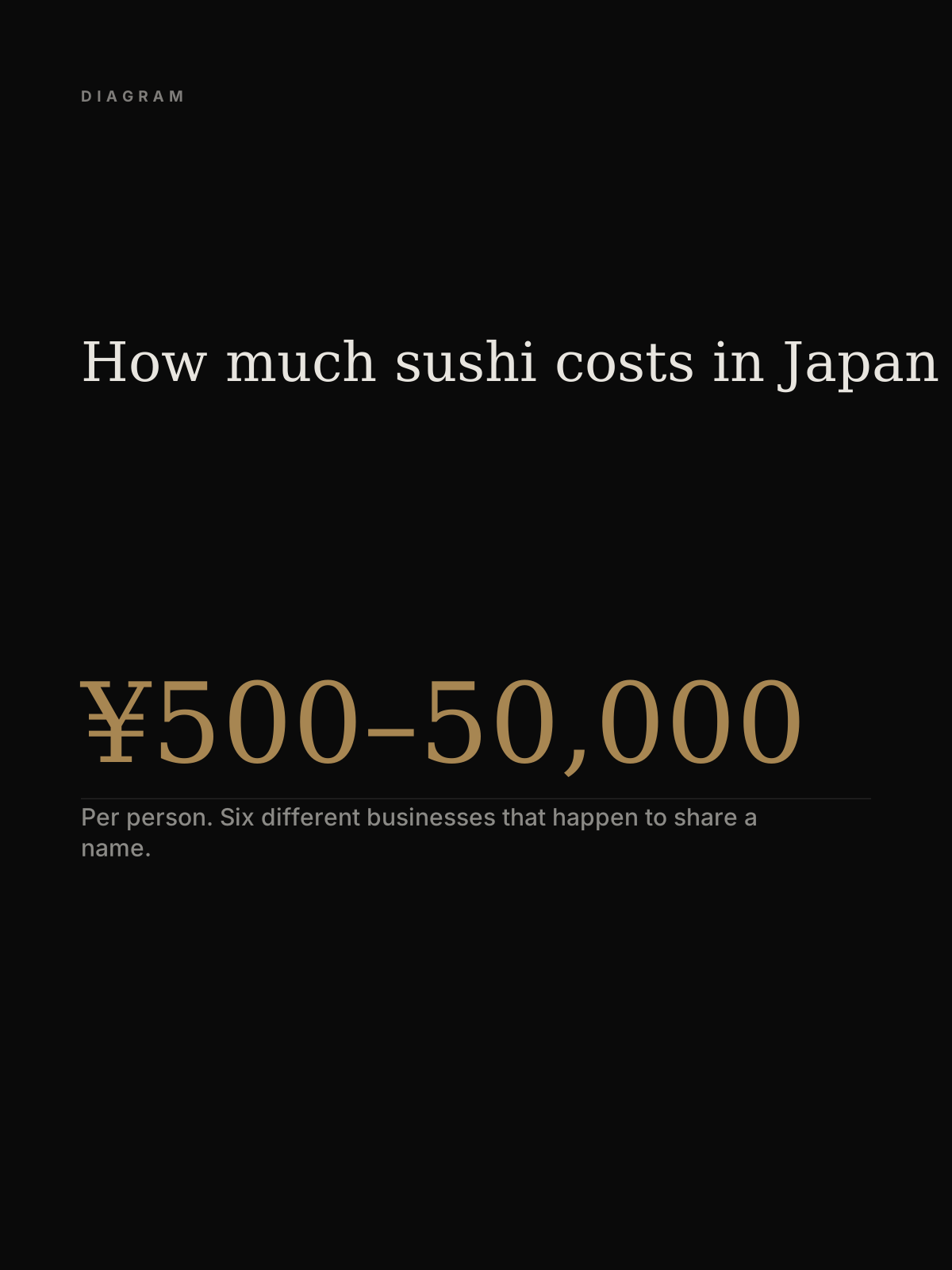
No per-piece figure from us. The thing to notice is thickness and temperature: a thick, cool piece with a readable grain and a clean sweet finish is the real proposition, and a thin, cold, slightly watery one has usually been through a freeze-and-thaw it did not need. Our guide to what sushi costs covers the tiers.
Frequently asked questions
What part of the scallop is used for sushi?
The adductor muscle — the single large muscle that opens and closes the shell, called kaibashira in Japanese. It is built from vertical fibres, which is why a thick-cut piece pulls apart in strands and shows a grain on the cut face.
Why does scallop taste sweet?
Because the muscle stores sugars and free amino acids. The sweetness is genuine rather than impressionistic, and it fades as the shellfish loses condition — which is most of what separates a good piece from a dull one.
What does namashoku-yō mean on Japanese shellfish?
That it has been handled to a standard permitting raw consumption. The alternative, kanetsu-yō, must be cooked. The distinction is about water quality and chain of custody rather than freshness alone — heating-grade shellfish is not older or worse.
Is farmed scallop worse than wild?
Not straightforwardly. Hanging culture produces younger, more tender muscle; seabed culture produces larger, denser, more strongly flavoured animals over several years. They suit different treatments rather than ranking against each other.
What is the frill served alongside scallop?
The mantle, called himo. It is chewy and strongly flavoured, and it is served separately — in a gunkan, or rolled with cucumber — rather than as part of the nigiri.
When is scallop in season?
Broadly winter through spring, as the animal builds reserves before spawning. It is harvested at scale and available year-round, and much of it is frozen at sea, which a single dense muscle survives far better than a whole fish does.