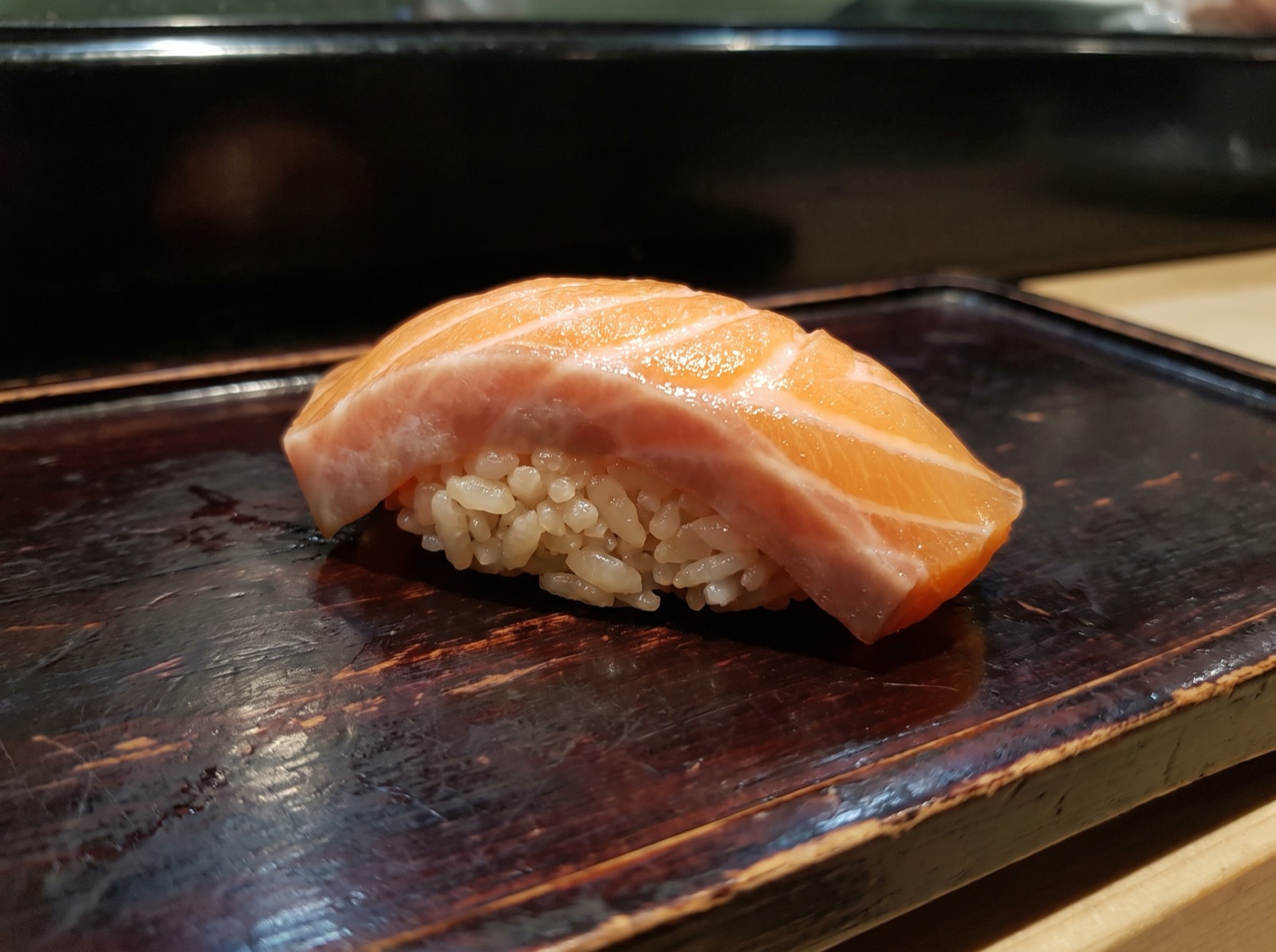
Salmon (サーモン, sāmon) is among the most frequently ordered sushi toppings in Japan and also one of the youngest. It was not traditionally eaten raw here at all: the fish Japanese kitchens knew as 鮭, sake, was salted and grilled. The raw orange piece on a modern belt is farmed Atlantic salmon, or sea-farmed rainbow trout sold as salmon trout, and it arrived through a Norwegian trade campaign that started in 1985.
What it is
Two words, two different things. サーモン (sāmon) is the loanword, and on a Japanese menu it means the raw item: farmed Salmo salar, or farmed rainbow trout reared in seawater and sold under the same word. 鮭 (sake, colloquially shake) is the native word, and it means the cooked one — wild Pacific salmon, salted, grilled, and eaten at breakfast rather than at a counter.
The split is so consistent that the two words are effectively different foods. You do not order 鮭 at a sushi counter, and サーモン is not the word a home cook reaches for at the grill. If you learn one thing about this fish before ordering, learn that.
What you will actually see written, roughly in order of how often:
- Sāmon (サーモン). Plain nigiri. Farmed, raw, sliced thick.
- Toro-sāmon (トロサーモン). The fattier belly cut. The word borrows tuna’s toro and has no regulated meaning.
- Aburi-sāmon (炙りサーモン). Surface passed with a blowtorch.
- Sāmon with onion or mayonnaise. Conveyor-belt territory, and unapologetic about it.
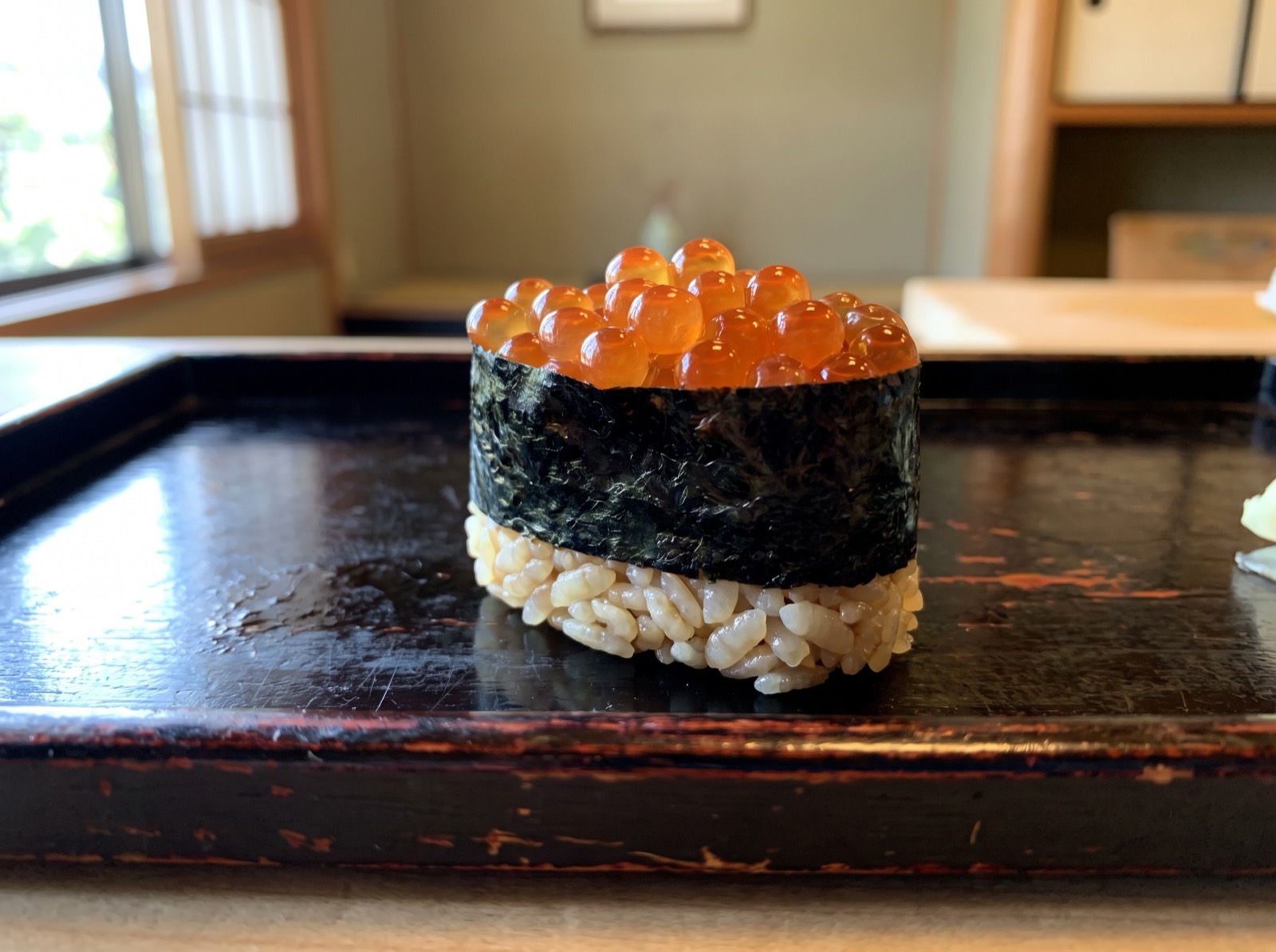
- Ikura (イクラ). Roe from a different salmon species — and much older on Japanese counters than the flesh.
That last line is the part most retellings miss. Japan had no objection to salmon. Ikura has been a settled item for generations. What Japan objected to was eating the flesh of this particular fish raw, and it had a reason.
Why it was not eaten raw
Parasites. Wild salmon feed at sea on the prey that carry nematode larvae, then run up rivers, and the risk travels with them. Japan’s Ministry of Health, Labour and Welfare names mackerel, horse mackerel, saury, bonito, sardine and squid among the species that carry Anisakis — salmon is not on that list — but the caution that kept wild salmon off the raw menu is the same caution, applied by kitchens rather than by regulators.
The ministry is also explicit about what does not work, and it is worth reading twice: vinegar, salting, soy sauce and wasabi do not kill the larvae. What does work is freezing at −20°C for 24 hours or more, or heating to 70°C (60°C for one minute), together with removing larvae by eye.
Read that list back and the traditional handling of Japanese salmon stops looking like prejudice and starts looking like arithmetic. Heat was available. Salt was available. Reliable deep freezing was not, until it was.
So the fish went to fire and to salt: aramaki-jake, the whole salted salmon sent as a winter gift; the grilled fillet on a breakfast tray; the miso-and-salmon pot of Hokkaido. The one traditional preparation that keeps the fish raw is ruibe, a northern method in which it is frozen hard and eaten in shavings. Freezing, again, arrived at by a different route.
Japan did not dislike salmon. It disliked raw salmon, and it was right to.
How Norway changed it
In 1985 a Norwegian delegation led by Thor Listau, the country’s former fisheries minister, arrived in Tokyo under a trade initiative called Project Japan. Norway had built a farmed-salmon industry faster than it had built customers. Japan, meanwhile, was eating more sushi than its tuna supply comfortably allowed.
The pitch took years rather than months. Bjørn Eirik Olsen, who ran market analysis for the project and landed in Tokyo in 1986, has described arriving to find a market that ate enormous quantities of raw fish and would not consider this one. The Norwegian side worked through importers and restaurateurs, and served salmon sushi at dinners at their embassy in Tokyo, for the better part of a decade.
What eventually carried it was not a change of taste. It was four practical facts:
- Farming. Fish raised in pens on formulated feed do not accumulate the parasite burden of a wild fish eating wild prey.
- Freezing. The measure the health ministry names — −20°C for 24 hours or more — is one an industrial cold chain can be specified to meet, which is not true of a fish carried in that morning on a local boat. It is a condition to be met, not a property a fish acquires by having been imported.
- Consistency. A farmed salmon has much the same fat content in midwinter and in midsummer. Almost nothing else on a sushi counter does.
- Supply. Year-round, in volume, at a price a buyer can plan around.
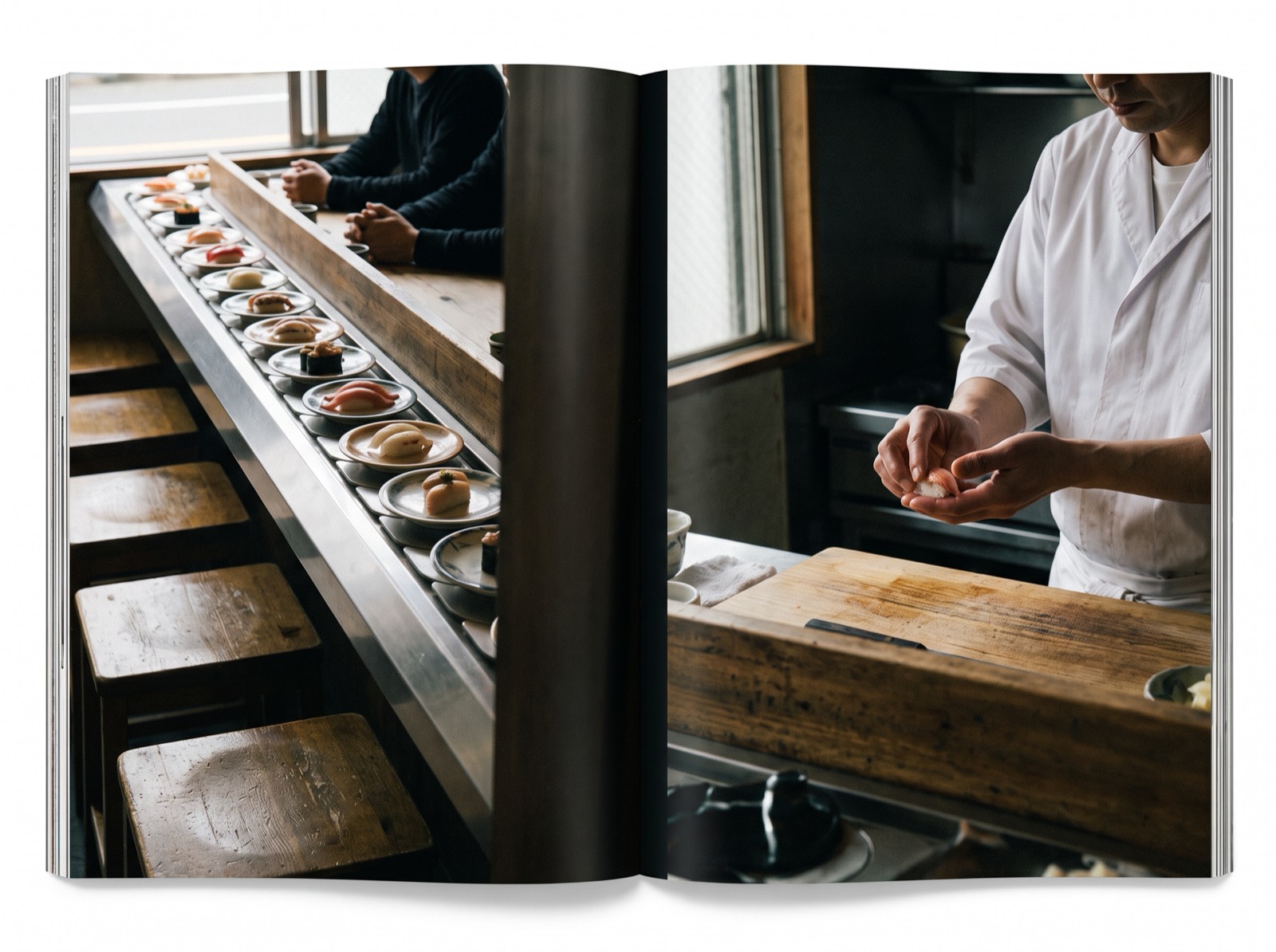
The last two mattered as much as the first two, because the buyer was never going to be the traditional counter. It was the conveyor belt, and then the supermarket. Both are formats that need a topping which behaves identically every week of the year, and neither had one until this fish showed up.
Norway’s seafood export body puts the trade at two tonnes shipped to Japan in 1980 and more than 45,000 tonnes a year twenty years later. Those are the exporter’s own figures and we quote them as such, but the direction is not in dispute. Salmon went from absent to unavoidable inside one generation.
When it is best
There is no season, and that is the entire commercial point of it. A farmed Atlantic salmon in spring is the same fish as a farmed Atlantic salmon in autumn, which is why it can anchor a menu that has to be printed.
Wild Japanese salmon does have a season — akizake (秋鮭), the autumn run — but that fish goes to the grill, not to the rice. If you want the seasonal version of this animal at a counter, order ikura, which is taken from that same autumn run and is genuinely seasonal.
What the chef does to it
Less than to almost anything else on the counter. Skin off, bloodline trimmed, pin bones out, and a slice cut so that the pale fat lines run across the bite rather than along it. No cure, no marinade, no ageing tradition to speak of. That absence of work is a large part of why salmon is cheap to serve, and therefore why it spread.
What separates a good piece from an ordinary one is thickness and temperature. Salmon fat softens quickly, so a piece cut thick and served fridge-cold eats waxy and stays in the mouth too long. A counter that takes it seriously slices thinner than a belt does and lets the piece come up a few degrees before it is served.
Aburi — one pass with a blowtorch — exists because it solves that problem bluntly. Heat melts the surface fat, adds a browned note the raw fish does not have, and covers a multitude of sins. It is a real technique with a real reason, and it is also the standard way to make an unremarkable fillet taste like something.
Why many counters still do not serve it
Not snobbery, or not only. Edomae is defined by what is done to a fish before it reaches you: curing, marinating, simmering, ageing. Salmon has no Edomae job. There is nothing to cure, nothing to simmer in tsume, no ageing convention, no traditional knife pattern. A chef whose whole craft sits in those jobs has nothing to say with this fish, and some of them will tell you so.
There is a supply logic underneath as well. A counter buying at Toyosu before dawn is buying whatever the sea produced that week; farmed Atlantic salmon is an industrial product delivered on a schedule. Ask and many shops will simply say they do not have it, which is usually the literal truth rather than a rebuke.
How it differs from what it is confused with
- Sāmon and sake are one English word covering two different Japanese foods. サーモン is raw and farmed; 鮭 is salted and cooked. Ordering the second at a counter will produce confusion rather than salmon.
- Salmon and salmon trout. A large share of what is sold in Japan as サーモン is サーモントラウト, farmed rainbow trout (Oncorhynchus mykiss) raised in seawater. It is a different species from Atlantic salmon, labelled honestly in most places, and indistinguishable to most eaters.
- Salmon and toro-sāmon. Same fish, belly cut, more fat. Unlike tuna’s otoro, which describes a specific part of a specific animal, toro-sāmon is a marketing word with no fixed definition.
- Salmon and ikura. Roe from a different salmon species, and by a long way the older item. If someone tells you salmon is not traditional in Japan, that is true of the flesh and false of the eggs.
How to say it
サーモン is sā-mon, with the first vowel held for two beats: sah-ah-mon rather than the English one-syllable start. 鮭 is sa-ke, two even beats, and yes, it is written in romaji exactly like the word for rice wine — the two are told apart by pitch and by context, which is a game not worth playing at a counter. Say sāmon and there is no ambiguity at all.
Edomae and Kansai
This is one of the few items where the Edomae and Kansai distinction barely applies. Salmon did not travel outward from a regional tradition; it arrived through national chains, in every city at once, in the same decade. There is no Kansai way of doing it and no Edomae way of doing it, because there is no way of doing it at all beyond slicing it well.
The variation you will actually notice is by format rather than by city. A belt in Osaka and a belt in Tokyo will offer near-identical salmon; a serious counter in either city may not offer it, and for the same reason.
Where you will see it, and roughly what it costs
Everywhere except the top of the market: conveyor belts, supermarkets, station kiosks, standing counters, hotel breakfasts. It is usually among the cheapest items on a belt and one of the few available at every price point below the omakase tier.
No per-piece figure from us, because the price of salmon is a function of the format rather than of the fish. What it costs on a belt is what a belt plate costs; what it costs at a counter is usually nothing, because it is not there. Our cost guide sets out the six formats and the price logic behind each.
Frequently asked questions
Is salmon traditional in Japanese sushi?
No. It is one of the newest common toppings. Raw salmon was introduced to the Japanese market through a Norwegian trade campaign that began in 1985, and became widespread through conveyor-belt chains and supermarkets rather than through traditional counters. Salmon roe, ikura, is much older.
Why did Japan not eat raw salmon?
Parasite risk. Wild salmon feed at sea and carry nematode larvae, and Japan’s Ministry of Health, Labour and Welfare states that vinegar, salting, soy sauce and wasabi do not kill them. What does work is freezing at minus 20C for 24 hours or more, or heating. Before reliable freezing, the safe answers were salt and fire, which is exactly how Japanese kitchens treated the fish.
When did salmon sushi start in Japan?
A Norwegian delegation led by former fisheries minister Thor Listau arrived in Tokyo in 1985 under a trade initiative called Project Japan, and the effort to sell farmed Atlantic salmon as a raw sushi topping ran through the following decade. Norway’s seafood export body puts shipments to Japan at two tonnes in 1980 and more than 45,000 tonnes a year twenty years later.
What is the difference between samon and sake?
They are the same fish in English and two different foods in Japanese. Samon, written in katakana, means the raw farmed item served on sushi. Sake, the native word, means wild salmon that is salted and grilled. Order samon at a sushi counter; sake belongs to a breakfast tray.
Is the salmon in Japanese sushi farmed?
Almost always. It is farmed Atlantic salmon or farmed rainbow trout raised in seawater and sold as salmon trout. Farming is not incidental to the story: controlled feed and cold-chain freezing are the two things that made raw service viable in the first place.
What is toro-salmon?
The fattier belly cut of the same fish. The word borrows toro from tuna, where it describes a specific part of a specific animal. Applied to salmon it is a marketing term with no fixed definition, so what you get varies by shop.
Do high-end sushi restaurants in Japan serve salmon?
Many do not. Edomae sushi is defined by the work done to a fish before it is served, and salmon has no such tradition attached to it: nothing to cure, simmer or age. The omission is usually about craft and supply rather than about status.