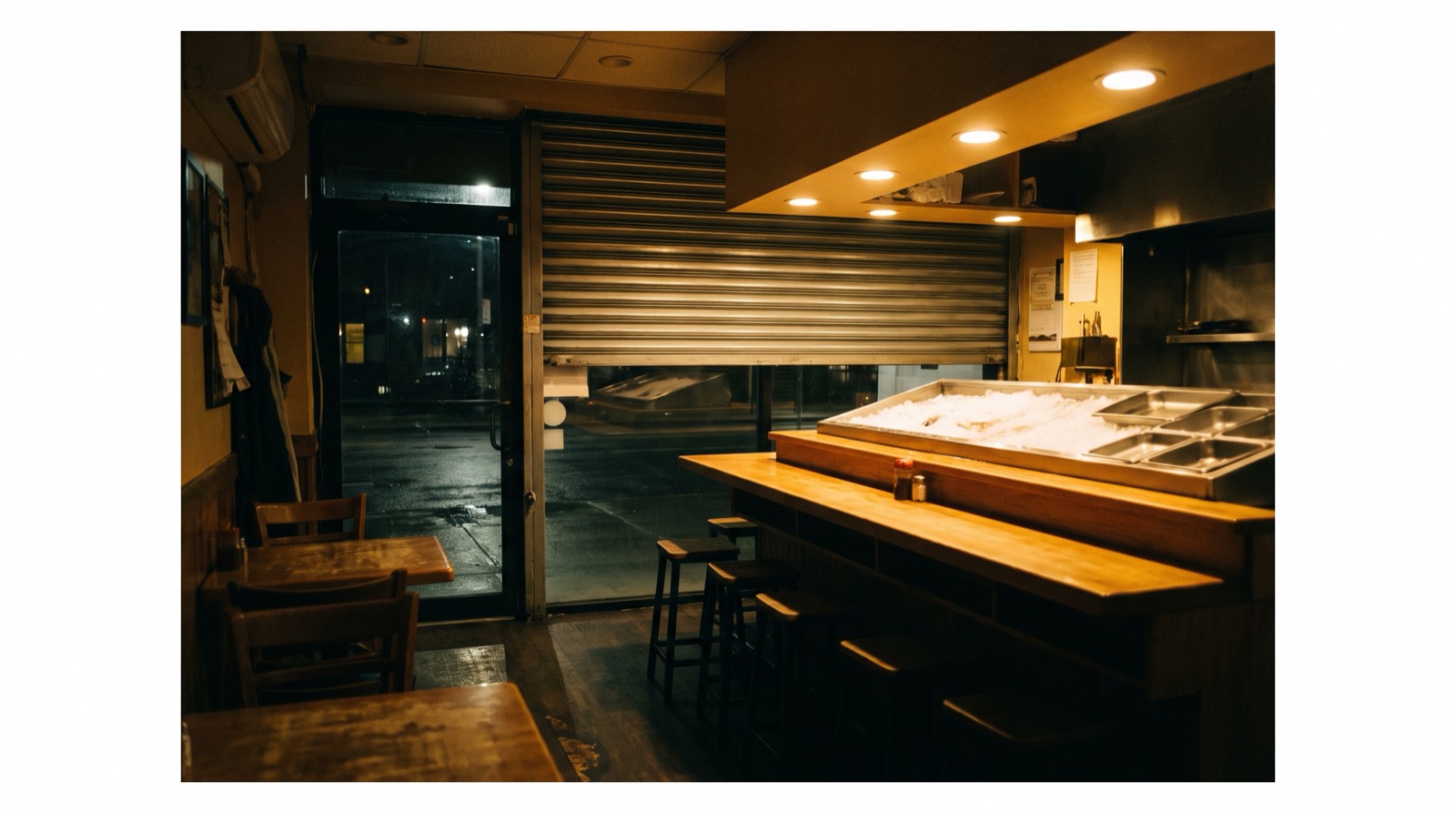
Every listing gives you one number, and the number looks like a promise. Open until 5:00. Open 24 hours. Open until 22:00. It reads like the end of a runway: arrive any time before it and something will happen.
We spent a day reading the official pages of five late-night sushi businesses in Tokyo — the restaurants’ own sites, not aggregator listings — and wrote down every time of day printed on them. What came back was not five numbers. It was closer to forty, and they disagreed with each other inside the same company, inside the same brand, and at one address, between the first floor and the second.
The first finding is small and it changes how you plan a night. “How late is it open” is not one question. It is at least three. When does the restaurant close. When does the kitchen stop taking orders. When does the door stop letting people in. Those are three separate numbers, all three are usually published somewhere on the page, and the earliest of the three is your actual deadline. On the pages we read, last order ran thirty to forty-five minutes before closing, and the door shut a full hour before the lights did.
The second finding is that the name on the sign does not tell you which set of numbers you are getting. One of the five operates seven restaurants in Tokyo under a single name. The earliest of the seven closes at 22:00. The latest closes at 5:00 in the morning. Another brand runs two shops in Tsukiji a few minutes’ walk apart; one shuts at 21:30 and the other stays open until 5:00. A third has one shop that never closes and another that closes for two and a half hours a night. If you search a restaurant name, read one page and plan around it, you can be wrong by seven hours without making any mistake at all.
This is not a ranking and it is not a list of the best sushi in Tokyo after dark. It is five businesses that publish late hours, chosen because each one publishes them differently, and because together they cover a single piece of the city from ¥99 a piece to a private room in Hiroo. Some of what we found is unflattering, and it is in here too.
Abe, one name and seven different clocks
Iki na Sushidokoro Abe runs seven restaurants in Tokyo — Hiroo, an annex a few streets from Hiroo, Gotanda, Roppongi, Toranomon Hills, Aoyama and Meguro. They share a name, a house style and one website. The site publishes a table of all seven with hours, last orders and, for some branches, last entry. Reading the table straight through is the fastest education in Tokyo restaurant hours we have had.
Here is the whole table, dinner service only, in the order the site lists it.
- Hiroo, the main shop, 5-19-17 Hiroo, Shibuya-ku. Dinner 17:30 to 3:00, last order 2:30. Open every day of the year. Ten minutes on foot from Hiroo station, fifteen from Ebisu.
- Gotanda, 7-16-3 Nishi-Gotanda, Shinagawa-ku. Weekdays 17:30 to 3:00; weekends and holidays from 17:00. The page adds a separate line: last entry for the late-night service is 2:00.
- Roppongi, 3-16-26 Roppongi, Minato-ku. Dinner 17:30 to 4:00, last order 3:30 — the latest last order in the group.
- Hiroo Annex, 4-2-38 Minami-Azabu, Minato-ku. Two floors, two clocks, described below.
- Toranomon Hills, on the fourth floor of the Mori Tower, 1-23-3 Toranomon, Minato-ku. Dinner 17:00 to 22:00, last order 21:15. Closed 1 and 2 January.
- Aoyama, in the basement of a building at 5-46-7 Jingumae, Shibuya-ku. Weekdays 18:00 to 3:00, weekends from 17:30, last entry 2:00 — followed by the sentence that the shop closes when the fish runs out.
- Meguro, 3-6-1 Kamiosaki, Shinagawa-ku. Dinner 17:30 to 23:00, last entry 22:00.
Read the first and last numbers in that list together. The Toranomon Hills branch stops serving at 22:00. The Roppongi branch stops serving at 4:00. The annex in Minami-Azabu, on its longest day, runs to 5:00. Same company, same name over the door, same menu discipline — and seven hours between the earliest close and the latest.
The reason is not mysterious once you see the addresses. Toranomon Hills is a floor inside an office tower, and office towers have building hours; the restaurant closes when the building empties. Meguro is a street-level shop in a residential ward and keeps residential hours. Roppongi, Aoyama, Gotanda and the two Hiroo addresses sit in the parts of Tokyo where people are still out at three in the morning, and they are open at three in the morning. The clock is a property of the block, not of the brand.
The Toranomon Hills entry carries two more sentences that no other branch has. One says the shop may close early depending on the state of the fish. The other recommends telephoning ahead if you plan to arrive without a reservation. Both are worth more than the 22:00 itself, and we come back to them later, because they describe what an opening hour actually is.
One more detail from the same table, offered without weight: the Hiroo main shop publishes an English dinner menu, and the group has written elsewhere that its staff include both overseas and Japanese employees. That is a fact about the company. It is not a fact about who is standing behind the counter at three in the morning, and no page we read claimed otherwise.
The floor changes the hour
The Hiroo Annex is one address with two rooms: a counter on the ground floor and private rooms upstairs. It is the only entry in the table that publishes four separate closing times, and it is the sharpest single fact in this article.
- Monday to Saturday, ground floor counter: 18:00 to 5:00. Last entry 4:00. Last order 4:30.
- Monday to Saturday, second floor and private rooms: 18:00 to 3:00. Last entry 2:00. Last order 2:30.
- Sunday and public holidays, ground floor: 18:00 to 3:00, last entry 2:00, last order 2:30.
- Sunday and public holidays, second floor: 18:00 to 1:00, last entry midnight, last order 0:30.
Stand in front of that door at half past three in the morning on a Wednesday and the answer to “are you open” is yes and no at the same time. The counter is open and will take you until four. The room upstairs closed half an hour ago. Two hours of difference at one street number, and the variable is not the day or the season but which chair you sit in.
There is a further rule underneath. On a Sunday that falls the day before a public holiday, both floors revert to the Saturday clock — the counter to 5:00, the rooms to 3:00. So the correct question is not even which floor. It is which floor, on which day, in a week whose shape depends on the national calendar.
The unit of opening hours is not the restaurant. On the pages that are honest enough to say so, it is the seat.
We suspect this is much more common than it is published. A counter with two staff can run four hours past the point where a floor of private rooms stops being economic, and plenty of restaurants must be quietly doing exactly this without writing it down. The annex is unusual because it tells you. That is a point in its favour, not against it, and it makes every other page slightly less trustworthy by comparison.
For planning, the consequence is simple and slightly annoying. If you are two people who want a counter, the late number is the one that applies. If you are six people who want a room, it is the early one — and on the six-person night, you are two hours worse off than the number you probably read.
Tsukiji Sushisen, where one street is worth fourteen hours
Tsukiji Sushisen is a fish-wholesaler group that runs sushi restaurants under one name in Tokyo and Kumamoto. Its site lists four Tokyo shops on a single page with hours and seat counts, and the four do not agree with each other about what time of day sushi happens.
- Main shop, 1-9-6 Tsukiji, Chuo-ku. Open 11:00 to 5:00. Eighty-eight seats and two private rooms holding four to twelve.
- Tsukiji 4-chome Outer Market shop, 4-9-7 Tsukiji, three minutes from Tsukijishijo station. Open 7:00 to 21:30. Twenty-five seats.
- Kaminarimon shop, 2-16-9 Kaminarimon, Taito-ku, in the Hulic & New building. Open 11:00 to 5:00. Fifty-two seats.
- Ebisu East Exit shop, 4-3-1 Ebisu, Shibuya-ku, one minute from the station. Open 24 hours. Forty-seven seats.
The two Tsukiji shops are the same brand, in the same neighbourhood, a short walk apart. One opens at seven in the morning and is dark by half past nine at night. The other opens at eleven and is still serving at five the next morning. Fourteen hours of difference between two shops with the same name in the same postcode.
Once you see why, it stops being strange. The outer market shop keeps market hours, because its customers are the morning trade — the people who are in Tsukiji at seven, and who are asleep by ten at night. It has twenty-five seats, which is the size of a shop built for turnover in a fixed window. The main shop, eighty-eight seats and private rooms, keeps night hours, because its customers are the evening trade in central Tokyo. They are two different businesses that happen to share a fish supply and a signboard.
The practical lesson is that “Tsukiji” is not a clock. It is at least two clocks, and which one you get depends on which side of the market you walk to. Our earlier piece on morning sushi around Toyosu and Tsukiji found the same structure from the opposite end: the shops that open at five in the morning are not the shops that are open at midnight, and the overlap is thinner than any map of the area suggests.
The Ebisu shop is the group’s answer to the other extreme, and it is worth naming what 24 hours means at forty-seven seats one minute from a JR exit. It means there is no closing time to plan around, which is genuinely useful at three in the morning. It does not mean the room is the same room all night, that the full menu is available, or that the fish arriving at four in the morning is the fish that arrived at eleven. No page claims any of that. We are noting it because “24 hours” is the phrase most likely to be read as a bigger promise than it is, and the next restaurant in this list proves the point in print.
Kizunasushi, open all night with the headline closed at nine
Kizunasushi’s Shinjuku Kabukicho branch sits in the basement and on the ground floor of a building at 1-18-8 Kabukicho, one minute from Shinjuku station. It is run by a listed restaurant group, it seats a hundred and twenty-five, it takes parties of forty to sixty, and its own page states the hours in two words: open 24 hours, no closing day.
The thing the restaurant is known for is a hundred-item all-you-can-eat sushi service at ¥5,000 for an adult and ¥2,500 for a child, or ¥6,200 with unlimited drinks on a coupon. It is on the front of the page. It is the reason most people search the name.
Further down the same page, in ordinary type, is this: last reception for the all-you-can-eat is 21:00.
So the restaurant is open at 23:00, and at 23:00 you cannot buy the thing the restaurant is for. Both facts are published, both are true, and every aggregator that reduces this shop to “24 hours” is technically accurate and practically misleading. If you walk in at ten at night expecting the ¥5,000 board, the answer is no, and it was no an hour before you left your hotel.
What you can buy at that hour is the menu by the piece, which starts at ¥99 before tax and runs up through salmon at ¥164, chutoro at ¥439 and seared fatty tuna at ¥549, each of those a single piece. That is a real and reasonable way to eat at midnight in Shinjuku. It is simply a different restaurant from the one on the poster, occupying the same room a few hours later.
- Open 24 hours, no closing day. One hundred and twenty-five seats, private hire for forty to sixty.
- All-you-can-eat: one hundred items, ¥5,000 adult, ¥2,500 child; ¥6,200 with drinks on a coupon. Last reception 21:00.
- By the piece from ¥99 before tax; salmon ¥164, chutoro ¥439, seared fatty tuna ¥549.
- Same-day reservations are not accepted, and the page says so explicitly — not by phone either. When it is busy, seats are handed out by a numbered ticket machine at the door.
- Smoking is permitted; there is a smoking area inside. One minute from the Marunouchi line and JR exits at Shinjuku.
That fourth line deserves a moment, because it inverts the usual advice. At most Tokyo restaurants the fix for a late arrival is to telephone. Here, on the day itself, there is no fix: the shop will not hold a seat for you over the phone, and the queue is a machine. At one in the morning on a Saturday in Kabukicho that is either fine or it is an hour of your life, and you cannot find out in advance. The compensation is that no-reservation walk-ins are explicitly welcome for the all-you-can-eat within its hours, which most all-you-can-eat services in Tokyo do not permit.
Sushimamire, one brand and two clocks
Sushimamire is operated by a grilled-meat group through a restaurant subsidiary, and its branch pages are published on the parent’s shop finder in a fixed template: address, telephone, hours, closing days, payment methods, nearest branches. We read two of the Tokyo pages. They do not say the same thing.
- Central Road, 1-15-5 Kabukicho, Shinjuku-ku. Open 24 hours, every day, no closing day.
- Ikebukuro, 1-21-13 Nishi-Ikebukuro, Toshima-ku. Open 5:00 to 2:30, every day, no closing day.
Same brand, same template, same city, ten minutes apart on the Yamanote line. One never closes. The other is dark from half past two in the morning until five — which is, precisely, the window in which someone would be looking for a 24-hour sushi restaurant.
The Ikebukuro shop is the more interesting of the two, because its clock runs the other way round from everything else in this article. A 5:00 opening is not a late shop; it is an early one. It belongs with the market restaurants that open before dawn, not with the Kabukicho rooms that fill up after midnight. It happens to also stay open until half past two, which makes it look like a night shop in a search result, but its shape is a nineteen-and-a-half-hour day that starts before sunrise and ends in the small hours. There is one two-and-a-half-hour hole in it, and if you are the person who wants sushi at three in the morning in Ikebukuro, the hole is exactly where you are standing.
We should be exact about the limits here. We read two branch pages, not the whole chain, and the two we read were chosen because both came up as late-night options. It would be wrong to conclude that half the brand is 24 hours and half is not; the only sound conclusion is the one we can support, which is that this brand’s hours are a branch-level fact and the brand name predicts nothing.
Uoshin, where the last hour is a drinking hour
Uoshin’s Shinjuku main shop is a sushi izakaya at 2-36-3 Kabukicho, on the ground floor of a hall building five minutes from Seibu-Shinjuku and seven from JR Shinjuku. Seventy seats, a counter, sunken-hearth seating, four private rooms of varying size, and a house style built on oversized cuts — tuna stacked, conger laid out whole, roe spilling over the rice. The page says the shop has been in Kabukicho for eight years.
Its hours are the clearest example in this article of why one number is not enough.
- Monday to Friday: 17:00 to 5:00. Food last order 4:00. Drink last order 4:30.
- Saturday, Sunday and public holidays: 16:00 to 5:00, with the same last orders.
- No regular closing day. Closed 1 and 2 January.
- On 31 December the shop closes at 23:00 — six hours earlier than every other night of the year.
- Seventy seats. Counter, sofa, sunken-hearth and floor seating; four private rooms from two to six people, some curtained and some walled.
Twelve hours of opening on a weekday, sixteen on a Saturday if you count from four in the afternoon. And inside that, three numbers on consecutive lines: the kitchen stops at 4:00, the bar stops at 4:30, the shop stops at 5:00. The final hour of the published day is not a dining hour. It is the hour in which people who are already inside finish what they already ordered.
If your plan is sushi at half past four in the morning, this page has already told you no. It took three lines to say it and it said it plainly. What is remarkable is how few pages do — and how easily the 5:00 travels on its own into a search result, a saved pin, a screenshot sent to a friend, with the 4:00 left behind.
The 31 December line is the same lesson in a different key. One day a year, this restaurant’s twelve-hour night becomes a six-hour evening. Abe’s Toranomon Hills branch is shut on 1 and 2 January; Uoshin is shut on the same two days. Nothing about the hours field on any aggregator will tell you this, and 31 December is not a hypothetical night to want sushi in Tokyo.
Three numbers, and the earliest one wins
Pull the five apart and the same three quantities appear, sometimes all three, sometimes one, rarely labelled as a set. They are not synonyms and they are not close together.
- Closing time. When the shop stops being a shop. This is the number that appears on aggregators, in search results and on maps, usually alone.
- Last order. When the kitchen stops accepting orders. On the pages we read this ran thirty to forty-five minutes before closing: Uoshin at 4:00 against a 5:00 close, Abe’s Hiroo shop at 2:30 against 3:00, Abe’s Toranomon Hills branch at 21:15 against 22:00. Some shops split it further, as Uoshin does, with a separate and later last order for drinks.
- Last entry. When the door stops admitting people. Where it is published it ran a full hour before closing: 2:00 against a 3:00 close at Abe’s Gotanda and Aoyama shops, 22:00 against 23:00 at Meguro, 4:00 against 5:00 at the Hiroo Annex counter.
Put the three together and a listed 3:00 close is really a 2:00 door and a 2:30 kitchen. You may enter within four hours of midnight and you have half an hour to order in. That is enough for a short late meal and it is not enough for anything unhurried, and neither of those sentences can be derived from the number on the listing.
The working rule we would now use, and it is a rule of thumb rather than a finding: to eat properly, arrive ninety minutes before the published closing time. To get in at all, arrive at least an hour before. Anything inside the last hour is a bar visit at best and a locked door at worst.
The complication is that no page publishes all three consistently. Abe gives last entry for some branches and not others, and last order for a different subset. Uoshin gives two last orders and no last entry. Kizunasushi publishes neither for the restaurant itself, only for its all-you-can-eat service, which is the one place a last-reception time was genuinely load-bearing. Sushimamire’s template has a single hours field and nothing else.
Where a number is missing, do not read the silence as an absence. A shop that publishes 3:00 and no last entry very likely still has one; it just has not written it down. This is the single most useful thing to know about Japanese restaurant hours as a visitor, and it is not written on any page, because the pages are the thing it is about.
The clock is a ceiling, not a promise
Two of the seven Abe branches carry a sentence that the other five do not, and both sentences say the same thing in different words.
The Aoyama page lists dinner to 3:00 with last entry at 2:00, and then adds: however, service ends when the fish runs out. Not as a disclaimer in small print at the bottom of the page — in the hours field itself, attached to the numbers, as part of the statement.
The Toranomon Hills page says the shop may close earlier than published depending on the state of the fish, and recommends telephoning ahead if you intend to arrive without a reservation. That is a restaurant telling you that its own published hours are the outer bound of what it is willing to do, not a description of what will happen.
This is the same structure we found when we read five restaurants’ menus in two languages: a sushi counter cannot make promises about tomorrow, because it does not yet know what it will have. There, the consequence was that the menu names categories rather than fish. Here, the consequence is that the hours name a ceiling rather than an outcome. Both are the same underlying fact wearing different clothes.
A published closing time is the longest the shop is prepared to stay. What ends the night is the fish, and the fish was decided that morning at the market by somebody who had never heard of you.
The instinct is to read those sentences as weaselling. We would read them the other way. A shop that writes “until the fish runs out” into its hours field is being more accurate than one that prints a clean 3:00 and quietly does the same thing. There is no version of an Edomae counter that guarantees a specific hour and also guarantees the fish, and any page that appears to promise both is promising one of them falsely.
The inverse holds for the shops that never close. “24 hours” is a statement about the door, not about the kitchen, the menu or the room. Kizunasushi is the proof in print: open all night, headline service closed at nine. Nobody hid that. It is on the page. It just is not in the field that gets copied.
What sushi after ten in Tokyo actually is
Something should be said plainly, because no list of late-night sushi restaurants we have read says it. None of these five is an omakase counter in the sense of the Ginza rooms or the eight-seat shops that take a single sitting a night. They are sushi izakaya, market restaurants, an all-you-can-eat, and chains. The seat counts tell the story on their own: eighty-eight at the Tsukiji main shop, one hundred and twenty-five at Kizunasushi, seventy at Uoshin.
The high counters keep the opposite hours. The Ritz-Carlton’s Japanese restaurant, which we read closely for an earlier piece, takes its last dinner order at 21:00 and closes at 22:30. Abe’s own branch inside an office tower — a formal address among its seven — keeps the earliest clock in the group. As the sushi gets more serious, the night gets shorter, with remarkable consistency.
So the pattern is worth stating as a rule: in Tokyo, the later a sushi restaurant is open, the more likely it is that sushi is one item on a long menu rather than the whole evening. Late-night sushi in this city is a large-room business. The small counter is a daytime and early-evening form, and it closes because one person cannot cut fish for fourteen hours.
This is not a complaint and it is not a warning. At two in the morning, a seventy-seat room with a counter, a long list of single pieces and a drinks menu that runs until half past four is very often the correct restaurant — more correct, at that hour, than a twenty-course sitting would be. The oversized cuts and the spilling roe are not a lesser version of anything. They are what that hour is for.
What is worth knowing is that the search “sushi open late in Tokyo” and the search “good sushi in Tokyo” return two almost entirely different sets of restaurants, and neither search tells you that. A visitor with three nights who wants one great counter and one late meal is planning two different things, and the mistake is to think the second is a version of the first at a different hour.
Reading a late-night listing in two minutes
Everything above reduces to a short sequence, which is what we would now do before going anywhere in Tokyo after ten at night.
- Find the branch, not the brand. Search the address or the station, and open the branch page on the company’s own site. Every disagreement in this article was between branches of one name.
- Look for three numbers, not one: close, last order, last entry. Take the earliest one that applies to you and treat it as the real time.
- Check which day. Weekday and weekend clocks differ at four of the five shops here, and Sunday and public holiday clocks are usually earlier, not later.
- Check the calendar note. 31 December and the first days of January override everything else, and they are printed in a separate line that is easy to skip.
- Check whether the thing you actually want has its own clock. All-you-can-eat, courses, lunch menus and private rooms frequently close before the restaurant does.
- Read for the fish sentence. If the page says service ends when the fish runs out, believe it and go earlier.
- Check how the shop wants to be contacted tonight. Some accept same-day phone calls, some explicitly do not, and some hand out numbered tickets at the door. This is the difference between a plan and a queue.
One thing beyond reading. If a page publishes a telephone number and you can use it, the two-minute call settles all seven of the points above and it settles them for tonight rather than for the day the page was last edited. Everything in this article is an argument for reading pages carefully, made by people who spent a day discovering how much a page cannot tell you.
If you want to book one of these
Several of the counters described above answer the telephone only in Japanese, and a few of them take bookings by no other route. AutoReserve is a Japanese reservation service with an English interface, and it states that it will place the call on a diner’s behalf where a restaurant takes reservations by telephone alone. We have not tested it against every restaurant on this page, and a listing there is not a guarantee of a seat — the doors described above are the doors either way.
Frequently asked questions
How late can you eat sushi in Tokyo?
Later than most guides suggest, but not at the restaurants those guides cover. Several sushi restaurants in central Tokyo publish closing times of 3:00, 4:00 or 5:00 in the morning, and a few operate 24 hours. They are overwhelmingly sushi izakaya, market shops and chains with large rooms rather than small omakase counters, which typically take their last order around 21:00 and close by 22:30. If you want a late meal and a serious counter on the same trip, plan them as two separate nights.
What is last entry at a Japanese restaurant, and how is it different from last order?
They are two different deadlines and Japanese restaurant pages often publish both. Last entry is the latest time the door will admit you; last order is the latest time the kitchen will take an order. On the pages we read, last entry ran a full hour before closing and last order thirty to forty-five minutes before. A restaurant listed as closing at 3:00 may stop admitting people at 2:00 and stop taking food orders at 2:30. Always take the earliest of the three numbers as the real one.
Are 24-hour sushi restaurants in Tokyo really open 24 hours?
The door usually is. The menu often is not. One Shinjuku restaurant we read publishes 24-hour opening with no closing day, and on the same page states that last reception for its hundred-item all-you-can-eat service — the thing it is known for — is 21:00. After that hour you can still eat there, by the piece, but you cannot buy the service on the front of the page. Check whether the specific menu you want has its own separate closing time.
Do all branches of a Japanese restaurant chain keep the same hours?
No, and this is the most common planning error. One Tokyo sushi company we read operates seven restaurants under one name; the earliest closes at 22:00 and the latest at 5:00 in the morning, a spread of seven hours. Another brand runs two shops in Tsukiji a few minutes apart, one closing at 21:30 and one at 5:00. Branches inside office towers and shopping complexes keep building hours; street-level shops in nightlife districts keep night hours. Always open the individual branch page.
Can you book a late-night sushi restaurant in Tokyo on the same day?
Sometimes, and one of the shops we read says clearly that you cannot — same-day reservations are not accepted even by telephone, and when it is busy seats are allocated by a numbered ticket machine at the door. Others take walk-ins freely at that hour. The useful move is to check how each shop wants to be contacted tonight, because it varies more than the hours do, and because at one in the morning the difference between a reservation and a ticket queue is an hour of your night.