The question arrives in the same shape every time. Where can I eat sushi at six in the morning in Tokyo. It is a good question with a real answer, and it is almost never the question that decides the morning. The counters are there. What sends visitors back to the hotel hungry is not the counters. It is the calendar.
Four of the five shops below sit inside Toyosu Market, which is not a restaurant district but a wholesale market with restaurants in it. The fifth is a fifteen-minute ride away in the Tsukiji outer market, and it is here because it is the one counter in this article that does not care what day it is. None of them is ranked. They are set out in the order you would meet them if you walked the market from the produce building to the fish building to the management building, and then took the train back across the water.
The calendar comes before the restaurant
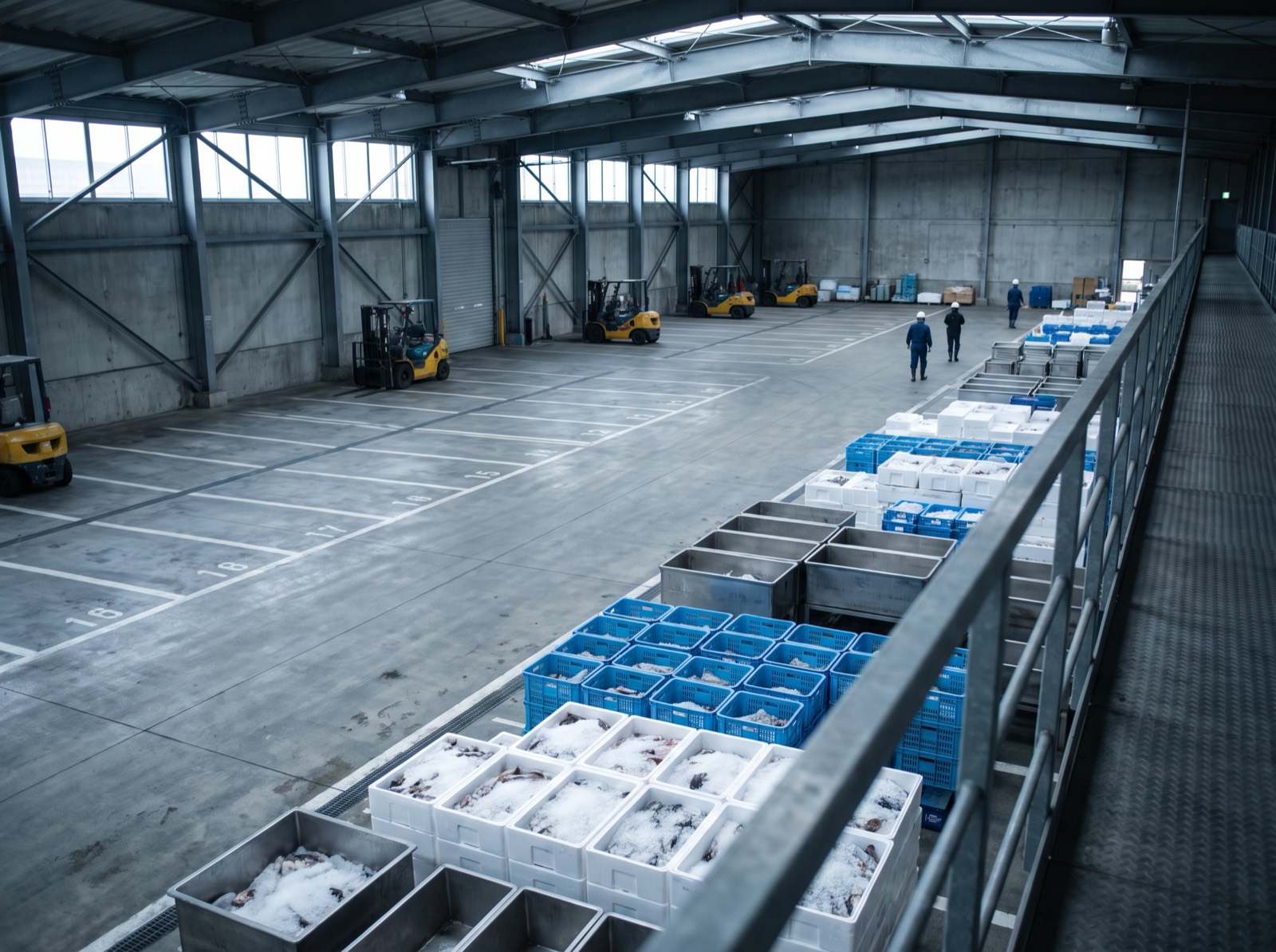
Toyosu is a working wholesale market. The restaurants inside it are tenants of that market, and they keep the market’s days, not their own. This sounds like a small administrative detail until you understand what it does to a morning.
The Tokyo Metropolitan Government publishes the visitor hours. The visitor walkway, which is the route that contains the dining and retail areas, is open from 5:00 to 17:00. The market’s PR corner runs 8:30 to 14:30, and to 11:30 on Saturdays. The rooftop garden is open 5:00 to 23:00. And then the sentence that matters: on a day the market is closed, the PR corner and the visitor walkway are closed as well. Only the rooftop stays open.
Read that again in practical terms. On a closed day the problem is not that your counter is quiet, or that the good fish went elsewhere. The problem is that the corridor to the counter is shut. You cannot get into the building. There is no queue to join and no back way in.
On a closed day the walkway is closed too. The question is not whether the shop is busy. It is whether you can get into the building at all.
The cooperative publishes the year’s closed days as a calendar, a full year ahead. For 2026 it reads like this in the two months a summer visitor is most likely to be holding tickets for:
- August 2026. Closed on the 2nd, 5th, 9th, 11th, 14th, 15th, 16th, 19th, 23rd, 26th and 30th. That is eleven days out of thirty-one.
- The Obon stretch. The 14th, 15th and 16th fall together, so the market is shut three days running in the middle of the month — exactly the week a great many people take their holiday.
- September 2026. Closed on the 2nd, 6th, 9th, 13th, 16th, 20th, 21st, 22nd, 27th and 30th. The 23rd, a public holiday, is marked as an extra open day, which is the sort of exception no rule of thumb will predict.
The underlying pattern is every Sunday, most Wednesdays, and the national holidays, with extra closures around Obon and the New Year and the occasional day added back. It is not a rule you can carry in your head. It is a calendar you look up, and the reason to look it up is that a wrong guess does not cost you a table, it costs you the morning.
Daiwa Zushi, in the building most visitors walk past
The first surprise about Daiwa Zushi is geographic. It is not in the fish building. It is on the ground floor of the produce building, block 5, which is the block nearest the station and the one most visitors turn away from on the assumption that the sushi must be where the tuna is.
- Where. Block 5, produce building, 1st floor. From the Yurikamome deck, take the left-hand path, pass the produce market gate, turn left at the first branch and take the lift or stairs down at the first corner.
- Hours. 5:30 to 13:00, on days the market is open.
- Seats. Counter, 24 seats, across two units, which makes it one of the roomier rooms in the market.
- Booking. Not accepted. You queue at the front and a member of staff seats you.
- Payment. Cash only. The listing is explicit that credit cards and electronic payment are not accepted.
- Price. From ¥300 a piece before tax, which is the only per-piece figure any of the four Toyosu counters here publishes.
- Telephone. 03-6633-0220. No takeaway.
The second surprise is that the shop tells you when to come, and what it says contradicts most of what is written about morning sushi at Toyosu. In its own message on the cooperative’s directory it says that until around nine in the morning it can seat people with almost no waiting, and recommends that as the time to arrive. Not half past four. Not before dawn with a thermos. Nine.
That single line is worth more than any queue-length anecdote, because it comes from the people counting the seats. It also reframes what the early hour is for. The market opens the walkway at five; the shop opens at half past five; and the shop itself is telling you that the pressure does not really begin until the tour groups arrive later in the morning.
Sushi Dai, and the menu that is rarely mentioned
Sushi Dai is the name that travelled. It is an eighteen-seat counter on the third floor of the fish building, it has the market’s longest-standing queue, and its own message on the directory is quietly pointed about it: the wait, the shop says, is shorter than it was in the Tsukiji years.
- Where. Block 6, fish intermediate wholesalers’ building, 3rd floor. From the Yurikamome deck take the right-hand path, carry straight on at the branch, turn left past the dining frontages and enter the fish building where the viewing deck entrance appears on your right.
- Hours. 5:30 to 14:00. Orders stop in line with the 14:00 close.
- Seats. Counter, 18 seats.
- Booking. Not accepted.
- Payment. Cash only, no cards, no electronic payment. No takeaway.
- Price. Not published. The house set is described as the chef’s selection — ten pieces, a piece of your choosing, and a roll — but no figure appears on any page the shop or its association controls.
- Telephone. 03-6633-0042.
The detail almost nobody carries over into English is on the English menu itself. According to the cooperative, back in the Tsukiji days a group arrived in which one guest could not eat raw fish, and the friends split up so that person could wait outside. The shop responded by putting cooked items on its English menu, and they are still there. If you are travelling with someone who does not eat raw fish, that is a solved problem at this particular counter, and it is solved in writing.
What is not solved is the price. We looked for one and there is none to quote, so there is none quoted here.
Iwasa Sushi, the one that prints a number
Two doors along the same third-floor row, Iwasa Sushi keeps its own website, and on it the thing the rest of the market withholds: a menu with prices.
- Where. Block 6, fish intermediate wholesalers’ building, 3rd floor, unit 305. About five or six minutes on foot from Shijo-mae station on the Yurikamome line.
- Hours. 6:00 to 15:00, the longest service of the four Toyosu counters here.
- Seats. Counter and tables.
- Booking. Not accepted. Queue at the front.
- Payment. Cash only, no cards, no electronic payment. No takeaway.
- Price. Omakase ¥4,400 including tax — ten pieces, a roll and a bowl of soup. Kai-zukushi, an all-shellfish set, also ¥4,400 — seven pieces, a roll and soup.
- House rule. One set per person. Enquiries by telephone only, on 03-6633-0755.
The one-set-per-person rule is not a detail to skim. At a counter with a queue outside and a nine-hour day to get through, a seat that orders nothing is a seat the room cannot afford. If you are arriving with somebody who only wants tea and company, this is the counter where that will not work, and it is better to know it standing up than sitting down.
Ryu Sushi, 1959, in the building nobody is walking towards
Toyosu has three visitor-facing blocks, and the third one, the management building in block 7, is where the crowd thins. Ryu Sushi has been in business since 1959 and moved here with everyone else when Tsukiji closed in 2018.
- Where. Block 7, management building, 3rd floor. From the Yurikamome deck, take the left-hand path straight on to the block 7 management building and follow the signs for the dining street through the automatic doors.
- Hours. 6:30 to 14:00.
- Seats. Counter.
- Booking. Not accepted.
- Payment. Cash only, no cards, no electronic payment. No takeaway.
- Price. Not published.
- Telephone. 03-6633-0053.
What the shop chooses to publish about itself is all craft and no marketing: conger eel simmered over a low flame for more than three hours, rice seasoned with red vinegar, prawns boiled after the order is placed. The room is a heavy marble counter and a copper wall that gets polished every day, and a wooden board from the Tsukiji counter, written in the previous owner’s hand, has been carried across and put back up.
The cooperative’s own note on this shop is unusually frank: it describes Ryu Sushi as the market’s quiet corner, the sushi counter that overseas visitors have not found. That is a strange thing for a trade association to print, and it is useful precisely because associations do not normally say it.
Sushizanmai Tsukiji Honten, the counter that ignores the calendar
Across the water, the old inner market is gone but the outer market is not, and on its main street sits the one counter in this article that has never had to think about closed days. Sushizanmai’s flagship is open twenty-four hours, every day of the year.
- Where. 4-11-9 Tsukiji, Chuo-ku, in the outer market. Three floors.
- Hours. 24 hours. Open every day of the year.
- Booking. Walk-in; the room is large enough that this is a different proposition from an eighteen-seat counter.
- Payment. Cash and credit cards.
- Price, by the piece. From ¥140 for bigeye or yellowfin tuna, egg, squid or octopus, through ¥272 for gizzard shad, ¥327 for sea eel or sea bream, ¥437 for salmon roe, to ¥1,408 for sea urchin. Bluefin runs ¥382 for lean, ¥547 for medium fatty and ¥657 for fatty.
- Price, by the set. ¥3,278 for the seafood chirashi bowl with soup, ¥3,828 for the twelve-piece set, ¥5,148 for the thirteen-piece deluxe, ¥5,478 for the premium tuna set.
- Telephone. 03-3541-1117.
This is a different kind of business from the four counters above and it is not being held up against them. What it offers that they cannot is certainty. The menu is printed in Japanese and English with a price beside every item, which means it is the only place in this article where a visitor can know the shape of the bill before sitting down, and the only one that will still be serving when Toyosu has been shut for three days over Obon.
The company’s own records put its founding in September 1985 and the opening of this flagship on 18 April 2001, and count forty-four sushi restaurants in the group as of March 2026. Whether that scale appeals to you is a matter of taste, and taste is not what this article is measuring.
Cash, at six in the morning
Four of the five counters here take cash and nothing else. Not “cards may be difficult”, not “prefer cash”. Their listings say plainly that credit cards and electronic payment are not accepted, and they say it in the same words, which suggests a market-wide habit rather than five separate decisions.
This is the single most common way a well-planned morning goes wrong, because it goes wrong at the end, after the queue and the meal, at an hour when the convenience stores near the station are the only banking you have. Draw the cash the night before. For a set at Iwasa you need under five thousand yen a head; at Sushi Dai and Ryu Sushi, where nothing is published, budget generously and do not rely on being able to top up.
The outer market runs on a third clock
If the Toyosu morning does not work — the calendar is against you, or you would rather not build a day around a walkway that shuts — the Tsukiji outer market is the alternative, but it does not keep restaurant hours either. Its own association divides the day into three bands: from 6:00 to 9:00 the street is mainly serving trade buyers, from 9:00 to 14:00 it is retail as visitors imagine it, and after 14:00 each shop pleases itself.
The same association publishes the wholesale market’s closure calendar on its own site with a warning attached: some outer-market shops close on those days too, and you should check with the individual shop. So the calendar reaches across the water after all. It simply stops being a rule there and becomes a probability.
Checking a morning yourself, in about a minute
This is the whole procedure, and it is short enough that there is no excuse for skipping it.
- Find the date you intend to go on the cooperative’s published closure calendar for the year. If it is a Sunday, or marked closed, stop — the walkway is shut and there is nothing to plan.
- Check the individual shop’s hours on the directory rather than a third-party listing. They differ by up to two hours between neighbours on the same corridor, and the closing time is when service ends, not when you may still join a queue.
- Decide your arrival time against the shop’s own advice rather than the internet’s. Daiwa Zushi says before nine is comfortable; nobody else publishes guidance, which is itself information.
- Draw cash. Assume no cards anywhere inside the market.
What the early hour actually buys
Not, on the evidence, a bargain. A set at Iwasa Sushi at ¥4,400 sits in the same territory as a mid-range lunch anywhere else in the city, and the two counters that publish nothing are unlikely to be cheaper for being early. What the hour buys is proximity: a counter inside the building where the fish was traded a few hours earlier, run by people whose day started before yours and will end at one in the afternoon.
And it buys a particular kind of quiet, if you take the shops at their word. Daiwa Zushi telling you that nine o’clock is fine, the cooperative telling you that block 7 is where the overseas visitors have not gone — both are invitations to arrive slightly later and slightly further along than the crowd, which is not advice the internet tends to give, because it is not exciting. It is just what the people in the building are saying.
If you want to book one of these
Several of the counters described above answer the telephone only in Japanese, and a few of them take bookings by no other route. AutoReserve is a Japanese reservation service with an English interface, and it states that it will place the call on a diner’s behalf where a restaurant takes reservations by telephone alone. We have not tested it against every restaurant on this page, and a listing there is not a guarantee of a seat — the doors described above are the doors either way.
Frequently asked questions
What time do the sushi counters at Toyosu Market open?
The earliest open at 5:30 — Sushi Dai and Daiwa Zushi both do, according to the restaurant cooperative’s directory. Most of the market’s sushi counters open between 6:00 and 7:00, and most close between 13:00 and 15:00. These are the hours on days the market is open; on closed days the visitor walkway itself is shut, so none of them can be reached.
Is Toyosu Market open every day?
No, and the closures are frequent. The market is closed every Sunday, most Wednesdays and the national holidays, with additional closures around Obon and the New Year. In August 2026 it is closed on eleven days out of thirty-one, including three in a row from the 14th to the 16th. The cooperative publishes the full year’s calendar in advance, and it is worth checking the specific date rather than relying on the weekday pattern, because extra open days are also marked — 23 September 2026, a public holiday, is one.
Can I reserve a seat at Sushi Dai or Daiwa Zushi?
No. All four Toyosu counters in this article state that reservations are not accepted. You join the queue at the shop front and staff seat you when a place opens. Daiwa Zushi is the only one that publishes advice on timing, and it says that until around nine in the morning it can usually seat people with little or no wait.
Do the market restaurants take credit cards?
The four Toyosu counters here all state cash only, and are explicit that credit cards and electronic payment are not accepted. Sushizanmai’s Tsukiji flagship takes both cash and cards. Draw cash before you travel to the market rather than expecting to find it inside.
Is Tsukiji still worth visiting for sushi in the morning?
Yes, but it is a different proposition from the wholesale market. The inner market moved to Toyosu in 2018; what remains at Tsukiji is the outer market, which is retail. Its association divides the day into trade buying from 6:00 to 9:00, ordinary retail from 9:00 to 14:00, and each shop’s own hours after that. It also warns that some outer-market shops close on the wholesale market’s closed days, so the same calendar is worth a glance even here.