Open the lunch page of almost any sushi restaurant in Osaka and the first thing you see is not a fish. It is a column of prices. Three of them, or four, one under the other, with a word attached to each: omakase, then jo, then tokujo, then sometimes gokujo — standard, upper, special upper, supreme. Same counter, same chef, same room, same ninety minutes. What changes is the number.
The word at the top of that column, omakase, means leaving it to the chef. It is the single most exported idea in Japanese sushi, and the promise inside it is that you are handing over the decisions. In Osaka at lunchtime, that promise arrives with a decision already attached, and it is the only one you get to make. Not which fish. Which rung.
So we read the rungs. Five restaurants across the city — two in the south, one in Umeda, one in Kita-Shinchi, one on the fortieth floor of a hotel in Nakanoshima — and for each one, every lunch course it publishes, item by item, in the order the restaurant lists them. Then we counted the sushi.
At the first restaurant, the price climbs by ¥9,000 between the cheapest lunch and the most expensive, and the sushi climbs by two pieces. At the second, ¥2,000 buys one grilled fish and no extra sushi at all. At the third, the count does rise cleanly, eight to ten to twelve — and then at dinner, the ¥30,000 course serves four pieces fewer than the ¥22,000 one. At the fourth, two courses ¥5,500 apart both serve exactly ten pieces. At the fifth, the operating company and the booking platform publish two entirely different ladders, five years apart, with the same course name on both.
None of that is a scandal. Every one of these restaurants publishes its contents in full, in advance, which is more than most sushi counters anywhere do. The point is what the contents say once you line them up: that the ladder is real, the ladder is priced, and the ladder is mostly not made of sushi.
This is not a ranking. It is five lunch menus, read closely.
What you are choosing at lunch in Osaka is not the fish. It is the rung.
The five, and what each one calls its lunch
Three of the five call the thing omakase. Two do not: both hotels, and both give their courses names instead — a wind, a tide, a district of the city. That split turns out to predict a great deal about how much you will be told before you sit down.
- Sushi Rei, Namba — a sixth-floor counter a minute from Osaka-Namba station. Four lunch courses, ¥6,000 to ¥15,000, all four described as omakase nigiri. Ninety minutes. Service charge of 10 per cent on top.
- Sushi Miyakawa, Umeda — a fifth-floor room three minutes from Higashi-Umeda station, thirty seats, six private rooms. Three lunch courses, ¥4,500 to ¥8,500. Sixty minutes.
- Kura, Conrad Osaka — a nine-seat sushi counter on the fortieth floor at Nakanoshima, sharing a room with a teppanyaki counter. Three lunch courses, ¥9,500 to ¥16,000, named Yunagi, Shiokaze and Sohkai. Tax and a 15 per cent service charge included.
- Benkay, Hotel Nikko Osaka — a hinoki counter inside a 98-seat Japanese restaurant on the third floor, directly above Shinsaibashi station. Four lunch courses, ¥5,500 to ¥16,000, named after Osaka districts. Tax and service included.
- Sushi Seikai, Kita-Shinchi — twenty-seven seats on the second floor of a building in Dojima, run by a Tokyo company with counters in Shinjuku, Minami-Aoyama and Ginza. Lunch on weekdays only, last order one hour after opening. No website of its own.
Four of the five publish a lunch that starts with eight pieces of sushi. It is the most consistent number in this article, and it is the number the ladder is built on top of.
Nine thousand yen more, and two more pieces of sushi
Sushi Rei is on the sixth floor of a building in Namba, one minute from the Kintetsu and Hanshin station, twenty-five seats across a counter, seats for couples and two private tables. The lunch sitting runs from noon to three, arrivals between 12:00 and 14:00, ninety minutes at the table. Four courses.
Here is what the restaurant publishes, in its own order, for each of them.
- Lunch omakase nigiri, ¥6,000 — thirteen items: an opening dish of crab and turnip in jelly with crab miso, chrysanthemum petals and flying-fish roe; four pieces of nigiri; chestnut chawanmushi; four more pieces of nigiri; a wasabi roll with egg and pickled daikon; red miso soup with aosa; milk ice cream. Eight pieces of sushi.
- Jo, ¥9,000 — sixteen items: the same opening dish; five pieces; a small bowl of ikura over rice; chestnut chawanmushi; five more pieces; a toro-and-pickled-radish roll with egg and pickled daikon; red miso soup; milk ice cream. Ten pieces.
- Tokujo, ¥12,000 — seventeen items: the same opening dish; sashimi of winter yellowtail; a squid-and-sea-urchin roll; five pieces; chestnut chawanmushi; five more pieces; the toro roll, egg, pickled daikon; red miso soup; milk ice cream. Ten pieces, and the bowl of ikura has gone.
- Gokujo, ¥15,000 — seventeen items: the opening dish again, with caviar where the flying-fish roe was; a live abalone served in its shell; the squid-and-sea-urchin roll; five pieces; chestnut chawanmushi; five more pieces; the toro roll, egg, pickled daikon; red miso soup; milk ice cream. Ten pieces.
The sushi count for the four courses is eight, ten, ten, ten. Between the ¥9,000 course and the ¥15,000 course — a difference of ¥6,000, or two thirds again — not one additional piece of sushi is served. The item count barely moves either: sixteen, seventeen, seventeen.
What does move is the front of the meal. The ¥12,000 course adds a plate of sashimi and a roll. The ¥15,000 course swaps the flying-fish roe in the opening dish for caviar and swaps the sashimi for a live abalone. Read down the four courses in order and you can watch the money migrate out of the sushi and into the things served before it.
From ¥6,000 to ¥15,000 the sushi goes from eight pieces to ten. The other ¥9,000 buys sashimi, caviar and an abalone.
Two details about the price itself. The first is that a service charge of 10 per cent is added on top of every figure above, stated in the notes rather than in the price — so the ¥15,000 course is ¥16,500, and the ¥6,000 course is ¥6,600. The second is what happens to those numbers on a booking platform: the same four courses appear elsewhere at ¥6,600, ¥9,900, ¥13,200 and ¥16,500. Every one is the restaurant’s own price multiplied by 1.1. The service charge has been folded into the display price on one page and left outside it on another, and nothing tells you which page you are reading.
Then there is the time. The lunch courses are sold with a ninety-minute limit. Immediately below, in the same block of notes, is a second line: a table may be requested back after two hours. Both statements are published together, and the ¥15,000 course — seventeen items including an abalone — is sold under the ninety-minute one.
The listing also reports an average lunch spend for the restaurant of ¥2,000. The cheapest thing on the lunch menu is ¥6,000 before service. That figure is a field on a directory page, not a claim by the restaurant, and it is wrong by a factor of three at the very least — a reminder that the average-spend band on any Japanese listing site is the least reliable number on it.
One more thing worth noticing, because it changes how you should read every published course in this article. Sushi Rei’s lunch courses are listed as available year-round. The dishes inside them are chestnut chawanmushi, chrysanthemum petals and winter yellowtail: autumn and winter cooking, published in August. The contents are not a forecast of what you will eat. They are a template describing the shape of the meal — how many pieces, how many plates, at which point the soup arrives — and the fish inside that shape will be whatever the season actually is.
The restaurant is also unusually candid about where its information comes from. Its own site carries a footer notice explaining that availability and online booking are handled by an outside reservation system, that details may differ from what you find on arrival, and that you should confirm directly with the restaurant. A restaurant disclaiming the accuracy of its own website is not common. It is also, in this case, honest.
And the site is not entirely its own. A maintenance notice on the page announces that on 3 August, from midnight until eight in the morning, the page cannot be viewed and none of its functions will work. The same notice, word for word, appears on the site of a restaurant three kilometres away in Kita-Shinchi. Both restaurants are tenants of the same publishing platform, and neither of them decides when their website exists.
Two thousand yen for one grilled fish
Sushi Miyakawa is on the fifth floor of a building in Sonezaki, three minutes from Higashi-Umeda station: thirty seats, six private rooms for two to eight people, non-smoking throughout, wheelchair-accessible toilet. The headline says the chef trained at a five-star hotel and that the restaurant came to Osaka by way of Hokkaido and Tokyo. Three lunch courses.
- Lunch omakase nigiri, ¥4,500 — fourteen items: an opening dish; a small bowl of ikura; crab chawanmushi; eight pieces of sushi; a roll; red miso soup; a sweet.
- Jo, ¥6,500 — fifteen items: an opening dish; a small bowl of ikura; grilled isaki; crab chawanmushi; eight pieces of sushi; a roll; red miso soup; a sweet.
- Tokujo, ¥8,500 — twenty items: a seasonal opening dish; sashimi of amberjack; a small bowl of ikura; five pieces; three seasonal tempura; crab chawanmushi; vinegar-cured Spanish mackerel; five more pieces; a toro-and-pickled-radish roll with egg; red miso soup; a sweet.
The middle course is the clearest single statement in this article. It costs ¥2,000 more than the one below it. It is one item longer. That item is a grilled isaki, a summer sea bass around thirty centimetres long, sold in Japanese fish markets as an everyday fish. The sushi does not move: eight pieces on both. Everything else on the two courses is identical, in identical order.
The difference between the ¥4,500 lunch and the ¥6,500 lunch is one grilled fish. The sushi count does not move.
The top course is a different meal rather than a bigger one. The sushi is split in two — five pieces, then an interruption of tempura, chawanmushi and cured mackerel, then five more — which is how a kaiseki course is built, not how a sushi course is built. Ten pieces in total, two more than the ¥4,500 lunch, for ¥4,000 more.
The restaurant describes that ¥8,500 course, its most expensive lunch, as a chance to try its sushi. The wording is a marketing formula — the taster, the introduction — and it appears here at the top of the ladder rather than the bottom, which tells you the ladder does not end at lunch. It ends somewhere in the dinner list, where the same restaurant sells four courses from ¥9,900 to ¥18,000.
The item counts across all seven of this restaurant’s courses, lunch and dinner, obey one rule exactly: the number of items equals the number of pieces of sushi plus the number of plates. The ¥8,500 lunch is ten pieces plus ten plates, twenty items. The ¥6,500 lunch is eight plus seven, fifteen. The ¥18,000 dinner is eleven plus eleven, twenty-two. Once you know the rule, the headline item count stops being a measure of generosity and becomes what it is: an addition.
It also catches errors. One dinner course is titled as eighteen items and headed, four lines lower, as twenty. Another carries a description praising its twenty-two items while listing nineteen, because the description belongs to a different course. The listings on this platform are assembled by hand and the seams show.
The time limit is the sharpest difference between this restaurant’s lunch and its dinner. The three lunch courses are sold with a sixty-minute limit. The dinner courses are sold with a hundred and twenty or a hundred and fifty. The twenty-item lunch and the twenty-item dinner are the same length of meal, and one of them is allotted less than half the time. The two-hour note appears in the lunch terms as well, immediately under the sixty-minute one.
The service charge behaves differently here too. The dinner notes carry a 10 per cent service charge. The lunch notes do not carry that line at all. Whether that means lunch has no service charge or means the line was not copied across, the restaurant does not say — and on the platform where it sells, the same three lunch courses appear with a discount badge: 18 per cent off ¥5,500, 20 per cent off ¥8,150, 16 per cent off ¥10,150. The discounted prices are ¥4,500, ¥6,500 and ¥8,500 — exactly the restaurant’s own list prices. The higher figures, the ones being discounted from, do not appear anywhere on the restaurant’s own pages.
The dinner courses can also be booked at noon: the arrival window published for them covers both 12:00 to 15:00 and 17:00 to 23:00. The lunch ladder is not the only thing available at lunch. It is the thing you are shown at lunch.
One line in the restaurant’s own description deserves to be quoted for what it promises: that the course listings include the preparation steps, so that guests can come with confidence. It is the clearest statement of intent any of these five restaurants makes. The contents are published not as a menu but as a reassurance.
The one ladder where the sushi count climbs
Kura is on the fortieth floor of the Conrad Osaka in Nakanoshima, and it is two restaurants in one room: a teppanyaki counter of twenty-four seats and a sushi counter of nine, forty-one seats in total. It opens Thursday to Tuesday, closed Wednesdays. Lunch runs 11:30 to 15:30 with a last entry of 14:00. Three lunch courses, published as a bilingual PDF with every item in Japanese and English.
- Yunagi, ¥9,500 — chawanmushi of Kyoto Uji free-range egg with scallop, junsai and yuzu; eight pieces of Edomae nigiri finished with a blend of three vinegars; a tuna roll; red miso soup; Osaka Kinuhikari rice with sake lees, and a sorbet of Daimon 45 junmai daiginjo.
- Shiokaze, ¥12,800 — the same chawanmushi, item for item; ten pieces; a kanpyo roll; the same red miso soup; the same rice and sake lees and the same sorbet.
- Sohkai, ¥16,000 — Hyogo pike conger with spaghetti squash, iwa-mozuku and Wakayama bergamot; two kinds of sashimi of the day; Densuke conger eel with Kyoto Kamo eggplant and Manganji pepper; twelve pieces; a kanpyo roll; red miso soup; the same rice and sake lees and the same sorbet.
Eight, ten, twelve. This is the only lunch ladder among the five where the sushi count rises at every rung, and it rises by the same amount each time, for roughly the same money each time: ¥3,300 for two more pieces, then ¥3,200 for two more. If you want a menu where the extra money visibly buys sushi, this is it.
Which makes the roll worth looking at. At ¥9,500 the roll is tekkamaki: raw tuna. At ¥12,800 and again at ¥16,000 it is kanpyo, dried gourd simmered in soy and sugar — a classic Edomae finisher, and by any market measure the cheaper ingredient of the two. There is a culinary logic to it. There is also the plain fact that the roll on the ¥9,500 course contains tuna and the roll on the ¥16,000 course does not.
The dessert is identical on all three: Osaka Kinuhikari rice with sake lees, and a sorbet made from a junmai daiginjo brewed in Osaka. The opening chawanmushi is identical on the first two, item for item, down to the junsai. Two of the three rungs open and close in exactly the same place.
And then there is dinner, which is where this ladder does something none of the others do. The evening sushi menu has two courses.
- Shun, ¥22,000 — Densuke conger eel with spaghetti squash, iwa-mozuku and Wakayama bergamot; sashimi of the day; a small dish of the day; twelve pieces of nigiri; a hand roll of bluefin toro with crisped red sushi rice; red miso soup; the rice-and-sake-lees dessert with the Daimon 45 sorbet.
- Tsuya, ¥30,000 — kuruma prawn with winter melon sauce, junsai, okra and fava bean; sashimi of Kyoto tilefish with myoga and Oita kabosu, then flathead with Osaka Senshu eggplant and lemon soy; steamed Ezo abalone with lotus root cake, yuba and sea cucumber entrails; premium kuroge wagyu fillet with Hokkaido bafun uni and sansho miso; eight pieces of nigiri; the same hand roll; the same soup; the same dessert.
The ¥30,000 dinner course serves four pieces of sushi fewer than the ¥22,000 one. Twelve, then eight. The ¥8,000 difference buys two kinds of sashimi instead of one, a steamed abalone, and a course of wagyu fillet with sea urchin — and pays for them, in part, with sushi.
At ¥22,000 the counter serves twelve pieces. At ¥30,000 it serves eight.
Line the five courses up and the pattern is unmistakable. Eight pieces at ¥9,500, ten at ¥12,800, twelve at ¥16,000, twelve at ¥22,000, eight at ¥30,000. The ¥16,000 lunch serves four more pieces of sushi than the ¥30,000 dinner. Nothing here is hidden; all of it is printed, in two languages, on a menu the hotel puts on its own website as a PDF. It simply does not survive being read in order.
The pricing convention is different again from the other four. The footer of every page states that prices include 10 per cent tax and a 15 per cent service charge. That is the highest service charge in this article and the only one that is already inside the number you are quoted. A ¥16,000 lunch here is ¥16,000. A ¥15,000 lunch at the counter in Namba is ¥16,500.
The same footer carries two more lines that no other restaurant here prints: that all rice used is a product of Japan, and that a vegetarian option is available on request. Both in English as well as Japanese, on a sushi menu, on the fortieth floor of an international hotel. The audience is stated in what the footnotes bother to answer.
The hotel’s own page lists these three lunch courses as three lines: ¥9,500, ¥12,800, ¥16,000. On the reservation platform the hotel uses, the same three courses become seventeen bookable plans. Yunagi alone appears six times — as an early-bird rate for two parties booking ten days ahead, as a discounted rate, as the standard rate, as a rate with a souvenir bear, as a rate with a different anniversary bear, and as a weekday rate with a welcome drink — at ¥8,500, ¥8,900, ¥9,500, ¥10,300, ¥10,600 and ¥10,800. Shiokaze appears six times and Sohkai five. The ladder you have just read has three rungs. The ladder you actually book has seventeen.
The counter where lunch and dinner cost the same
Benkay is the Japanese restaurant on the third floor of the Hotel Nikko Osaka, directly connected to exit 8 of Shinsaibashi station. Ninety-eight seats, non-smoking throughout, two fully enclosed private rooms and one that can be partitioned. Inside it, behind a kumiko lattice screen, is the sushi counter: a single plank of Yoshino hinoki from a tree said to be two hundred and fifty years old. The hotel names its sushi chef, describes rice cooked firm and dressed with red vinegar, and singles out cured fish served at the moment the curing is right.
What the hotel does not publish anywhere on that page is how many seats the sushi counter has. The 98-seat figure is the whole restaurant. For a counter this specifically described — the tree, the age, the plank — the one number a solo diner needs is the one that is missing.
Four courses at lunch, none of them called omakase. They are named after places.
- Shinbashi, ¥5,500 — an opening dish; chirashi, the sushi served scattered over red-vinegared rice rather than as nigiri; chawanmushi; miso soup; dessert.
- Shinsaibashi, ¥6,300 — an opening dish; eight pieces of nigiri; a thin roll; chawanmushi; miso soup; dessert. Described by the hotel as the one to book for a business lunch.
- Midosuji, ¥10,500 — an opening dish; ten pieces of nigiri, toro included; a thin roll; miso soup; dessert.
- Daihoji, ¥16,000 — an opening dish; thinly sliced white fish; an assortment of sashimi; chawanmushi; ten pieces of nigiri; miso soup; dessert.
The top two courses are ¥5,500 apart and both serve ten pieces. What the extra ¥5,500 buys is a plate of thinly sliced white fish, an assortment of sashimi and a chawanmushi — and it costs you the thin roll, which is on the ¥10,500 course and not on the ¥16,000 one. Same counter, same chef, same ten pieces, and the difference between the two is entirely a question of what arrives before them.
Now the dinner menu. It has two courses: Daihoji at ¥16,000 and Midosuji at ¥10,500. Identical prices, identical contents, identical descriptions. The evening menu is the lunch menu with the bottom two rungs removed.
This is the only restaurant of the five where lunch is not cheaper. It is worth sitting with that, because the assumption underneath the entire category of the sushi lunch is that midday is the discount window — the same craft, less of it, at an hour the counter would otherwise be empty. Here the hotel simply declines to price the clock. If you want the ten pieces with toro, it is ¥10,500 whether you eat them at half past twelve or at eight in the evening, and the only thing lunch adds is two cheaper ways in that the evening does not offer.
All four prices are published as totals, tax and service included. Under each one, the hotel prints a second price for members of its free loyalty programme: 10 per cent off, so ¥14,400, ¥9,450, ¥5,670 and ¥4,950, with points on top. A further note offers 15 per cent off to members who register this particular hotel as a preferred property.
Which sets up the strangest number in this article. On the reservation platform the hotel sells through, the ¥6,300 course appears at ¥4,900, under a heading offering a special price to first-time visitors. The hotel’s own loyalty price for the same course is ¥5,670. The ¥10,500 course appears on the platform at ¥8,400 against a loyalty price of ¥9,450. At this counter, the cheapest way to eat the same food is to have never eaten there before.
Below the courses is a line that no other restaurant in this article prints: that a la carte dishes are available, and that sushi can be ordered by the single piece. Ask about it at the counter, the hotel says. The ladder is the published product; the thing the ladder is made of can also be bought one piece at a time, and you have to be in the room to find out how.
The rest of the restaurant runs its own parallel ladder. The lunch kaiseki courses are ¥8,800, ¥13,500 and ¥17,000, published in full with the month’s actual dishes rather than a template, and two courses inside each of them — the grilled dish and the middle dish — can be upgraded to wagyu for ¥3,800 each. A guest on the ¥8,800 course can therefore spend ¥16,400 without moving up a rung, which is ¥600 less than the top course and a different meal entirely. The loyalty discount applies to the upgrades too. It is the most explicit statement any of these five make about what the rungs are for: they are a starting point for a negotiation, not a fixed set.
Two practical notes the hotel does publish. Lunch runs 11:30 to 14:30. And children at the sushi counter must be of primary school age or older — a rule about the counter specifically, not the restaurant, which is the clearest signal available that those seats are meant to be quiet.
The restaurant with two ladders, five years apart
Sushi Seikai opened in Kita-Shinchi in November 2021, on the second floor of a building in Dojima, five minutes from the JR Tozai Line station and ten from Osaka station. Twenty-seven seats. Irregular closing days. It has no website of its own.
What it has instead is an operating company: a Tokyo firm with a named representative director, a head office telephone number in the 03 area code, and sushi counters in Shinjuku, Minami-Aoyama and Ginza. The Osaka opening was announced on that company’s news page as a new challenge following those three. The company also lists its principal trading partners, and among them is the Toyosu tuna wholesaling group that supplies the bluefin specialist at Kuromon Market in Minami. Two restaurants at opposite ends of Osaka, one a ¥30,000 counter in the entertainment district and one a market stall with a queue, drawing on the same wholesaler in Tokyo.
The announcement page is dated 25 November 2021 and it is still online, and it publishes a full ladder.
- Limited summer taster nigiri course, ¥9,900 — an opening dish; an appetiser; four pieces (chutoro, white fish, a silver-skinned fish); a small bowl of ikura; a specialty dish; four more pieces (red meat, white fish, blue fish); chawanmushi, a roll, soup and a sweet. Eight pieces.
- Omakase nigiri course, ¥15,000 — an opening dish; an appetiser; sashimi; a small bowl; sea urchin; a steamed dish; ten or more pieces; roll, egg, soup and a sweet.
- Seasonal tokujo nigiri course with a tasting of nine sea urchins, ¥25,000 — an opening dish; an appetiser; sashimi; a grilled dish; a specialty dish; nine kinds of sea urchin; a steamed dish; ten or more pieces; roll, soup and a sweet.
- Lunch only: midday nigiri course, ¥5,800 — an opening dish; a small bowl; a steamed dish; eight or more pieces; roll, soup and dessert.
That is a coherent ladder and, for Kita-Shinchi, an unremarkable one: ¥5,800 at noon, ¥9,900 to ¥25,000 in the evening, with the sushi count moving from eight to ten and the money above that going into sea urchin.
The lunch ladder the restaurant currently sells, on the platform it books through, starts at ¥21,780.
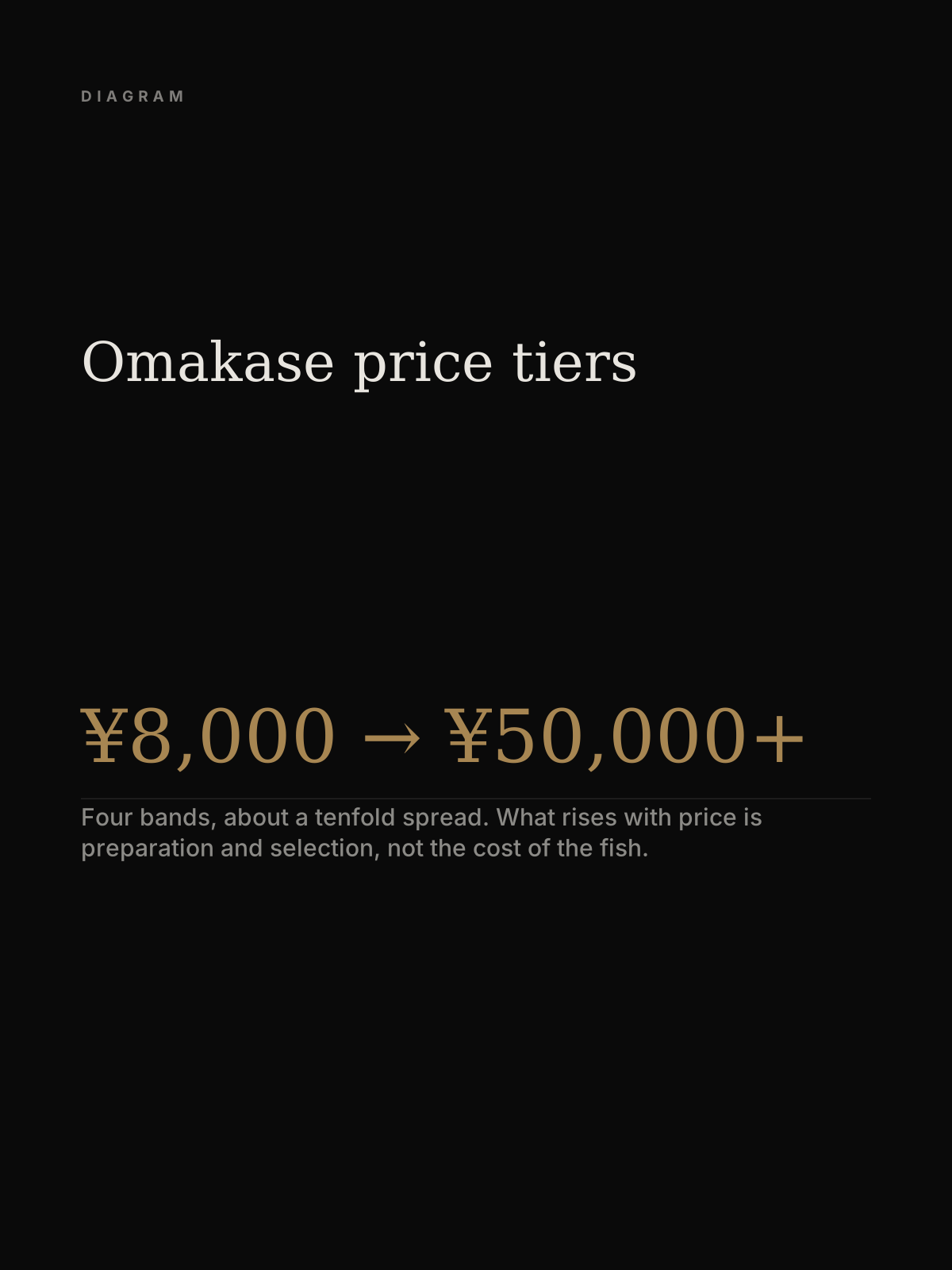
There are four lunch plans. The seasonal omakase nigiri course is ¥21,780. The same course with a tasting of six sea urchins is ¥26,180. The tokujo course with a tasting of nine sea urchins is ¥31,680. A tokujo course with the sea urchin tasting and a lobster is ¥55,880. Every one of those figures is a round number multiplied by 1.1: ¥19,800, ¥23,800, ¥28,800 and ¥50,800, each with 10 per cent added.
So the course called a seasonal tokujo nigiri course with a tasting of nine sea urchins exists at two prices on two pages the same company controls: ¥25,000 on the operating company’s site, ¥31,680 on the booking platform. And the ¥5,800 lunch, which is still published on the company site today, is not on the platform at all. The cheapest lunch you can actually book is three and three-quarter times that.
The honest reading is that the company page is five years old and nobody has taken it down. That is not deception; it is the ordinary decay of a restaurant with more than one publisher, which is the condition of nearly every restaurant in this city. But it is worth knowing that a price published on a restaurant’s own corporate site can be five years stale while the booking engine two clicks away is current, and that the only way to tell them apart is the date stamp on the announcement.
One published detail matters more than any of the prices. Lunch here is weekdays only, from 12:00, with last orders at 13:00. The kitchen stops taking lunch orders one hour after the room opens. Kita-Shinchi is an entertainment district that works in the evening, and its midday service is a narrow window held open out of obligation. If you plan a ¥21,780 lunch here for one o’clock, you are arriving as it closes.
What the extra money is actually buying
Set the five ladders side by side, cheapest rung to most expensive, and count only the sushi.
- Sushi Rei — ¥6,000 to ¥15,000, a rise of ¥9,000. Sushi: eight pieces to ten. Two more pieces.
- Sushi Miyakawa — ¥4,500 to ¥8,500, a rise of ¥4,000. Sushi: eight to ten. Two more pieces.
- Kura, lunch — ¥9,500 to ¥16,000, a rise of ¥6,500. Sushi: eight to twelve. Four more pieces.
- Benkay — ¥6,300 to ¥16,000, a rise of ¥9,700. Sushi: eight to ten. Two more pieces.
- Kura, dinner — ¥22,000 to ¥30,000, a rise of ¥8,000. Sushi: twelve to eight. Four fewer pieces.
Four of the five lunch ladders start at eight pieces. All five top out at ten or twelve. The largest price increase in the group, ¥9,700 at the hotel counter in Shinsaibashi, buys two pieces of sushi. The only ladder that adds four adds them for ¥6,500, which is also the cheapest sushi per rung anywhere here — and it is on the fortieth floor of a Conrad.
Here is the same comparison from the other direction: everything that appears on an upper rung and not on the rung below it, across all five restaurants.
- Sashimi — at four of the five, in one form or another: winter yellowtail, amberjack, thinly sliced white fish, two kinds of the day, an assortment.
- Sea urchin — as a roll, as a tasting of six, as a tasting of nine, and once as a garnish on wagyu.
- A live or steamed abalone — at two of the five.
- Caviar, replacing flying-fish roe in an otherwise identical opening dish.
- Wagyu fillet, at ¥30,000, in place of four pieces of sushi.
- Tempura, a grilled dish, a cured fish, a chawanmushi, a small bowl of ikura.
- And, at one restaurant, one grilled isaki for ¥2,000.
There is exactly one thing on that list that is sushi, and it is the sea urchin roll. Everything else is the food a Japanese restaurant serves around sushi. The upper rungs of an Osaka sushi lunch are not more sushi. They are a kaiseki course with sushi inside it, and the further up you go the more true that becomes, until at ¥30,000 the sushi is a section of the meal rather than the meal.
There is exactly one item on that list that is sushi. The rest is the food a Japanese restaurant serves around sushi.
Then there is the word. Three of these five call their lunch omakase — leave it to us. All five publish every course in full, in advance, dish by dish, before you have booked anything. Two of them publish the exact number of pieces and what the roll is made of. One publishes the preparation steps so that guests can arrive with confidence. Whatever omakase means on these menus, it does not mean that the contents are unknown to you. The one decision genuinely left to the chef is which fish goes into the eight, ten or twelve slots that have already been sold to you by number.
The two restaurants that decline the word are both hotels, and both are more forthcoming than the three that use it, not less. They name the courses after winds and districts, print the whole menu as a bilingual PDF or a web page with every item listed, and state the service charge inside the price. The word omakase, at lunch in Osaka, is doing marketing work rather than describing a way of eating.
The clock is its own ladder, and it runs the wrong way. Miyakawa sells a twenty-item lunch on a sixty-minute limit and a twenty-item dinner on a hundred and fifty. Sushi Rei sells a seventeen-item lunch with an abalone in it on ninety minutes, with a note that the table may be wanted back after two hours. Kura closes its lunch door at 14:00 for a service running to 15:30. Seikai takes its last lunch order sixty minutes after opening. The more you spend at lunch, the more courses have to fit into a window that does not widen.
And the price is not the price at three of the five. Sushi Rei adds 10 per cent on top and says so in the notes. Miyakawa states a service charge on its dinner terms and omits the line on its lunch terms. Seikai’s platform prices are all round numbers plus 10 per cent. The two hotels include everything and quote a total, and one of them includes a service charge of 15 per cent while doing it. If you are comparing a ¥15,000 counter in Namba against a ¥16,000 counter on the fortieth floor of a Conrad, the real numbers are ¥16,500 and ¥16,000, in that order.
What all of this gives you is not a way of finding the best lunch. It is a way of reading a column of prices. Before you choose a rung, find the item list for the rung below it and the rung above it, and identify the difference. If the difference is two pieces of sushi, you are paying for sushi. If the difference is an abalone, a caviar substitution and a plate of sashimi, you are paying for a Japanese lunch that ends in sushi, which is a perfectly good thing to buy and is not the thing the word at the top of the menu promised.
And if what you want is sushi and only sushi, the answer at four of these five restaurants is the cheapest rung. It is the one where the sushi is the highest proportion of the meal, the one where nothing has been pushed aside to make room for wagyu, and — at the counter in Namba, the counter in Umeda and the counter in Shinsaibashi — it is eight pieces, which is one or two short of the ten that the money above it buys.
Lunch service, as published
All of this is what the restaurants publish about themselves, read in August 2026. Hours, sittings and prices in Japan change without notice, and three of these five are described by more than one publisher who do not agree with each other. Confirm before you travel for one.
- Sushi Rei, Namba, Chuo-ku. Sixth floor, one minute from Osaka-Namba station. Lunch 12:00–15:00, arrivals 12:00–14:00, ninety minutes. Four courses ¥6,000–¥15,000 plus 10 per cent service. Twenty-five seats including a counter, seats for couples and private tables. No closing day published. Dress code given as casual formal. Same-day changes and cancellations by telephone only.
- Sushi Miyakawa, Sonezaki, Kita-ku. Fifth floor, three minutes from Higashi-Umeda station. Lunch 12:00–15:00, sixty minutes. Three courses ¥4,500–¥8,500. Thirty seats, six private rooms for two to eight. Non-smoking throughout; accessible toilet. Dinner courses can also be booked at midday.
- Kura, Conrad Osaka, Nakanoshima, Kita-ku. Fortieth floor. Thursday to Tuesday, closed Wednesdays. Lunch 11:30–15:30, last entry 14:00. Three sushi courses ¥9,500–¥16,000, tax and 15 per cent service included. Nine seats at the sushi counter, forty-one in the room. Full menu published as a bilingual PDF; vegetarian option on request.
- Benkay, Hotel Nikko Osaka, Nishi-Shinsaibashi, Chuo-ku. Third floor, connected to exit 8 at Shinsaibashi. Lunch 11:30–14:30. Four sushi courses ¥5,500–¥16,000, tax and service included, with a published 10 per cent loyalty rate. Sushi counter seat count not published. Sushi also sold by the piece. Children at the counter from primary school age.
- Sushi Seikai, Dojima, Kita-ku. Second floor, five minutes from Kitashinchi station. Lunch weekdays only, 12:00–14:00, last order 13:00. Dinner from 17:00 on weekdays and 16:00 at weekends. Twenty-seven seats. Irregular closing days. Lunch courses on the booking platform ¥21,780–¥55,880; the ¥5,800 lunch on the operating company’s site dates from 2021.
If you want to book one of these
Several of the counters described above answer the telephone only in Japanese, and a few of them take bookings by no other route. AutoReserve is a Japanese reservation service with an English interface, and it states that it will place the call on a diner’s behalf where a restaurant takes reservations by telephone alone. We have not tested it against every restaurant on this page, and a listing there is not a guarantee of a seat — the doors described above are the doors either way.
Frequently asked questions
What does omakase actually mean on an Osaka lunch menu?
Less than the word suggests. All five restaurants in this article publish the complete contents of every lunch course in advance — the opening dish, the number of pieces of nigiri, what the roll is made of, where the soup comes and what the dessert is — and three of the five call those courses omakase while doing it. One of them states that it lists the preparation steps as well, so that guests can arrive with confidence. What is genuinely left to the chef is which fish goes into the eight, ten or twelve slots that have already been sold to you by number. The structure of the meal is fixed, priced and published. The fish is the variable.
Does the most expensive lunch course have the most sushi?
Usually not by much, and once not at all. Across the five lunch ladders here the sushi count runs eight to ten, eight to ten, eight to twelve, eight to ten, and the price rises by between ¥4,000 and ¥9,700 to do it. Only one restaurant — the counter on the fortieth floor of a hotel in Nakanoshima — adds two pieces at every rung. That same restaurant’s dinner menu then serves twelve pieces at ¥22,000 and eight pieces at ¥30,000, because the ¥30,000 course makes room for a course of wagyu fillet with sea urchin. If the piece count is what you are buying, the cheapest rung is often the best value on the page.
Why is the price on a booking site different from the restaurant’s own page?
Three separate reasons appear in this article. At one restaurant, every platform price is the restaurant’s own price multiplied by 1.1 — the 10 per cent service charge stated in the small print on one page and folded into the display price on the other. At a second, the platform shows a discount badge whose discounted price is exactly the restaurant’s list price, with the higher original figure appearing nowhere on the restaurant’s own pages. At a third, the operating company’s website still publishes a lunch course from an announcement dated November 2021 that the booking engine no longer sells at all. Read the date on any page quoting a price, and treat the booking engine as the current one.
How long do I get for a sushi lunch in Osaka?
Between sixty and ninety minutes at the three non-hotel counters here, and the limit does not lengthen as the course does. One restaurant sells a twenty-item lunch on a sixty-minute limit and a twenty-item dinner on a hundred and fifty. Another sells a seventeen-item lunch on ninety minutes and prints, in the same block of notes, that the table may be wanted back after two hours. The hotel counters manage it with a last entry time instead — 14:00 for a service that runs to 15:30 at one of them. And one restaurant in Kita-Shinchi takes its last lunch order at 13:00, an hour after opening. Book the beginning of the window, not the end of it.
If I only want sushi, which course should I book?
At four of these five restaurants, the cheapest one. That is where the sushi is the highest proportion of the meal and where nothing has been displaced to make room for sashimi, tempura or beef. It is eight pieces at the counters in Namba, Umeda and Shinsaibashi, against the ten that the money above buys. The exception is the hotel counter in Nakanoshima, where the count genuinely rises to twelve for ¥6,500 more — though the roll at ¥9,500 is tuna and the roll at ¥16,000 is simmered gourd, so even there the upper rung is not straightforwardly more of everything.