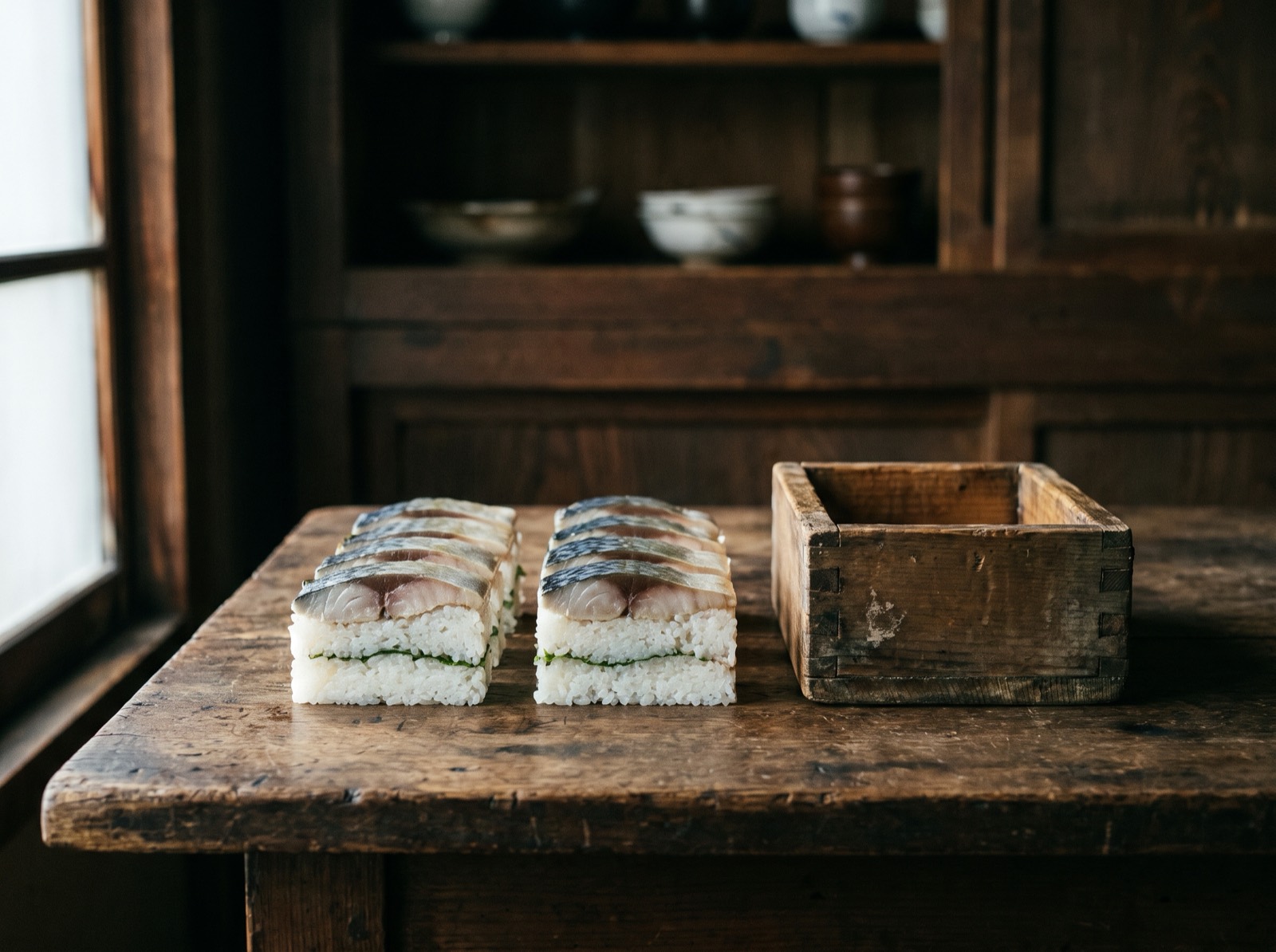
Minami is the southern half of central Osaka, and it is the half that photographs well. Dotonbori runs east to west along a canal lined with signs that move: a crab with articulated legs, a pufferfish lantern, a running man who has been running since 1935. Two hundred metres north is Shinsaibashi, a covered shopping street. Ten minutes east is Kuromon Market, five hundred and eighty metres of fishmongers, and the market’s own site calls it the kitchen of Osaka. Between them, within a twenty minute walk, you can eat sushi at a counter, standing at a stall, off a conveyor belt, in a private room on the fourth floor, or out of a paper tray while leaning against a chest freezer.
What none of this tells you is who you are buying from.
We picked five places in Minami where you can eat sushi, and then read what each one publishes about itself — company registration, group structure, business description, the order in which it lists its own product lines. Three of the five are not sushi restaurants in any legal sense. They are fish businesses: a tuna wholesaler at the central market, a seafood retailer owned by a trading house, and a dried-fish wholesaler founded in 1975 that now turns over about ¥19.3 billion a year. In each case the sushi is the outlet, not the enterprise. One of the five is a sushi restaurant and nothing else, has been for sixty years, and has no website at all. And one of the five started as a four-and-a-half-tsubo sushi bar in 1963 and became a food-service corporation with eleven restaurant formats, of which sushi is now one.
The second thing they share is stranger. In Minami, the selling is staged. The tuna wholesaler calls its shop a theatre — not as a passing metaphor but as its permanent headline, with a curtain that goes up and an invitation to attend rather than to visit. The ¥19.3 billion company runs a live tuna-cutting show at six every evening, and only at one of its six branches in the area. The seafood retailer books a rakugo comedian into the shop for an evening and shortens its hours to do it. None of that is on the menu, and all of it is the product.
This is not a ranking. It is what five places in Minami say about themselves when you read past the sign, and what that tells you about how to eat there.
Three of the five are legally fish businesses. The sushi is the outlet, not the enterprise.
The five, and what each one actually is
- Maguroya Kurogin, Kuromon main shop — a bluefin specialist run by the operating arm of a tuna wholesaler inside Osaka’s central market. Open from 9:00, closes when it sells out. No booking for the counter.
- Kuromon Sanpei — a seafood retailer wholly owned by a trading company, forty-eight staff, four languages on its website. You order at the till, take a ticket, and sit down. Open 8:00 to 20:00, every day of the year except the New Year period.
- Daiki Suisan Kaiten Sushi, Dotonbori — conveyor belt sushi from a company founded as a dried and salted fish wholesaler in 1975, now about ¥19.3 billion a year and 3,698 staff. Open 11:00 to 23:00, no closing day, no reservations, and a tuna cut daily at around 18:00 that runs at this branch only.
- Sushidokoro Kuromon Suehiro — sixty years of sushi and nothing else, on the market street, with no website of its own. The market’s directory is the only publisher it has, and the directory files it under Vegetarian.
- Ganko, Sushi Dotonbori branch — 151 seats over several floors, from a company that began in 1963 as a four-and-a-half-tsubo sushi bar in Juso and renamed itself GANKO Co., Ltd. in 2024. Open 12:00 to 22:30, and its own listing page has no closing-day field at all.
Read those five lines again and notice what is missing. Only one of the five keeps hours that a sushi restaurant would recognise. Two of them close when the fish runs out or when the shopping centre does. Three of them cannot be booked by any means, because the concept of a booking does not apply to a fish counter. If you arrive in Minami with a list of restaurant names and a plan to reserve tables, the list will not work, and the reason is not language.
The tuna wholesaler that calls its shop a theatre
Maguroya Kurogin’s Kuromon main shop stands at 2-11-1 Nipponbashi, on the ground and first floors of the Kuromon Building, telephone 06-4396-7270. It opens at 9:00 and the published closing time is 21:00, with two qualifications printed alongside it: hours change with the season, and service ends when the stock is gone. Closing days are given as irregular, plus 1 to 4 January. That is the whole of the practical information, and every part of it is contingent.
The shop is built to look like a stall. You stand at the front, you choose a cut — kama-toro from behind the collar, otoro, chutoro, akami — and then you choose the form it arrives in: sushi, sashimi, or over rice in a bowl. The tuna is broken down where you can see it. There is a hotpot of tuna and spring onion, negima-nabe, that exists only at the Kuromon shop, must be reserved, and cannot be taken away. There is a rolled item they call a maguro roll, made in limited numbers on no fixed schedule.
Now read the company page. The shop is operated by Kurogin Japan Co., Ltd., capitalised at ¥10 million, whose stated business is restaurants and specialist tuna retail, with its head office on the third floor of the same Kuromon Building. Kurogin Japan sits in a group. The other operating company is Nagase Suisan Co., Ltd., capitalised at ¥30 million, and its stated business is specialist tuna wholesaling and marine product processing. Its registered address is inside the Osaka Municipal Central Wholesale Market at 1-1-86 Noda, Fukushima-ku. The same man, Ryuichi Nagase, is representative director and president of both companies.
So the counter you are standing at is the retail end of a wholesaler that holds a stall at the market where Osaka’s fish is distributed. That is the whole business model, stated plainly on a page most visitors never open.
It goes one step further. The group page records a business alliance with the Yamayuki group, which trades inside Toyosu Market in Tokyo, and lists Yamayuki’s head, Yukitaka Yamaguchi, as a director of Kurogin Japan. Two more companies complete the structure: Japan Silver Seas, which does property leasing and acts as the holding company, and Kurogin Co., Ltd., which handles finance, personnel and information systems. The board, as published in July 2025, includes a certified tax accountant, a registered management consultant, a specially qualified labour and social security attorney, an administrative scrivener, and a second labour and social security attorney.
That is an unusual board for a stall that sells tuna over a counter, and it tells you something the menu does not: the thing being run here is a supply chain with a shopfront on the end of it.
And then there is the language. The Japanese homepage opens with a line that translates roughly as delicious tuna, tuna that puts on a show — and then, on its own line, the Kurogin Theatre, curtain up. What follows keeps the metaphor going without a break. The stage is a corner of a bustling market. A market experience that shakes all five senses. Japanese tuna, Kurogin’s tuna, here it is. And the closing line is not please come and see us but the phrase a theatre uses for an audience: please attend. In the footer the same conceit appears again with the other theatrical verb, the one for a performance beginning rather than a season opening.
The English page carries the same photographs and the same structure. The theatre is gone. You will find this incredible flavor in a corner of the market, it says, where the Japanese says the stage is a corner of the market. It closes with we look forward to seeing you. There is no curtain, no stage, no audience, no attendance. Every practical fact survives translation intact; the only thing lost is how the company sees itself.
Every practical fact survives translation. The only thing lost is how the company sees itself.
This is worth naming because it inverts the usual complaint. Visitors expect the English version of a Japanese restaurant site to omit facts — the prices, the rules, the closing days. Here the facts are all present. What has been quietly dropped is the claim that the shop is a performance, which is the single most useful thing to know before you stand in front of it. You are not queueing at a fish counter that happens to be busy. You are attending something the operator has designed to be watched, priced accordingly, and staged in a market aisle.
The same company runs a Tsukiji main shop in Tokyo, at 4-10-12 Tsukiji in the Tsukiji Center Building, telephone 03-3544-7440, and describes it in the Tsukiji style, with a phrase that means a full house. If you have read our Tokyo morning sushi piece, you have walked past it.
- Address 2-11-1 Nipponbashi, Chuo-ku, Osaka — Kuromon Building, ground and first floor
- Telephone 06-4396-7270
- Hours as published 9:00–21:00, varying by season, ending when sold out
- Closed irregular, plus 1–4 January
- Booking not applicable to the counter; the negima-nabe hotpot must be reserved and cannot be taken away
Where sushi is the fourth item on a fish shop’s list
Two hundred metres north along the same market street is Kuromon Sanpei, at 1-22-25 Nipponbashi. The shop telephone is 06-6634-2611. There is a separate head office number, 06-6635-1938, staffed 9:00 to 17:00 on weekdays. The website appears in Japanese, English, traditional Chinese and Korean. The shop is open 8:00 to 20:00 and closes only from 1 to 4 January.
The corporate page reads like a fish merchant’s, because it is one. Kuromon Sanpei Co., Ltd. was established on 25 July 2013, taking over the business of Sanpei Suisan Co., Ltd., and was set up as a wholly owned subsidiary of Shokuryu Co., Ltd. Capital is ¥50 million. Staff, forty-eight. The representative director is Hirohiko Kamata, in post since 17 May 2024, succeeding the founding appointee Shoichi Iwasaki. The predecessor company, Sanpei Suisan, began as a wholesaler inside the Osaka central market, dealing principally in salted salmon and fish roe.
The naming detail is the one worth carrying with you. The company’s own history says that Kuromon Sanpei was a new trading name adopted when the business opened a shop in Kuromon Market, and that the trading name later became the company name. The market did not adopt the shop. The shop adopted the market, then took its name.
Now the line that decides how you should read the whole place. Under business activities, the company lists a Kuromon Market Division, and describes it as the retail of marine products generally, and in-store food service. In-store food service is the second clause of one line about a retail division. Sushi is not the business. It is a way of selling fish to someone who is already standing in the shop.
The list of what they handle confirms it, and the order matters: fresh fish and shellfish, salted and dried goods, sashimi, sushi, in-store dining. Sushi is fourth.
The eat-in menu, all prices including tax and every dish served with miso soup, runs like this. Sea urchin and salmon roe over rice, ¥3,850, marked as their number one. A seafood bowl at ¥1,650, described as the fish shop’s serious seafood bowl, toppings changing daily. Grilled eel over rice, ¥1,320, their number three. Bluefin over rice by cut: akami ¥1,650, chutoro ¥2,200, otoro ¥3,300. Salmon and salmon roe, ¥1,650. A plate of nigiri at ¥1,650, again with the day’s toppings rather than a fixed set. Roast beef over rice at ¥1,650, using Hokkaido beef, and pork at ¥1,320. And a weekday-only set lunch at ¥1,000, made in limited numbers.
There are sharing sets too, priced for two: a pufferfish hotpot set at ¥11,000 built on one farmed domestic tiger puffer, a crab hotpot at the same price, and a hand-roll set at ¥1,650 that comes as about two portions. Drinks are priced like a shop rather than a restaurant — draught beer ¥380, a 334ml bottle ¥500, a One Cup Ozeki ¥500, a highball ¥400.
Note what the daily-changing items mean in practice. Two of the cheaper dishes, the seafood bowl and the nigiri plate, are explicitly composed of whatever the shop has. You cannot know in advance what you will be served, and the reason is not chef’s discretion. It is that the kitchen is downstream of the shop floor.
The ordering flow is published as four numbered steps, and it is a fish shop’s flow, not a restaurant’s.
- Order at the till.
- Pay, and receive a meal ticket.
- Take a seat and wait.
- The food is brought to your table.
There is no table service in the ordinary sense, no menu handed to you after you sit, and no bill at the end. You are buying across a counter and then being allowed to sit down with it. For a visitor this is good news and bad news at once: nothing is gated behind a conversation, and equally there is nobody coming to your table to sell you anything or explain anything.
The shop extended its hours from February 2026 to run 8:00 to 20:00, and it says why: breakfast through to an early drink and on to dinner. From 16:00 it sells a cheap standing-drink set, the kind of offer that in Osaka is named after the thousand-yen note it is supposed to cost.
Two notices from July 2026 show what the extended hours are for. On the 17th the shop held an evening rakugo event. On the 23rd it closed early for staff training. Both days ran 8:00 to 17:30 instead of 8:00 to 20:00. This is the practical trap in every published opening time in this article: the market’s own directory carries the standard hours, and the exceptions exist only on the shop’s own site.
The second notice from the same week is the more interesting one. On 23 July, from 10:00, students from the international communication course of a high school in Shiga prefecture conducted a survey of customers inside the shop. The shop’s notice says the exercise started in 2018, stopped during the pandemic, and resumed in 2025 with the Osaka Expo as the prompt. A fish shop in a tourist market is being used as a language classroom, and it tells its customers so in advance.
The company’s history is a chain of openings and one closure: trading began on 1 October 2013 with three locations at once — the Kuromon shop, a Hankyu Umeda counter and a Takashimaya Osaka counter. A branch opened in a farmers’ market in Wakayama in April 2017 and closed in August 2020. Hankyu Kobe followed in April 2020, Hankyu Kawanishi in October 2021, and a shopping centre in Kadoma in April 2023. In June 2018 the Kuromon shop obtained Osaka’s prefectural food safety certification.
And on Instagram, where the shop writes for itself in one line, the bio says: we are a fish shop in Osaka’s Kuromon Market.
- Address 1-22-25 Nipponbashi, Chuo-ku, Osaka
- Telephone 06-6634-2611 (shop); 06-6635-1938 (head office, 9:00–17:00 weekdays)
- Hours 8:00–20:00, extended from February 2026; standing-drink set from 16:00
- Closed 1–4 January only; early closing on event and training days, announced only on the shop’s own site
- Ordering pay at the till, take a ticket, sit down
The dried-fish wholesaler that became a ¥19.3 billion company
Walk west out of the market and across to Dotonbori and you reach Daiki Suisan Kaiten Sushi at 1-7-24 Dotonbori, on the ground floor of the Shikairo Dotonbori Building, telephone 06-6214-1055. It opens 11:00 to 23:00 with last orders at 22:30, and its published closing days are none.
Daiki Suisan Co., Ltd. was established on 22 November 1975, inside the Sakai municipal central wholesale market, with dried and salted goods wholesaling as its principal business. The head office is still in Sakai, at 607-1 Nakamura-cho, Kita-ku. Shinya Saeki is president; Yasunobu Saeki is chairman. Capital is ¥50 million. Turnover was about ¥19.3 billion for the year to August 2025, and about ¥30.9 billion across the group. Staff number 3,698, of whom 3,297 are part-time.
As of January 2026 the company runs 34 conveyor belt restaurants, 29 fish shops under a separate retail name, and 13 other restaurants. Its corporate motto translates as freshness is the feast, and its own summary of itself is direct: we started as a fish shop in 1975 and have always been with fish.
The company history is a useful corrective to the idea that conveyor belt sushi is where a fish business ends up when it gives up. The order runs the other way.
- May 1988 — opens a live fish distribution centre in Sakai, shipping direct from Sakai port in Tottori. Entering retail, it simultaneously begins a radio slot on an Osaka station reporting market conditions from the landing ports.
- 30 December 1994 — takes ¥100 million over the counter in a single day.
- November 2000 — opens its first conveyor belt restaurant, attached to a supermarket in Nara.
- October 2002 — renames its Moriguchi branch and opens what it records as Japan’s first conveyor belt sushi restaurant inside a department store.
- August 2018 — expands its Sakai fish shop from about 200 tsubo to about 800 and renames it a tuna park.
- July 2019 — opens a tuna stadium on the riverside at Hachikenyahama.
A company that was selling dried fish to Sakai in 1975 was buying radio airtime in 1988 to broadcast the state of the market, and by 2018 was calling its own shop a park and its riverside site a stadium. The theatre at Kuromon is not an isolated affectation. It is the regional grammar.
The corporate structure repeats the pattern seen at Kurogin, and one detail gives it away completely. The group includes Daiki Sangyo, whose business is the wholesale of fish and shellfish, a company called Machi no Minato, whose business is described as retail with event planning, and a development company. The copyright line at the foot of the conveyor belt sushi brand site does not read Daiki Suisan. It reads Machi no Minato Co., Ltd. The sushi brand’s website belongs to the retail company.
The brand pages are unusually explicit about why the restaurants exist. One page addresses the decline in fish eating among younger people in Japan, says the company wants people to eat fish in whatever form they will accept, and describes the restaurants as what a fish shop’s restaurant can do. The conveyor belt is stated as a distribution strategy for a product the company already sells.
There are six branches of the same brand inside Minami: Namba CITY, Namba Walk, Dotonbori, Daimaru Shinsaibashi, one in the Naniwa area, and Namba Takashimaya. They are not interchangeable, and the differences are the practical content of this section.
The Dotonbori branch is the one with no queue system, no table seating and no car park, and it is the only one of the six with the daily event: from 7 May 2026, a live bluefin tuna cutting at around 18:00 every day, listed as Dotonbori branch only. A second Dotonbori-only recommendation list started on 22 May 2026. The facility tags it does carry are takeaway sushi, delivery, close to a station, credit cards, and QR payment.
Compare that with its neighbours. The Namba CITY branch, at 2-10-1 Nambanaka, telephone 06-6644-2470, opens 11:00 to 22:00 with last orders at 21:30, has a queue system and table seating, and gives its closing days as according to Namba CITY. The Daimaru Shinsaibashi branch, on the tenth floor of the main building at 1-7-1 Shinsaibashi-suji, telephone 06-6251-6211, opens 11:00 to 22:00 with last entry at 21:00, and gives its closing days as according to the Daimaru Shinsaibashi store.
Two of the three do not know when they are closed. Their landlord does. If you are planning around a public holiday or a New Year period, the restaurant’s page is not the page to read; the shopping centre’s is. The Dotonbori branch, which stands in its own building on the street, is the one that can say no closing days and mean it — and it is also the one with no reservation system and no tables, which is to say the one designed for people who walked past.
- Address 1-7-24 Dotonbori, Chuo-ku, Osaka — Shikairo Dotonbori Building, ground floor
- Telephone 06-6214-1055
- Hours 11:00–23:00, last orders 22:30
- Closed no closing days
- Booking none, and no queue ticket system either; counter seating only
- Daily live tuna cutting at around 18:00, this branch only, from 7 May 2026
Sixty years of sushi, filed under Vegetarian
Back on the market street, at 1-21-33 Nipponbashi, is Sushidokoro Kuromon Suehiro, telephone 06-6646-0145. It opens 10:30 to 21:00 with last orders at 20:30, and 11:00 to 20:30 on Sundays and public holidays. It closes on Wednesdays, on 1 and 2 January, and takes a two-day Tuesday-Wednesday break in the third week of each month. The description attached to it is that it has done sushi and only sushi on this street for sixty years.
It has no website. This is the one restaurant in this article whose facts you cannot get from the business itself, and the effect of that is worth watching closely, because it is the situation most small Japanese restaurants are in.
What exists instead is the market’s own directory, run by the Kuromon Market cooperative from an office at 2-4-1 Nipponbashi. The directory is competent. It carries the address, the telephone number, the two sets of hours, the closing pattern including the third-week break. Everything in the paragraph above came from it. As a publisher of facts about a shop that publishes nothing, it does the job.
Then look at where it has put the shop. The breadcrumb trail on the page reads: Home, then Gourmet and Food, then Vegetarian, then the name of the sushi restaurant.
The breadcrumb reads: Home › Gourmet and Food › Vegetarian › a sushi restaurant.
The badge row underneath repeats it and adds more. In one unbroken line the page tags the shop as gourmet and food, vegetarian, shopping, fresh fish, a 2025 New Year feature, a New Year feature for fish and shellfish, food and drink, eat-in, the Suehiro-kai block association, debit cards accepted, and the S row of the Japanese syllabary. A sixty-year-old sushi counter is simultaneously vegetarian, shopping, and fresh fish.
This is not a mistranslation and it is not a joke at the shop’s expense. It is what happens when a directory built for a market of about a hundred and fifty stalls has to file a restaurant. Look at the other four sushi-serving businesses in the same directory and the pattern holds. Kuromon Sakaesushi, at 1-22-30 Nipponbashi, telephone 06-6710-9976, open 11:00 to 23:00 with no closing days, is filed under Fresh Fish. Maguroya Kurogin and Kuromon Sanpei are both filed under Shopping, then Fresh Fish.
The directory has no category called sushi. It has categories for vegetarian, vegan, halal and eat-in, which tells you exactly which questions its visitors were asking often enough to justify a filter. Sushi was not one of them, because in a fish market sushi is not a distinction.
A second thing the directory does is worth knowing before you rely on it. Its URLs do not follow the shop names. Suehiro’s page is not at a path containing suehiro; guessing that returns a 404. The path is unrelated to the trading name, and the only reliable way to reach a shop’s page is to follow a link from the listing. If you are searching for one of these shops by typing a likely address into the bar, you will conclude the shop does not exist.
The freshness of the directory is mixed in a way that is easy to test. In August 2026 the 2025 New Year feature tag is still attached to Sanpei, Kurogin and Suehiro. More usefully, several entries carry two different sets of hours at once: printed opening times in the data field, and a separate currently-open line that contradicts them. One butcher prints 9:00 to 18:00 and then says it is currently open 12:00 to 22:00 with last orders at 21:30. A takoyaki shop prints 9:00 to 19:00 and then says 10:30 to 18:00. The overriding line is the newer one, and it is not in the field a scraper would read.
For the market itself the directory is good on the things a market knows about. Kuromon runs about five hundred and eighty metres and holds roughly a hundred and fifty shops, two minutes from exit 10 of Nippombashi station on the Sennichimae line. The name comes from the black gate of a temple that once stood here. The seasonal pattern is pike conger in summer and pufferfish in winter, and about one in ten of the fishmongers deals in pufferfish alone. Twenty-five businesses are listed as food and drink, of which five serve sushi in some form — and of those five, exactly one is a sushi restaurant.
- Address 1-21-33 Nipponbashi, Chuo-ku, Osaka
- Telephone 06-6646-0145
- Hours 10:30–21:00, last orders 20:30; Sundays and public holidays 11:00–20:30
- Closed Wednesdays; 1–2 January; Tuesday and Wednesday together in the third week of the month
- Published by the market cooperative’s directory only — there is no site of its own
The sushi bar that became the food-service company
The fifth is at 1-8-24 Dotonbori, a few doors from the canal: Ganko, the branch it calls Sushi Dotonbori. The listing gives 151 seats, a maximum banquet capacity of 56, hours of 12:00 to 22:30 with last orders at 22:00, and a card list that runs through the international networks to UnionPay and a Japanese phone-payment app. The nearest station is given as Shinsaibashi on the subway. The telephone number begins 050 — an internet number rather than an Osaka one — and is printed with a parenthetical instruction not to misdial it. There is no closing-day field on the page at all.
The company history explains what you are walking into, and it is the mirror image of the other four.
- 1963 — Junji Kojima opens a sushi shop of four and a half tsubo, about fifteen square metres, in Juso in north Osaka, as a sole proprietor.
- 1965 — the Juso shop reopens with 106 seats and is talked about as a large-format sushi restaurant.
- 1969 — the business incorporates.
- 1973 — a central kitchen goes into the basement of the Juso main shop.
- 1980 — the company renames itself Ganko Food Service Co., Ltd.
- 1983 — its first large composite restaurant opens in Namba, and a point-of-sale system is developed to run it.
- 1989 — a tofu workshop opens and the company enters food manufacturing.
- 2008 — a production management system replaces the point-of-sale system, and the company signs a joint research agreement with the national institute’s service engineering research centre.
- 2009 — it establishes an in-house research institute and begins studying service at the point of customer contact.
- 2018 — it wins a robot award from the national machinery federation.
- 2020 — it wins the economy minister’s prize in the national service awards.
- 2024 — the company renames itself GANKO Co., Ltd.
Read the 1983 line again. The first large composite restaurant, the one that required a bespoke point-of-sale system, opened in Namba — which is to say that the pivot from sushi shop to restaurant operator happened here, in the district this article is about, and it happened forty-three years ago.
The company now describes itself as running eleven restaurant formats. Sushi and Japanese food is one of them. The others are a mansion series, a fish-and-drink format, conveyor belt sushi, a tea salon, two separate pork cutlet formats, a rice and demi-glace format, a cultural experience format, an udon specialist acquired in 2002, and a soba specialist.
Inside the sushi and Japanese food format there are thirty branches, and this is where the arithmetic gets interesting. Twenty-two of them are named Japanese Food, followed by the place: Japanese Food Namba Main Branch, Japanese Food Umeda Main Branch, Japanese Food Juso Head Branch, and so on. Seven are named Sushi, followed by the place: Sushi Dotonbori, Sushi Tenma, Sushi Temmabashi, Sushi Hankyu Sanbangai, Sushi Itami Airport, Sushi Sannomiya, Sushi Panjo Senboku. One is named after neither and called a tea salon.
A company founded as a sushi bar in 1963 now calls seven of its thirty sushi-and-Japanese branches sushi. The word that started the business has become a minority label inside its own format.
Seven of thirty branches are called sushi. The word that started the business is now the minority label.
Both halves of that split exist in Minami, four hundred metres apart, and they are not the same proposition. Japanese Food Namba Main Branch is at 3-1-15 Namba, telephone 050-1720-2494, with 331 seats and a banquet capacity of 120. It opens 11:00 to 22:00 with last orders at 21:30 from Sunday to Thursday and on public holidays, and 11:00 to 23:00 with last orders at 22:30 on Fridays and Saturdays. It states a service charge of 10 per cent.
It also states, in the same field as the opening hours, two conditions a visitor should read before booking anything. A 10 per cent charge applies to reservations only — including a reservation for seats alone. And a booking that specifies table seating may still be seated in a private room or on tatami.
So at this branch, walking in costs less than booking, and the difference is 10 per cent of the bill. That is a rule most visitors would assume works the other way around, and the only place we found it stated is inside an opening-hours field on a Japanese page.
Sushi Dotonbori, the branch a visitor to Minami is more likely to reach, has 151 seats, opens later at 12:00, and carries no service charge field on its page at all. Same company, same format, four hundred metres apart, different terms. The pattern here is the one our Kita article found across five different operators: the branch page is the contract, and the brand page is advertising.
- Address 1-8-24 Dotonbori, Chuo-ku, Osaka
- Telephone 050-1720-2721 — an internet number, printed with a warning not to misdial
- Hours 12:00–22:30, last orders 22:00
- Closed no closing-day field is published
- Seats 151, banquet capacity 56; cards including UnionPay
- Compare the Namba main branch, 331 seats, 10 per cent service charge, and a further 10 per cent for booking at all
What this means when you are standing in Dotonbori
The practical content of all this is a single instruction: in Minami, read the operator, not the sign. Five sushi signs on one map turn out to be a wholesaler’s shopfront, a trading house’s retail subsidiary, a ¥19.3 billion fish company’s distribution channel, an actual sushi restaurant, and a restaurant group’s branch. Almost everything that will affect your evening follows from which of those you are dealing with.
Fish businesses sell out. Kurogin publishes a closing time and then says service ends when the stock is gone, and that is not a disclaimer, it is how a fish counter works. If you want a specific cut of tuna at a specific hour, go early in the day, not late.
Fish businesses do not take bookings, because a shop is not booked. Three of the five here have no reservation route of any kind for the counter. This is the reverse of the Tokyo problem, where the difficulty is getting a reservation; in Minami the difficulty is that there is nothing to reserve, and the queue is the system.
Restaurant groups take bookings and may charge you for them. The Ganko rule — 10 per cent for reserving, on top of a 10 per cent service charge, at the Namba branch — is the clearest example in this article of a fact that changes the bill and appears nowhere near the price list.
Closing days may not belong to the restaurant. Two of the six Daiki Suisan branches in Minami give their closing days as whatever their shopping centre decides. A branch inside a department store or a station complex is closed when the building is, and the building’s calendar is the one to check.
And the show is the product, at least at two of the five. The tuna cutting at the Dotonbori conveyor belt branch is at around 18:00 daily and does not happen at the other five branches of the same brand in the same district. If that is what you came for, the branch matters more than the brand. At Kurogin the staging is continuous rather than scheduled, and the invitation to attend it exists only in Japanese.
One more thing, and it applies beyond these five. Of the five, two publish nothing that a search engine would rank — Suehiro has no site, and the Ganko branch page is a database record. Two publish through a parent company whose name is not on the sign. One publishes beautifully in four languages and buries the fact that it is a fish shop with tables in the second clause of a line about a retail division. Judging a Minami restaurant by the quality of its web presence measures the operator’s corporate function, not the food.
Hours and closing days, as published
- Maguroya Kurogin, Kuromon — 9:00–21:00, seasonal, ends when sold out. Closed irregularly and 1–4 January. No booking.
- Kuromon Sanpei — 8:00–20:00 daily; closed 1–4 January. Early closes for events appear only on its own site. Order at the till.
- Daiki Suisan Kaiten Sushi, Dotonbori — 11:00–23:00, last orders 22:30, no closing days. No booking, no queue ticket. Tuna cut around 18:00 daily.
- Sushidokoro Kuromon Suehiro — 10:30–21:00, last orders 20:30; Sundays and holidays 11:00–20:30. Closed Wednesdays, 1–2 January, and Tuesday and Wednesday in the third week.
- Ganko, Sushi Dotonbori — 12:00–22:30, last orders 22:00. No closing-day field published. Telephone booking on an 050 number.
Every line above was taken from the operator’s own page or, for Suehiro, from the market cooperative’s directory, in August 2026. Two of the five have already changed their hours within the last twelve months, and one of those changes was announced only in a news post. Check before you walk.
If you want to book one of these
Several of the counters described above answer the telephone only in Japanese, and a few of them take bookings by no other route. AutoReserve is a Japanese reservation service with an English interface, and it states that it will place the call on a diner’s behalf where a restaurant takes reservations by telephone alone. We have not tested it against every restaurant on this page, and a listing there is not a guarantee of a seat — the doors described above are the doors either way.
Frequently asked questions
Do I need a reservation for any of these?
For three of the five there is nothing to reserve. The tuna specialist at Kuromon works as a stall, the seafood retailer takes your order at the till, and the conveyor belt branch in Dotonbori has no booking system and no queue ticket system either. Only the Ganko branch takes telephone bookings, on an 050 internet number. There is one reservation in this article worth making and it is not for a table: the tuna and spring onion hotpot at the Kuromon tuna shop exists only at that shop, must be booked in advance, and cannot be taken away. And there is one reservation worth not making: at Ganko’s Namba main branch a 10 per cent charge applies to reservations, including a reservation for seats alone, on top of the 10 per cent service charge.
What time should I go to Kuromon Market?
Earlier than the published closing times suggest. The market’s food businesses are fish businesses, and the tuna specialist states plainly that service ends when the stock is gone, whatever the printed 21:00 says. The seafood retailer now opens at 8:00 and runs to 20:00, having extended its hours in February 2026, and starts a cheap standing-drink set at 16:00. The one actual sushi restaurant on the street opens at 10:30 and closes at 21:00 with last orders at 20:30, and shuts on Wednesdays and for a two-day break in the third week of every month. Mid-morning is when the market is doing what it exists to do; late evening is when it is closed.
Is the tuna cutting show worth planning around?
If you want to see one, note that it is a branch-level fact rather than a brand-level one. The conveyor belt company runs six branches inside Minami and the daily cutting at around 18:00 is listed for the Dotonbori branch only, running since 7 May 2026. Turning up at the Namba CITY or Daimaru Shinsaibashi branch of the same brand will not get you one. The other staged operation in this article, the tuna specialist at Kuromon, is not scheduled at all: it breaks down fish at the front of the shop throughout the day, which is the product rather than an event.
Why is a sixty-year-old sushi restaurant listed under Vegetarian?
Because it has no website, so the only publisher it has is the market cooperative’s directory, and that directory was built to answer the questions market visitors ask. It has categories for vegetarian, vegan, halal and eat-in. It has no category for sushi, because in a fish market sushi is not a distinguishing feature. The same directory files a second sushi restaurant under Fresh Fish and both tuna shops under Shopping. The information on the page is accurate — address, telephone, both sets of hours, the monthly two-day closure — and the classification above it is meaningless. Read the fields, ignore the shelf.
Is conveyor belt sushi in Dotonbori just for tourists?
The company running it was established in 1975 as a dried and salted fish wholesaler inside the Sakai municipal market, turns over about ¥19.3 billion a year, employs 3,698 people, and operates 29 fish shops alongside its 34 conveyor belt restaurants. Its own pages describe the restaurants as a response to declining fish consumption in Japan and as what a fish shop’s restaurant can do. The copyright line on the sushi brand’s website belongs to the group’s retail company, not to the restaurant company. Whatever else it is, it is not a tourist operation with a fish theme; it is a fish company with a tourist-facing outlet, which is a different thing and shows up in the sourcing.