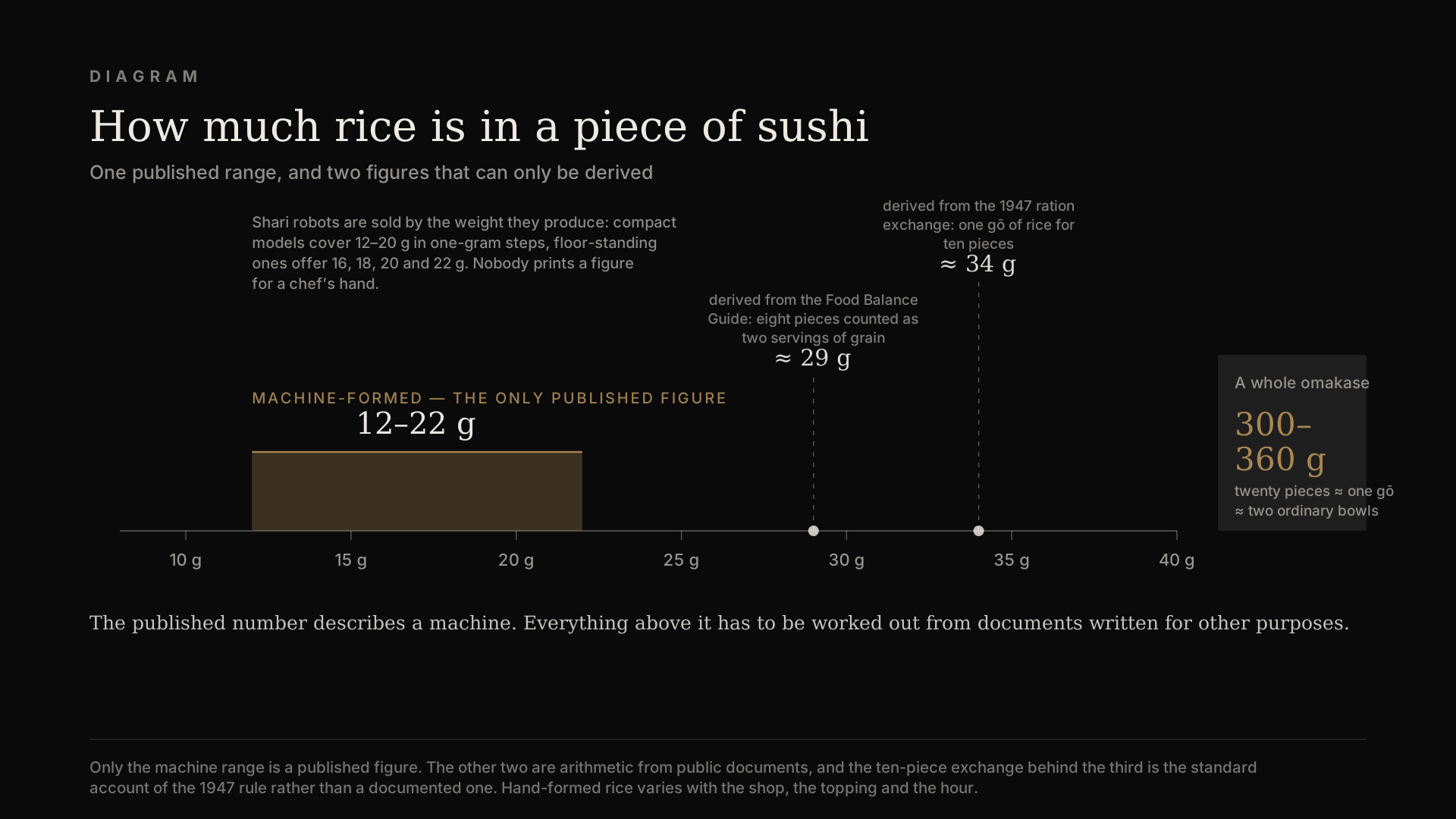
Between 12 and 22 grams, if the piece was formed by a machine — that is the range the manufacturers publish, and it is the only hard number anybody publishes at all. No shop discloses what its chefs put in a hand-formed piece, and there is no standard to disclose against. The useful figure is therefore the total: twenty pieces of nigiri carry roughly 300 to 360 grams of cooked rice, which is one gō of rice, or about two ordinary bowls.
The only published numbers
Sushi robots have specification sheets, and specification sheets have to state a weight. Suzumo, which manufactures most of the machines forming rice balls in Japan, publishes the following: its compact model is specified at 12 to 20 grams, adjustable in one-gram steps, at 1,200 pieces an hour. Its floor-standing model switches between 16, 18, 20 and 22 grams, and its fastest setting — 4,800 pieces an hour — is available only at 18 grams or less.
Read that last clause again, because it is the most revealing sentence in this article. The machine goes fastest when the piece is smallest. Any format built around throughput has a standing incentive to shave the rice, and the specification sheet is where that incentive becomes visible.
What no manufacturer, shop or trade body publishes is what a chef’s hand puts in. The figure varies between shops, within a shop across an evening, and between one topping and the next; a piece of ōtoro and a piece of kohada are not built on the same amount of rice.
What the government counts as a piece
Japan’s Ministry of Agriculture publishes a Food Balance Guide, and it does contain sushi. In its serving table, eight pieces of nigiri count as two servings of staple food — the same as one large bowl of rice. A small bowl is one serving, a normal bowl one and a half.
One serving is defined as about 40 grams of carbohydrate derived from grain. The Ministry of Education’s food composition table puts cooked white rice at 34.6 grams of carbohydrate per 100 grams. Work backwards and two servings is around 231 grams of rice, which across eight pieces is about 29 grams each — noticeably more than the machines are set to.
The discrepancy is not an error in either source. Serving counts are rounded to the nearest half serving for public-health purposes, and the sushi the guide has in mind is plainly the supermarket or delivery pack, where pieces are larger than at a counter. The two numbers are measuring different objects that share a name.
The ration that fixed the count
There is one historical figure, and it comes from an unlikely place. On 1 July 1947, under food rationing, an emergency ordinance stopped restaurants trading. Sushi shops survived by reclassifying the meal as contract processing: the customer brought their own rice, and the shop returned it as a fixed number of pieces. The arrangement spread nationally, and it is one of the two reasons nigiri stopped being an Edo speciality and became Japanese food.
The exchange is almost always given as one gō of rice for ten pieces of nigiri, or four rolls. No primary source gives those numbers — the standard reference books say only “a fixed number” — so treat the ten as the standard account rather than as documented. Taken at face value it converts cleanly. The Ministry of Agriculture puts a gō at 150 grams of uncooked rice and says cooking multiplies the weight by 2.2 to 2.3, which is about 340 grams on the plate. Divided by ten, that is 34 grams a piece.
The ration piece carried something like 34 grams of rice. A machine today is set between 12 and 22. Whatever the postwar rule fixed, it was not the size.
That figure is routinely cited as the origin of the modern piece, and the claim is repeated in Japanese reference books too. As a statement about weight it does not survive the arithmetic: a ration piece was roughly double a machine-formed one. What the rule plausibly did fix was the count — the idea that a serving of sushi is about ten pieces, which is still how a set is built — and the format of paying for a fixed number rather than for an evening.
Why none of the numbers agree
Because a piece of sushi is not a unit. It is a decision, taken fresh each time, by a person or a machine, about how much rice a particular slice of fish will balance. The variables are real ones.
- Machine or hand. A machine holds a set weight to the gram all evening. A hand does not, and is not trying to.
- The topping. A dense, fatty slice needs less rice under it than a lean one of the same area. The piece is being balanced, not filled.
- The format. Belt, supermarket pack and counter are three different economics, and the rice is where the difference shows first.
- The era. Nigiri began as street food eaten standing at a stall, and the pieces were substantially larger than anything served today. The direction of travel has been downward for two hundred years.
What a whole meal comes to
This is the number worth carrying, because it is the one that surprises people. Twenty pieces at the weights a machine is set to — 15 to 18 grams, the only published figure there is — comes to 300 to 360 grams of cooked rice. One gō cooked is about 340 grams. So a twenty-piece course is, in rice terms, a single cup of rice: roughly two ordinary bowls, spread across two hours.
A conveyor-belt meal lands in the same place by a different route. Ten plates of two pieces is twenty pieces, and the arithmetic does not change. If you are eating at a counter where the pieces are visibly smaller, the total is lower again, and one of the quiet reasons a long omakase does not feel like a large meal is that, measured in rice, it is not one.
Rolls sit differently. Under the same postwar exchange, four rolls stood in for ten pieces of nigiri, which puts an uncut roll at something like 85 grams of rice — two and a half pieces of nigiri per roll. That is a figure derived from a count we could not source, so hold it loosely; the useful part is the ratio, which matches what a hosomaki looks like next to a piece of nigiri.
If you want less rice, ask
Shari sukuname de onegai shimasu — less rice, please — is a legitimate request, and Japanese books on counter etiquette list it alongside asking for no wasabi or for smaller pieces. Give a reason and it is not rude. Some long-established shops will decline, and that is their prerogative rather than a snub: at a counter working to a fixed sequence, the ratio of rice to fish is the thing being judged, and altering it changes what you are being served.
Which is the real answer to the question in the title. The weight of the rice is not a nutritional fact that happens to vary. It is the variable the chef is actually working with, adjusted piece by piece against a slice of fish that was different from the last one. That is why nobody publishes it.
Frequently asked questions
How many grams of rice are in one piece of sushi?
Machine-formed pieces are specified between 12 and 22 grams, depending on the model and setting. Hand-formed pieces are not published by anyone and vary by shop, by topping and across an evening. A useful working figure for a counter piece is 15 to 18 grams, borrowed from the machine specifications for want of any published hand-formed weight.
How much rice is in a twenty-piece omakase?
Roughly 300 to 360 grams of cooked rice — about one gō, the Japanese cup measure, or two ordinary bowls. Spread over two hours, which is part of why a long course does not feel like a large meal.
Is a piece of sushi the same as a bowl of rice?
No. Japan's Food Balance Guide counts eight pieces of nigiri as two servings of staple food, the same as one large bowl. A normal bowl is one and a half servings. So a bowl of rice is somewhere between four and six pieces, on the government's rounding.
Why is sushi rice smaller than it used to be?
Nigiri began as street food eaten standing at a stall and the pieces were much larger. Under the postwar rationing arrangement a cup of rice became about ten pieces, or some 34 grams each. Machines today are set between 12 and 22 grams. The direction has been steadily downward.
Can I ask for less rice at a sushi restaurant?
Yes — shari sukuname de onegai shimasu. Japanese etiquette books list it with the other reasonable requests. Some traditional shops will decline, because the ratio of rice to fish is the thing they are being judged on.
Does sushi rice weigh the same as plain rice?
Not exactly. Shari is dressed with vinegar, sugar and salt, so a gram of it is not a gram of the plain cooked rice in the composition tables. The difference is small enough not to matter for the totals here, and large enough that the figures above are ranges rather than measurements.