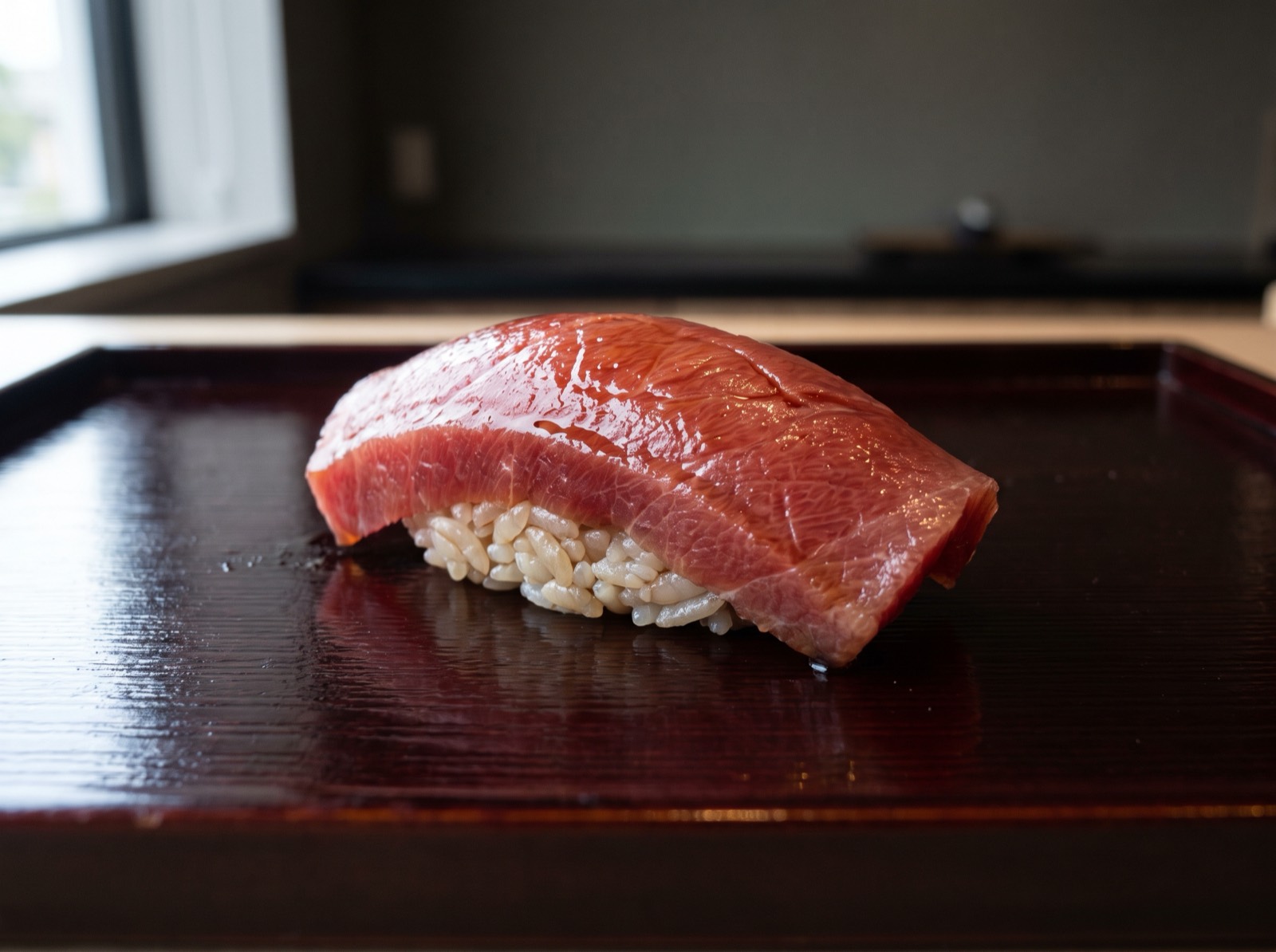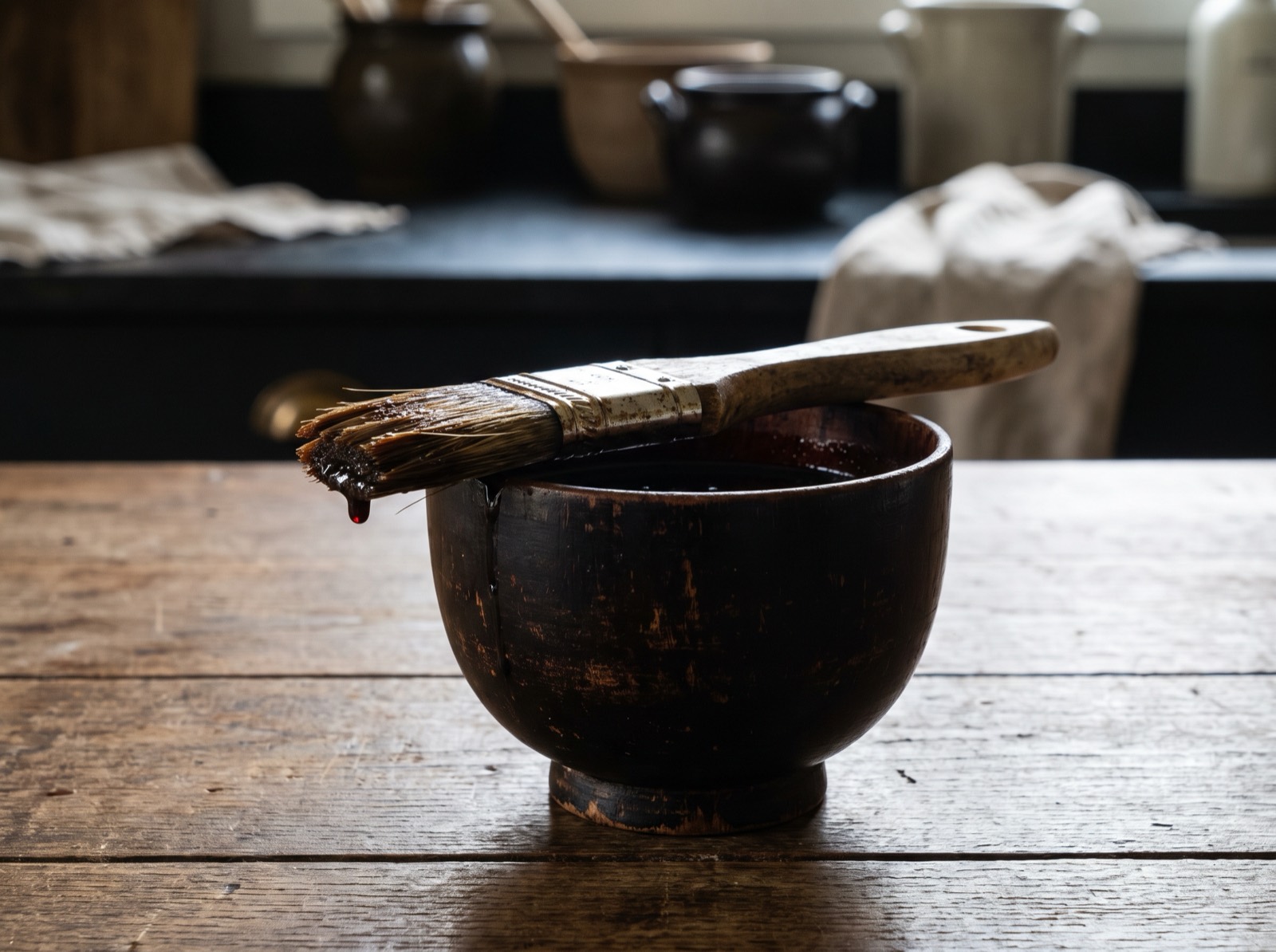
A piece of tuna arrives glossy and a shade darker than the one before it, and the chef says a single word before setting it down: zuke. It is one of the few pieces of shigoto — work done to a topping before it reaches the rice — that a counter will actually name out loud, because it is one of the few a diner can be offered instead of the plain version.
What it is
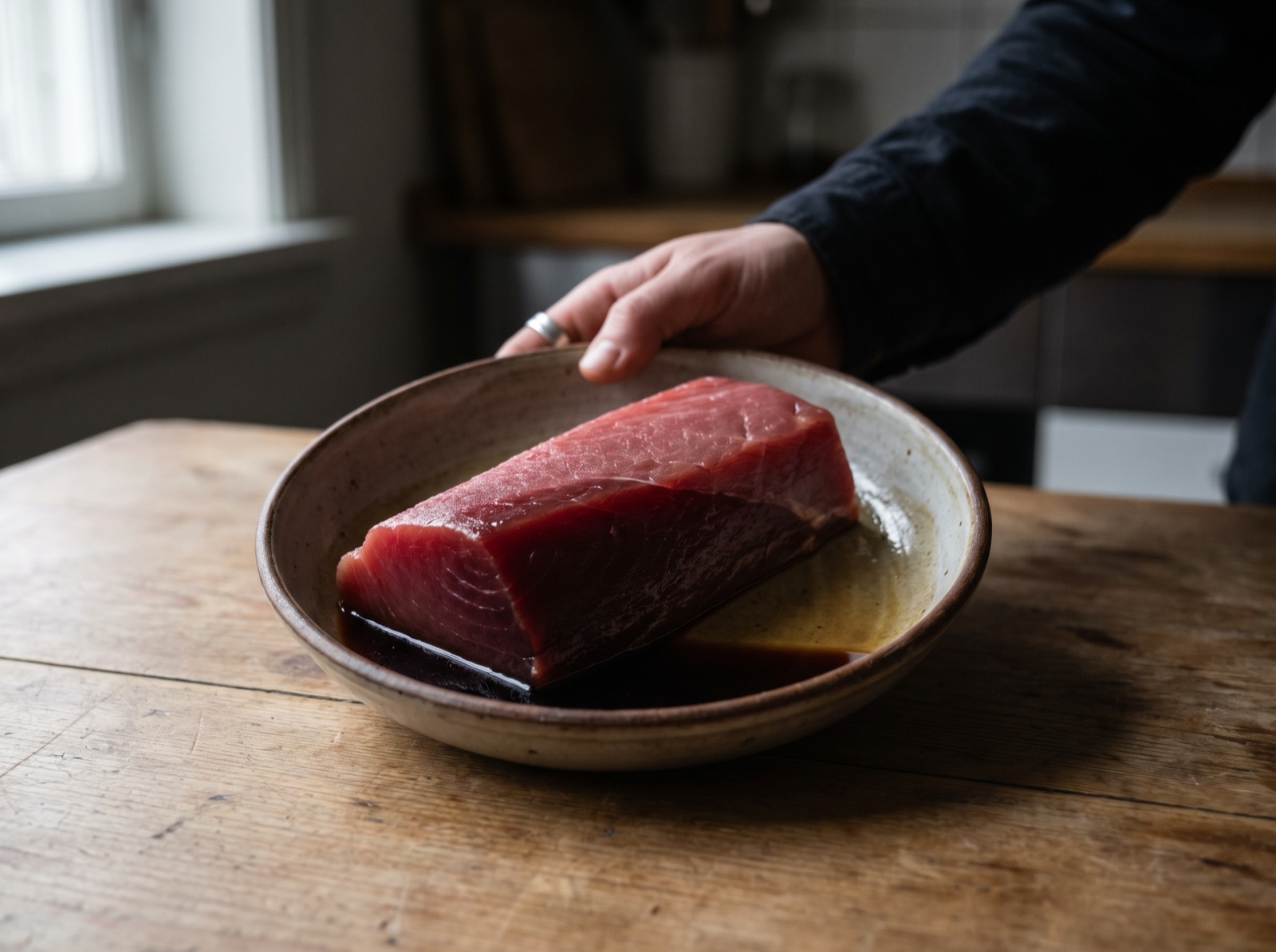
Zuke (漬け) is fish steeped in a soy-based marinade rather than brushed with one, most often the lean red meat of tuna. The word comes from tsukeru, the ordinary verb for steeping or pickling something, and the same verb turns up well outside the tuna course: our entry on ikura describes shio-zuke, salmon roe cured in salt alone, and shōyu-zuke, the same roe in soy, sake and mirin — two cures sharing the one ending. Zuke on a tuna menu is one specific case of a larger family of steeped things.
On tuna it means one thing: the lean cut, given time in the marinade rather than a single pass with a brush. What that marinade is made of and does to the fish’s colour and density is set out in full in our entry on akami, where zuke is discussed from the fish’s side. This entry is about the technique on its own terms: how it is actually made, and why a job it no longer needs to do is still being done.
When it is used
Zuke belongs almost entirely to the tuna part of a meal. Fattier grades resist the marinade for the reason covered in our entry on otoro — soy does not move through fat — so a shop offering zuke is nearly always offering a second version of the same akami a diner has tasted, or will taste, plain. That makes it an actual choice in a way most shigoto is not: nobody is asked whether they want their kohada vinegar-cured, but a case holding both a plain and a marinated tuna is deliberately giving a diner something to pick between.
The literature behind this site also describes the word being extended past tuna, to fattier grades and to white fish, once refrigeration removed the reason it had ever been limited to the one cut lean enough to survive a long soak. On an English menu, though, an unqualified “zuke” still defaults to one meaning — marinated tuna — and a shop doing something else with the word will usually say so.
What the chef actually does
There are, broadly, two ways to make it, and the difference between them is less a matter of house style than of which era of the technique a kitchen is drawing on.
- The whole block. A saku, the same cut used for sashimi, goes into the marinade as a single piece and sits for what is, by any account, a long soak — measured in hours, not minutes — with the liquid working in from the surface toward the centre.
- The single piece. The tuna is sliced first, to the size that will sit on a piece of nigiri, and each slice spends only minutes in the marinade before it is lifted back out.
The first method is the older one, descended directly from the problem zuke was built to solve: nineteenth-century Edo had a growing tuna catch and no way to keep it cold, so a whole cut held in enough salted liquid slowed its spoiling. The second method could not have existed before refrigeration made it beside the point — there is no reason to marinate one slice at a time when the purpose is to buy a whole block more days.
What the second method is actually for, the sources are direct about: seasoning a piece to the chef’s judgement of how it should taste that day, not extending how long it survives. A kitchen finishing pieces the day they are cut favours a shorter, stronger soak; one holding tuna to serve the next day uses a milder marinade over more time — and it is the refrigerator doing the preserving there, not the soy. None of this makes the fish any safer, in the sense of killing parasites: Japan’s health ministry names soy specifically, alongside vinegar, salt and wasabi, as a measure that does not work, a point our kohada entry covers in full, and the measures that actually do are set out in is sushi safe to eat in Japan.
How long either soak runs is a judgement, not a measurement — the same kind of by-feel decision described for the salt and vinegar timings behind kohada, made here about a different fish and a different marinade. What the finished piece looks and tastes like next to an untreated cut is covered fully in our entry on akami.
Why it is done
The plain history is that zuke does not need to exist any more, in the sense it first did. Edo had no ice; a modern kitchen has none of the problems tuna once did. Our guide to what Edomae actually means describes this same shift across all four historical fish treatments — a chef today is making a decision about flavour and texture, not extending a fish’s life.
What is specific to zuke is that the job did not simply get reinterpreted the way the others did. It split. The whole-block, long-soak method — the one that actually held tuna edible two centuries ago — is still practised, close to unchanged, by kitchens that inherited it; our entry on akami describes ordering it as “not nostalgia,” a genuinely different result rather than a gesture at history. Alongside it, a shorter, piece-by-piece method exists with no real equivalent before refrigeration, because there was never a reason to marinate one slice at a time when the point was to buy the whole fish more days. The two methods share a name, a marinade family and an origin. They do not share a reason for existing.
That is a claim the sources support at the level of method, not motive: nothing in the literature explains why a kitchen keeps the same word for the newer practice rather than inventing a different one, and this site does not know either. What can be said is narrower, and more interesting — the job zuke was built for is gone, and the technique is still here, doing a different one, under a name that has not changed.
The two methods share a name, a marinade family and an origin. They do not share a reason for existing.
How it differs from what it is confused with
- Zuke and nikiri are both soy-based, which is most of why they get confused. Our entry on nikiri sets out the distinction: zuke is a soak, sliced tuna sitting in the liquid long enough to firm and darken; nikiri touches the surface once, seconds before the piece is plated, and never returns. The two also behave differently on a menu — nikiri is applied to almost everything and is rarely named, while zuke is one of the few treatments a shop will actually announce.
- Zuke and su-jime are sometimes grouped together in English as “curing,” but only one uses an acid. Su-jime, the salt-then-vinegar treatment behind kohada, changes the fish chemically with vinegar. Zuke’s marinade has no acid in it, which is also why the two fail differently: an over-cured su-jime piece turns sour, an over-soaked zuke piece turns tough and salty.
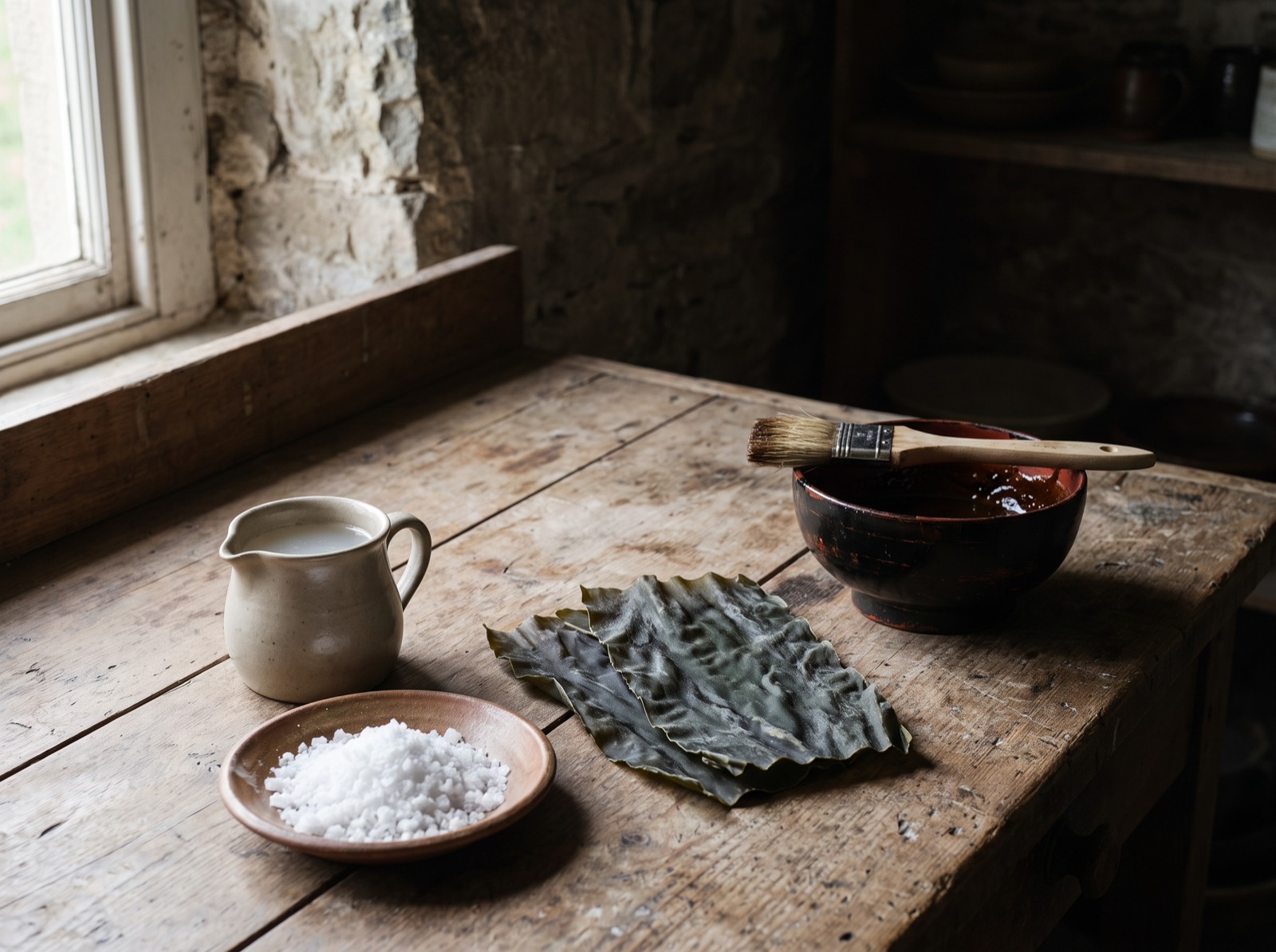
- Zuke and kobujime both hold fish against a flavour source rather than seasoning it in an instant, but the source and the target differ. Kobujime presses lean white fish against dried kelp; zuke steeps lean tuna in liquid soy. Our entry on kobujime covers the kelp side in full.
- Zuke and cooked tuna. Nothing about the marinade cooks the fish. A zuke piece is raw in the same sense sashimi is raw — the firming and darkening come from salt and time, not heat.
How to say it
Zu-ke, two beats, with a hard z as in “zoo.” As a suffix it is voiced the same way wherever it turns up — shio-zuke, shōyu-zuke, the two salmon-roe cures our ikura entry describes. Said on its own, mid-sentence, at a counter, it needs no suffix and no further explanation: it means tuna, unless someone says otherwise.
Where you will see it
On an English menu, most often as a single word next to “tuna” or “maguro,” sometimes translated as “marinated” with the Japanese dropped, which loses the distinction from nikiri. On a Japanese menu it is written 漬け, usually attached to a cut: まぐろの漬け, 赤身の漬け. It is one of the few pieces of shigoto printed at all, for the same reason it is one of the few offered as a choice.
A shop that still makes it the slow way, a whole block at a time, is not doing anything more traditional than one that marinates piece by piece. Both are Edomae technique carrying the same two-hundred-year-old name. Only one of them is still doing the job the name was invented for.
Frequently asked questions
What is zuke?
Zuke (漬け) is fish steeped in a soy-based marinade rather than brushed with one, most often the lean red meat of tuna. The word comes from tsukeru, the verb for steeping or pickling something, and the same ending shows up on other cures, including salmon roe's shio-zuke and shōyu-zuke.
Is zuke the same as marinated tuna?
On an English menu, yes, the two usually mean the same dish. What the English phrase loses is the distinction from nikiri, which is also a marinade in the loosest sense but is brushed on once, seconds before serving, and never soaked into anything.
Why was zuke invented?
To keep tuna edible before refrigeration existed. A cut held in a strong soy marinade lasted longer than one left plain, at a time when there was no other way to slow spoiling.
Is zuke still used to preserve fish today?
Not in the original sense. Refrigeration does that job now. The sources describe modern zuke as a seasoning decision — how strong a marinade, for how long, judged against a particular piece — rather than a way of extending how long the fish keeps.
What is the difference between zuke and nikiri?
Zuke is a soak: sliced tuna sits in a soy marinade long enough to firm and darken. Nikiri is a single brushed layer applied just before the piece is served and never soaked into anything. Our nikiri entry sets out the distinction in full.
How long is fish marinated for zuke?
The sources do not give a fixed time, and we do not print one. What is described is a range: a long soak, measured in hours, for a whole block of tuna, and just minutes for an individual sliced piece — the choice depends on the fish, the cut and when it will be served.