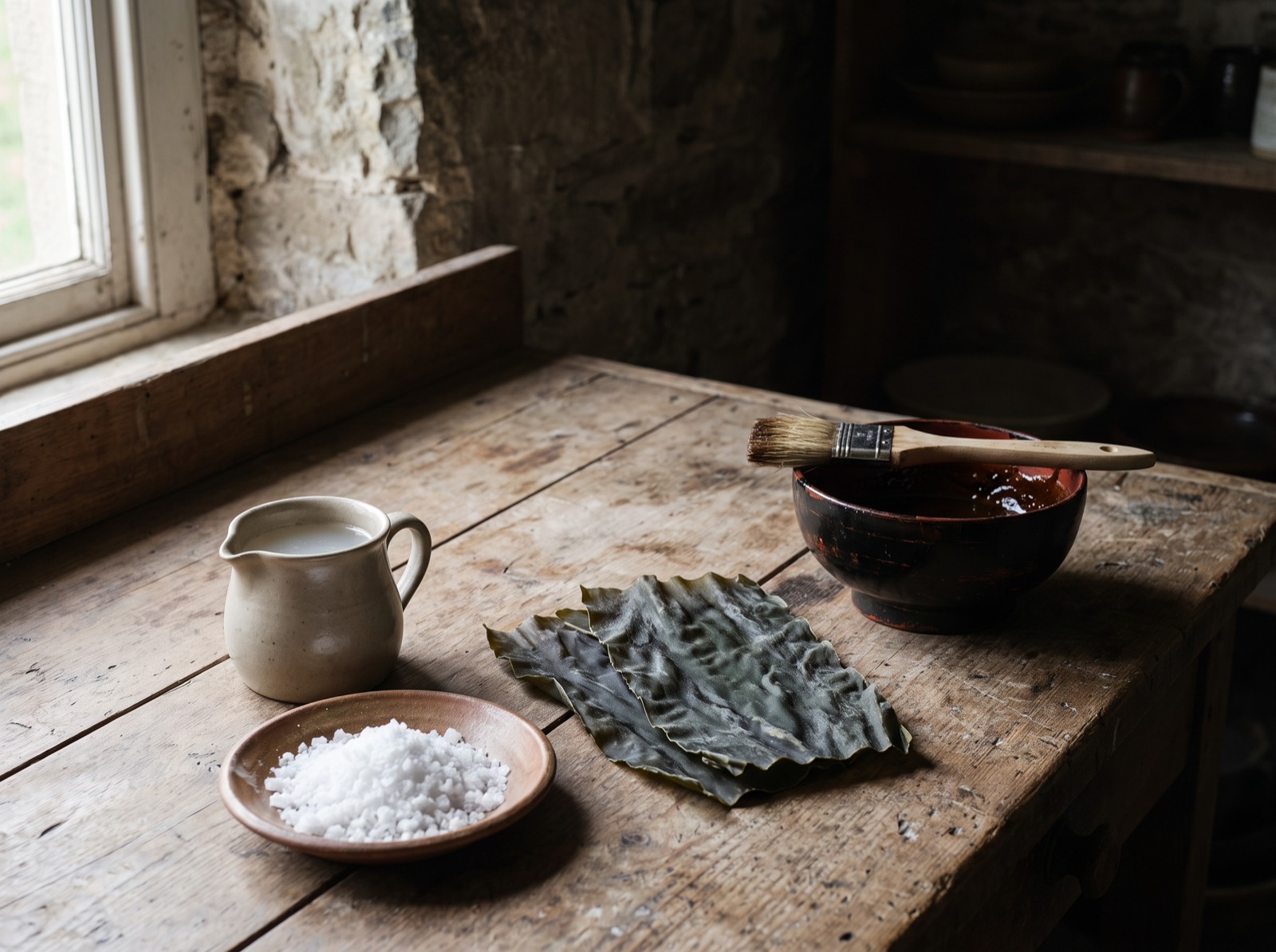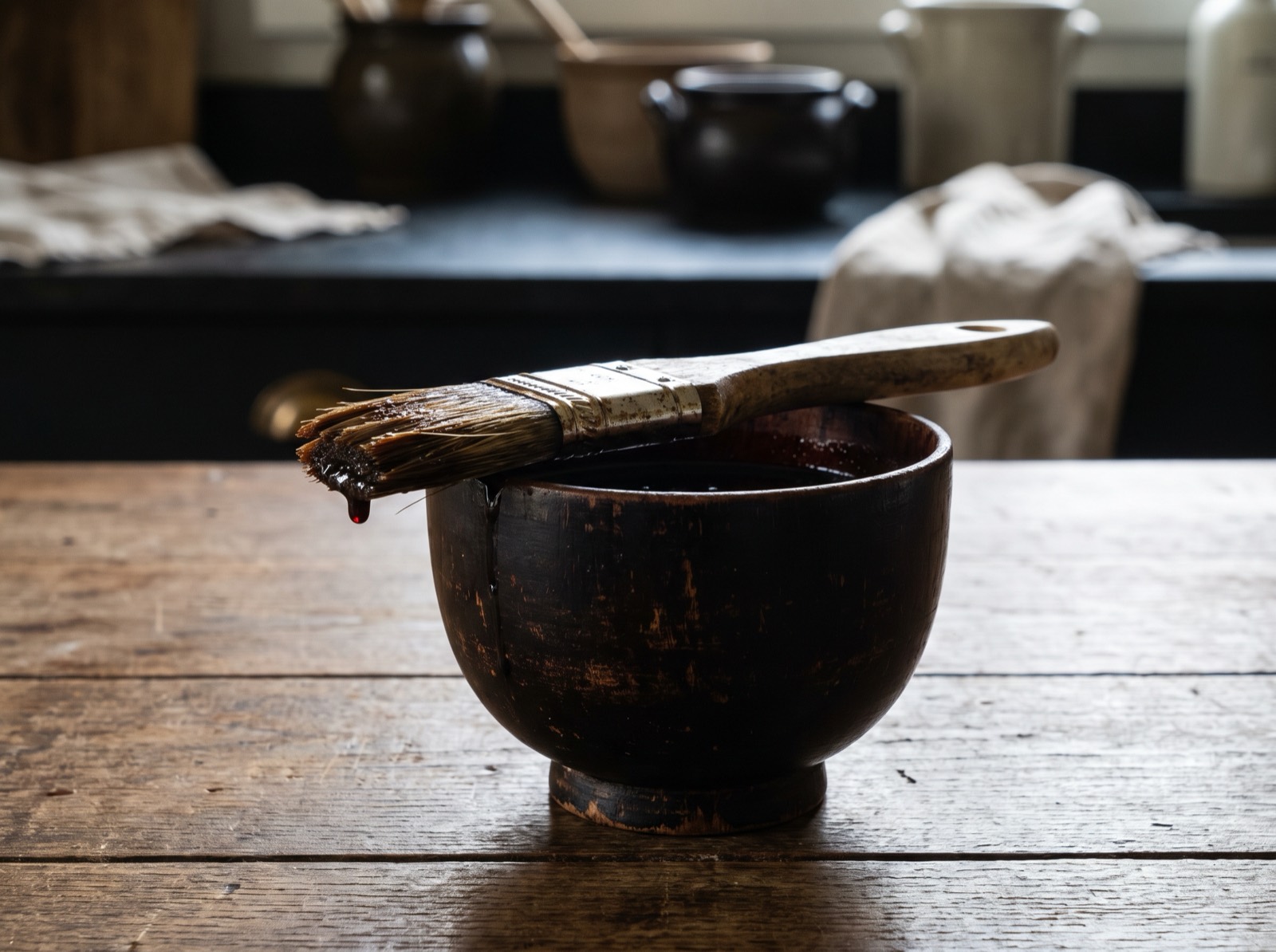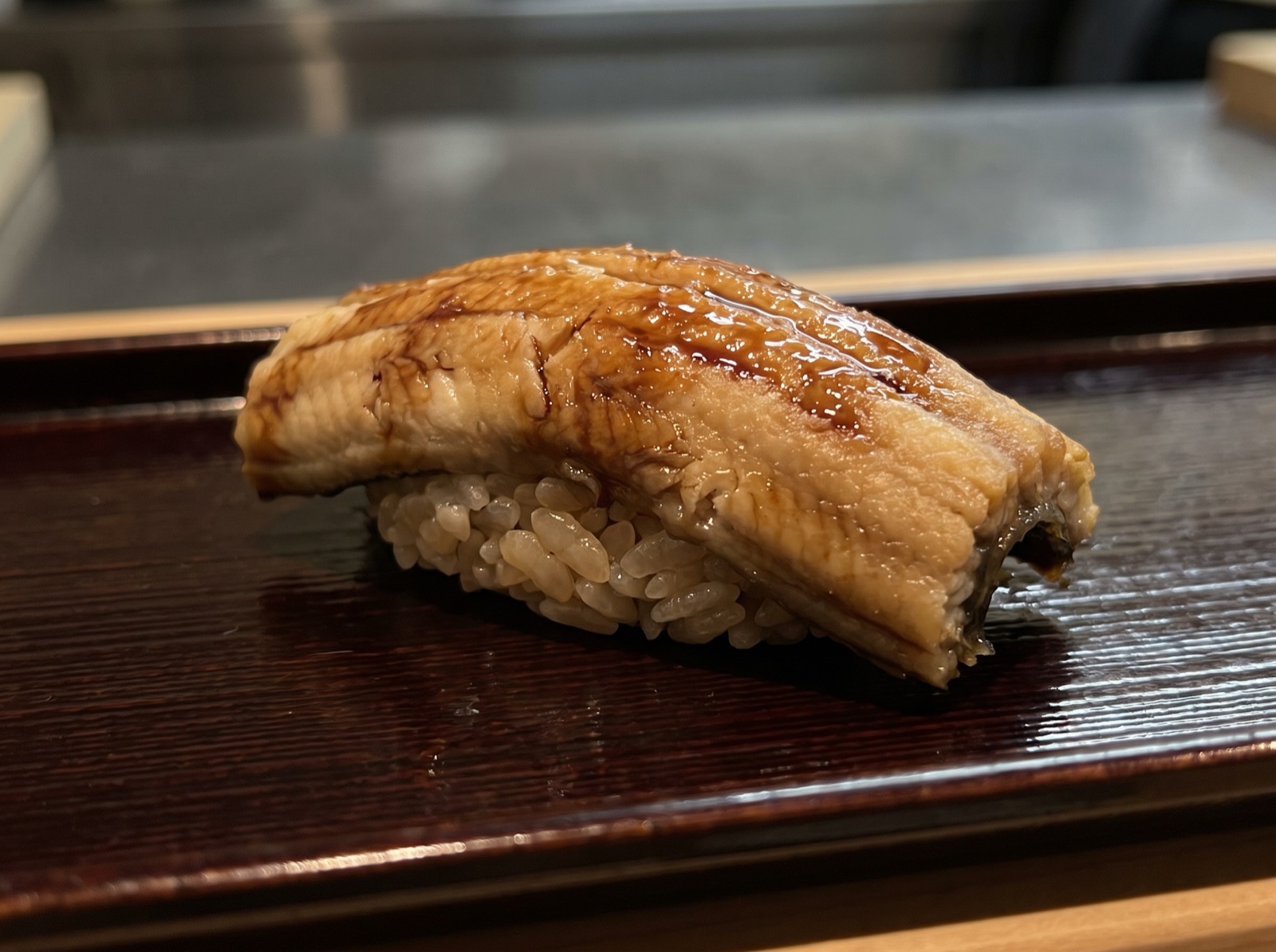
A single evening at a counter working in the Edomae style can put the same dark, glossy brushstroke on four or five different things — conger eel, clam, octopus, mantis shrimp, sometimes the liver of an abalone — and none of those toppings taste of quite the same pot. The stroke is nitsume (煮ツメ), usually shortened at the counter to tsume, and it is one of the most frequently seen and least explained things on a menu: a sauce with no fixed recipe, built new each time from whatever it happens to be finishing.
What it is
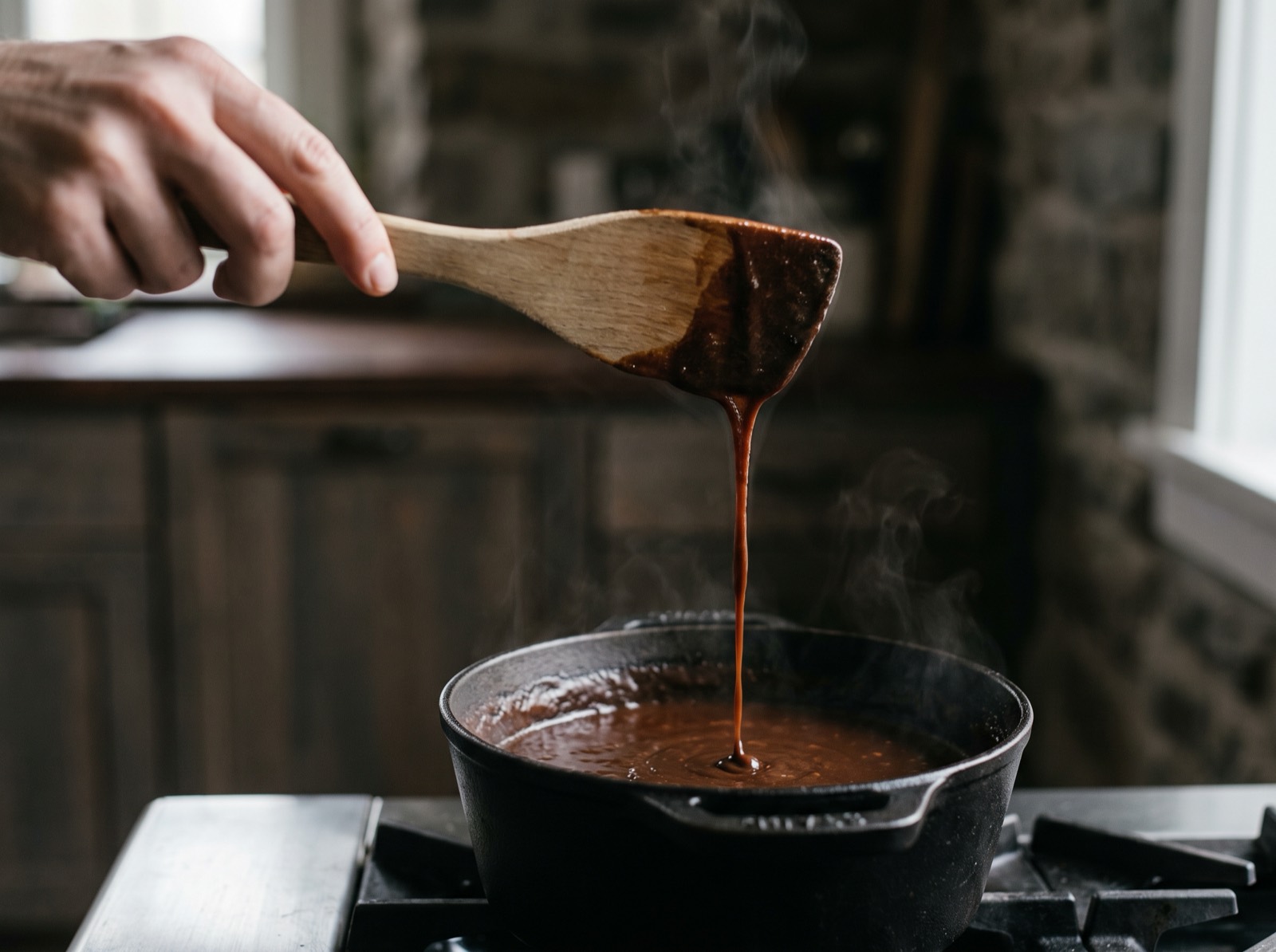
Nitsume (煮詰め) is a Japanese word before it is a kitchen term: nitsumeru means to boil something down until it thickens, and tsume is the contraction that ends up on a counter's lips. What gets boiled down is not a mixture measured out in advance the way nikiri is. It is the liquid a topping was already cooking in — soy, mirin, sugar and whatever the fish or shellfish gave off while it simmered — reduced further, after the topping comes out, until it thickens into something dark and glossy enough to sit on the surface rather than sink into it.
That is the whole of what makes nitsume a category rather than a single sauce. A shop's tsume for conger is not built the same way as its tsume for clam, because the two started from different cooking liquids; what unites them is the method, not the ingredients.
When it is used
Nitsume finishes a topping; it does not season one that is still raw. It is the second half of the same job that simmers conger, clam and octopus in the first place — our guide to what Edomae actually means names that job as one of four things done to fish before it reaches the counter. This entry looks only at the second half: what happens to the liquid once the topping comes out of it.
Five toppings turn up with it most often, and most already have their own page for the parts that belong there rather than here:
- Conger (anago), the topping most identified with it, simmered until it collapses and finished with a reduction of its own broth.
- Clam, simmered the same general way, though it does not yet have its own entry on this site.
- Octopus (tako), simmered and glazed by Edomae counters for as long as they have simmered conger.
- Mantis shrimp (shako), which arrives glazed with no other option offered.
- Abalone (awabi), sometimes finished with the same reduction and sometimes with a liver-based sauce instead, covered in full in that entry.
What the chef actually does
The mechanics start with whatever is already in the pot. A topping simmers in a liquid built around soy, mirin and sugar; once it is lifted out, cooked through and set aside, that liquid keeps reducing — sometimes on its own heat, sometimes folded into a separate pot that has been running for longer than the topping itself has been in the kitchen. What comes out the other side is thicker than the liquid it started as, dark enough to look almost black in the pan, and sweet enough that a chef will thin it before serving rather than brush it on straight if a topping is delicate.
Because the base is a byproduct rather than a recipe, continuity matters more here than in most sauces at the counter. A pot is more often topped up than thrown out and remade, which carries flavour forward from whatever has already passed through it rather than starting from zero each service. What that looks like for one specific pot, built from one specific topping over one specific stretch of time, is the subject of our anago entry; the mechanism generalises to whatever else a kitchen simmers.
What the sources do not say is whether a shop keeps one tsume for everything it simmers or a separate pot for each topping. Both are plausible, both appear in the trade literature without either being called standard, and nothing we have read settles it. It is one of the few points in this entry where the honest answer is that we do not know, rather than that the sources disagree.
Application, once the reduction is ready, uses the same single motion as nikiri: a brush, dipped and drawn once across the topping, immediately before it is set down. The two sauces share a tool and a moment. They do not share a kitchen process to get there.
Why it is done
Simmering is gentle by design; it is exactly what keeps conger from breaking apart in the pot and clam from turning to rubber. But gentleness has a cost. A long, slow simmer settles a topping's own flavour into the broth around it as much as it cooks the flesh, and what comes out can taste quieter than what went in. Nitsume is that same broth, taken further and returned. It gives back, concentrated, roughly what the pot spent hours drawing out.
The glaze does not season the topping. It returns, concentrated, what a slow simmer spent hours drawing out of it.
How it differs from what it is confused with
Three things sit close enough to nitsume in casual English writing about sushi that they get folded into it. None of them are the same job.
- Nitsume and nikiri share a brush and a moment — both are painted on in a single stroke immediately before a piece is served — and that is nearly the whole of what they share. Nikiri starts as a decision: soy, mirin and dashi, mixed and simmered fresh for service, built to season fish that has not been cooked. Nitsume starts as a byproduct of cooking something else, inherited rather than mixed, and it finishes toppings that have already been simmered. One is planned before the pot goes on; the other exists because the pot was already on for a different reason.
- Nitsume and tare look almost identical on the plate — both dark, both sweet-savoury, both glossy enough to catch the light, and both kept going for years rather than remade from scratch. But they are built by opposite methods. Tare is built over the fire: an eel is basted, returned to the grill, basted again, coat after coat, until a lacquer forms on the surface of something still cooking. Nitsume is built off the fire, after the topping has already come out of the pot, from the liquid left behind rather than anything brushed on and re-cooked.
- Nitsume and a topping's own substitute are not always distinct at every counter. Our abalone entry describes a liver-based sauce that some kitchens use in place of the usual reduction — a different starting point that lands in roughly the same place on the plate. It is a reminder that the glaze answers a question, how a cooked topping gets finished, more consistently than it names one fixed ingredient.
How to say it
nee-tsoo-MEH is close enough at a counter, though what you will actually hear far more often is the short form, tsume, two beats, the initial consonant a single sound rather than “t” followed by “su” — the same sound covered in our anago entry. Written alone, without the 煮 that marks it as something boiled down, tsume is also just the ordinary Japanese word for a fingernail or a claw. Context carries the difference; nobody at a counter is confusing the two.
Where you will see it
Almost never as its own line on a menu, in either language — the same is true of nikiri, and for the same reason: it is not an item ordered on its own but a default applied to whatever needs it. What you can see is the result. A piece that comes out matte, pale, and clearly showing the grain of the flesh underneath has not been glazed. A piece that comes out dark, glossy and slightly tacky at the surface has.
The clearest tell is a plate that mixes both kinds in the same course: something raw and bright beside something simmered and lacquered, one seasoned seconds before it reached the counter, the other carrying a reduction that may have started long before that piece of fish was even bought. Both are the chef's decision. Neither one is a garnish.
Frequently asked questions
What is nitsume, or tsume?
A dark, sweet-savoury reduction brushed onto simmered toppings such as conger eel, clam and octopus, built from the liquid the topping was cooked in rather than mixed to a fixed recipe.
Is nitsume the same as nikiri?
No. Nikiri is soy sauce simmered with mirin and dashi and mixed fresh for service; it seasons raw and lightly cured fish. Nitsume is a byproduct of simmering a topping, reduced from that topping's own cooking liquid, and it finishes toppings that have already been cooked.
Which sushi toppings get nitsume?
Conger eel most often, along with clam and octopus. Mantis shrimp is usually glazed with it by default, and some counters use a liver-based sauce on abalone instead of the usual reduction.
Is nitsume the same as the tare used on unagi?
No, though the two look similar. Tare is built over the fire, by repeatedly basting and re-grilling eel until a lacquer forms. Nitsume is built off the fire, by reducing the liquid left behind after a topping has already been simmered.
Why is a simmered topping glazed with nitsume instead of served plain?
A long simmer that keeps a topping tender also settles its flavour into the surrounding broth. Nitsume is that same broth, reduced further and brushed back on, returning concentrated what the simmering drew out.
How do you say nitsume?
Roughly nee-tsoo-MEH, though tsume, the two-beat short form, is what you will hear most often at a counter.