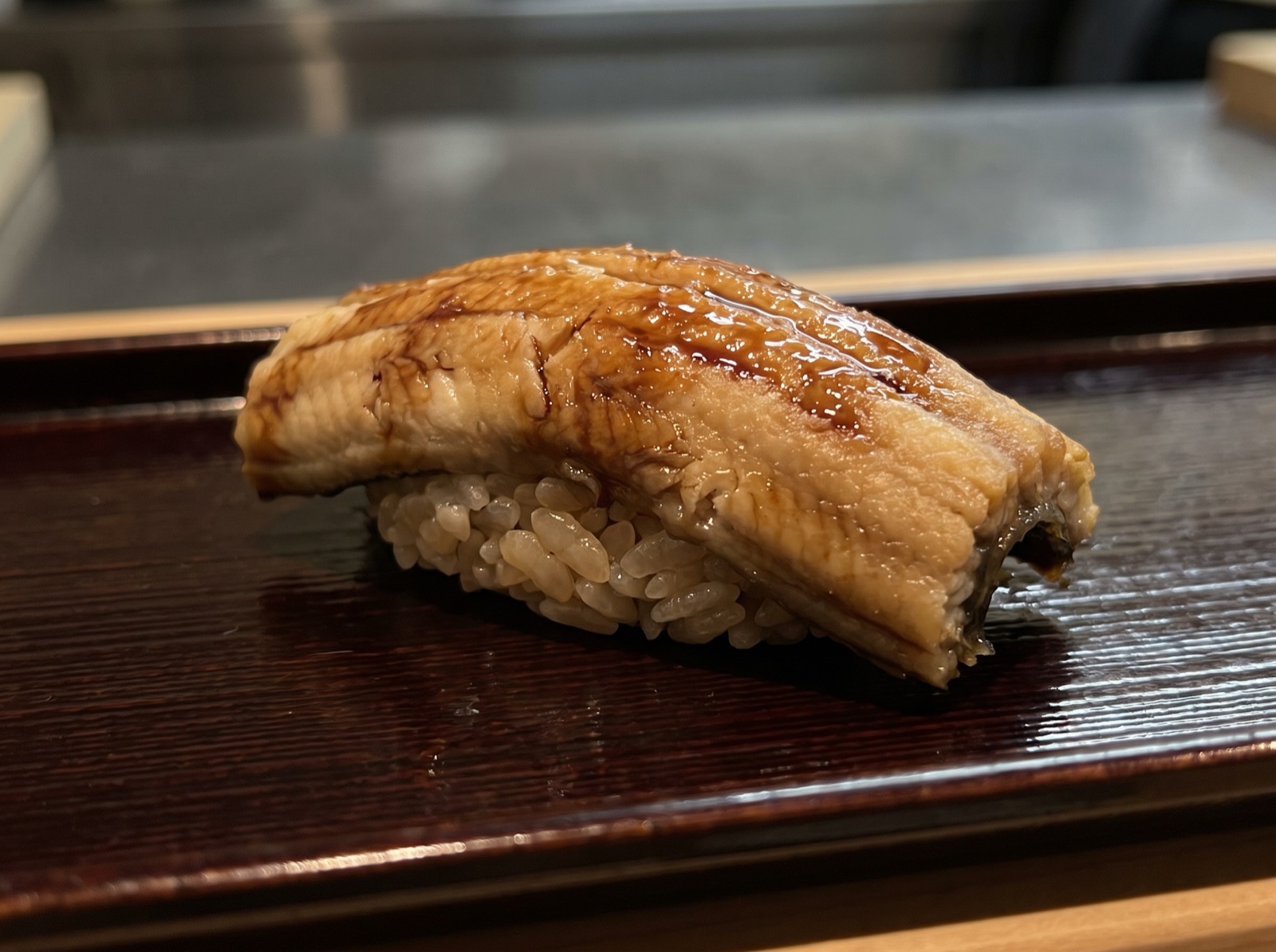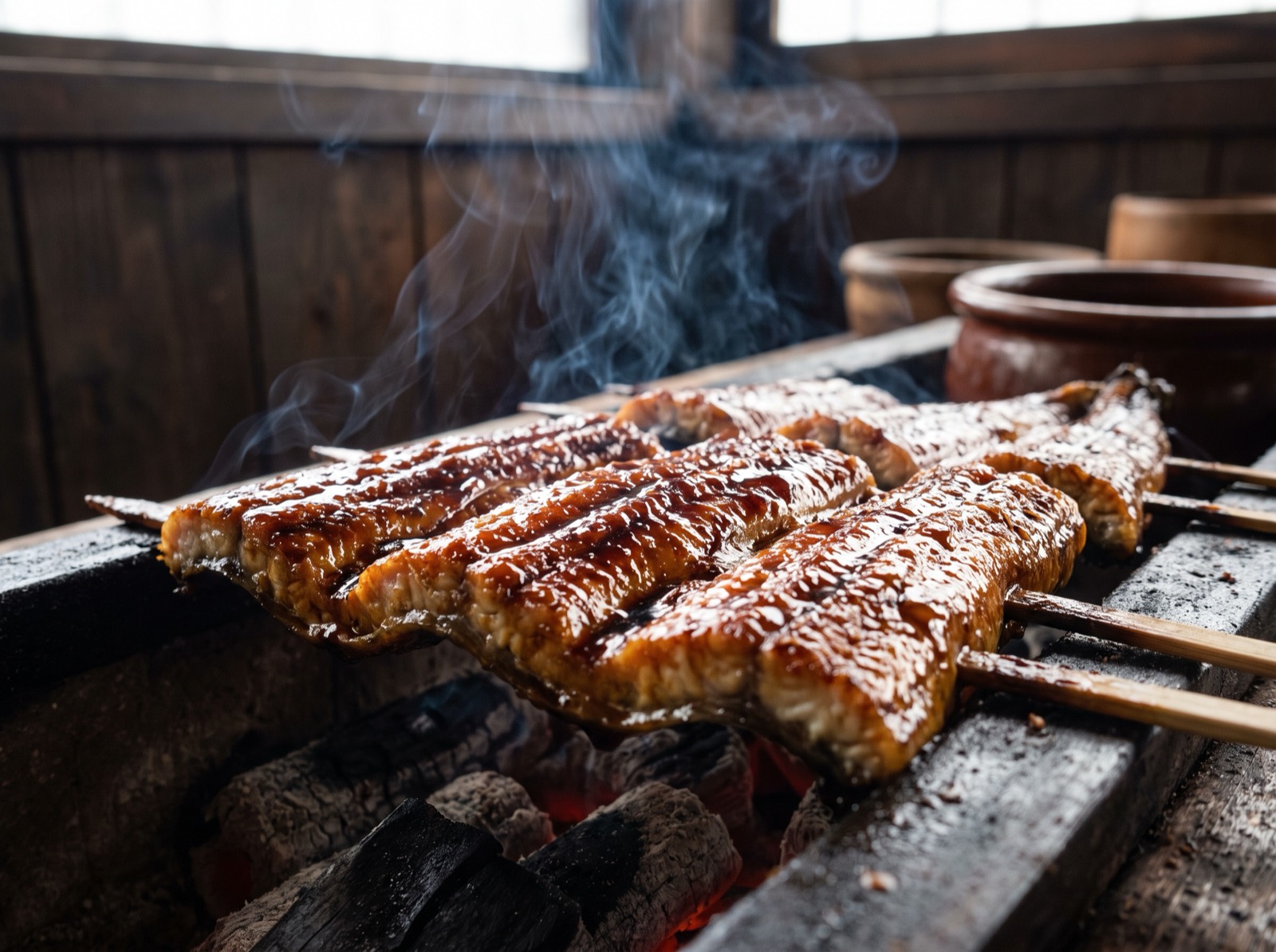
Unagi (ウナギ) is freshwater eel, Anguilla japonica, grilled over charcoal and repeatedly brushed with a sweet soy-based sauce. It appears at sushi counters as nigiri, but its natural home is a specialist restaurant tradition of its own, where it is served over a box of rice. It is not anago, and the difference is not a technicality.
What it is
A fatty, rich, strongly flavoured fish, and one with an unusual life history: Japanese eels spawn far out in the Pacific and the larvae drift back to East Asian rivers. The life cycle has been closed in captivity — Japan’s Fisheries Research and Education Agency managed it first, in 2010, and can now produce glass eels in the tens of thousands a year — but not at anything near the scale or the cost the market runs on. What is farmed is still not bred but caught: juvenile eels taken as they arrive and grown on. A hatchery glass eel cost about ¥1,800 to produce in 2023, against ¥180–600 for a wild one at market. That gap is the whole question.
That is also why unagi carries a sustainability question that most fish on a sushi menu do not. The Japanese eel has been assessed as endangered on the IUCN Red List, and juvenile catches have been volatile for years. We flag it here rather than resolving it: the status is a live matter, the figures move, and a reader who wants the current position should check the assessment rather than a food article.
The Japanese words for eel
- Unagi (ウナギ) is the freshwater eel. On an English menu, “eel” almost always means this one.
- Anago (アナゴ) is the saltwater conger: leaner, and simmered rather than grilled.
- Hamo (ハモ) is the pike conger, a third fish again, and the summer speciality of Kyoto and Osaka.
- Kabayaki and shirayaki are not fish at all but methods: grilled with repeated coats of sauce, and grilled plain.
When it is best
Autumn into winter, when wild eels fatten before their migration. And almost nobody eats it then.
Japanese unagi consumption peaks in high summer, on doyō no ushi no hi (土用の丑の日), the midsummer ox day, when eating eel is held to fortify you against the heat. The custom is Edo-period, and the account most often repeated is that it began as a marketing device for a shop with slow summer trade. Whether that origin is true is disputed by Japanese scholars; that the custom is now enormous commercially is not.
So this is one of the few items on this site where the season and the tradition point in opposite directions, and it is worth saying plainly: the eel is better in autumn and winter, and the country eats it at the height of summer.
What the chef does to it
- Split, boned and skewered. The live eel is split, the backbone removed, and the fillets held flat on skewers so they cook evenly.
- Shirayaki (白焼き), “white grilled”. Grilled plain, with no sauce, and eaten with salt or wasabi. It is the version that shows what the eel itself tastes like, and it is worth ordering once.
- Kabayaki (蒲焼き). Grilled and then dipped or brushed with tare (a soy, mirin and sugar sauce) repeatedly, with a return to the fire between each coat, building a lacquer. Specialist shops maintain their tare over years, replenishing rather than replacing it.
- At a sushi counter, the grilled eel is cut and laid on rice, usually with a brush of the same sauce and sometimes a little sansho pepper, whose citrus-numbing sharpness exists specifically to cut the fat.
The Kanto and Kansai split
Unagi preserves the sharpest surviving regional divide in Japanese cooking technique, and the traditional explanations for it are as good as the techniques are different.
- Where it is cut. Kanto splits the eel along the back; Kansai splits it along the belly. The standard account is that Edo was a city of samurai, where cutting open a belly carried an unwelcome association, while Osaka was a merchant city where hara wo watte hanasu, to open the belly and speak, meant honest dealing.
- Whether it is steamed. The Kanto method grills the eel, steams it, then grills it again with sauce. Steaming renders fat and produces a soft, almost collapsing texture. Kansai does not steam: it grills throughout, which leaves a firmer bite and a crisper, more caramelised surface.
- The head. Kansai traditionally grills with the head on, removing it afterwards; Kanto removes it first.
- The result. Kanto unagi is soft and light; Kansai unagi is denser and more directly grilled. Both are correct, and people hold strong views.
Edo was a city of swordsmen and Osaka a city of merchants, and you can still taste the difference.
Whether the samurai explanation is historical or folk etymology is not settled; it is the account given in Japanese sources, and we pass it on as such. The technical divergence is not in doubt.
How it differs from what it is confused with
- Unagi is freshwater; anago is saltwater. Different species entirely.
- Unagi is grilled; anago is simmered. Unagi gets fire and a lacquered sauce; anago gets a gentle simmer and a reduction of its own broth.
- Unagi is fatty; anago is lean. Unagi is rich and assertive; anago is delicate and light.
- Unagi is usually its own meal; anago is part of a sushi course. A specialist unagi restaurant serves it over rice in a lacquered box, with pickles and a clear soup, and that is the dish’s proper home.
- “Eel” on an English menu usually means unagi, and the sweet dark sauce that accompanies it is often called eel sauce abroad — a name that exists nowhere in Japan.
How to say it
oo-NAH-ghee is understood everywhere. Three beats, u-na-gi, with a hard g. Kabayaki is four beats; shirayaki four.
Edomae and Kansai
Covered above, because with this fish the regional split is the subject. The one thing to add is practical: if you are eating unagi in both cities on the same trip, eat it in each and compare. It is the most legible regional difference available to a visitor in a single dish, and unlike most such comparisons it does not require expertise to perceive.
Where you will see it, and roughly what it costs
At sushi counters as a piece, on conveyor belts as a cheap staple, and at specialist restaurants as a full meal, which is the expensive case, and the one worth doing once. A proper unaju at a dedicated shop is a substantial expenditure, comparable to a mid-band sushi lunch.
One consumer note. Cheap unagi is overwhelmingly imported and pre-cooked, and the gap between that and eel grilled to order at a specialist is one of the widest in Japanese food. If you have eaten unagi only from a supermarket pack, you have not really eaten it. See omakase price tiers for the wider price picture. Eat it once where they grill it to order.
Frequently asked questions
What is unagi?
Freshwater eel, Anguilla japonica, grilled over charcoal and repeatedly brushed with a sweet soy-based sauce. It appears as nigiri at sushi counters but its home is a specialist restaurant tradition where it is served over rice in a lacquered box.
What is the Japanese name for eel in sushi?
Unagi is the freshwater eel, and it is what “eel” almost always means on an English sushi menu. Anago is the saltwater conger, simmered rather than grilled. Hamo, the pike conger, is a third fish again, and a summer speciality of Kyoto and Osaka.
What is the difference between unagi and anago?
Unagi is a freshwater eel, fatty and rich, and it is grilled. Anago is a saltwater conger, lean and delicate, and it is simmered then glazed with a reduction of its own broth. Different species, method and flavour.
Why do Tokyo and Osaka prepare unagi differently?
Tokyo splits the eel along the back and steams it between two grillings, giving a soft texture. Osaka splits along the belly and grills throughout without steaming, giving a firmer, more caramelised result. The traditional explanation is that Edo was a samurai city where cutting a belly carried an unwelcome association, and Osaka a merchant city where it meant speaking honestly.
When is unagi in season?
Autumn into winter, when wild eels fatten before migrating. Consumption, however, peaks in high summer on doyō no ushi no hi, the midsummer ox day, when eating eel is held to fortify you against the heat.
What is the difference between kabayaki and shirayaki?
Kabayaki is grilled with repeated coats of a soy, mirin and sugar sauce, building a lacquer. Shirayaki is grilled plain with no sauce and eaten with salt or wasabi, the version that shows what the eel itself tastes like.
Is unagi endangered?
The Japanese eel has been assessed as endangered on the IUCN Red List, and juvenile catches have been volatile for years. The species has not been bred reliably in captivity; farmed eels are caught as juveniles and grown on. It is a live issue and worth checking the current assessment.