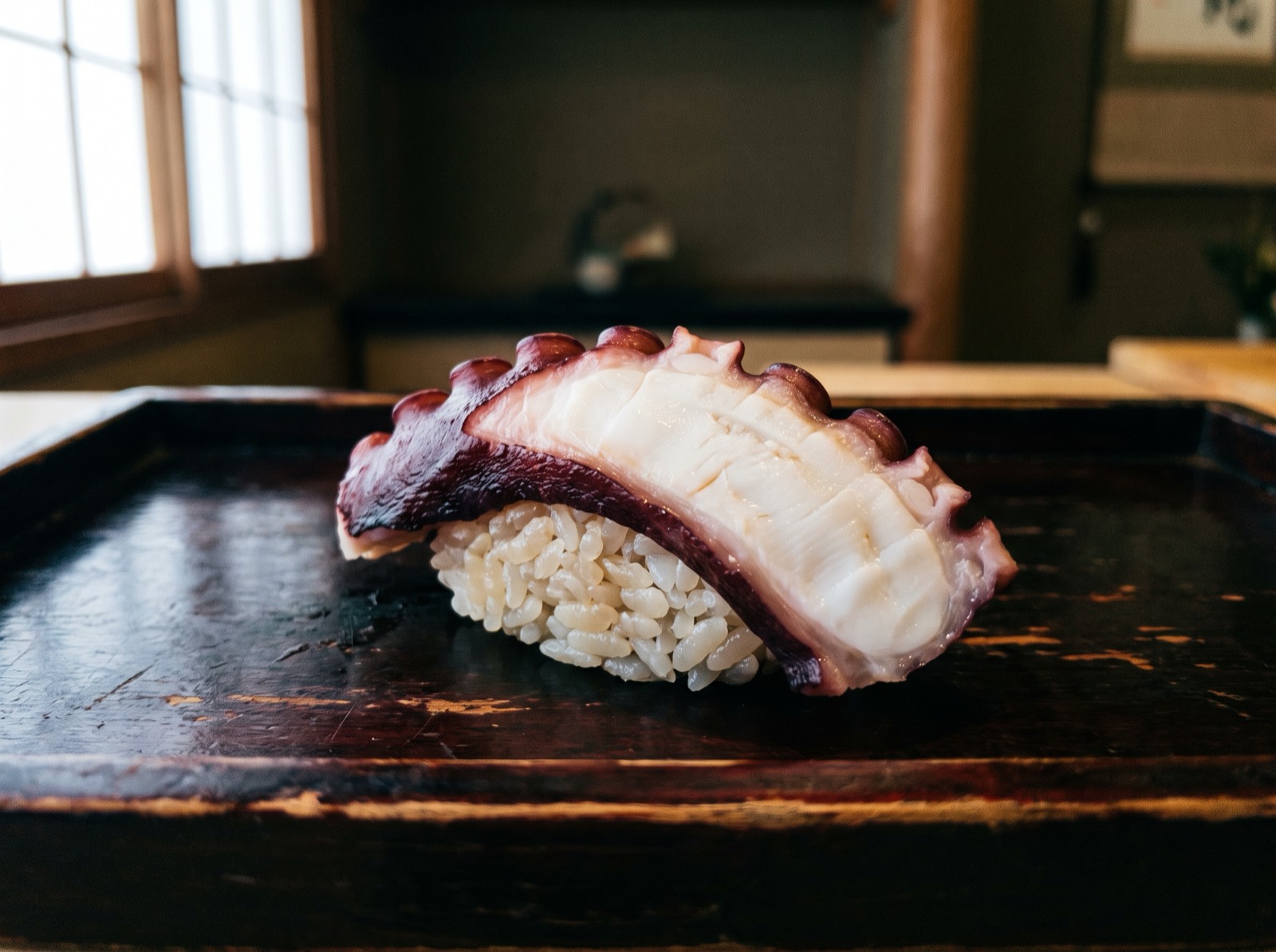
Tako (タコ, octopus) is one of the few things at a sushi counter that is served cooked as a matter of course. The piece is a slice of boiled leg over rice: purple-red at the skin, white through the middle, with the row of suckers making the pattern along one edge. It is cheap, it is everywhere, and it is a much better test of a kitchen than its price suggests.
What it is
Usually ma-dako (真蛸), the common octopus, which is the standard counter animal. In the north, and increasingly on menus elsewhere, mizu-dako (水蛸) — the giant Pacific octopus of Hokkaido — appears as well; it is larger, softer and more watery, and it is the one you will occasionally see served raw.
Among Japanese producing areas, Akashi in Hyōgo prefecture is the name that carries weight. The strait there runs hard and the octopus that live in it are unusually muscular, which is exactly the quality being paid for.
What the chef does to it
Almost all of the work happens before the counter opens.
- Cleaning. The raw animal is coated in slime and has to be rubbed hard, usually with salt, until it comes clean. This is heavy, unglamorous work and skipping it leaves a smell that no amount of seasoning covers.
- Boiling. The legs are dipped in and out of hot water two or three times before being lowered in, which sets the skin and makes the legs curl into their characteristic shape. Then a controlled simmer — and this is where the piece is won or lost, because the window between raw-firm and rubber is narrow and the far side of it is permanent.
- Tenderising. Some kitchens add tea leaves, grated daikon or azuki to the pot, both for colour and to soften the flesh. A slow, long simmer to deliberate softness is called yawaraka-ni (柔らか煮), and it is a different dish from the springy standard version rather than a better one.
- Cutting. A straight slice off a boiled leg is hard to bite through. So the knife goes in at an angle, or in a wave — nami-giri (波切り) — or the surface is scored in a fine diamond lattice, kanoko (鹿の子). All three do the same job: shorten the distance your teeth have to travel.
You cannot rescue an overboiled octopus. The knife can only make the damage easier to chew.
How to read the piece
Because so much of tako is decided in advance, it reports more honestly than most items. Three things to notice.
- The cut face. Angled, waved or scored means somebody thought about it. A flat straight disc means somebody did not.
- The resistance. It should yield and then spring — two stages. If it is uniformly hard, it was boiled too long or not worked enough beforehand; if it is uniformly soft, it was either simmered deliberately or it is mizu-dako.
- The edge colour. A clean purple-red rim against white flesh. Grey or muddy at the boundary suggests the skin was disturbed in the pot.
When it is best
Common octopus is generally regarded as best in summer in western Japan, which is when the Akashi fishery is at its most celebrated, and again in winter when the flesh firms. It is available year-round and much of what is sold in Japan is imported and frozen — a fact worth knowing without treating it as a scandal, since freezing does a competent octopus very little harm.
There is a small seasonal cousin worth ordering if you see it: iidako (飯蛸), a tiny octopus taken in late winter and spring with the head full of eggs, which cook to a texture like grains of rice — which is what the name says.
How it differs from what it is confused with
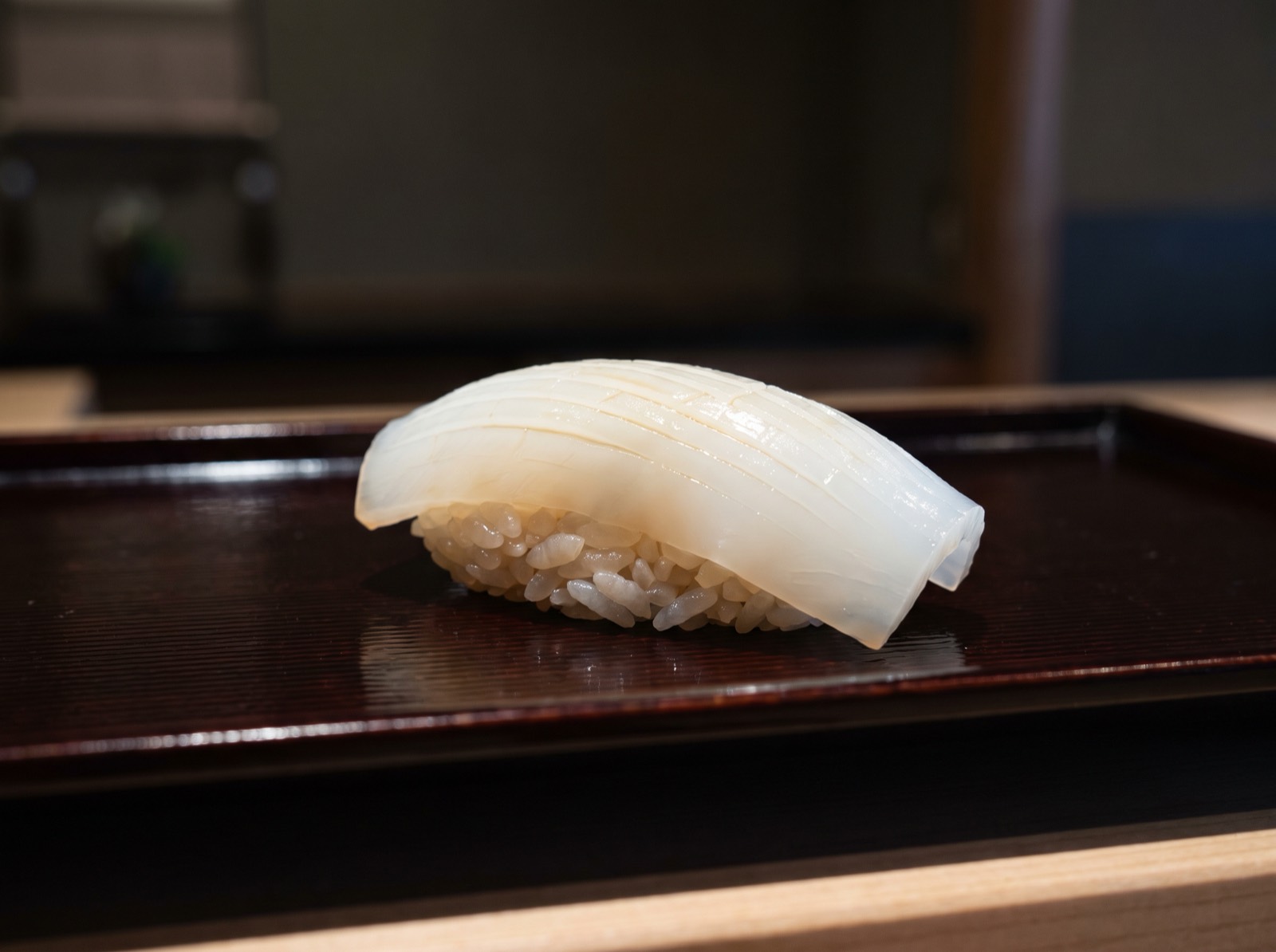
- Tako and ika. Octopus and squid, and they are not interchangeable. Squid at a counter is usually raw, white, and cut with fine scoring; octopus is usually boiled, purple-rimmed, and springy.
- Ma-dako and mizu-dako. Common versus giant Pacific. The first is the firm, standard piece; the second is softer, larger and the one occasionally served raw.
- Boiled tako and takoyaki. Same animal, opposite worlds. The Osaka street snack uses small pieces in a batter ball, and the octopus in it is chosen to be soft.
- Tako and tako-su. The vinegared octopus salad served as a small dish is a preparation, not a different creature.
How to say it
ta-ko, two even beats, hard t and k. It is worth knowing that the same two syllables with a different pitch pattern mean “kite” — nobody at a sushi counter will misunderstand you, but it is one of the small pitch-accent pairs Japanese learners collect. Iidako is i-i-da-ko, with the first vowel held.
Edomae and Kansai
Octopus is standard in both cities, and Edomae counters have simmered and glazed it for as long as they have simmered conger. But the animal belongs, culturally, to the west: Akashi is a Kansai fishery, takoyaki is an Osaka invention, and there is a Kansai custom of eating octopus at the seasonal marker of hangeshō in early July, on the wish that the rice roots take hold as firmly as the legs do.
If you want the difference in one plate, order it as nigiri in Tokyo and then eat it out of a paper tray in Osaka. Our comparison of the two cities and our guide to Osaka cover the rest.
Where you will see it, and roughly what it costs
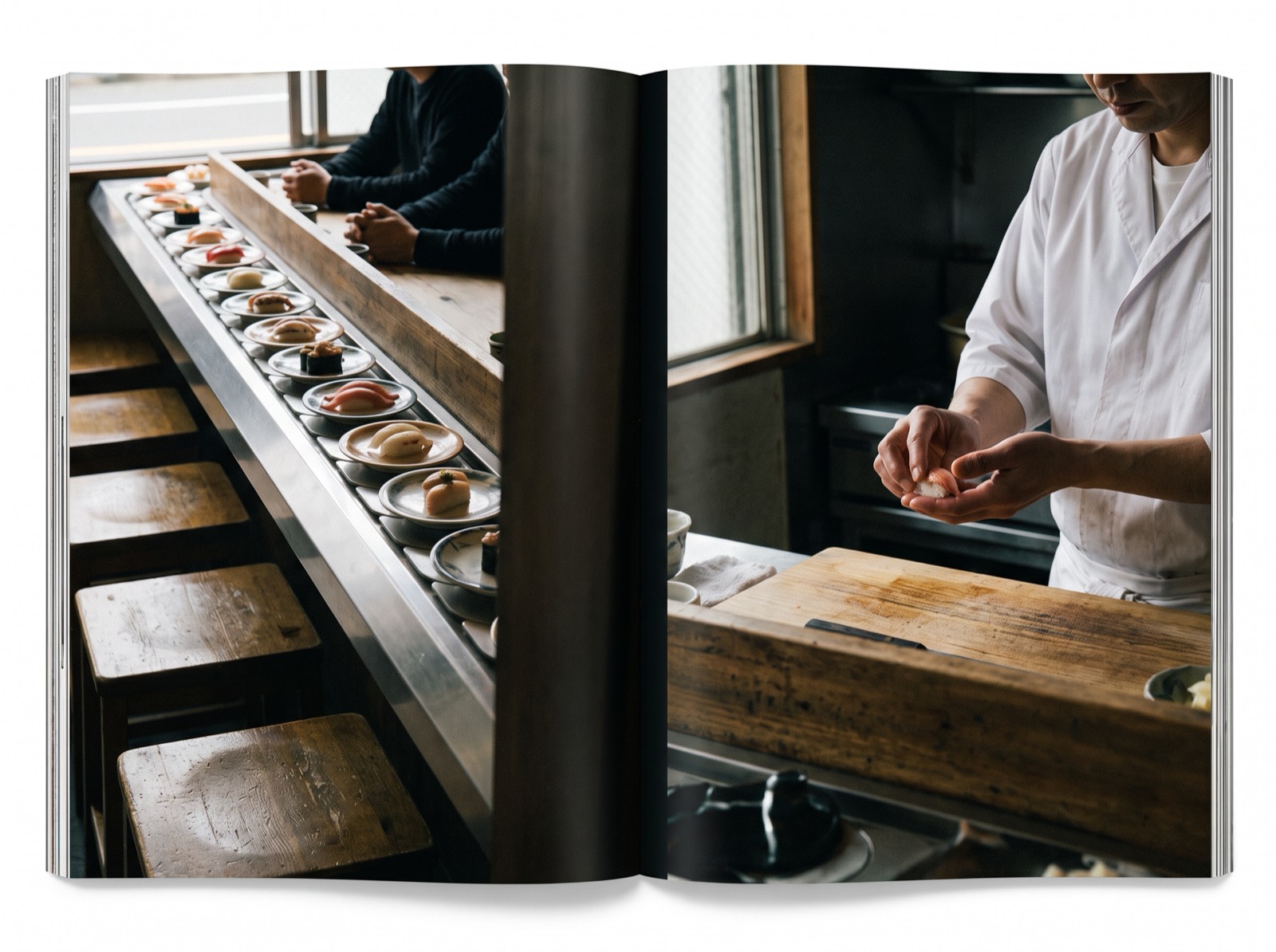
Everywhere and at every tier, which is the useful part. It is one of the cheapest things on a conveyor belt and it is also on the list at serious counters, so it is one of the few items where you can compare directly across the whole market.
No per-piece figure from us. What we would say is that tako is the piece to order first at an unfamiliar mid-range shop: it costs almost nothing, it cannot be disguised, and the answer arrives in one bite. Our guide to belts and counters sets out where the tiers sit.
Frequently asked questions
Is octopus at a sushi restaurant raw or cooked?
Cooked, almost always. The standard piece is a slice of boiled leg over rice. Raw octopus appears occasionally, usually the softer giant Pacific octopus from Hokkaido.
Why is some sushi octopus tough?
Usually because it was boiled too long; too little tenderising beforehand does the same thing. The window between properly set and rubbery is narrow and the far side of it is permanent — nothing done afterwards will recover it. Angled or wave cuts and fine scoring only make an overcooked leg easier to chew.
Why is octopus cut on a diagonal or scored?
To shorten the distance your teeth have to travel. A straight slice off a boiled leg is hard to bite through, so the knife goes in at an angle, in a wave, or scores the surface in a fine diamond lattice.
What is Akashi octopus?
Octopus from the strait at Akashi in Hyōgo prefecture. The current there runs hard and the animals are unusually muscular, which is the quality the name is paid for.
What is the difference between tako and ika?
Octopus and squid. Octopus is usually boiled, has a purple-red rim against white flesh and eats springy. Squid is usually served raw, is plain white and is cut with fine scoring.
What is iidako?
A small octopus taken in late winter and spring with the head full of eggs, which cook to a texture like grains of rice — which is what the name refers to. It is a seasonal item worth ordering if you see it.