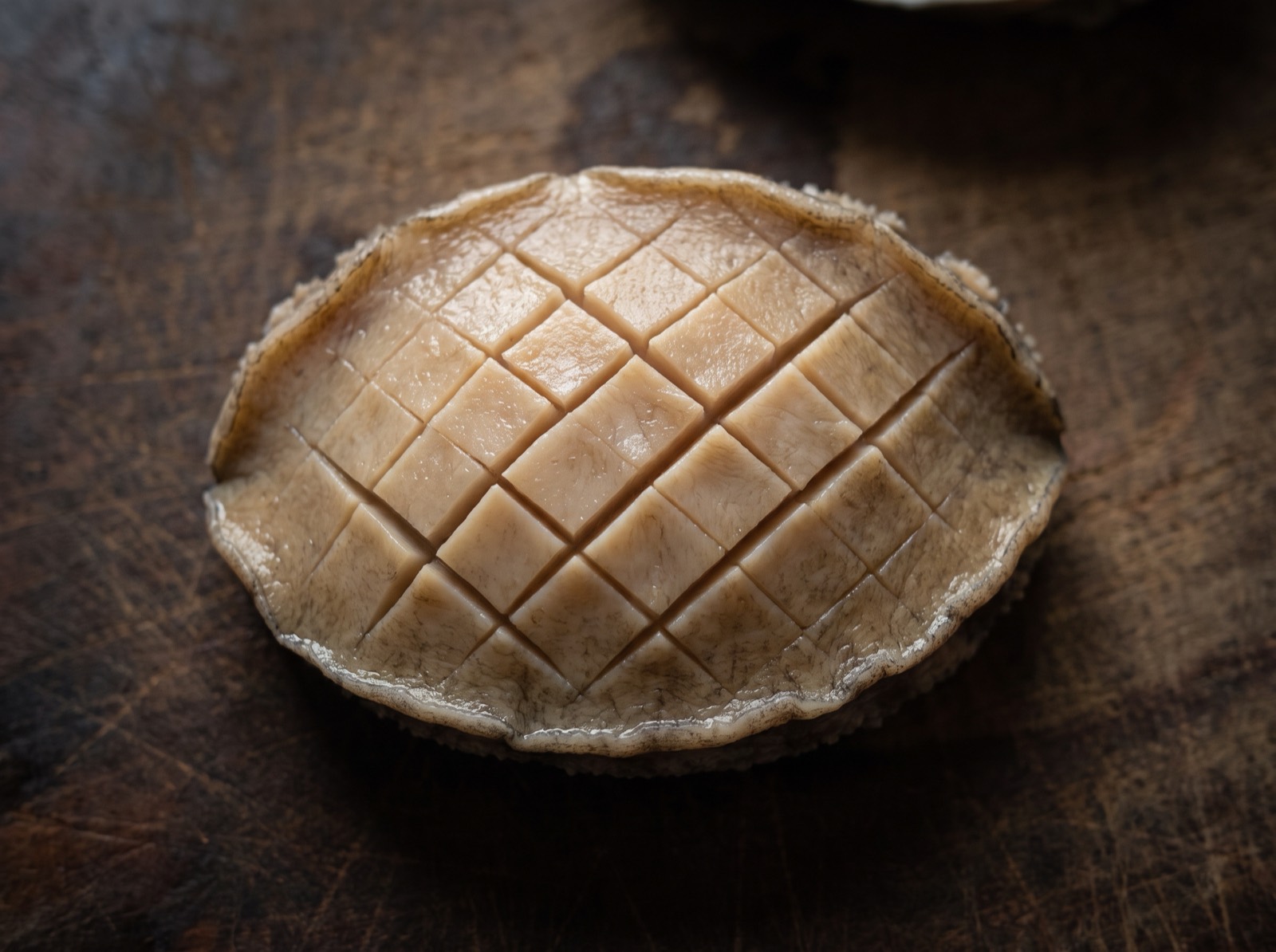
Awabi is the one word on an Edomae menu that can mean two almost unrelated textures: a crisp, cold slice cut straight from the shell, or a soft, deeply savoury piece that has spent a long time over gentle heat.
The split is not random. It tracks two things: which of several species answering to the single English word “abalone” is in the case that day, and which of two old culinary traditions — eating the muscle raw, or cooking it long and gently — the kitchen in front of you has inherited. Both traditions are genuine. Neither has replaced the other.
What it is
Awabi is abalone: a large single-shelled sea snail, not a bivalve like the clams and scallops it sits beside in the shellfish case. It lives clamped to rock in shallow coastal water, and the broad muscular foot that grips the rock is the only part of the animal served as sushi.
Say just “awabi” in Japanese and most people mean one particular species, kuro-awabi (黒鮑), black abalone. It is documented across the trade literature as the default the bare word calls to mind, the one a counter means unless it says otherwise — but it is not the only one that reaches a counter.
- Kuro-awabi (黒鮑), black abalone. The default species, and the one most likely to be served both raw and cooked, at different counters or even on the same night.
- Ezo-awabi (蝦夷鮑), from the cold waters around Hokkaido. Normally served raw; some counters instead steam it in sake, which softens it and changes the flavour rather than simply cooking it through.
- Megai-awabi (メガイアワビ), from warmer water. Naturally softer-fleshed, and conventionally treated as better suited to simmering than to raw service.
- Madaka-awabi (マダカアワビ), the largest of the four. Conventionally reserved for cooking almost entirely, and rarely served raw at all.
When it is used
Most shellfish on an Edomae counter are at their best from winter into early spring. Kuro-awabi runs against that pattern: sources in the trade literature single it out as a summer item, in season while most of its neighbours in the shellfish case are not. Ezo-awabi runs the other way, best from late autumn into spring. Between the two, some form of abalone is realistically available across most of the year, even though any single species is not.
What the chef actually does
Preparation starts the same way regardless of which treatment follows. The shell and internal organs are removed, and the foot is scrubbed clean by hand under running water; the frilled edge in particular collects dark residue and gets a thorough scrubbing of its own. Only after this do the two paths diverge.
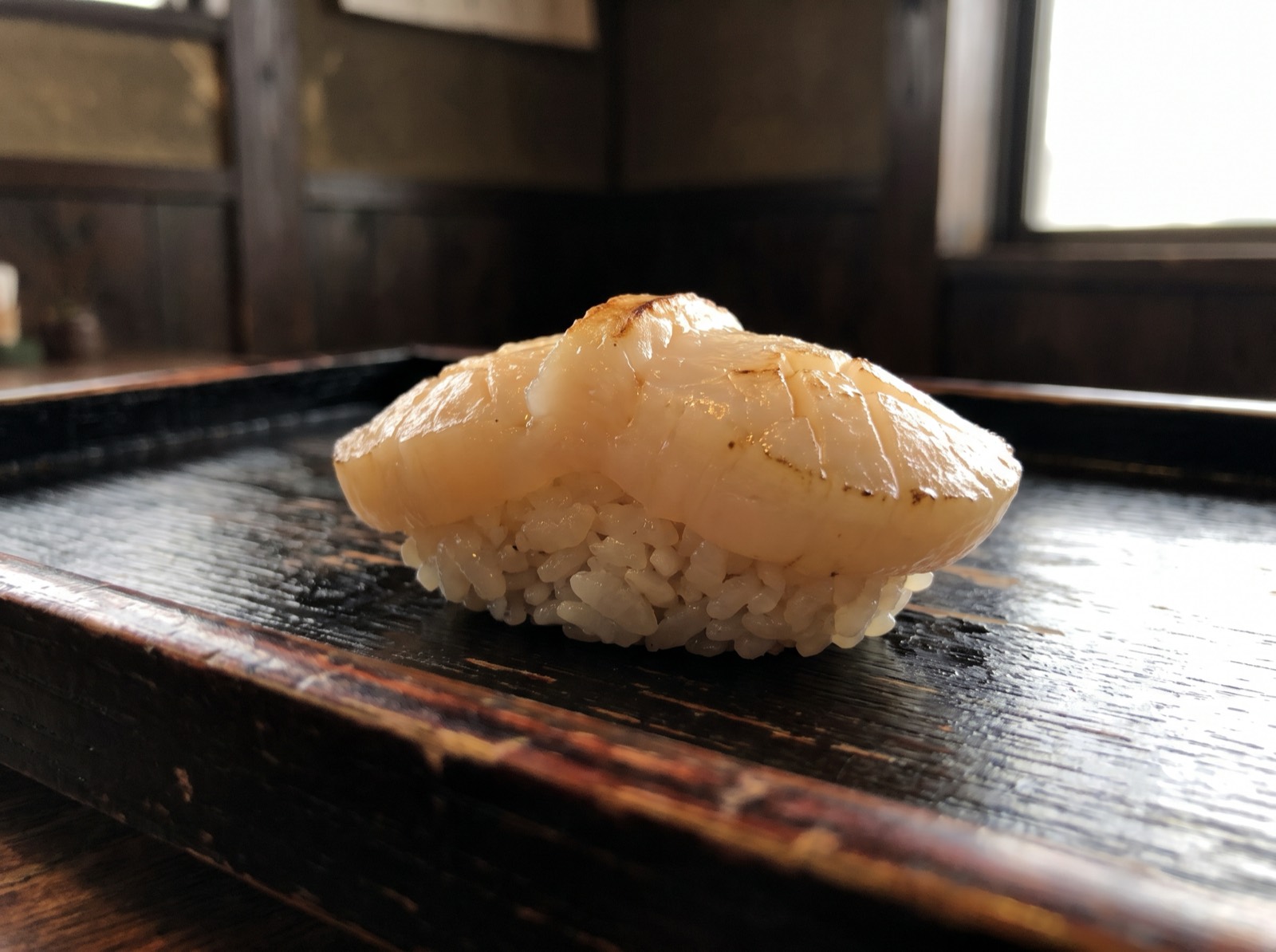
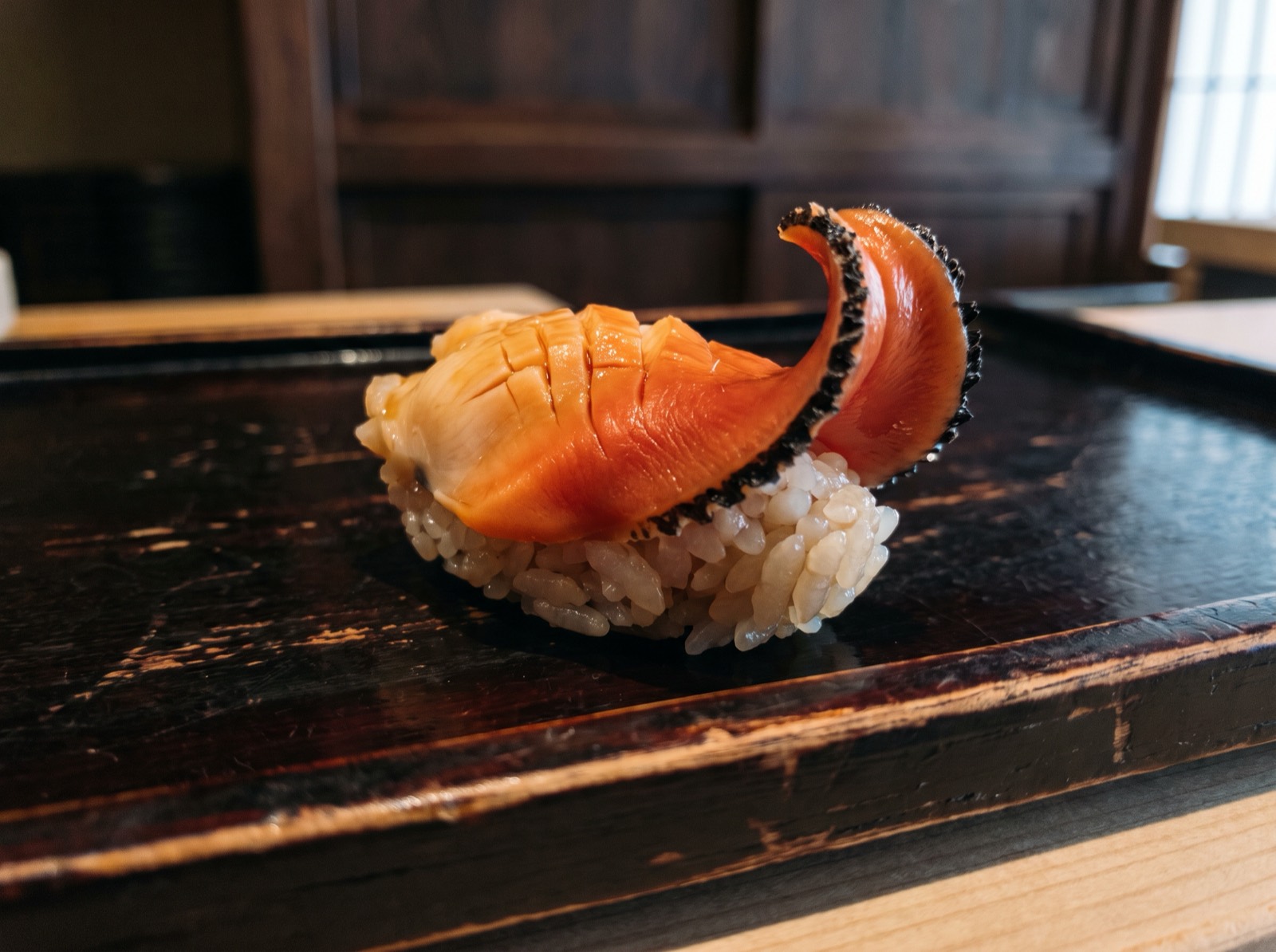
For raw service, the cleaned foot is sliced thin and usually given a light decorative scoring — cuts too shallow to separate the piece, but enough to help it sit against the rice and bite more easily. This is the path that keeps the texture the animal is best known for: a dense, springy resistance that gives way slowly rather than all at once.
For most shellfish at a sushi counter, raw or briefly blanched is the ordinary treatment. Abalone is one of the few shellfish on the counter where cooking, not rawness, is the traditional choice, a status it shares with the hard-shell clam, 蛤. Where a light sear or a quick blanch finishes something like surf clam or cockle, abalone gets real cooking: simmered or steamed over a long, gentle heat, closer to how a shop treats conger eel or octopus than to how it treats most of the shellfish case.
How that cooking happens varies by shop, but a recurring account in the literature describes real trial and error to get there: a pressure cooker, tried for speed, set aside for cooking unevenly and driving off aroma; plain simmering in a seasoned broth, set aside for masking the shellfish’s own flavour. The method that stuck packs the cleaned foot tightly into a container to push out as much trapped air as possible, wraps it, and steams it slowly with little or no seasoning, so what concentrates in the flesh is the abalone’s own liquid, not a sauce poured over it.
Once cooked, the pieces are typically cooled and left to sit in their own cooking liquid rather than served hot from the pot, so the flavour keeps settling in; only right before service is a piece warmed again, in that same liquid, then sliced and shaped onto rice. Some shops build it into a pouch rather than a flat slice, cutting a pocket into the side and packing it with rice instead of laying the rice underneath in the usual way.
The liver, 肝 (kimo), is usually kept separate rather than served as part of the same piece: some counters purée it, strain it smooth, and brush it on in place of the sweet glaze used on other simmered items, trimming away the bitterest portions and any roe first.
Why it is done
The reason raw and cooked abalone taste and feel like different foods comes down to a single protein. The dense, springy bite of raw abalone is produced by collagen in the foot muscle, and heat is what changes it: sustained warmth gelatinises that collagen into something much softer. The muscle carries a far higher share of collagen than most things eaten raw at a counter, closer to octopus than to a typical fish — which is also why a quick sear or blanch, enough to change texture on other shellfish, barely touches abalone. The shift from crisp to soft only comes with real time under heat.
Exactly how long that heat is applied is not fixed by any recipe. The literature describes chefs splitting into two camps, a shorter-heat school and a much longer one, and treats the choice as individual preference rather than a correct answer: longer cooking keeps softening the collagen and shifts the balance of what gives the meat its savoury depth. It is the same principle already at work in how a shop decides its salt and vinegar timing for kohada: no fixed number exists, only a result the chef is aiming for.
Abalone is one of the few shellfish on the counter where cooking, not rawness, is the traditional choice.
How it differs from what it is confused with
- Awabi and hotate both carry raw-or-cooked distinctions, but hotate’s is a supply-chain certification fixed before the scallop reaches the kitchen — namashoku-yō versus kanetsu-yō, decided by handling and water quality. Awabi’s raw-or-cooked choice is not a certification; it follows the species and the individual chef.
- Awabi and other thick-shelled sea snails, such as whelk and turban shell, are usually served raw and firm-bitten — the ordinary path for a hard-shelled animal at this counter, which is exactly what makes abalone’s split behaviour unusual.
- Awabi and nitsume, simmering. Our guide to Edomae sushi names conger eel, clams and octopus as the usual subjects of that treatment. Abalone belongs in the same family, worked here in far more depth than the guide’s overview covers.
How to say it
ah-WAH-bee is close enough. Strictly it is three even beats, a-wa-bi, with no strong stress on any of them — the same flat rhythm as kohada or wasabi.
Where you will see it
Look for 鮑 or the phonetic あわび, sometimes with a prefix that specifies the treatment: mushi-awabi (蒸し鮑), steamed abalone, as distinct from a plain raw listing. A counter that lists it as a plain, unprefixed nigiri is very likely serving it raw; steamed or simmered abalone is nearly always labelled as such, because the two are different enough that a menu cannot leave it to guesswork.
None of this makes one version more correct than the other. A shop serving kuro-awabi raw and a shop steaming megai-awabi for hours are both doing the traditional thing with the animal in front of them; what changes is which animal it is, and whose hands it passed through. The next time awabi turns up on two menus wearing two different textures, that is not an inconsistency to resolve — it is the word doing exactly what it has always done.
Frequently asked questions
What is awabi?
Abalone: a large single-shelled sea snail served as sushi, either raw or cooked, depending on the species and the individual chef's practice. It is not a bivalve, despite sitting in the same shellfish case as clams and scallops.
Is abalone sushi raw or cooked?
Both traditions are genuine. Kuro-awabi, the species most commonly meant by the bare word, is served both ways at different counters or even the same one. Other species, such as megai-awabi and madaka-awabi, are conventionally treated as better suited to cooking, while ezo-awabi is normally served raw.
Why is cooked abalone simmered or steamed for so long?
Its texture comes from collagen in the foot muscle, and only sustained heat gelatinises enough of it to soften the flesh; a quick sear or blanch barely changes it. How long that heat is applied is a matter of individual chef preference rather than a fixed recipe.
What is mushi-awabi?
Steamed abalone. Menus generally mark the cooked version with a prefix like this rather than leaving it unlabelled, because a plain, unprefixed listing is very likely to mean the raw version.
When is abalone in season?
Kuro-awabi, the default species, is at its best in summer, unlike most shellfish on the counter, which peak from winter into early spring. Ezo-awabi runs the opposite way, best from late autumn into spring, so some form of abalone is available across most of the year.
How do you pronounce awabi?
Ah-WAH-bee is close enough. Strictly it is three even beats, a-wa-bi, with no strong stress on any of them.